The conference room smelled like expensive cologne and desperation. Derek paced in front of the glass wall like a tiger on stimulants, and I already knew what was coming before he opened his mouth. I’m Harper, the lead systems architect. I built the engine that kept this company alive, and the founder’s son had just decided I was yesterday’s news.
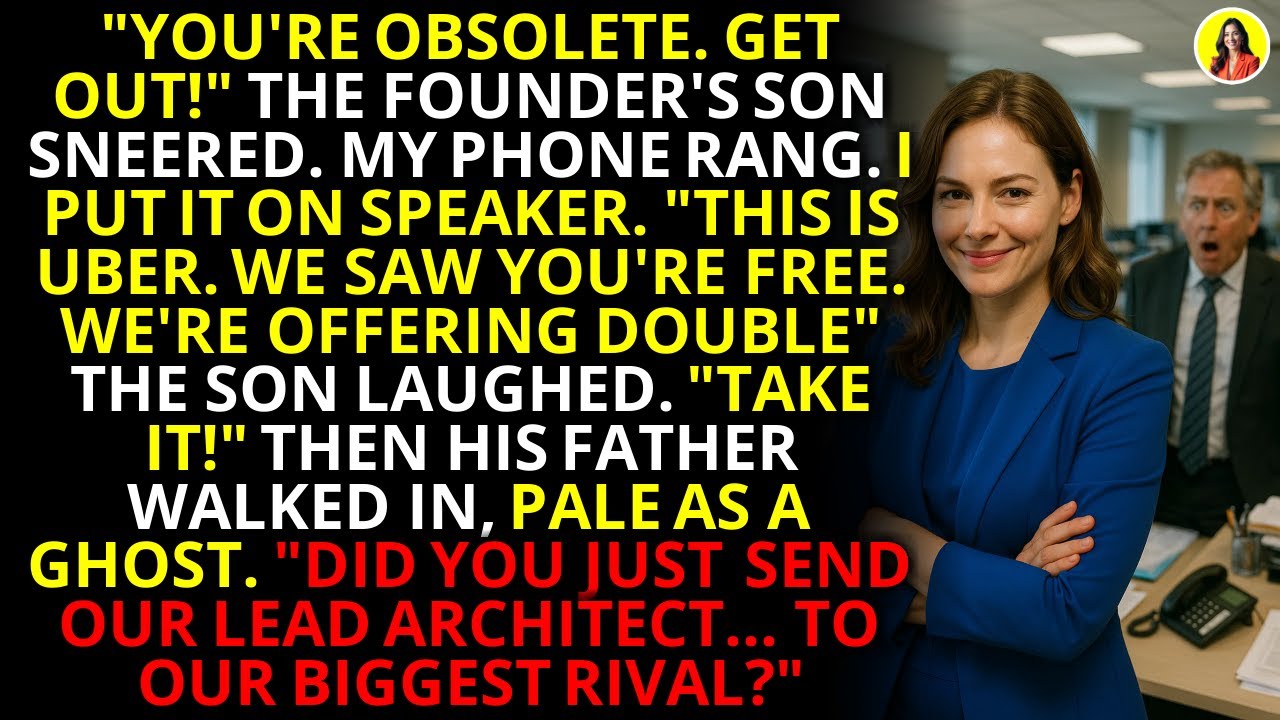
“We need to talk about velocity,” Derek said, admiring his own reflection. “We need to trim the fat. ”
Twelve of us sat around that mahogany table. Engineers, product leads, people with mortgages and kids who needed braces.
Derek had just finished an MBA that apparently taught him that human beings were rows in a spreadsheet you could delete to make the margins green. “Our velocity is fine,” I said, keeping my voice level. “We shipped Q3 with zero downtime. If you trim the fat now, you’ll cut into muscle.
”
He gave me that bored look, the one a man gives when he’s already made up his mind and you’re just a formality. “That’s the problem, Harper. You’re obsessed with stability. Your stack is looking a little vintage.
”
Vintage. I’d built the routing algorithm that cut our clients’ delivery times by 18 percent. I’d written the redundancy protocols that saved this company when the East Coast grid flickered last winter. I’d translated his father’s incoherent napkin scribbles into a logistics engine valued at $40 million.
“Vintage keeps the lights on, Derek. ”
He smirked. “Which brings me to the hard part. We’re restructuring the architecture division.
Your role is redundant. ”
My second in command, a sharp kid named Ben, looked like he was going to be sick. Derek kept talking, saying something about an “evolutionary exit” and consultants waiting in the lobby with a box for my badge and laptop. He wanted a scene.
He wanted me to cry or beg or flip the table so he could tell the story over drinks at the country club. Instead, I stood up and felt a strange calm wash over me. The calm of a demolition expert who knows the fuse is lit and everyone else is standing too close to the blast zone. I was about to hand over my badge when my phone buzzed against the table.
Not a text. A call. My phone was on silent. The vibration rattled the mahogany.
The caller ID said: Yuber VP Engineering. Marcus. We’d met at a conference three years ago. He’d been trying to poach me for eighteen months, and I’d always said no.
I was loyal. This was my building. But now I was redundant. Derek looked annoyed.
“Turn that off. Take your personal calls in the parking lot. ”
I looked at him. I looked at my terrified team.
Then I looked back at the phone. A dark, perfect thought bloomed in my mind. Unprofessional. Petty.
Absolutely perfect. I swiped green and pressed speaker, maintaining dead eye contact with the man who had just called me obsolete. “This is Harper. ”
Marcus’s voice boomed through the silent room.
“Harper, thank God. Did you just toggle to open to work? Because if you did, I need you. I can get the offer letter over in ten minutes.
Double your current base. Full equity. Name your signing bonus. Just tell me you’re free.
”
The silence shifted from a funeral to a bomb squad watching a wire get cut. Derek’s smirk faltered. “Is this a joke? Who is that?
”
“It’s Yuber, Derek. The competition. ”
He sneered, doubling down because his ego wouldn’t let him back up. “If they want my scraps, let them have them.
Take it. ”
Marcus heard him. “Harper, who is that? You in a meeting?
”
I smiled. It wasn’t a nice smile. “I’m sitting with the COO of my current company. He just informed me I’m obsolete.
He says you can have me. ”
“Send the dock, Marcus. ”
“Sending now. Check your personal email.
And don’t sign anything with those clowns until you see our numbers. ”
I hung up and set the phone on the table. Derek looked like a man who’d swallowed a bee and was trying to pretend it was a breath mint. “That was theatrical,” he scoffed.
“Did you set that up? ”
“Marcus is the VP of engineering at Yuber. You can Google him. ”
Ben finally spoke up, trembling.
“Derek, that was Marcus Lynn. He wrote the white paper on distributed hashing. If he’s calling Harper, that means something. ”
“It means she’s good at networking,” Derek snapped.
“We need React Native rockstars, not whatever legacy backend mess she’s been hoarding. ”
My phone lit up again. An email notification. Subject: Offer Letter.
Principal Infrastructure Architect. “Legacy backend mess,” I repeated. “That mess processes 40,000 transactions a second. It’s not a mess.
It’s a cathedral, and you’re kicking out the stonemason because you want to put up drywall. ”
“We have the wiki. We have the code comments. Any junior dev could run this system.
”
Ben and I both knew the truth. The wiki was three years out of date because Derek had cut the budget for technical writers. The code comments were cryptic notes I’d written to myself at 4 a. m.
, referencing inside jokes and heavy metal lyrics. “You think the documentation is sufficient? ”
“I know it is. Now hand over the laptop.
”
Sarah, a quiet engineer who handled the API gateways, raised her hand. “Um, Derek, the encryption keys for the load shedding protocols—are those in the wiki? Because last time we tried to patch the server without Harper, the whole database locked up for six hours. ”
Derek turned on her.
“We will figure it out. That’s what I’m paying you for. Harper has made herself a bottleneck on purpose. By removing her, I’m liberating you.
”
He was liberating them from the parachute right before kicking them out of the plane. I closed my laptop, unplugged the HDMI cable, and unclipped my badge. I slid it across the table. It spun and came to rest in front of him.
“There. I’m gone. The fat is trimmed. ”
I walked toward the glass doors when Ben called out.
“Harper, the master credentials for the AWS root account. The MFA token. It’s on your phone. ”
Derek looked up.
“What root access? ”
“It’s tied to Harper’s device. If she leaves, we can’t push hot fixes. ”
“So transfer it right now.
”
I stopped at the door and turned back. A contract clause Derek had made everyone sign three years ago surfaced in my memory. It was supposed to stop employees from stealing IP, but it cut both ways. “I can’t,” I said.
“What do you mean you can’t? ”
“You just fired me, effective immediately. Per company security policy, section 4 paragraph 2—which you wrote—I am strictly prohibited from accessing, transferring, or modifying any company systems. If I touch that root account now, I’m committing a crime.
”
“I’m authorizing you! ”
“Authorize a non-employee to access root? That voids your SOC2 compliance. You’d lose your insurance.
You’d lose the bank contracts. ”
“Then we’ll figure it out,” he yelled, his face blotchy red. “Just get out. We’ll reset it.
”
“Support takes 48 hours to verify identity for a root reset. Hope nothing breaks before Tuesday. ”
I pushed the door open. “Goodbye, Derek.
Try not to touch the thermostat. ”
I walked past the server room, my baby, and heard the familiar hum of the cooling fans. I knew which rack vibrated if the AC kicked on too hard, which hard drive slot on cluster B was finicky. It wasn’t just hardware.
It was an organism, and I’d just been surgically removed from its immune system. It was raining when I hit the lobby. I threw my bag into my beat-up Ford F-150, the truck I drove specifically because it annoyed Derek’s Tesla sensibilities. My hands were shaking from adrenaline.
I’d just nuked my career of ten years in under twenty minutes. I pulled up Marcus’s email. Base salary $320,000. Signing bonus $50,000.
Fifteen thousand RSUs vesting monthly. Title: Chief Infrastructure Strategist. It was screw-you money. But it wasn’t about the money.
Derek had called me obsolete. Marcus called me a strategist. A knock on my window. It was Richard, Derek’s father, the founder.
He looked older than I remembered, his wispy white hair wet from the rain. “Leaving early, Harper? ”
“I’m not leaving early, Richard. I’m leaving for good.
Derek just terminated me. Said I was obsolete. ”
Richard’s face went pale. “No, that’s a mistake.
I’ll talk to him. Come back inside. ”
“Too late. I already accepted another offer in the boardroom while he was firing me.
”
“Who? ”
“Yuber. ”
Richard physically recoiled. He knew what that meant.
I wasn’t just leaving. I was defecting to the biggest competitor in our space. “The non-compete—Derek voided it. He fired me without cause in Washington state.
You should check with legal, but I’m pretty sure your son just handed your playbook to the enemy. ”
I put the truck in gear. “Tell Derek that spaghetti code is what Italians call a masterpiece. ”
I didn’t look back as I peeled out of the lot, the Talking Heads blasting “Burning Down the House” on the radio.
In the rearview mirror, the gray building shrank until it was just a smudge against the rainy sky. The first week at Yuber was like stepping out of a submarine into a luxury resort. My new office had a view of the Sound. The coffee was single-origin and actually hot.
My team of twelve developers listened when I spoke. No mansplaining. I drew a diagram and they built it. But I kept a tab open on DownDetector for Mobility Tech.
For the first three days, nothing happened. That’s the thing about good architecture. It has inertia. A well-built system can coast on autopilot for a while, even if the pilot is dead at the controls.
On Thursday, the wobble started. A text from Ben on a burner app. The load balancers were acting weird. Latency was up 400ms.
Derek told them to just reboot the clusters. I knew you never reboot during peak hours with a warm cache—it causes a thundering herd problem. I told was told. Ben texted back.
They rebooted anyway. Database CPU pegged at 100%. By Friday afternoon, the wobble became a shake. I was in a strategy meeting with Marcus when Mobility Tech’s status page updated: “Degraded performance on East Coast nodes.
”
“Looks like your old friends are having a rough day,” Marcus observed. “They’re rebooting the clusters to clear a memory leak that isn’t a memory leak. It’s a queue backup. I designed the queue to back up when the fraud detection API gets too aggressive.
It’s a safety valve. If they reboot, they flush it. The fraud checks will fail open. ”
That turned out to be the least of their problems.
Derek’s consultants—three guys in Patagonia vests who couldn’t read a raw SQL query—decided to horizontally scale. They spun up fifty new instances. But the system had a hard-coded license cap on the third-party mapping API, a cap I’d negotiated to save money. The contract allowed 100 concurrent connections.
They hit 150. The mapping provider’s automated system detected the breach and instantly revoked the API key. Friday, 4:15 p. m.
Every driver on the platform lost their map. Twitter exploded. “My app just went blank. I’m stuck in traffic and I don’t know where I’m going.
” Ben texted me one word: blackout. I sat in my ergonomic chair and watched the chaos unfold from the safety of the competition. Derek was probably screaming at his consultants, trying to call the mapping vendor without knowing the account number or the password. The rep’s contact info was in my Rolodex.
The physical one. Currently in a box in my garage. “Should we call them? ” Marcus asked, half-joking.
“Offer to acquire them for pennies? ”
“Not yet. Let them simmer. ”
Monday morning brought the lawyers.
When a narcissist fails, his first instinct isn’t to apologize. It’s to find someone to blame. An email from legal at Mobility Tech: “Urgent demand for return of proprietary data. We believe you have retained encryption keys, root passwords, and architectural schematics in violation of your employment agreement.
Return them within 2 hours or we will seek injunctive relief and damages for sabotage. ”
I made a cup of tea, then drafted a reply. I knew their contracts better than they did. I’d been escorted out without an exit interview.
I surrendered my laptop and badge. All documentation exists on the company’s Confluence server, but the search function is broken—the files require specific tag-based queries. If your team can’t find them, it’s not because they’re missing. It’s because they don’t know how to ask the library for the book.
Regarding the encryption keys: they’re in the hardware security module in the server room. Access requires a physical fob. My fob was on the keychain I handed to security. If you lost it, that’s a physical security breach, not a theft.
I’m now an employee of a competitor. Any request for me to work on your systems constitutes consulting services. My rate is $5,000 per hour with a 10-hour minimum, payable in advance. I hit send.
Ten minutes later, Ben called. “Derek’s purple. He threw a stapler at the wall. He’s saying you encrypted the documentation on purpose.
”
“I didn’t encrypt it. I just organized it using the Dewey decimal system of logic, and he’s trying to read it with a coloring book mindset. ”
“Did they find the HSM fob? ”
“Yeah, it was in the box security took.
But nobody knows the PIN. ”
I paused. The PIN that unlocked the hardware keys for the entire kingdom. Derek had demanded a security audit six months ago and changed all the master PINs himself.
He wrote them down in that black Moleskine notebook he carried everywhere. The one he’d left in an Uber on the way to the airport last week. I started laughing. A dark, guttural laugh that scared the HR rep walking by.
He’d locked himself out of his own house and lost the only key. “So we’re screwed? ” Ben asked. “You’re not just screwed, Ben.
You’re bricked. You have to reset the hardware. That wipes the data. All of it.
”
On Wednesday, two days after the blackout weekend, I received a file from an anonymous Proton Mail account. A video attachment labeled “Board Q3 Emergency Session. mp4. ”
The video was grainy, shot from a laptop webcam left on during a hybrid meeting.
The board was gathered around the long oak table. Richard sat at the head, looking like a ghost. Derek sat to his right, sweating through his shiny suit. Across from them sat Alina, the venture capitalist who owned 30% of the company.
“Let me get this straight,” Alina said. “We’ve been offline for 72 hours. Customer churn is up 12%. And you’re telling me you can’t restore the database because it’s a hardware issue?
”
“Legacy hardware,” Derek stammered. “The HSM modules are antiquated. ”
“You lost the PIN,” Alina said flatly. “My technical auditor spoke to your SYS admin.
You are locked out of your own encryption. ”
Derek wiped his forehead. “When Harper left—”
“Yes, let’s talk about Harper. You fired your lead architect on the same day you initiated a major restructuring.
Do you know where she is now? ”
Derek stayed silent. “She’s at Yuber. She started Monday.
And according to my sources, she’s already leading a team to implement a new predictive logistics feature. Does that sound familiar, Derek? That was our roadmap. ”
“She signed a non-compete,” Derek shouted.
“Which you voided by firing her without cause,” Richard snapped, speaking for the first time. He slammed his fist on the table. “I checked with legal, Derek. You didn’t even consult HR.
You gave away our castle and the architect who built it. ”
Alina stood up. “I am calling for a vote of no confidence. Pending a full audit of the IP loss.
”
“You can’t do that. My family holds majority voting rights. ”
Alina looked at Richard. Richard looked at his son.
At the chaos. At the stock price bleeding red on the wall. “I abstain,” Richard whispered. Derek’s eyes went wide.
“Dad—“
“I abstain,” Richard repeated, putting his head in his hands. The video ended. I sat back in my chair and took a sip of cabernet. It was bold, full-bodied, with notes of oak and vengeance.
I didn’t feel happy exactly. It’s hard to feel happy watching something you love die. But I felt balanced. The scales had tipped.
My phone buzzed. A text from Richard. Can we talk? Coffee tomorrow?
I responded: “8 a. m. The Starbucks on Fourth. Don’t bring Derek.
”
Richard was already at a corner table when I arrived, looking like a man who hadn’t slept in days. He didn’t say hello. He just slid a check across the table. A blank check, drawn on his personal account, the amount line empty.
“Name your price,” he said, his voice raspy. “Come back. We’ll fire Derek. We’ll make you CTO.
We’ll give you 10% equity. Just fix it. ”
I looked at the check. It was tempting—not for the money, but for the power.
To walk back in there and take the throne. But I remembered the team at Yuber. Marcus, who listened to me. The feeling of building something new instead of patching something old.
“I can’t, Richard. ”
“Why? Is it the money? I can liquidate assets.
Harper, the clients are leaving. FedEx just pulled their contract. If we lose DHL, we’re insolvent. ”
“It’s not the money.
I’ve moved on. And frankly, Richard, I don’t trust you anymore. You let Derek run wild. You watched him dismantle the culture I built, and you said nothing because he was your son.
”
Richard winced. “I know I failed. But the tech—it’s your baby too. ”
“No.
It was my baby. Now it’s just code. Broken code. ”
“I can’t fix the HSM modules,” Richard admitted.
“The data is encrypted. The backups are corrupted because the keys were on the same ring. We’re looking at a total rebuild. We don’t have six months.
We have six weeks. Harper, you have the logic in your head. You could rebuild the core routing table in a weekend. ”
I took a sip of tea.
“I could. But I won’t do it as an employee. ”
“Then as a consultant. Whatever you want.
”
I pulled a folded document from my bag. I’d typed it up that morning, just in case. “One million dollars,” I said. “Cash upfront.
And I keep the IP rights to the modular scaling framework I build. You get a license to use it. But I own the code. Which means I can license it to others.
Including Yuber. ”
Richard’s jaw dropped. “You want to sell our core tech to our competitor? ”
“I’m building it, Richard.
If you want me to save you, we do this on my terms. You get to survive. I get the patent. That’s the deal.
”
He looked at the blank check. At the text messages flashing on his phone from the board. He had no choice, and he knew it. “Okay,” he whispered.
“Okay. Do it. ”
I smiled. “Wire the money.
I’ll start Friday night. And Richard—tell Derek he’s not allowed in the building while I’m there. I don’t want his modern energy messing up my vintage workflow. ”
The office was empty on Friday night.
Security had been instructed to let me in and keep everyone else out. The place still smelled the same—burnt coffee and carpet glue—but the energy was dead. I sat at my old desk. They hadn’t even cleared it off.
My ergonomic mouse was still there. A Post-it note with a doodle of a cat was still on the monitor. I plugged in my laptop and jacked into the mainframe. The system was a mess.
Derek’s consultants had tried to patch the API failures with spaghetti code that looped back on itself. Like a wound stitched with dirty shoelaces. I didn’t try to fix it. I deleted it.
Called it `/consultant_scratch`. For forty-eight hours, I lived in the code. Red Bull, Metallica, and the logic I pulled from my brain. The spatial indexing, the load shedding, the vintage architecture that worked because it was built on math, not hype.
I rebuilt the routing engine from the ground up, leaner and faster than the old version. A masterpiece. By Sunday morning, the dashboard was all green. System status: operational.
Latency: 12ms. API connections: stable. I’d saved them. But I wasn’t done.
I opened the core library and added a comment. A signature: “Architecture by Harper. Property of Harper Holdings LLC. License to Mobility Tech.
License revocable upon 30 days notice. P. S. If you’re reading this, Derek, you’re welcome.
”
I committed the code and pushed to production. As the servers spun up, my phone buzzed with a Yuber press release: “Yuber Freight Announces Quantum Route, a New Predictive Logistics Engine. ”
The project I’d started at Yuber on Monday was launching that day. The code I’d written there was cloud-native, AI-driven, truly modern.
The code I’d just written for Richard? Solid. Stable. But it was the past.
I had just sold them a very expensive, very reliable spare tire. I was already building a jet engine for the competition. I packed up my bag and took my old ergonomic mouse. I’d earned it.
I walked out of the building without nostalgia. Like a contractor finishing a renovation on a house she used to own. A nice house. But I didn’t live there anymore.
I texted Richard: “It’s done. System is live. DHL won’t leave. Money is in the bank.
Goodbye, Richard. ”
Three months later, Mobility Tech had stabilized. They didn’t go bankrupt. They kept their clients.
But they were no longer the innovators. They were the legacy option. The safe, boring choice for companies that liked old-school servers and didn’t mind slower updates. Derek was gone.
“Pursuing other opportunities,” according to the press release. I heard through the grapevine he was trying to launch a crypto-based dating app. I gave it six months before he lost the passwords to the users’ wallets. Richard remained as chairman, but the board had installed a new CEO, a number-crunching woman from Oracle who banned the word “disruption.
” She called me once a month to authorize the licensing check for my code. I always answered on the second ring. I liked hearing the sound of my passive income. At Yuber, I was the Chief Infrastructure Strategist.
My team had shipped Quantum Route. It was crushing the market. We were faster, smarter, and cheaper than Mobility Tech could ever hope to be. I was sitting in a glass-walled conference room celebrating Q4 numbers, champagne in paper cups, when my phone buzzed.
An email from Richard: “We’re seeing some degradation in routing speed again. The new CEO wants to know if you’d be open to a retainer arrangement to optimize the code you wrote in October. We can offer. ”
I didn’t finish reading.
I looked at the young engineers around me. Bright kids, hungry, respectful. They didn’t call me vintage. They called me boss.
I forwarded the email to Yuber Legal with a note. “Reply and tell them my consulting rate has doubled. And send a cease and desist if they try to modify the core library without a license extension. ”
I put my phone down, face down.
I wasn’t angry anymore. I wasn’t seeking revenge. I’d achieved something far more dangerous. I’d achieved leverage.
I had built their foundation. I’d watched them burn it. And then I’d forced them to buy the ashes back from me at a premium. I took a sip of champagne.
It tasted like victory. The AC vents hummed above me, a perfect, efficient, silent flow of cool air. I closed my eyes and listened to the system running. It was working perfectly.
And this time, I had the keys.