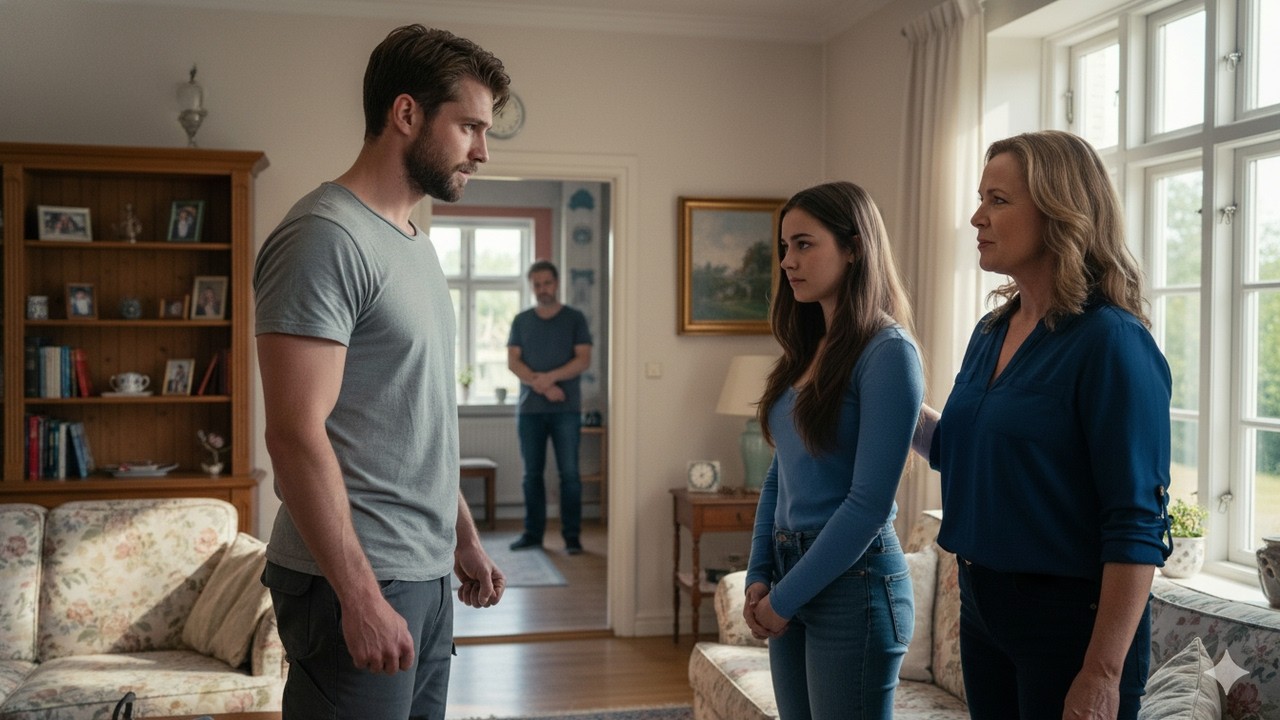
Six days after my father’s funeral, my stepmother handed me an envelope across the kitchen table where I’d eaten a thousand meals as a child. Inside was a check for eleven thousand dollars. She told me it was more than fair for thirty years of being his daughter. I looked at that check for a long time.

Long enough that she started to smile, thinking I was grateful. Long enough that my stepbrother, Tyler, sitting on my father’s leather couch like he already owned it, checked his watch and asked if we were about done here. I wasn’t crying. That surprised them.
They expected tears or maybe rage, something they could roll their eyes at later. What they got instead was silence, and a woman quietly folding an eleven-thousand-dollar check into her coat pocket and saying, “Okay. Just okay. ”
Remember that word.
Because three weeks later, in a courtroom, in front of a judge, a forensic accountant, and every single person who thought I was the fool of this family, it would be the last calm thing I said before I took everything back. My name is Rachel Coleman. I’m thirty-four years old, and for most of my life, I was the good daughter. Not the favorite, never the favorite, but the good one.
The one who called every Sunday. The one who drove four hours each way twice a month to sit with my father, Walter Coleman, while he complained about his blood pressure medication and pretended he wasn’t lonely in that big house outside Asheville, North Carolina. My mother died when I was nine. Ovarian cancer, fast and cruel, the kind of illness that doesn’t give you time to prepare a child for the rest of her life.
My father raised me alone for six years before he married Denise. I want to be fair to Denise even now, even after everything. She wasn’t cruel to me as a child. She was distant.
Cold in the particular way that some people are cold—polite, correct, never once raising her voice, never once making it obvious that she saw me as an inconvenience attached to the man she wanted. It took me years to understand that coldness is its own kind of cruelty. It doesn’t leave bruises. It leaves absence.
Denise had a son from her first marriage, Tyler, two years older than me. Tyler got the master bedroom’s adjoining room, the one with the good closet. I got the room down the hall, the one that used to be my father’s home office, with a window that looked out over the garage roof instead of the backyard. Small things.
The kind of small things a nine-year-old notices and never mentions because mentioning them makes you sound ungrateful. My father worked in commercial real estate his whole life. Not flashy. No private jets.
No yacht. But steady, smart money. Over thirty-five years, he built a portfolio: a strip mall in Hendersonville, two apartment complexes in Asheville, a warehouse he’d converted into storage units that alone brought in six figures a year. He wasn’t rich the way people on television are rich.
He was rich the way quiet men in small southern towns are rich. The kind of wealth you don’t see until somebody dies and the truth comes out of hiding. I never asked my father about money. Not once in thirty-four years.
Everything Denise and Tyler later tried to paint me as—grasping, greedy, only showing up for the inheritance—none of it was true. I showed up because he was my father. The money was never the point. But it became the point.
And what I found out, digging through what they thought I’d never see, wasn’t really about money at all. It was about a lie that had been sitting inside my family for fifteen years, waiting for my father’s heart to finally give out so it could crawl into the light. The call came on a Tuesday morning in March. I was at my desk.
I work as a project coordinator for a construction firm in Charlotte, which in hindsight is almost funny, given what I’d end up needing to understand about my father’s real estate holdings. It was Tyler, not Denise. Tyler almost never called me directly. His voice was flat.
Careful. “Dad had a heart attack this morning. They took him to Mission Hospital. You should come.
”
I don’t remember driving to Asheville. I remember arriving. I remember the smell of the ICU. The particular quiet of a hospital corridor at eleven p.
m. And I remember my father’s hand in mine, still warm, machines making sounds I didn’t want to understand. He died at two forty-seven a. m.
I was holding his hand. Denise was in the chair by the window. Tyler was in the hallway on the phone with his wife. And for one long, strange minute, it was just me and my father and the flatline tone.
And I thought, stupidly, I never asked him where he kept the good pictures of my mom. That’s the kind of thing grief does to you. It makes you think about photo albums instead of what’s coming. The funeral was on a Saturday, six days after he died, at the same Baptist church where he and my mother had married thirty-nine years earlier, and where he’d married Denise eight years after that.
Nearly three hundred people came. My father had been a deacon, a Rotary Club president, a man who coached little league for a decade after his own kids aged out, just because he liked the boys on the team. He was, by every account except perhaps Denise’s private one, a genuinely good man. I gave the eulogy.
Denise asked me to, which surprised me—one of maybe three genuinely kind things she ever did for me. And I stood at that podium and talked about a man who used to wake up at five in the morning to make me pancakes shaped like the letter R before school because he said every Coleman deserved to start the day knowing their name mattered. I meant every word. I still mean it.
Whatever happened after, whatever Denise and Tyler did, none of it changes what my father was to me before he died. It’s what happened after the funeral that this story is really about. We went back to the house—his house, the big colonial on Cedarwood Lane that he’d bought with my mother in 1994, the house I grew up in until I moved out at eighteen. Denise had catered a small reception.
Extended family, a few of my father’s old business partners, my aunt Carol from Knoxville, who I hadn’t seen in four years. And it was there, standing in the kitchen over paper plates of pimento cheese sandwiches, that Denise pulled me aside. “Rachel,” she said, in that same careful, controlled voice she’d used my entire life. “I want to talk to you about the estate, just so there’s no confusion later.
”
I remember feeling a small, cold drop in my stomach. Not suspicion exactly. Just a sense that something formal was about to happen at the worst possible time. “Your father’s will is very simple.
The house and the majority of the estate come to me as his wife. There’s a small provision for you. I believe it’s around eleven thousand dollars, from a savings account he kept separate. Tyler and I want to make sure you’re taken care of, obviously.
So, we’re prepared to be generous beyond what the will requires. ”
Generous. Beyond what the will requires. I want you to sit with that phrase for a moment, because it is going to come back around in this story in a way that will make you as angry as it made me.
I asked carefully. “Can I see the will? ”
Denise’s face did something small and quick. A flicker there and gone.
The kind of expression you’d miss if you weren’t watching for it. But I was watching for it, because some old animal part of me had already started to sense that something was wrong. “Of course,” she said. “It’s with the attorney.
I’ll have him send you a copy. ”
She never sent me a copy. Not that week. Not the next.
Three weeks later, she handed me the check for eleven thousand dollars in an envelope at that same kitchen table and told me it was more than fair. Here’s something you should know about me, something that has nothing to do with money and everything to do with why I didn’t just take that check and disappear the way Denise clearly expected me to. I am by profession a person who reads contracts for a living. Not a lawyer.
Six years of managing construction bids, subcontractor agreements, and change orders teaches you something specific. It teaches you to notice when language is doing more work than it should be. It teaches you to notice when a document has been written around something instead of about something. When Denise finally emailed me a scanned copy of my father’s will a full month after the funeral, only after I’d asked three separate times, I read it twice, and something felt wrong before I could even articulate what.
The will was dated eleven months before my father died. It named Denise as primary beneficiary of all real and personal property, with Tyler as a contingent beneficiary. I was mentioned exactly once, in a single paragraph: “To my daughter, Rachel Anne Coleman, I leave the sum of $11,000, held in account 4471 at First Citizens Bank, in recognition of our relationship. ”
Eleven thousand dollars for thirty-four years.
Four hundred Sunday phone calls. Every holiday I drove four hours each way. The eulogy I’d just given three weeks earlier. I called the attorney’s office listed on the will, a firm called Brantley and Voss in downtown Asheville.
I asked to speak to whoever had drafted the document. I was told that attorney, a man named Harold Voss, had retired the year before, and the firm no longer had a working relationship with the estate. When I asked who was handling probate now, they gave me the name of a young associate, Marcus Webb, who Denise had apparently hired directly. I called Marcus Webb’s office.
He was polite, professional, and told me in the careful, non-committal way of a lawyer who knows exactly which side of the fence he’s standing on that the will had been properly executed, witnessed, and notarized, and that unless I had specific evidence of fraud or undue influence, there was very little basis to contest it. I didn’t have evidence. Not yet. What I had was a feeling, sharp and cold, sitting in the pit of my stomach.
The same feeling I used to get as a nine-year-old girl standing in a hallway, listening to my stepmother’s voice change the second my father left the room. So I did what I do for a living. I started reading everything line by line, looking for the places where the language was doing more work than it should have been. My father kept a filing cabinet in the garage.
Metal, gray, older than me. The kind of cabinet that had survived three house moves because throwing it away felt disrespectful to whatever version of himself had bought it in 1988. Denise had told me in that same kitchen conversation that I was welcome to take a few keepsakes from the house before she and Tyler began “downsizing. ” A word that made my stomach turn.
I went to the garage on a rainy Thursday afternoon while Denise was at her hair appointment. I opened that filing cabinet and started going through thirty years of my father’s paperwork. Most of it was mundane. Old tax returns.
Warranty cards for appliances that had been replaced a decade ago. A folder of my report cards from elementary school that made me sit on the cold concrete floor and cry for the first time since the funeral. But in the bottom drawer, underneath a stack of expired insurance policies, I found a folder labeled in my father’s handwriting: RAAC Trust. My initials.
Rachel Anne Coleman. Inside was a document dated nine years earlier, five years before the will Denise had shown me, establishing something called the Rachel Anne Coleman Irrevocable Trust, funded, according to the paperwork, with a twenty percent ownership stake in Coleman Properties LLC, my father’s real estate holding company. Twenty percent of a company that, according to a financial summary stapled to the back, in my father’s own handwritten notes, was worth conservatively $4. 2 million.
I sat on that garage floor for a long time. An irrevocable trust means exactly what it sounds like. Once established and funded, it cannot be undone or altered, not even by the person who created it, except under very specific legal circumstances. If this trust was real, if it had actually been funded the way the paperwork described, then twenty percent of Coleman Properties LLC belonged to me.
Had belonged to me for nine years, regardless of what any will written eleven months before my father’s death said. Which meant one of two things. Either my father had changed his mind and legally dissolved the trust, which the paperwork in front of me gave no indication of, or someone had made absolutely sure that I—and probably the courts—would never know this trust existed. I photographed every page of that folder with my phone.
Forty-three pages. Then I put the folder back exactly where I’d found it, closed the drawer, and drove home to Charlotte in complete silence. Because I understood, somewhere in the pit of my chest, that I had just found the hidden fight this family had been having without me for nine years. And I hadn’t even known I was in it.
The trust documents named a trustee. Not Denise. Not Tyler. A name I didn’t recognize at all: Gordon Pruitt, CPA, with an office address in downtown Asheville.
I called Gordon Pruitt’s office the next morning, gave my name, and said I needed to speak with him about the Rachel Anne Coleman Trust. There was a pause on the line. A long one. “Miss Coleman,” the receptionist finally said.
“Mr. Pruitt has been trying to reach you for almost two weeks. Can you hold, please? ”
Trying to reach me for two weeks.
Nobody had told me anything. Gordon Pruitt turned out to be a soft-spoken man in his sixties who had handled my father’s business accounting for over twenty years. When I sat across from him in his office three days later, the first thing he did was slide a folder across the desk and say, “I owe you an apology, and I owe you the truth. And I’m going to give you both, because your father would have wanted that.
”
Here is what Gordon Pruitt told me. Nine years earlier, my father had come to him with a plan. He wanted to protect a piece of his company for me. Not the whole thing.
Not in a way that would create conflict with Denise or Tyler while he was alive. But a real, legally binding twenty percent stake, held in an irrevocable trust that would exist regardless of what happened later. My father’s exact words, according to Gordon, were: “I want to make sure my daughter isn’t left standing outside the door of her own life someday. ”
The trust was properly established, properly funded, properly filed with the state.
It was, Gordon confirmed, completely real, completely legal, and completely mine. And then, roughly fourteen months before my father died, Denise had come into Gordon’s office alone, without my father, and asked him a series of questions about how the trust could be restructured or consolidated into the general estate. Gordon had told her, correctly, that an irrevocable trust cannot be dissolved or restructured without either the beneficiary’s consent—mine, which nobody had ever asked for—or a court order proving fraud, incapacity, or another narrow legal exception. Denise had left his office that day, and according to Gordon, never mentioned the trust to him again.
Eleven months after that conversation, in the exact same window in which the new will was drafted, my father’s official company records—the ones filed with the LLC’s registered agent—no longer listed a twenty percent interest belonging to my trust. The ownership structure had been quietly amended. My father’s signature was on the amendment. “I need you to understand something,” Gordon said, watching my face carefully.
“I don’t believe your father did that willingly, with full understanding of what it meant. In the last two years of his life, Walter’s memory was not what it used to be. He had two small strokes that never made it into casual conversation, only into his medical chart. I saw him in this office sign paperwork that I do not believe he fully understood, on days when Denise was present for every minute of the meeting.
And I was never once alone with him to ask if he was certain. ”
I sat in that office and felt something shift permanently inside my chest. Not just grief anymore. Something colder, sharper, and far more useful.
“Mr. Pruitt,” I said. “I need copies of everything. Every document.
Every date. Every amendment. Everything you have. ”
He nodded slowly.
“I was hoping you’d say that. I kept copies of all of it separately for exactly this reason. I’ve watched families do this before, Rachel. I wasn’t going to let your father’s real wishes disappear into a filing cabinet.
”
For the next six weeks, I didn’t tell Denise or Tyler anything. This is, I think, the most important lesson of any hidden family fight: the side that reveals its hand first almost always loses. Denise had been operating under the assumption for over a year that I would never know the trust existed—that an eleven-thousand-dollar check and a warm hug at the funeral would be the full and final accounting of my father’s estate. Every advantage I had came from her continuing to believe that.
So I let her believe it. I hired an estate litigation attorney, a woman named Patricia Nguyen, who came recommended by a colleague at work whose own family had been through something similar. Patricia was blunt in our first meeting in a way I found strangely comforting. “This is actually a very clean case if the documents are what you’re describing,” she said, flipping through the photographs I’d taken in the garage and the copies Gordon Pruitt had given me.
“An irrevocable trust is called irrevocable for a reason. If your stepmother pressured your father into signing amendment paperwork during a period of documented cognitive decline, without independent counsel present, that’s not just a will dispute. That’s potentially undue influence, possibly elder financial exploitation, and depending on what else we find, possibly fraud. ”
“What happens now?
” I asked. “Now,” Patricia said, “we file a formal objection in probate court. We request that my forensic accountant get access to Coleman Properties LLC’s full financial records for the past three years. And we find out exactly how much of your inheritance your stepmother has already tried to spend.
”
That last part turned out to matter more than any of us expected. Patricia’s forensic accountant, a meticulous man named David Pharaoh, spent five weeks going through Coleman Properties LLC’s books, banking records, and amended ownership filings. What he found, laid out in a report thick enough to require a binder clip, painted a picture far uglier than a single quietly altered document. In the fourteen months between Denise’s visit to Gordon Pruitt’s office and my father’s death, roughly three hundred and forty thousand dollars had moved out of Coleman Properties LLC’s operating accounts in a series of transfers labeled as “management consulting fees” and “distribution advances,” paid to a company called DVC Holdings LLC.
DVC Holdings LLC had been registered eighteen months earlier. Its listed registered agent was a paralegal at a completely unrelated firm. The kind of shell arrangement people use when they don’t want their own name easily attached to something. But corporate filings, unlike casual conversation, leave a paper trail.
And David Pharaoh was very good at following paper trails. The initial incorporation documents for DVC Holdings LLC listed a single organizing member: Denise Victoria Coleman. DVC. Not a coincidence.
Not even, I think, an attempt at real subtlety. More like the quiet, almost arrogant confidence of someone who has never once imagined being caught. Three hundred and forty thousand dollars drained out of the company my father spent thirty-five years building, funneled through a shell entity bearing my stepmother’s own initials, in the fourteen months leading up to his death. While my father’s medical records showed two undisclosed strokes, worsening memory, and increasing dependence on Denise for help managing his affairs—a phrase that appeared chillingly in his own primary care physician’s notes.
And on top of all of that, my twenty percent trust interest quietly erased from the company’s ownership records during that same window, replaced with new paperwork my father had signed on a day when, according to Gordon Pruitt’s calendar, Denise had personally driven him to the appointment and sat in the room for the entire meeting. I remember reading that report at my kitchen table at eleven at night, alone, and feeling something I can only describe as grief and fury occupying the exact same space in my chest at the same time. Grief for a father who, in his last confused, weakened year, had been managed and maneuvered by a woman he trusted completely. Fury at a woman who had looked me in the eye at his funeral, three weeks after quietly stealing from him, and told me an eleven-thousand-dollar check was more than fair.
Patricia and I made a decision. We would not send a warning letter. We would not give Denise the courtesy of a heads-up, an opportunity to hire her own forensic accountant, an opportunity to start moving money again before the court could freeze anything. We filed everything at once.
The formal objection to the will. The petition alleging breach of fiduciary duty and undue influence. And an emergency motion to freeze all Coleman Properties LLC accounts and DVC Holdings LLC accounts pending investigation. On a Thursday morning in late September, six months after my father’s death, Denise was served with the papers at the house on Cedarwood Lane.
My house, I kept reminding myself. Twenty percent of everything in it, at minimum, was legally mine and had been for nine years. She called me that same evening. I almost didn’t answer.
“What is this? ” she said, no greeting, her careful, controlled voice cracking in a way I had genuinely never heard in twenty-five years of knowing her. “What is this, Rachel? A trust?
What trust? ”
“You know exactly what trust, Denise. ”
“Your father never told me about any—stop. ”
“I said it quietly,” and something in my voice must have carried the weight of everything I now knew, because she actually did stop.
“I have the original trust documents from nine years ago. I have Gordon Pruitt’s notes from the meeting where you asked him to dissolve it. I have the amended LLC filings with Dad’s signature, from a day you drove him to the appointment and sat in the room the entire time. And I have a forensic accountant’s report showing three hundred and forty thousand dollars moving out of Dad’s company into a shell LLC with your initials on it in the fourteen months before he died, while his doctor was writing in his chart that he was becoming increasingly dependent on you for help managing his affairs.
”
Silence on the other end of the line lasted so long I thought the call had dropped. “You don’t understand what it was like,” she finally said, her voice smaller now, stripped of its usual composure. “Taking care of him at the end. Nobody understands what that’s like unless they’ve done it.
”
“I would have,” I said, “if anyone had told me he was declining. If anyone had let me help. Instead, you drove him to sign away my inheritance while he was too confused to fully understand what he was signing. And then you handed me a check for eleven thousand dollars at his funeral reception and called it generous.
So no, Denise. I don’t think you get to talk to me about what it was like to take care of him. I think you get a courtroom. ”
Tyler called two days later.
Unlike Denise, he didn’t bother with any performance of confusion. He was angry, defensive, threatening in the vague way people are when they know they’re on the losing side of something and are trying to talk their way out before the facts catch up. “You’re going to destroy this family over money. ”
“No,” I told him.
“Your mother already did that. I’m just the one who found out. ”
The months that followed were frankly the least cinematic part of this entire story, and also the most important. Litigation is not a courtroom shouting match.
It is depositions in fluorescent-lit conference rooms. It is document requests answered eleven days late with excuses about still gathering records. It is Denise’s attorney trying repeatedly to argue that the original trust documents from nine years earlier were somehow superseded by “implied consent” from a later informal conversation with my father that no one but Denise claimed to remember. Patricia dismantled that argument in about ninety seconds during a deposition, using Gordon Pruitt’s own contemporaneous notes.
Notes he’d taken and dated in real time nine years earlier, with no possible motive to fabricate anything, since at the time he took them, there was no dispute to anticipate. The deposition that changed everything wasn’t Denise’s. It was Tyler’s. Tyler had co-signed several of the DVC Holdings LLC banking documents as an authorized signer.
Something he clearly hadn’t expected to come up, based on how visibly he flinched when Patricia slid the signature card across the table during his deposition. “Can you explain to me,” Patricia asked, in that flat, patient voice she used when she already knew the answer and simply wanted it stated for the record, “why your signature appears as an authorized signer on the DVC Holdings LLC account, opened eighteen months before Walter Coleman’s death? ”
Tyler’s attorney tried to object, tried to redirect, tried the classic maneuver of having his client claim he didn’t recall the specifics. But banking records don’t care what you recall.
They only care what you signed. And what Tyler had signed, eighteen months before his stepfather died, was a document giving him direct access to withdraw funds from an account that had received three hundred and forty thousand dollars skimmed from a company he had no ownership stake in and had done no consulting work for. By the time that deposition ended, it wasn’t just Denise facing potential liability anymore. It was both of them.
Six weeks before trial, opposing counsel requested mediation. This is standard. Most estate disputes settle before they ever reach a courtroom, because trials are expensive, unpredictable, and, for families, exhausting in a way that goes beyond money. Patricia recommended I at least sit through it, if only to see what Denise’s side was prepared to offer.
The mediation was held in a conference room downtown, the kind with a long table and a box of tissues placed a little too deliberately in the center of it. Denise looked older than she had at the funeral. Thinner. Tired.
The careful composure I’d known my whole life finally cracked at the edges. Her attorney’s opening offer was insulting on its face. They proposed I receive one hundred and seventy-five thousand dollars in exchange for dropping all claims related to the trust, the shell company, and the amended will. A fraction of what the trust alone was worth, let alone the damages from the diverted funds.
I looked at Denise across that table. Not at her attorney. At her. “You had nine years,” I said, “where that money was never yours to touch.
You had a husband who explicitly set that trust up so I wouldn’t be, in his words, standing outside the door of my own life someday. And in the last confused year of his life, when he needed protecting more than he ever had, you didn’t protect him. You used him. And now you want me to accept forty cents on the dollar so you can keep whatever’s left of what you took.
”
“I raised you too,” Denise said quietly. And for one strange moment, I almost believed there was something real underneath it. Some genuine grievance about years of feeling unacknowledged as a stepmother. Some old resentment I’d never fully understood.
“You never once called me Mom,” she said. “Not once in twenty-five years. Never once made me feel like I was allowed to. ”
“There’s a difference,” I said, “between raising a child and tolerating one until her father dies and you can finally stop pretending.
”
Mediation ended without a settlement forty minutes later. Denise’s attorney requested a recess to discuss options with his client. They never came back to the table. We were going to trial.
The trial lasted eight days in Buncombe County Superior Court, in front of a judge whose expression, for eight straight days, never once suggested which way she was leaning. A professional neutrality that I found at various points both maddening and reassuring, because it meant the case would live or die on the evidence alone, not on theatrics. Gordon Pruitt testified for nearly three hours, walking the court through nine years of documentation with the calm precision of a man who had clearly rehearsed this moment in his mind many times. Hoping he’d never have to give it.
But ready the second he was called. His testimony about the conversation with Denise—her direct questions about restructuring an irrevocable trust, his direct answer that it could not be done without my consent—was, Patricia told me afterward, probably the single most damaging piece of testimony in the entire trial. Because it established, in Denise’s own documented words to a licensed CPA, that she had known, more than a year before my father’s death, exactly what the trust required and exactly what she would need to circumvent. My father’s primary care physician testified about the two strokes, the documented cognitive decline, the notes about increasing dependence on Denise.
Under cross-examination, when Denise’s attorney tried to suggest my father had been of entirely sound mind throughout the relevant period, the doctor simply read aloud from his own chart notes, dated four months before the amended LLC filing: “Patient exhibited difficulty recalling recent conversations. Wife present for entire appointment and answered several questions directed at patient before he could respond. ”
David Pharaoh walked the jury—because it had, by the final weeks, become a jury trial at Denise’s own attorney’s request, a decision Patricia privately called the worst tactical mistake she’d seen in years—through every dollar of the three hundred and forty thousand diverted through DVC Holdings LLC. Matching bank statement to bank statement, transfer to transfer, until there was no version of events left in which the money’s path could be explained as anything other than exactly what it was.
Tyler took the stand and, under oath, finally admitted—after nearly forty-five minutes of Patricia methodically closing off every alternate explanation he tried to offer—that he had known the DVC Holdings account was funded through transfers out of Coleman Properties LLC, and that he had, at his mother’s request, withdrawn twenty-two thousand dollars of it himself for what he called “personal expenses” during a period when he’d been between jobs. Denise testified last. I will give her this. She did not fall apart on the stand the way I half expected her to.
She held herself with a strange, brittle dignity, insisting throughout that everything she’d done had been to protect the family’s assets, and that she had never intended to permanently deprive me of anything. That she’d planned, eventually, to make things right. Patricia’s cross-examination was quiet, patient, devastating. “You testified you intended to make things right eventually,” Patricia said.
“Can you tell the court when exactly that was going to happen? Was it before or after you offered Rachel eleven thousand dollars at her father’s funeral reception and told her it was, in your words, more than fair? ”
Denise didn’t answer for a long moment. “I don’t recall the exact timeline,” she finally said.
“I don’t have any further questions,” Patricia said. The jury deliberated for six hours across two days. I have watched a lot of court dramas in my life, the way most people have, and none of them prepared me for what it actually feels like to sit in a wooden pew and wait for twelve strangers to decide whether the last year of your father’s life was stolen from both of you by someone he trusted completely. The foreperson stood.
I remember gripping Patricia’s hand under the table so hard she later told me she had a bruise. The jury found in my favor on every count. The trust amendment was voided as the product of undue influence, restoring my full twenty percent ownership interest in Coleman Properties LLC, retroactive to the original nine-year-old trust date. Meaning I was also entitled to nine years of accrued distributions I had never received—a figure that, once calculated by David Pharaoh in the following weeks, came to just over six hundred and ten thousand dollars.
The jury further found that Denise and Tyler had jointly breached their fiduciary duties and engaged in the fraudulent diversion of company funds through DVC Holdings LLC, awarding compensatory damages of the full three hundred and forty thousand dollars diverted, plus punitive damages the jury set at an additional two hundred and fifty thousand dollars, specifically citing, in the post-verdict interview one juror later gave to a local paper, the deliberate exploitation of a cognitively declining elderly man by the person legally and morally responsible for his care. All told, between the restored trust interest, the accrued distributions, and the damages award, the judgment came to just over one point four million dollars. Denise’s attorney requested a stay pending appeal. The judge granted a limited stay, but ordered immediate freezing of remaining LLC assets to prevent further dissipation.
A legal way of saying, you don’t get to spend what’s left while you decide whether to fight this further. They appealed. Eleven months later, the appellate court upheld the verdict in full. I want to be honest with you about what winning actually felt like, because it wasn’t the triumphant, cathartic thing you might expect from the way these stories usually end.
The first thing I felt when the verdict was read wasn’t victory. It was a strange, hollow kind of sadness. The recognition that everything this case had proven—every document, every deposition, every hour of testimony—amounted to a detailed forensic account of exactly how badly my father had been failed in the last confused year of his life by the one person who was supposed to be protecting him. Winning didn’t undo that.
Nothing could undo that. Denise sold the house on Cedarwood Lane eight months later to satisfy the judgment. She moved to a small condo outside Charlotte, close enough that I sometimes wonder if I’ll run into her at a grocery store someday. And I genuinely don’t know what I’d say if I did.
Tyler and I have not spoken since the trial ended. I don’t expect that to change. Gordon Pruitt still calls me every few months just to check in. And I think, in a strange way, he’s become the closest thing I have left to a connection to my father’s actual world.
The man who knew him not as a husband to be managed or a stepfather to be tolerated, but as a client. A friend. A man who once sat in his office and said quietly, “I want to make sure my daughter isn’t left standing outside the door of her own life someday. ”
I used the money to do three things.
I paid off my remaining student loans, which I’d been carrying since I was twenty-two. I set up a genuine, honest, properly documented college fund for my niece, my sister’s daughter, on my mother’s side of the family—the side that never once tried to take anything from me. And I bought a small property in Asheville. Not the family home.
A different house. A fresh start, where I planted a garden in the backyard. Because my father used to tell me, every spring of my childhood, that a garden was proof that something planted quietly, patiently in the dark could eventually come up into the light and be undeniable. I think about that a lot now.
About patience. About things planted quietly and hidden for years, waiting for someone to finally dig deep enough to find them. My father hid a trust in a filing cabinet in his garage nine years before he died, because some deep, careful part of him must have suspected even then that a day might come when I would need proof of how much he loved me, filed away somewhere no one could quietly erase it. He was right.
And when that day came, I dug until I found it. If you’re reading this and something in this story feels a little too familiar—a stepparent who’s been strangely vague about the estate, a sibling who suddenly stopped returning your calls right around the time a parent’s health started declining, a will that seems to have been signed during a period nobody wants to talk about too closely—I want to say one thing directly to you. Not as a narrator, but as someone who lived through exactly what you might be starting to suspect. Ask for the documents.
All of them. Early and often, and in writing. Talk to the accountant, the attorney, the doctor—anyone who might have their own independent paper trail, separate from whatever story your family is currently telling itself. And trust the cold feeling in your stomach when something doesn’t add up, even when everyone around you is smiling and calling an insulting number “more than fair.
”
Sometimes the hidden fight in a family isn’t the loud one—the one with slammed doors and screaming matches at holiday dinners. Sometimes it’s the quiet one. A filing cabinet in a garage. A trust nobody mentions.
A check handed over three weeks after a funeral, with a smile that dares you not to ask questions. Ask the questions anyway.