The envelope arrived on a Tuesday afternoon, three years after she’d signed the papers with a smile, and it landed on her kitchen island like a grenade. The cream-colored stock felt heavy in her hand, and the gold letters pressed into the front spelled out a name she hadn’t heard in a thousand days: Mr. Jordan Maddox and Ms. Tessa Wren.
Or, as the tiny script below it read, request the honor of your presence. She stood very still, staring at it, until her assistant Priya read it over her shoulder twice and said, “He didn’t. ”
“He did,” Avery said quietly, turning the envelope over. On the back was a single line of handwriting she’d know anywhere, tight and controlled.
You should see what moving on looks like. It was a message meant to wound her, to drag her back into the ache of twelve years, the shared penthouse, the slow erosion of a life where she’d made herself smaller so he could feel larger. He’d always handled the money, always reminded her gently that she wasn’t a business mind. She hadn’t fought over the house or the accounts or the vacation home.
She’d looked at him and said, “Keep it. All of it,” and he’d thought it meant she was broken. He’d told everyone that story for three years while she built a company from a rented desk in Brooklyn, clearing her first acquisition by the end of year one, owning a building by year three. Cole Ventures was worth $120 million the morning that envelope showed up.
Avery didn’t crumple it. She didn’t throw it. She just set it down and made one call to her head of security, Dray. “Clear my Saturday.
”
Dray knew her better than anyone, so when he saw the quiet, still version of her standing before the mirror in a Champagne silk gown, he folded his arms and said, “Don’t do the face. ”
“I’m going to a wedding,” she said. “You’re going to his wedding. ”
She turned from the mirror.
“Dray, what do I always say? ”
He exhaled. “You don’t go to battles. You go to conclusions.
”
“Exactly. ” She picked up her clutch. “He wanted me to see what he built. Let’s go see what I built.
”
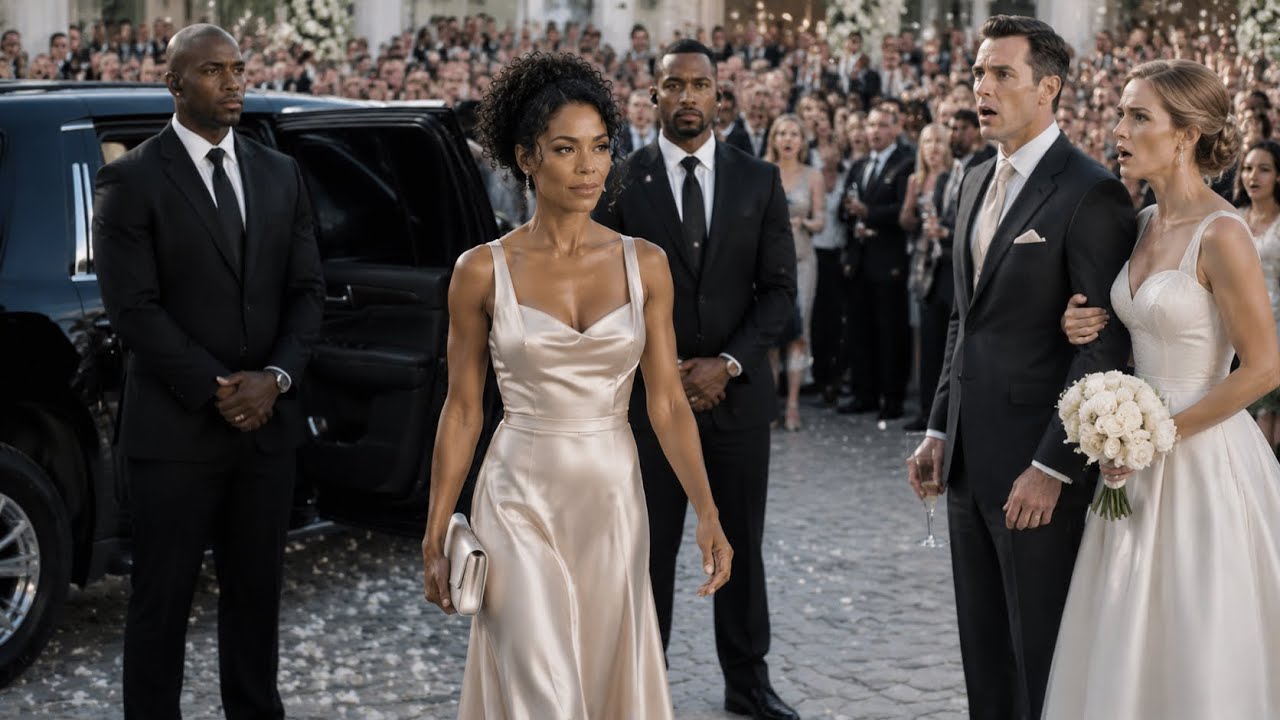
The Keller estate was the kind of venue engineered to make people forget themselves. Two hundred guests, white floral archways, a string quartet flown in from somewhere expensive, the whole afternoon arranged like a declaration of wealth. Jordan was greeting arrivals near the entrance when the first black SUV rolled through the gate, then a second, then a third, all tinted, moving in quiet coordination. Two men stepped out first in suits and earpieces, then two more from the third vehicle.
They spread out in a loose perimeter. Then the middle door opened, and Avery stepped out. She didn’t scan the crowd or rush. She simply stood, let the afternoon light catch the silk, and walked forward with the easy authority of someone who’d walked into a hundred rooms where nobody knew her name and left with all of them knowing it.
A woman near the fountain leaned to her husband and whispered, “Who is that? ” He had no answer. Thirty feet away, Jordan stopped moving entirely. The champagne glass in his hand felt suddenly heavy.
Tessa appeared at his elbow before he could collect himself. “Jordan. ”
“It’s fine. ”
“Who is she?
”
“Nobody. ”
Tessa’s voice tightened. “Nobody didn’t arrive with four bodyguards and three private vehicles. ”
The whispers spread faster than the welcome drinks, and among them, Avery moved through the garden like she’d organized the event herself.
She complimented the florist, greeted strangers with warmth, accepted sparkling water instead of champagne. She stood near the stone fountain, unhurried and unreadable, a woman so comfortable with herself that comfort looked like power. Dray stayed eight feet behind her, quiet and watchful. It was Nora Maddox who reached her first.
Jordan’s mother was seventy-one, silver-haired, and sharper than most people half her age. She stopped in front of Avery like she was assessing something she needed to understand. “Avery. ”
“Nora,” Avery said, smiling genuinely.
“You look beautiful. ”
Nora studied her. The silk, the stillness, the quiet authority of a woman who had stopped pretending she needed anyone’s approval. Something shifted in Nora’s face.
“You’ve done well,” she said softly. “I have,” Avery agreed. No performance, no false modesty. Just the clean truth.
Nora glanced back at her son, who stood watching them, jaw tight. Then she looked at Avery again. “He told people you were struggling. ”
Avery turned her water glass slowly.
“People tend to see what they expect to see. ” She smiled once more and drifted away, leaving Nora standing motionless. Tessa pulled Jordan aside before the ceremony. Her voice was low but barely controlled.
“Your ex-wife has a security team. At our wedding. Why does your ex-wife have four bodyguards? ”
Jordan had been dreading this since the first SUV rolled through the gate.
He’d imagined Avery arriving quietly, taking a back seat, watching his happiness from a polite distance and carrying the weight of everything she’d given up. He had not imagined this. “She’s always been dramatic,” he said. “That’s not drama, Jordan.
That’s infrastructure. ” Tessa’s eyes tracked Avery across the garden. “She’s not dressed like a guest. She’s dressed like the person who booked the venue.
”
“You’re overthinking. ”
“My mother just asked me if she was a celebrity,” Tessa said, and her voice cracked. “At my wedding. ”
Jordan reached for her hand.
She let him take it, but her eyes didn’t leave Avery. “Why did you invite her? ”
He opened his mouth, then closed it, because the honest answer was that he’d wanted her to hurt. He’d wanted her to sit in those white chairs and feel the specific ache of watching the life she’d thrown away become someone else’s highlight reel.
But the woman in the golden light, surrounded by security, wasn’t hurting. The question crept in next, unwelcome: had he been the one who lost? He made his first mistake when he walked over to her. She was seated near the garden’s edge, alone for a moment, water glass in hand.
She looked up when she heard his footsteps. No flinch, no intake of breath. Just her eyes, steady and calm, giving nothing away. “Jordan,” she said.
He sat down without meaning to. “You look—”
“Like someone who’s doing well? ” she offered. He shifted in his chair.
“I wanted you to come. I thought—”
“You thought it would hurt me. ” It wasn’t a question. She said it the way you state a fact about the weather.
When he said nothing, she continued quietly. “I know. You wrote it on the invitation, Jordan. You wanted me to see.
”
His voice came out tighter than he intended. “And what do you see? ”
She tilted her head. “I see a beautiful venue.
A lovely bride who deserves better than a man who invites his ex-wife to wound her. ” She paused, letting a beat of silence sit between them. “And I see you. Exactly where I left you.
”
He frowned. “I’ve built—”
“I know what you’ve built,” she said, picking up her water glass. “I built more. ” She wasn’t being cruel.
She said it like she was reading a number off a page, factual, final. That was the part that broke something open in him. His best man, Cam, found him walking away from the table a few minutes later, jaw locked. “Hey, you good?
”
“Fine. ”
Cam held up his phone. Jordan stopped walking. On the screen was a Forbes feature.
Avery Cole, founder and CEO of Cole Ventures. Nine-figure valuation. International acquisitions across three continents. Jordan stared at it.
Cam lowered the phone slowly. “You told me she never recovered from the divorce. You said she was struggling, man. ”
“Three years ago, she was,” Jordan said, his voice hollow.
Cam looked back toward Avery, who was laughing softly at something Nora had returned to say. “That woman,” he said quietly, “has not been struggling for a long time. ”
The string quartet began to tune nearby. Guests drifted toward the ceremony chairs.
The whole afternoon was moving forward, arranged and on schedule. Jordan stood still, remembering the line he’d written on the invitation. He pressed his eyes shut. Avery stood before the ceremony began.
Dray was beside her before she’d fully straightened, no signal or word, just presence. She smoothed her silk, placed a small ivory envelope on the table with two fingers, picked up her clutch. She didn’t make a scene. She never made scenes.
She left the way she’d arrived, with complete quiet control, her detail falling into formation around her. Guests parted without being asked. At the entrance arch, an older man she didn’t recognize stepped forward. “You’re leaving before the ceremony.
”
“I came to pay my respects,” she said pleasantly. He blinked. “It’s a wedding. ”
But she was already moving.
Inside the first SUV, Priya was already on a call. “Tell the Cape Town team she’s available Monday. Confirm the Paris dinner Thursday. Push the Zurich call to seven.
”
Avery leaned her head back against the headrest and closed her eyes. She had done what she came to do. Nothing. And everything.
Jordan found the envelope after the ceremony. He’d been smiling for four hours, through toasts, photos, the first dance, the careful performance of a man celebrating his best moment. He stepped away from the reception tent for one minute, and there it was, still on the garden table where she’d left it, ivory, her initials pressed into the seal. Not “AM.
” Just “C. ” Hadn’t been “AM” for three years. He opened it alone. Inside was a single card.
No speech, no venom, no triumph. Just two lines in her clean, precise handwriting:
Thank you for the invitation. I hope you find in this marriage everything you were never willing to build in ours. And below that, smaller, like an afterthought that wasn’t:
I forgave you a long time ago.
That’s why I could come. He read it three times. Cam found him standing there, card in hand, the noise of the reception bleeding out from the tent behind him. “Toasts are starting.
”
Jordan folded the card carefully and slid it into the inside pocket of his jacket, against his chest. He didn’t know why he kept it there. He walked back to his bride, back to the flowers and the music and the architecture of a day designed to declare his success. But something had changed, quietly, without drama, in the space that Avery Cole had occupied for ninety minutes before leaving without looking back.
Back in the city, Avery stood at her window, watching the skyline blink and shift below her. Seventeen unread messages waited on her phone. Partners. Advisors.
A journalist. Her life ran at a frequency she’d had to teach herself to hear. On the drive home, Priya had asked, “Was it worth going? ”
Avery had taken her time.
She’d gone because she needed to know. Not to hurt Jordan. Not to display herself. Not even to prove anything to anyone watching.
She’d needed to know if the old ache was still in there somewhere, the one that lived in the corner of twelve years and shared Sunday mornings and the slow, quiet drain of a life spent making herself smaller. She stood at the window now and checked herself carefully, the way a doctor presses gently on a healed scar to see if it still hurts. It didn’t. There was something else where the ache used to be, quieter, warmer, like arriving somewhere you’ve been trying to get to for a very long time.
She picked up her phone and called her mother. “How was it? ” her mother asked. Avery watched the city below, all those lights burning steady in the dark.
“He wanted me to see what moving on looks like,” she said softly. “I think I showed him. ” She paused. “And then I came home to mine.
”