The moment my own sister stood in court and called me mentally ill, the entire room turned to stare at me. She had hired a respected psychiatrist, produced polished medical reports, and even convinced my mother to cry on the witness stand. Their goal was simple: declare me legally incompetent and seize the $3. 2 million trust our grandfather left in my name.
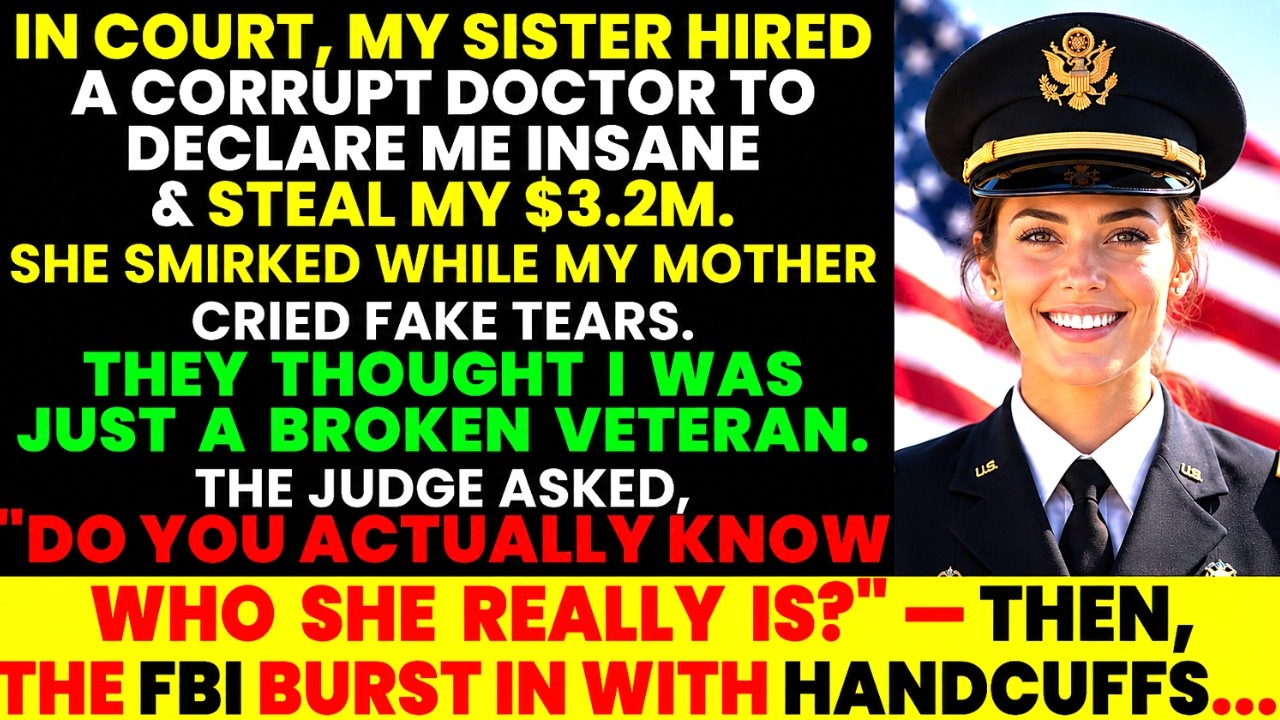
For a terrifying moment, it looked like they had already won. Then the courtroom doors slammed open. FBI agents marched inside with a federal warrant. Seconds later, the people smiling at me were wearing handcuffs instead.
My name is Emily Carter. I’m 30 years old, and the day my own sister calmly told a judge I was mentally ill was the day I realized betrayal doesn’t always come from strangers. Sometimes, it comes from the people you’ve loved your entire life. Three months earlier, my grandfather had passed away peacefully at the age of 86.
He had raised my sister, Olivia, and me after our father died, and he always believed that responsibility mattered more than popularity. When his will was read, he left me control of the family’s $3. 2 million trust, explaining in a handwritten letter that my financial background and careful judgment made me the best person to protect what he had built. Olivia never accepted that decision.
She smiled through the funeral, hugged relatives, and even told me she respected Grandpa’s wishes. Looking back, every word had been an act. Less than four weeks later, I was served with legal papers claiming I was mentally incompetent and unable to manage my own finances. Olivia wasn’t simply contesting the inheritance.
She wanted the court to appoint her as my legal guardian, giving her complete control over everything Grandpa had left behind. I couldn’t believe what I was reading. Then came the medical report. A well-known psychiatrist claimed I suffered from severe psychological instability and poor decision-making.
His report painted me as someone incapable of living independently, despite the fact that I had worked successfully as a financial analyst for nearly eight years without a single disciplinary issue. The courtroom was packed the morning of the hearing. Olivia sat beside our mother, dressed in black as if she were attending another funeral. Every few minutes, Mom dabbed her eyes with a tissue while avoiding any eye contact with me.
When the psychiatrist took the witness stand, he spoke with absolute confidence. “In my professional opinion,” he told the judge, “Miss Carter lacks the mental capacity necessary to responsibly manage substantial financial assets. ”
The words echoed through the silent courtroom. Then my mother stood and tearfully told the judge she feared I would hurt myself if someone didn’t take responsibility for my life.
I wanted to scream. Instead, I looked toward my attorney. He remained completely calm. Leaning closer, he whispered quietly enough that only I could hear.
“Don’t react, Emily. ”
I looked at him, confused. He gave the smallest nod. “They think they’ve already won,” he said.
“Let them keep believing that. ”
Across the courtroom, Olivia caught my eye and smiled with complete confidence, convinced the judge was only moments away from handing her my future. She had no idea this hearing wasn’t the only investigation already underway. As I listened to the psychiatrist describe me like I was a stranger, my mind drifted back to the moment everything had started making sense.
About six weeks before the hearing, I had been organizing Grandpa’s financial records when I noticed something odd. One of the trust statements referenced a consulting payment that had nothing to do with the estate. Curious, I traced the transaction through public business records. It eventually led to a company owned by my sister.
At first, I assumed it was a bookkeeping mistake. Then I found another payment, and another. The amounts weren’t enormous, but they all ended up connected to the same psychiatrist who was now testifying against me. My instincts told me something wasn’t right.
Instead of confronting Olivia, I hired an experienced estate attorney named Daniel Brooks. He listened carefully, reviewed the documents, and immediately advised me not to let anyone know what we discovered. “If this is what it looks like,” he told me, “they’ll make mistakes if they believe you’re completely unaware. ”
So I stayed silent.
Daniel brought in a forensic accountant who spent days tracing financial transfers, invoices, and business records. Piece by piece, an alarming picture emerged. Several payments had been disguised as consulting fees. Email records obtained through lawful discovery suggested conversations about creating medical documentation that would strengthen Olivia’s guardianship petition.
Even more troubling, portions of the psychiatrist’s report appeared to repeat language taken directly from notes prepared by Olivia’s attorney. None of it proved guilt by itself. Together, however, it painted a very different story from the one being presented in court. Daniel carefully organized every document, every bank transfer, every email, and every timeline into a detailed evidence package.
Rather than creating a scene, he quietly submitted everything to the appropriate federal authorities several weeks before the hearing. Then we waited. Back in the courtroom, Olivia stood with complete confidence. “Your Honor,” her attorney said, “the evidence clearly demonstrates that Ms.
Carter cannot responsibly manage this inheritance. We respectfully request immediate appointment of Ms. Olivia Carter as guardian. ”
The psychiatrist nodded confidently.
“I fully support that recommendation. ”
For several long seconds, the judge silently reviewed the documents lying before him. My heartbeat pounded so loudly I could barely hear anything else. Then the courtroom doors suddenly swung open.
Every head turned. Three FBI agents entered alongside two investigators carrying folders. The lead agent walked directly toward the judge’s bench before presenting official credentials and a sealed warrant. “Your Honor,” he said calmly, “we respectfully request a brief interruption.
Our office is executing federal warrants connected to an active investigation involving alleged financial fraud, falsified documentation, and conspiracy related to this inheritance proceeding. ”
The silence that followed was unlike anything I had ever experienced. Olivia’s confident smile disappeared instantly. For the first time that morning, she looked genuinely afraid.
No one moved. The courtroom, so full of whispered conversations only seconds earlier, became completely silent. The lead FBI agent handed a folder to the judge before turning toward Olivia and the psychiatrist. “Ms.
Olivia Carter,” he said evenly, “and Dr. Michael Sanders, we have federal warrants authorizing further action as part of an ongoing investigation involving alleged financial fraud, falsified records, and conspiracy connected to this inheritance matter. ”
Olivia stared at him in disbelief. “There has to be some mistake,” she said, forcing a nervous laugh.
“This is a family probate hearing. ”
The agent didn’t argue. He simply replied, “You’ll have every opportunity to address these matters through the proper legal process. ”
The psychiatrist suddenly looked far less confident than he had only moments before.
“I’ve done nothing wrong,” he insisted. “My medical opinions were independent. ”
One of the investigators calmly placed several documents on the evidence table. “Our investigation recovered financial records showing multiple undisclosed payments connected to your consulting company,” she explained.
“Those records, along with additional evidence, are now part of this investigation. ”
The judge adjusted his glasses and slowly reviewed the documents. When he finally looked up, his expression had completely changed. “This court cannot rely on evidence that is now under active federal investigation,” he said firmly.
“These proceedings are suspended pending the outcome of that investigation. ”
Olivia turned toward her attorney. “Do something,” she whispered. He didn’t answer.
For the first time since this nightmare had begun, she realized no one could simply explain away what had been uncovered. As the agents escorted both Olivia and Dr. Sanders from the courtroom, every confident smile they had worn disappeared. Neither resisted.
Neither spoke. The heavy courtroom doors closed behind them, leaving only stunned silence. A few months later, the investigation reached its conclusion. Financial records, emails, and witness interviews confirmed that misleading medical documentation had been created to strengthen Olivia’s attempt to gain legal control of Grandpa’s $3.
2 million trust. The court determined that the guardianship petition had been built on unreliable evidence, and it was dismissed in its entirety. Grandpa’s wishes remained exactly as he had written them. I cut the trust not because I had defeated my sister, but because the truth had finally been allowed to speak louder than manipulation.
Wanting something meaningful to come from everything that had happened, I established a charitable foundation in Grandpa’s name that supports financial education and mental health awareness. No one should ever have genuine mental health struggles exploited for personal gain. Sometimes people ask whether I hate Olivia. I don’t.
Hate would keep me tied to the worst chapter of my life. Instead, I remember Grandpa’s favorite words: character isn’t revealed when life is easy. It’s revealed when doing the right thing costs you something. He was right.
The people who tried to convince the court that I was mentally ill ultimately exposed only one thing: their own deception.