The room fell silent when my mother-in-law snatched a champagne glass from Rosa and said, loud enough for all six hundred guests to hear, “The staff should know better than to stand with the family. ”
Rosa didn’t argue. She didn’t defend herself. She just lowered her eyes, murmured an apology that nobody deserved to hear from her, and walked quietly toward the kitchen entrance.
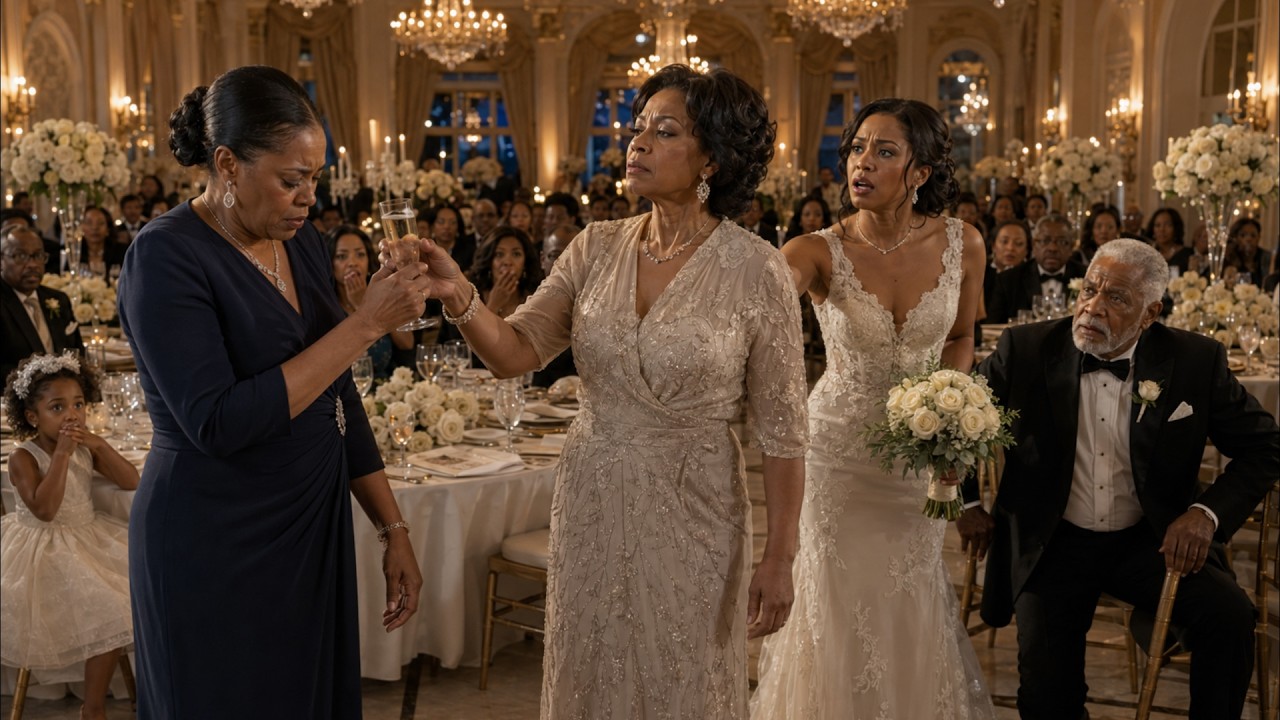
I stood frozen, stunned into silence. But before I could even move, my grandfather slowly pushed back his chair and stood up. My name is Olivia Brooks, and I’m a pediatric nurse in Savannah, Georgia. I lost my mother when I was ten.
It was sudden, an illness that moved too fast, and I remember very little from that time except fragments: a hospital hallway, my grandfather’s hand gripping mine so tightly it almost hurt, and the strange quiet that settled over our house. My grandfather, William Brooks, raised me from then on. He had built his construction company from nothing, and even in his later years he still worked long hours. So someone else needed to be there for me during the daily parts of childhood, and that someone was Rosa.
Rosa had worked for our family since before I was born. After my grandmother passed, and then after my mother died, she quietly became something far more than a job title ever described. She wasn’t staff. She was family in every meaningful sense, even if she never shared our last name.
My grandfather was a quiet man. He didn’t speak often, but when he did, people listened. He had one lesson he repeated to me throughout my childhood: “You can tell a person’s character by how they treat someone who cannot benefit them. ”
I met Daniel Harper during my second year as a nurse.
He was kind in a way that felt genuine, patient with his young cousin who was recovering from surgery. We started dating a few months later, and over the next two years, I fell deeply in love with him. Daniel was a successful attorney, thoughtful and caring. But I noticed early on that he struggled to stand up to his own family, especially his mother, Victoria.
Victoria Harper was elegant, respected, the kind of woman whose opinion carried weight everywhere she went. She wasn’t openly cruel. Her flaw ran quieter than that. She believed in boundaries between different kinds of people, that household staff belonged in a separate category from family.
To her, that wasn’t unkind. It was simply how the world worked. I saw the early signs as we planned our wedding. Victoria mentioned, almost casually, that staff attending the reception should enter through the service entrance.
Another time, she suggested firmly that employees shouldn’t appear in formal family photos, because it might confuse guests about who actually belonged in each picture. I felt discomfort rising every time, but I told myself it wasn’t worth creating conflict during an already stressful time. Daniel noticed tension building, but he assumed it was ordinary wedding stress. I never fully explained how much those comments were bothering me.
That was my failure, one I would come to regret deeply. The wedding day began beautifully. We held the ceremony at a historic garden venue, the late afternoon light turning everything golden as we exchanged vows in front of six hundred guests. Rosa sat near the front, in a seat I had specifically requested for her.
I remember catching her eye during the vows, watching tears stream quietly down her face, feeling overwhelming gratitude that she was there. The reception was equally beautiful, at least for the first several hours. As evening settled and the temperature dropped, Rosa noticed me shivering near the dance floor. She disappeared briefly and returned with a soft shawl she had retrieved from my overnight bag, draping it around my shoulders the way she had done countless times throughout my life.
Our photographer, clearly assuming Rosa was just another beloved family member, asked her warmly to step into frame for a quick candid photograph. Rosa hesitated, glancing at me with a small, uncertain smile. She began to step closer. Before the photographer could take the shot, Victoria appeared suddenly beside us, moving across the dance floor with urgency.
She reached out and pulled Rosa firmly by the wrist, stepping between her and the camera. “The help doesn’t belong in family pictures. ”
Her voice carried clearly across the reception. Conversations nearby fell silent.
I have relived that exact moment more times than I can count. The way the surrounding noise disappeared. The way Rosa’s expression shifted from warmth to something quieter and far more painful. The way her eyes lowered toward the ground as she gently pulled her wrist free and stepped back.
Hundreds of guests had heard those words. I stood frozen, unable to form any response quickly enough. Rosa didn’t argue. She simply apologized quietly and turned to walk toward the kitchen entrance.
An overwhelming shame washed over me. Not embarrassment on Rosa’s behalf, as though her presence were the problem. Shame in myself, sharp and immediate, because I had failed in that critical moment to protect someone who had spent thirty years protecting me without ever once expecting anything in return. Around us, the reception slowly resumed its noise, unevenly.
Some guests pretended nothing had happened. Others whispered, their expressions a mixture of shock and discomfort. Daniel stood beside me, visibly caught off guard. For several long seconds, he hesitated, unsure how to respond to his own mother in front of hundreds of guests.
That hesitation, brief as it was, hurt almost as deeply as Victoria’s words. It was in that heavy silence that my grandfather finally moved. He had been seated quietly throughout the reception, watching everything the way he always did. He slowly pushed back his chair, the sound cutting through the surrounding murmur, and rose to his feet.
He didn’t walk toward Victoria. He didn’t move toward Daniel. Instead, he walked directly toward the kitchen entrance where Rosa had just disappeared. He found her standing just inside the doorway, quietly composing herself before returning to her duties as though nothing unusual had happened at all.
My grandfather reached out and gently took her hand. Then, still holding it, he turned back toward the reception hall and spoke in a voice far stronger and more commanding than I had heard from him in years. He told the assembled crowd exactly who Rosa Alvarez was. Not simply an employee who had worked for our family for nearly three decades, though that alone would have deserved more respect than she had just received.
He explained that Rosa had raised me following my mother’s death, stepping into a role no one had assigned her but that she had carried faithfully for years. That she had stayed with our family through repeated tragedies, declining better-paying positions because of her loyalty to us. That after my grandmother passed, it was Rosa who had quietly helped him navigate the hardest months of his grief, preparing meals he barely remembered eating, sitting with him during evenings he couldn’t otherwise have faced alone. “If anyone here believes Rosa isn’t family,” he said, his voice carrying across the silent hall, “then they don’t understand what family actually means.
”
He gently asked Rosa to stand beside him. Then he turned toward me, extending his other hand, inviting me to join them. I walked toward them without hesitation, tears streaming down my face, taking my place beside the two people who had shaped nearly every meaningful part of my life. Our photographer, still standing nearby, captured the entire moment naturally.
The reception hall erupted into applause, genuine and sustained, guests rising from their seats. It was then that Daniel finally stepped forward. He walked directly to Rosa and offered her a sincere, heartfelt apology in front of everyone present. He turned to our photographer and said, loud enough for everyone to hear, “This is the family portrait I want remembered.
”
Victoria stood apart during all of this, her expression caught somewhere between shock and slowly dawning discomfort as she watched the moment unfold entirely without her. What happened to Victoria in the weeks that followed wasn’t a story of dramatic public downfall. Nobody confronted her aggressively or sought punishment. Instead, something quieter happened on its own.
Word of what had occurred spread gradually through her social circles, as these things inevitably do. Several close friends reached out, some gently, others more pointedly, expressing genuine discomfort with what they had witnessed. Invitations to certain gatherings became noticeably less frequent. Conversations at events she did attend felt cooler, more distant, carrying an unspoken judgment.
Victoria slowly began to understand that a carefully built reputation cannot repair wounds inflicted on people who mattered far more than appearances ever could. Months passed, and life settled into its new rhythm. When Daniel and I finally chose the photograph to display in our home, we didn’t pick the polished, professionally posed one from earlier that evening. We chose the candid image captured in that unplanned moment near the kitchen entrance.
The four of us standing together: William, Rosa, Daniel, and me. Several months later, Victoria visited Rosa privately, something none of us had arranged. She apologized sincerely, without excuses, in a conversation Rosa later described as genuinely humbling to witness. Victoria hadn’t been forced by external pressure.
The social consequences had already settled. She came because she had finally, truly understood something she had spent decades failing to recognize. People often assume a wedding reveals how deeply two people love each other. Mine revealed something I consider even more important.
It revealed who among us truly understood the meaning of family. Rosa never shared our last name, and she spent thirty years insisting she was just doing her job. But she carried our family’s burdens as faithfully as if she had been born into them. My grandfather didn’t stand up because Rosa had worked for us for so many years.
He stood up because Rosa had spent decades quietly standing up for us in every way that truly mattered, long before any of us fully understood how much that steady loyalty was worth. That day taught me that respect isn’t measured by titles, wealth, or social standing. It’s measured by how we treat the people whose quiet kindness shapes our lives without ever asking for recognition in return.
And sometimes the strongest voice in an entire room belongs to the person who waits patiently, saying very little, until the exact moment the truth finally needs to be spoken.