The Arizona sun pressed down like it had a personal grudge, and Max, my mutt, had never liked the heat. But he tolerated it for me. That afternoon, I was repotting a cactus by our driveway, and he was nosing around, tail sweeping slowly. I smiled at him, not knowing it would be the last normal moment we’d ever share.
The HOA had recently hired a new landscaping company. They came early, no notice, spraying weeds and trimming bushes deemed too unruly for community standards. I didn’t see them do it that morning. But Max had.
It started with a cough. Not a bark, not a whimper—a sound too foreign to belong to him. I turned, the ceramic pot still in my hands. He stood on the edge of the driveway, legs tense, body angled oddly.
His eyes, usually warm and expressive, were clouded. He looked up at me as if asking a question I didn’t understand. Then he dropped. I was on my knees beside him before I remember running.
His body trembled violently as he tried to stand, then collapsed sideways with a painful wheeze. Foam pooled at the corners of his mouth. His breath came in shallow, ragged gasps. I touched his flank, and his muscles jumped beneath my hand.
He’d been poisoned. I didn’t have confirmation. I didn’t need it. My phone was on the porch.
The vet was fifteen minutes away, and I knew Max didn’t have fifteen. I lifted him carefully, his heartbeat wild under my arm like a trapped bird. The nearest help was a public utility faucet at the end of the block by the tennis court, the only water source not locked behind a private gate. I ran.
I must have looked insane to the neighbors watching from behind their blinds—a man sprinting down a sunlit street with a half-conscious dog in his arms. But no one came out. By the time I reached the spigot, Max was barely twitching. I dropped to my knees, reached for the handle, and stopped.
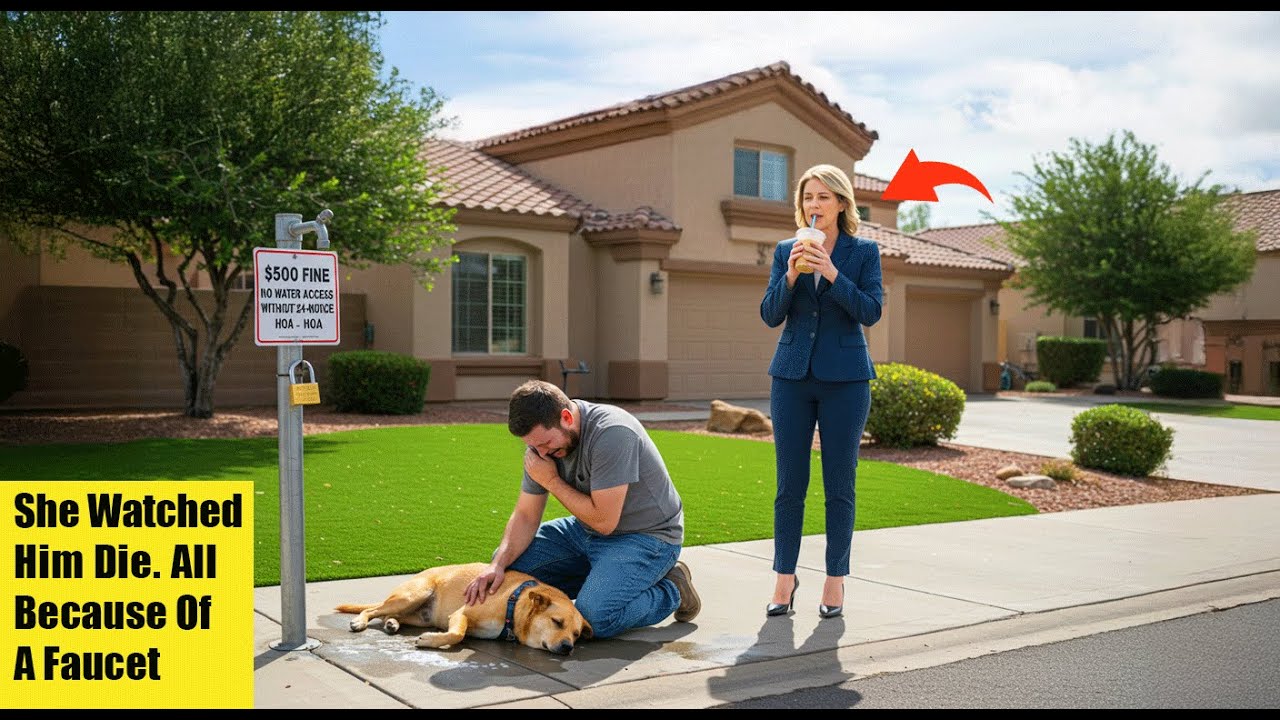
It was locked. Not jammed. Not broken. Padlocked, sealed with a thick, gleaming clamp and a laminated sign zip-tied to the pipe.
“Community notice: Unauthorized use of water is prohibited. Violation will result in a $500 fine. Requests for water access must be submitted 24 hours in advance. HOA Compliance Committee.
”
I read the words again, as if reading slower would make them mean something different. Max whimpered faintly, a sound so pitiful it tore something open in me. I stood, looked around. Houses, lawns, driveways—every one identical, every one silent.
I pounded on the nearest door. Nothing. I screamed, “Please, I need water. My dog is dying.
” Curtains twitched. A door opened, then closed again before I could reach it. Max convulsed. I grabbed my phone and dialed the HOA emergency number.
“Sacarin and sterile. This is Patricia, community relations officer. How may I assist you? ”
“My dog is dying,” I said.
“He’s been poisoned. He needs water now. The public tap is locked. Please unlock it.
”
A pause. Clicking, typing, or indifference. “I’m sorry, sir, but all utility water is restricted for scheduled maintenance and conservation efforts. Did you submit a request?
”
“He’s dying,” I whispered. “I understand this is upsetting,” she replied, as if reading from a script, “but water access requires a 24-hour notice as outlined in section 7B of the HOA regulations. Unauthorized use is…”
I hung up. I screamed again, a guttural, helpless sound.
Max convulsed once more, then went still. I pressed my ear to his side. Nothing. I held him there, on that patch of concrete shaded by nothing but guilt.
His fur was still warm, his collar digging into my wrist as I rocked him—not to soothe him, he was past soothing, but because I couldn’t stop. I only realized someone else was there when I heard the click of high heels on pavement. I looked up. A woman stood ten feet away, framed against the identical beige homes.
She held a phone in one hand, iced coffee in the other. Her name tag shimmered. Patricia, HOA compliance chair. She didn’t speak right away, just looked at me, then at Max.
“Sir,” she said, tone clipped, “this is not an approved pet activity zone. ”
I couldn’t answer. My entire body went numb. “If you feel this incident was caused by HOA actions,” she continued, checking her watch, “you may submit a formal grievance by email.
Responses are typically processed within seven to ten business days. ”
She turned. She walked away. The moment Max died, I thought that would be the worst of it.
But it wasn’t. The worst came later, in the stillness. In the hours after I carried him home, wrapped in an old flannel shirt, I washed his bowl and left it out anyway. I sat on the floor beside his bed long after sunset.
Every creak of the house felt like accusation. I wasn’t sad, not yet. At first, I was just hollow. Around midnight, I remembered the camera.
Not mine—Mr. Dillon’s, my neighbor across the street. He’d installed a smart doorbell last fall, and I’d helped him. He answered on the second ring.
No hello, just, “I saw. ”
“You did? ” I blinked. “Didn’t want to intrude.
Thought you might need time. ” A pause. “But I have it. The whole thing.
From the moment you ran. ”
I didn’t ask him to send it. He did. Five minutes later.
The video was six minutes, twenty-three seconds long. I watched it once, then again, then a third time with the volume turned off, because Max’s whimper near the end cracked something I didn’t have the tools to fix. There was no ambiguity. No missing context.
The footage showed me sprinting with Max in my arms, yelling for help. It showed the locked faucet. It showed Patricia arriving in heels and sunglasses, sipping her iced coffee like she was watching someone violate a noise ordinance. It showed her gesturing to the laminated sign as I knelt over Max’s body.
It showed her walking away. But the worst part was the sound. Her voice, calm and detached. “This is not an approved pet activity zone.
”
I don’t remember uploading it. Not exactly. I remember creating a new YouTube account with no name, no profile picture. I titled the video, “My dog died because my HOA locked the water supply.
Watch what they said. ” No music. No narration. Just the truth.
I posted the link in the local Facebook group, the one where people mostly complained about trash pickup times. Then I went to bed. I didn’t sleep. By noon the next day, it had 14,000 views.
By sunset, it had passed 300,000. I woke up to 127 unread messages and a phone battery too hot to touch. People from all over the country had seen it, commented, reposted. A local reporter emailed me with the subject line, “Do you have time to talk about Max?
” I said no. I didn’t want to be anyone’s headline. I wanted my dog. But the world didn’t wait.
The video spread across social media. Someone ripped the audio and uploaded a slowed version captioned, “This HOA killed a dog over a water faucet. ” Another spliced it into a montage of HOA horror stories—lawn citations, fine threats, elderly harassment. Max’s story became the crescendo.
Then came the emails. Not from strangers, but from neighbors, from people who had passed me in silence before, who now sent long paragraphs filled with apologies, rage, and secrets. One had been fined $250 for installing a birdhouse. Another was cited for leaving their garage door open too long.
A woman wrote, “They locked the playground water fountains last summer. My son fainted during practice. I never said anything. I’m sorry.
”
By the end of the week, a pattern had emerged. It wasn’t about Max anymore. It was about all of us. I got a call from a woman named Eliza, a veterinary toxicologist in Tucson.
She offered to examine Max, said she could determine what killed him even without a necropsy. She came in person, sat with me in silence while I held Max one last time. She explained gently that the symptoms—tremors, drooling, collapse—were classic indicators of organophosphate poisoning, common in cheap turf treatments. “The HOA hired new landscapers,” I said.
She closed her notebook. “Then you’ll need paperwork, contracts, proof of chemical use. ”
That night, I filed a Freedom of Information Act request with the city’s environmental health office. It felt like hurling pebbles at a glass wall.
But something inside me, brittle and sharp, wouldn’t let go. I wasn’t just grieving. I was holding a ledger. And now I was turning the page.
Three days later, Patricia called. Not a text, not an email—a real phone call. I didn’t pick up. She left a voicemail.
Her voice, no longer clipped or rehearsed, trembled. “We’d like to resolve this quietly. We’re deeply sorry for the misunderstanding. ”
I listened to it twice—once to hear the words, once to hear what wasn’t there.
Not once did she say his name. Not once did she say Max. Only “this situation. ”
The HOA tried damage control.
They issued a public statement full of buzzwords and passive voice: “Our hearts go out. In accordance with policy. Unforeseen circumstances. ” They called it an incident.
But the comments shredded it to pieces. “You padlocked a life-saving water source in a desert. Are you serious? ” “Not unforeseen.
Uncaring. ” “This isn’t an incident. It’s neglect with a body. ”
By the weekend, news vans lined our street.
CNN picked it up. The headline read, “Desert dog dies after HOA blocks emergency water access. ” I didn’t speak to the media. But I left the faucet untouched—still locked, still sealed, still bearing the sign.
Because now the world was watching. And I wanted them to see. It’s strange how quiet anger can be. Not the kind that throws things, but the kind that seeps slow and patient into every conversation, every sidewalk smile.
That week, our neighborhood didn’t shout. It watched. Patricia stopped appearing in public. The HOA office remained locked, blinds drawn.
A “closed for maintenance” sign appeared on the door, though no work was being done. Still, the mail came. Still, the violations were delivered. But no one paid.
Something had shifted. The neighbor with the flamingo lawn ornament, who’d been fined $75 for it, put up two more. The father warned about excessive chalk art let his daughter draw a mural across the entire sidewalk. People stopped trimming their hedges.
A woman planted wildflowers in the center of her front lawn and dared anyone to tell her otherwise. No one did. Then came the signs. Hand-painted, propped on fences: “Water shouldn’t kill.
” “Max deserved better. ” “A dog died. A rule survived. ” They weren’t aggressive, just present.
Quiet indictments in every direction. One morning, I found a man standing at the locked faucet—mid-sixties, clean-cut, stiff posture. I thought he might be another HOA enforcer at first. But he turned, and his face was lined with something softer.
He introduced himself as Brian Keller, a former member of the HOA board. He’d resigned two months earlier, citing philosophical differences. No one had asked why. Now I knew.
“I saw the video,” he said quietly. “And I thought if I don’t say something now, I never will. ”
He handed me a folder—thin, manila, taped shut with a strip of red electrical tape. Inside were printed emails, committee notes, expense logs.
At the top of one page was a name I recognized: Patricia L. Klein, compliance chair. The emails were clinical in tone, but venomous in meaning. “If they won’t follow protocol, they’ll learn the hard way.
” “Dogs don’t belong in shared zones. ” “Enforcement must be visible. ” And the one that stopped me cold, dated two days before Max died: “Note, water restrictions are an excellent leverage point. Suggest padlock on south spigot immediately.
”
Brian didn’t explain. He didn’t need to. “I resigned because I couldn’t do it anymore,” he said. “I thought I could walk away and forget.
But Max didn’t get to walk away. ” His voice broke on that last line. He left without another word. The video now had 3.
2 million views. News outlets began circling back, not just for the story, but for blood. A group of residents, led by a retired attorney, a nurse, and the chalk artist’s father, filed an official complaint with the city’s civil rights review board. They accused the HOA of negligent behavior leading to the death of a companion animal, obstruction of emergency care, and violation of local environmental safety laws.
It was the first time anyone had ever sued our HOA. The city responded faster than anyone expected, probably because of the cameras, the petitions, the relentless digital drumbeat. Within seventy-two hours, the mayor made a statement. “No one, human or animal, should suffer because a faucet was locked.
We are launching an investigation into HOA governance procedures across the city. ”
People clapped. I didn’t. I just stood there, surrounded by faces I used to pass like ghosts.
One woman, the same one who once wrote me up for leaving my recycling bin out overnight, squeezed my arm and whispered, “I’m so sorry. ” And I believed her. Not because it helped, but because it mattered. Then came the subpoenas.
Patricia was called to testify. So were the remaining board members. It turned out none of them had voted on the faucet locks. The padlocks weren’t in the minutes.
The budget line item for water compliance had been added retroactively, marked with Patricia’s initials. When asked why she’d bypassed the vote, she gave a single answer: “I didn’t think it required one. ”
That quote made the headlines. So did the footage of her entering the HOA building in silence, flanked by two uniformed officers.
No cuffs. Not yet. But the optics were enough. Someone edited a side-by-side photo—her sipping iced coffee beside a still frame of Max on the pavement—captioned, “Regulations over life.
”
I started getting letters. Not from lawyers or press, but from strangers across the country, from towns with different names but identical problems. A man in Florida wrote, “They towed my RV while I was at my wife’s funeral. Said it was blocking the street view.
I did nothing. I regret it every day. Thank you for not staying silent. ” A teenager in Texas said, “They made my mom cry over a wreath.
Said it wasn’t seasonally appropriate. I’m studying law now. I’m coming for people like her. ” Each letter was a wound and a balm.
The day they removed the padlock from the faucet, no one clapped. No one needed to. Instead, someone tied a blue leash to the handle, gently, deliberately, and left a small wooden sign in the grass below it: “For Max. ”
That night, I sat beside the spigot.
No cameras, no media, just me. I turned the water on, just for a moment, watched it splash onto the sidewalk—cold, clear, too late, but there nonetheless. The courtroom was colder than I expected—not in temperature, but in the way the room swallowed sound. Patricia sat at the defendant’s table in a navy blazer, no longer in heels, no longer wearing her signature sunglasses.
She didn’t look at me, not once. The charges read like they’d been scraped from bureaucratic concrete: negligent obstruction of emergency aid, reckless endangerment, violation of municipal health codes. They’d thrown in misuse of authority under private governance bylaws, just to make it sting harder. But the real trial had happened months earlier, in inboxes, forums, living rooms, and sidewalks.
This was just punctuation. Still, when the verdict came, I held my breath. Guilty on all counts. Patricia didn’t cry, but she exhaled a long, sharp breath, the sound of a balloon deflating after trying to be a zeppelin.
She glanced down once, then at her lawyer, and nodded like someone signing off on her own disappearance. I wasn’t happy. I didn’t cheer. But I felt something move inside my chest, like a door that had been closed for too long finally creaking open.
The sentence wasn’t prison, not technically. She received probation, fines, a lifetime ban from serving on any HOA board again, and two hundred hours of mandated animal welfare education. She’d spend every weekend at the county shelter cleaning cages, scrubbing floors, walking dogs she didn’t deserve. The punishment wasn’t about revenge.
It was about placement—putting her somewhere she couldn’t ignore the things she once thought were beneath her. The city followed suit. Within two months, the council passed Max’s Law, a mandate requiring all public and private communal water sources to remain accessible in emergencies. Padlocks were banned.
Emergency override valves became standard. New signs read, “Water is a right, not a request. City of Red Mesa. ” Other HOAs took notice.
Some updated their policies quietly. Others dissolved entirely. One by one, people began asking the question that had long been avoided: What are we actually protecting? I moved eventually—not out of spite, not even grief, just completion.
Max’s leash stayed hung by the door longer than it should have. His bowl came with me, though I never filled it again. I kept the folder Brian gave me too, not as evidence, but as a reminder. I ended up in a little house north of Sedona, where the grass grows wild and uneven, and no one blinks if your trash bins stay out an extra day.
There’s no HOA, no bylaws, just neighbors, some deer, and a view that humbles the sun. The backyard has a fence now, one I built myself—crooked but sturdy. And next to the gate, a brass plaque I hammered into the soil: “Max. You were never just a dog.
You were proof that some rules deserve to be broken. ”
Sometimes people recognize me at the grocery store or gas station. They don’t ask for interviews anymore. They just nod quietly, respectfully.
Almost all of them say the same thing: “Thank you. ” As if I did something noble. But the truth is simpler. I didn’t choose this.
I didn’t want to fight. I just wanted to save my dog. One year later, almost to the day, a package arrived at my new doorstep. No return address.
Inside was a small canvas painting—a watercolor of Max lying in the shade of our old driveway, tongue out, eyes bright, body whole. Behind him stood a silver faucet, gently running. Clear water spilled onto green grass that never used to grow there. A handwritten note was tucked beneath it:
“My daughter watched your video.
She asked why the lady wouldn’t give the dog water. I didn’t have an answer. So we made this. For you.
For him. For all of us. L. Hernandez and Ava, age 8.
”
I hung the painting in the kitchen. And sometimes, when the house is quiet and the wind moves just right through the open window, I swear I hear the familiar click of paws on tile. Not loud. Not sad.
Just home.