Amara Osei stepped off a bus from Atlanta with one rolling bag, a work authorization card, and her grandmother’s last words playing in her head like a voicemail she couldn’t delete: “You have strong hands, baby. Use them to lift people. ”
Four months later, she stood in a Houston penthouse over a woman sprawled on the marble floor, her palm still stinging from the slap. Behind her, a wheelchair.
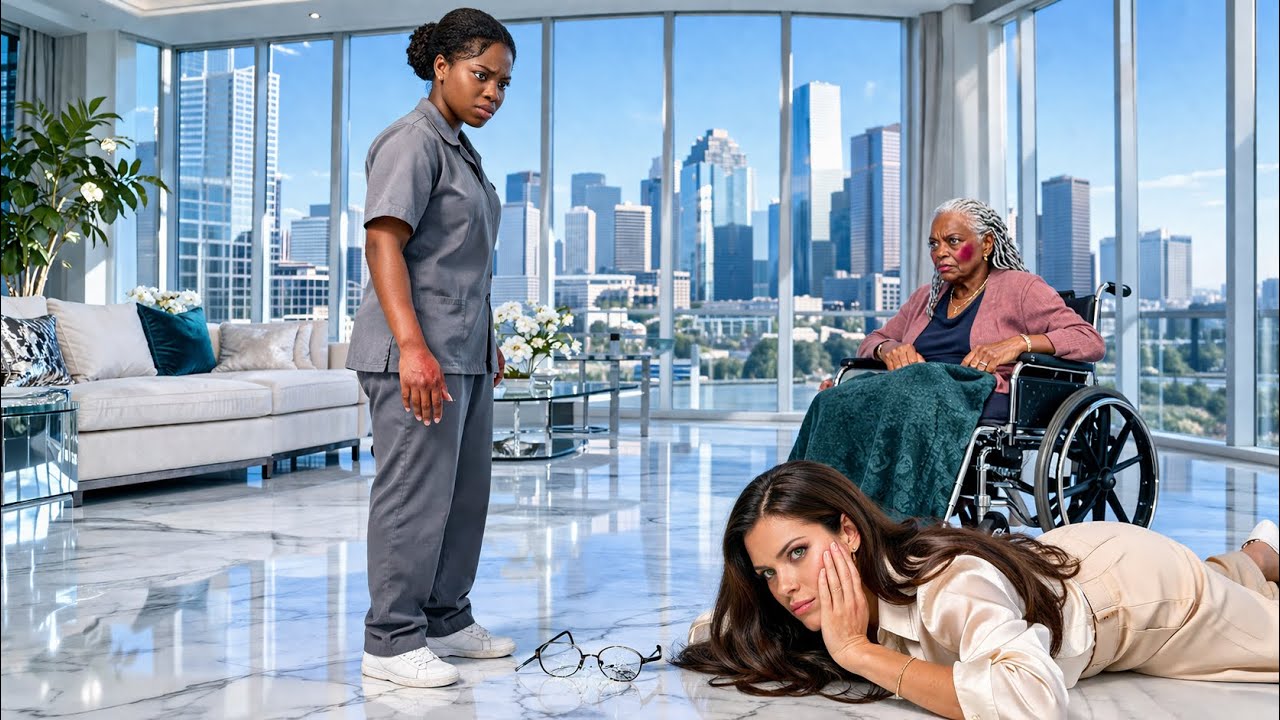
In it, 74-year-old Dr. Odette Briggs, her reading glasses on the floor, a fresh handprint across her left cheek. Dex Briggs walked in. Six-foot-two, suit pressed, phone in hand.
He saw three things in one second: his girlfriend on the floor, his housekeeper standing over her, his mother with someone’s mark on her face. Three people. Three stories. Ten seconds to decide which one was true.
Four months earlier, Amara stood at the service entrance of a 41-story high-rise in Midtown Houston. Twenty-six years old, Ghanaian-American, wearing a blazer she’d ironed with a towel and a hair straightener because she couldn’t find an iron. The building manager, Ms. Faye, walked her up without smiling—the kind of woman who’d watched half a hundred girls quit before lunch.
Dr. Odette Briggs was a retired professor, paralyzed from the waist down for two years. Sharp. Sharp enough to test everyone who walked through her door.
“Convince me,” she said, looking at Amara the way professors look at students on the first day. “You’re Ghanaian. Born here, but both parents from Kumasi. Ashanti.
”
“Yes, ma’am. ”
“I taught African literature for 22 years. Do you read? ”
“I read everything.
”
“Name something you hated. ”
Amara didn’t pause. “The ending of *Their Eyes Were Watching God*. Janie buries Tea Cake and the book acts like that’s peace.
That’s not peace. That’s survival dressed up pretty. ”
Something moved on the old woman’s face. Not a smile—the space where a smile could live.
“You start this afternoon. ”
Amara had been lifting women who couldn’t walk since she was eight. Her grandmother had MS. Amara bathed her, dressed her, braided her hair, pushed her wheelchair to church every Sunday.
Her grandmother died when Amara was 23, her last words through the oxygen mask: “Strong hands. Use them to lift people. ”
That’s the only reason Amara took this job. She knew what it meant to care for someone the world stopped seeing.
Within two weeks, she and Dr. Briggs found their rhythm. Mornings, Dr. Briggs read poetry aloud, her professor’s voice returning like muscle memory.
Afternoons, they argued about books the way people fight when they’ve been waiting their whole lives for someone worth the disagreement. The braiding started in week three. “Can I take these down and wash them? Start fresh.
My grandmother said clean locks felt like a crown. ”
“I’m 74,” Dr. Briggs said. “My grandmother was 81.
”
Silence. “Do it. ”
Hours later, Amara held up a mirror. Dr.
Briggs touched her fresh locks slowly, like she was reading something in them. “I look like somebody’s grandmother. ”
“You look like a professor. Those aren’t different things.
”
She laughed—real and full, something that had been locked in a drawer for two years and finally remembered it was allowed to exist. From the hallway, footsteps. Someone listening, then walking away. Jade, Dex’s girlfriend, arrived every day around noon.
She ran a wellness brand with 40,000 Instagram followers. She called Dr. Briggs her queen, her inspiration. She brought flowers.
She posted photos: “Spending the afternoon with the most elegant woman I know. ”
Amara watched. Real warmth was clumsy—it interrupted itself, laughed at wrong moments, forgot what it said. Jade’s warmth was choreographed.
Every gesture landed where it was supposed to. Every word was preloaded. Amara’s grandmother used to say, “When someone is too careful with their kindness, they’re hiding the opposite. ”
Day 11.
Amara came back with afternoon tea. The door was cracked. Jade’s voice, low and smooth: “He’ll put you somewhere eventually. After the wedding.
A facility. You’ll have your books, but you won’t have this view. You won’t have him stopping by, because I’ll explain that the facility offers better care, and he’ll believe me. He always believes me.
”
Dr. Briggs’s voice, small, frightened: “Please don’t do this. ”
“Then don’t make me. When the new doctor comes on Friday, you’ll tell him you’ve been confused, forgetting things.
Do you understand? ”
“Yes. ”
Amara stood in the hallway, tea tray in her hands, fingers bloodless. Then she walked in smiling, normal, smooth.
Jade straightened. Her smile returned without a flicker. Amara set down the tray. And she began to watch.
Day 15. While helping Dr. Briggs change, Amara saw the bruise inside her upper arm—purple, the shape of three fingertips pressed hard. “Wheelchair arms don’t leave fingerprints,” Amara said quietly.
Dr. Briggs pulled away. “I bumped it. ”
“I bathed my grandmother every day for 15 years.
I know the difference between a bump and a grip. ”
The old woman looked at the window. “It’s nothing. ”
The gate stayed closed.
But Amara had seen behind it now. Day 18. Amara finished her shift and passed Dr. Briggs’s room.
The wheelchair faced the wall, inches from white paint. Dr. Briggs sat still, staring at nothing. She couldn’t turn the chair herself—her arms weren’t strong enough.
“How long have you been like this? ”
“What time is it? ”
“3:40. ”
“Since 10.
”
Almost six hours. Facing a wall because someone pointed her there and left. Amara gripped the handles, turned the chair back to the window. Afternoon light hit Dr.
Briggs’s face. She blinked. Slow. Like surfacing.
“She said the light was hurting my eyes. ”
“Was it? ”
“No. ”
Amara opened the curtains wider, adjusted the lap blanket, handed her the book from the side table.
Didn’t say another word. Dr. Briggs read. Her hands shook through the first page.
By the third, the professor’s voice was back. Amara stood by the window and listened. Her jaw clenched so tight it throbbed. Day 22.
The glasses were gone. Amara searched for two days before she found them, tucked in the back of a bureau drawer beneath folded scarves. Jade had put them there. Dr.
Briggs had been sitting for days in a blur—unable to read, unable to see the skyline, unable to be the professor, just a woman in a fog. Amara cleaned the lenses with her apron, knelt beside the wheelchair, and placed them on Dr. Briggs’s face the way she used to place her grandmother’s glasses—gently, like they mattered, because they did. Dr.
Briggs’s eyes focused. The room sharpened. “Thank you,” she whispered. Day 27.
Amara heard it from the corridor. A sharp sound. Skin on something hard. A short, cut-off cry.
She opened the door. Jade stood beside the wheelchair. Dr. Briggs’s hand was in her lap, already swelling.
Jade’s heel had been on her fingers. “Amara, I was just fixing her blanket. ” The smile was instant. Perfect.
That night, Amara wrapped the swollen finger with medical tape and an ice pack. “Tell Dex,” Dr. Briggs said. “She’ll put me in a home.
She’s been telling him for months that I’m confused. She brought a doctor, told him I’m declining. She’s building a case to have me declared mentally incompetent. ”
“You’re the sharpest person I’ve ever met.
”
“It doesn’t matter what I am. It matters what she makes him think I am. ”
“She’s not smarter than you,” Amara said. “She’s just meaner.
”
Those are different things. Day 32. Amara went to Dex’s home office—glass walls, a desk the size of her first apartment. She told him everything.
The threats. The hidden glasses. The bruise. The heel on the fingers.
The whispered promise of a facility. He listened. Then he called Jade. Jade arrived.
The performance began. Tears. A voice that sounded like it was breaking. She pulled up photos on her phone—her and Dr.
Briggs laughing, smiling, cheek to cheek. “Why would I do any of that? I love Odette. Why would this girl lie?
”
Dex went to his mother’s room. “Mom, Amara says Jade has been hurting you. Is that true? ”
Dr.
Briggs’s eyes moved slowly from her son’s face to Jade, standing just behind him. Jade’s expression was full of love and heartbreak and concern. But her eyes said something else. *The facility.
The papers. Say what you’re supposed to say. *
Dr. Briggs looked at her lap.
“No, Amara is mistaken. Jade has been very kind to me. ”
Dex turned to Amara. “My mother has spoken.
If you make accusations like this again, I’ll have to let you go. ”
He left. Jade walked out behind him. From the doorway, she looked back at Amara.
The tears were gone. What was underneath was smooth, cold, unbothered. Amara stood alone in the room with Dr. Briggs.
The old woman stared at her hands. “I’m sorry, Amara. ”
“Don’t be sorry. Be angry.
”
“I’m too tired to be angry. ”
“Then I’ll be angry for both of us. ”
Amara sat beside the wheelchair, took Dr. Briggs’s wrapped hand in both of hers.
The room was quiet. “Don’t leave me alone with her,” Dr. Briggs whispered. “I’m not going anywhere.
”
The weeks passed. Amara stayed. Braided. Read.
Cooked. Argued. Held. Dex began to notice—not the abuse, but the change.
One afternoon he passed his mother’s room and heard laughter. He stopped. Both women were mid-argument about whether Zora Neale Hurston was fearless or reckless. His mother was winning.
He hadn’t heard that sound in two years. That evening, in the kitchen: “My mother laughed today. ”
“She laughs most days. ”
“She didn’t used to.
”
“She wasn’t given enough reasons. ”
“What did you do differently? ”
Amara turned to face him. “I braided her hair.
I read with her. I made her jollof. I argued about books. I treated her like a human being, not a liability in a wheelchair.
I treat her well. You treat her like a duty. ”
Nobody talked to Dex Briggs like this. Not board members.
Not lawyers. His housekeeper just did. “She was a professor,” Amara said. “She shaped people’s thinking for 22 years.
And she’s been sitting in that wheelchair for two years with no one who treats her like she’s still that woman. ”
He said nothing. That night, he went to his mother’s room. He stayed for over an hour.
Jade noticed the shift too. Dr. Briggs was stronger. Louder.
Dangerous. Jade escalated. She limited Amara’s hours. Replaced the physical therapist with someone who reported back to her.
Tightened everything. Month four. Thursday. 4:12 p.
m. Dr. Briggs found the professor’s voice one last time. “I’m going to tell my son what you are.
He sat with me last week. He heard me. He’s starting to see me again. And when he sees me clearly, he’ll see you clearly.
”
Jade’s voice dropped. Flat. Final. “No, he won’t.
”
The sound came before the comprehension. Sharp. Skin on skin. An open hand striking a 74-year-old woman’s face hard enough to knock her sideways.
The glasses spun off and hit the marble. Amara opened the door. Frame one: Jade standing over the wheelchair, hands still raised, face completely blank—the look of someone completing a task they’d done before. Frame two: Dr.
Briggs, head turned from the impact, left cheek dark, eyes open. Defiant. Frame three: The glasses on the floor. One lens cracked.
The things she needed to read, to see, to be herself. Amara looked at the handprint, the glasses, Jade’s blank face. Something ignited. Not anger.
Not bravery. A reflex—the same reflex that made her lift her grandmother every morning, the same one that made her ice a swollen finger at midnight. The reflex of a woman built by 18 years of pushing a wheelchair to church, of standing between the vulnerable and the world. Three steps.
Her right hand, open palm. Not a fist. A correction. Her palm connected with Jade’s cheek.
Jade went sideways off the armrest, hit the marble. Her hair fanned out. Her hand flew to her face. Amara stood between the wheelchair and the woman on the floor.
Her palm stung. Her visa was over. Her job was over. She didn’t move.
“Don’t touch her again. ”
Behind her, Dr. Briggs looked at Amara’s back with an expression that had no name. The expression of someone watching a stranger run into traffic for them.
*Someone fought for me. *
Thirty seconds. The door opened. Dex walked in.
Jade spoke first. Always first. The tears were already there, right on schedule. “She hit me.
Out of nowhere. I was just visiting your mother, and she hit me. ”
Dex looked at Amara. She said nothing.
Stood still. “Mom, what happened? ”
Dr. Briggs’s eyes moved to Jade.
Behind Dex, Jade’s face was grief and shock and love. Her eyes said, *The home. The papers. Say what you always say.
*
But something was different. Today, a woman in a gray uniform had crossed a room for her. Not for money. Not for status.
Because she had strong hands and someone told her what they were for. *Someone fought for me. *
The gate opened. “She slapped me.
”
The room went still. “Jade slapped me today. And before today. ” Dr.
Briggs’s voice grew steadier with every word. The professor returning. “She pinches my arms. She stood on my fingers.
She hid my glasses. She turned my wheelchair to face the wall and left me there for hours. She whispered that she’d put me in a home. That she’d tell you I’m losing my mind.
”
Jade shook her head. “She’s confused, Dex. I told you she’s been—”
“She just described a two-year campaign in precise chronological order,” Dex said. “That is not confusion.
That is testimony. ”
He looked at Jade for a long moment. “Get out. ”
“You’re choosing the housekeeper over me?
”
“I’m choosing my mother. I should have chosen her two years ago. ”
Jade left. Heels on marble getting quieter, then gone.
But not finished. At 6:22 p. m. , Jade called the police.
“My boyfriend’s domestic worker assaulted me. ”
Technically true. The law doesn’t ask why. Amara was questioned.
Her work authorization was flagged. Immigration notified. Jade leaked the story to a blogger she knew. *Billionaire’s housekeeper attacks girlfriend.
African immigrant faces deportation. *
The comments were immediate, vicious, predictable. *Deport her. Who does she think she is?
*
Amara read them in her small room at the end of the service hall. Her hands didn’t shake. Her grandmother had heard worse from church ladies who thought a woman in a wheelchair was divine punishment. Dex knocked on her door.
“I’ve called a lawyer. ”
“Why? ”
“Because you did what I should have done. ”
“I hit your girlfriend.
”
“You hit the woman torturing my mother. Courts won’t see it that way. ”
“Courts will see the evidence. ” He paused.
“I had cameras installed after the renovation. Every common room. They upload to a private server. Jade didn’t know.
”
Amara stared at him. “Two years of footage. Why didn’t you check when I told you the first time? ”
He had no answer.
The answer was: he didn’t want to see. “I’m watching now. ”
He watched it alone. Six hours.
His office dark except for the screen. He saw Jade hide the glasses—methodical, open the drawer, place them inside, close it, walk out. Leaving a 74-year-old woman in a blur. He saw her turn the wheelchair to the wall.
Watched his mother grip the armrests, try to turn herself, fail, give up, sit for hours facing white paint while the Houston skyline shone behind her. He saw her stand on his mother’s fingers. The cut-off cry. The smile on Jade’s face.
Not cruelty. Something worse. Boredom. He heard the whispered threats.
Audio clean. Every word. *“He’ll put you somewhere clean. You’ll have your books.
But you won’t have him. ”*
He watched his mother absorb each word. Watched the professor compress. Watched a woman being made smaller, visit by visit, whisper by whisper.
And he watched Amara braiding locks, patient. The same pattern every week. Dr. Briggs’s face shifting from hollow to alive as each row took shape.
Amara finding the glasses. Cleaning the lenses with her apron. Kneeling. Placing them on Dr.
Briggs’s face like they were precious—because they were. Amara turning the wheelchair back to the window. The light hitting his mother’s face. His mother blinking slow, like coming out of a dark room.
Amara sitting beside the wheelchair in the middle of the night, not speaking, just there. Two women in the same room across two years. One shrinking her. One rebuilding her.
He watched the footage from that afternoon last. Jade’s slap. The glasses spinning. Amara crossing the room.
He watched it three times. On the third viewing, he noticed something he’d missed. After the hit, after Jade fell, Amara’s hand was shaking. Her whole body was shaking.
She was terrified—but she didn’t move away from the wheelchair. She planted herself between Dr. Briggs and the woman on the floor. And she stayed.
Dex opened the family trust documents. Then he called his head of legal. Then he called his private investigator. “The accident two years ago.
My mother’s spinal injury. I need the full incident report. Vehicle maintenance records. ”
“That case was closed.
”
“Open it. ”
The report came back 48 hours later. The brake inspection scheduled for the morning of the accident had been canceled by a phone call. The number traced to Jade’s business manager.
The brakes. The phone call. The timing. Dex sat with it for a full day.
His stepfather—the man who fixed everything in the house, who made terrible jokes and kept every promise—died in that crash. His mother was paralyzed because someone canceled a brake inspection. He told Amara. She went still.
“Your mother doesn’t know? ”
“She’s blamed herself for two years. She told me she’s the one who said they were running late. He skipped the mechanic because of her.
”
“She needs to hear this from you. Not from a lawyer. From her son. ”
They told Dr.
Briggs together by the window, the Houston skyline beyond the glass. She listened with a professor’s face, processing, cataloging—then: “The brakes. Someone canceled the inspection. ”
“Yes.
”
“He said they felt wrong that morning. He almost called. I told him we were running late. ” Her voice dropped to almost nothing.
“I’ve carried that for two years. ”
“It wasn’t your fault, Mom. ”
She didn’t cry. She went completely still.
The room held its breath. Then the professor’s voice came back. Clear, absolute, like a verdict. “I want her to know that I know.
And I want the world to know. All of it. ”
The press conference. Dr.
Briggs insisted on attending. Wheelchair. Fresh locks. New glasses—Amara found an identical pair within a day and wouldn’t let her go without.
The room was full of cameras. Reporters expecting a celebrity scandal. Dex spoke first. “Three days ago, my housekeeper struck my girlfriend.
Media reported it as an unprovoked attack. I’m here to show you what actually happened. ”
The screens activated. Twelve minutes of footage.
The room watched in silence. The hidden glasses. The wheelchair turned to the wall. The heel on the fingers.
The gasps were audible. The whispered threats rolled across the screen in subtitles. The psychiatric forms. The facility letter—drafted, addressed, waiting on a signature.
Then: Amara braiding locks. Making jollof rice. Finding the glasses. Turning the chair back to the window.
Holding a swollen hand in the dark. Then Jade’s slap. The glasses spinning. Amara crossing the room.
*“Don’t touch her again. ”*
The room erupted. Dex raised one hand. “There’s more.
”
The trust documents. The filing. The phone call canceling the brake inspection. The connection to Jade’s family firm.
The accident that killed his stepfather and paralyzed his mother—currently under reinvestigation. Cameras everywhere now. Dr. Briggs rolled to the center of the platform.
“My name is Dr. Odette Briggs. I taught African-American literature at Howard University for 22 years. I am not confused.
I am not declining. I am a woman in a wheelchair who was told to be quiet or lose everything. ”
She looked to the side of the room. Gray uniform, white sneakers, eyes wet.
“Today I choose to speak because a young woman, a housekeeper in my son’s house, chose to fight for me when I had stopped fighting for myself. ” She held Amara’s gaze. “Amara Osei hit my abuser, and I wish I’d had the legs to stand up and do it myself. ”
Jade was investigated.
Elder abuse. Fraud. Potential criminal conspiracy in connection with the accident. Her wellness brand went dark overnight.
The comments flipped. *Protect Amara. She’s the real one. *
Amara’s charges were dropped by end of day.
Three weeks later. Dr. Briggs’s room. Morning.
Amara braided locks. Same pattern. Same hands. The reading lamp was on.
The window faced the garden. The wheelchair was in full light. “You’re staying,” Dr. Briggs said.
Not a question. “I’m staying. Not as a housekeeper. I’m not sure what else to call it.
Companion, reader, lock braider, jollof chef, friend—if that’s not too soft for someone from Kumasi. ”
“We’re sentimental. We just hide it. ”
“So do we.
”
Dex had offered Amara a formal position. Full salary, benefits, visa sponsorship. She accepted with one condition. “I answer to your mother.
Not to you. ”
“That seems to be how everything works in this house now,” he said. “Slow learner. But you’re getting there.
”
That evening, Tuesday, Amara was in the kitchen. Jollof rice. The smell filled the whole floor. Dex sat at the counter and watched her cook.
“You changed everything in this house. ”
“I made rice and braided hair. Your mother did the rest. ”
Silence.
“I don’t know how to do this,” he said. “Feel something for someone who works here without it being wrong. ”
“I don’t work in your house. I work for your mother.
There’s a difference. ”
“Is there? ”
“She thinks so. She told me last week, ‘My son looks at you like you’re a problem he’s hoping never gets solved.
’”
“She said that? ”
“She’s a professor. She notices everything. ”
He reached across the counter.
Not for her hand. For the spoon. Took a bite directly from the pot. Amara stared at him.
“You did not just eat from the pot. ”
“I’m learning different ways to earn things. ”
“That’s not how earning works. ”
“Then teach me.
”
She looked at him. He looked at her. The counter between them. Same kitchen where she’d told him he treated his mother like a duty.
Where he’d first heard laughter from down the hall and stopped walking. The distance was smaller now. By choice. “Tuesday,” she said.
“What about it? ”
“Come back next Tuesday. Sit with your mother for an hour first. Then come here.
I’ll make extra. ”
“Is that a date? ”
“It’s jollof rice. Don’t make it weird.
”
From down the corridor, clear, full, commanding: “I can hear you both. And yes, it’s a date. ”
Amara laughed. Dex almost smiled.
The sound of a 74-year-old professor’s voice carrying through a penthouse was the sound of a house finishing its long way back to being a home. Morning. Dr. Briggs’s room.
Door open. Lamp on. Books open. Window full of light.
She was in her wheelchair. Locks braided. Glasses on. Reading aloud.
African-American poetry. The professor’s voice full, unhurried, unsilenced. Amara sat beside her. She didn’t understand every reference.
She didn’t need to. The sound of this woman’s voice—strong and unafraid—was the only proof she needed that what she did was right. On the windowsill, two framed photos. Dr.
Briggs and her late husband. And beside it, Amara and Dr. Briggs, taken by Dex. Neither woman was looking at the camera.
Both were mid-argument. Both certain they were winning. She came to Houston with one rolling bag and a work authorization card. She took a job because she knew how to care for a woman who couldn’t walk.
She braided locks. She made jollof rice on Tuesdays. She argued about books with a professor who hadn’t argued in two years. And when she saw a handprint on that professor’s face, she crossed a room and used her strong hands the way her grandmother taught her.
Not to hurt. To hold someone up. Some people spend their whole lives waiting for permission to do the right thing. Amara didn’t wait.
She saw broken glasses on a marble floor and she moved. Strong hands don’t ask for credit. They just refuse to let go.