“Mommy, don’t let grandma come inside. ”
I froze with my hand on the doorknob. My eight-year-old daughter Lily had grabbed my arm, her voice barely a whisper. I glanced back at the camera on my phone.
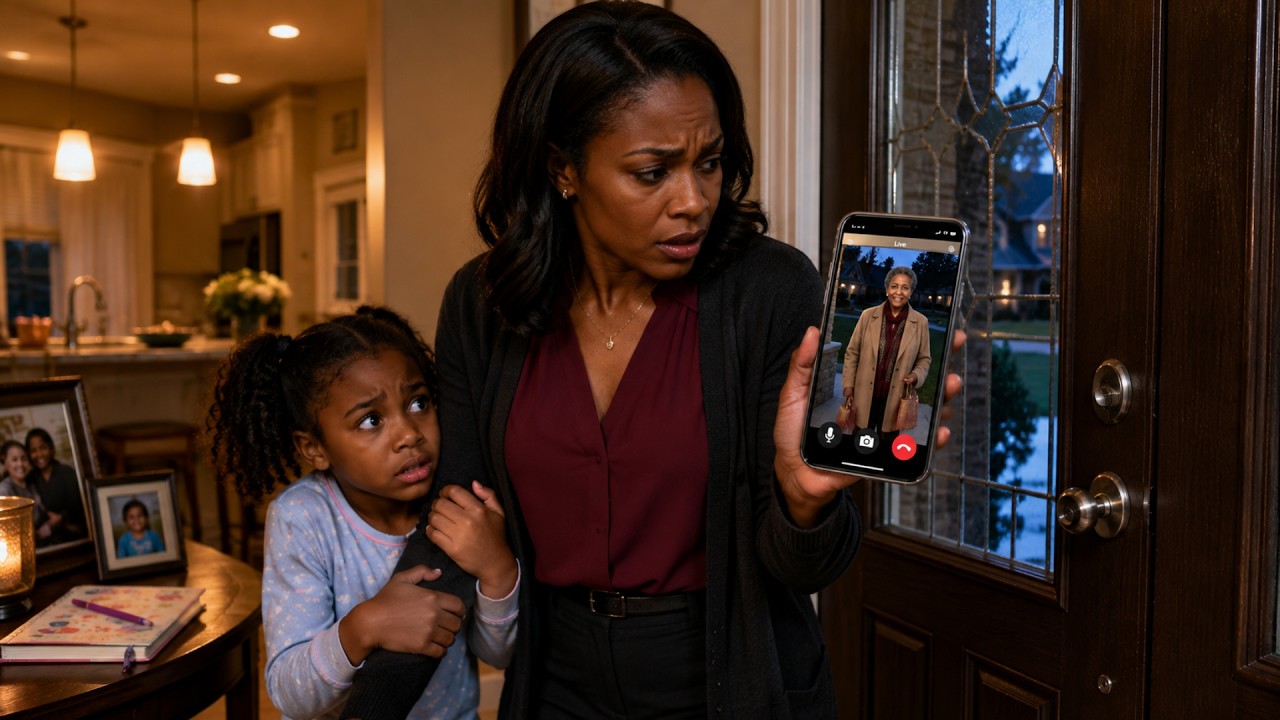
My mother, Evelyn, stood on the porch, smiling and waving. “Why? ” I asked. “What did grandma do?
”
Lily looked toward the door, then back at me. “She told me not to tell you. ”
The doorbell rang again. “Rachel, it’s me,” my mother’s voice crackled through the speaker.
I didn’t open the door. I stood there, my heart pounding, staring at my daughter’s frightened face. I thought she was afraid of my mother. I was wrong.
She was afraid of what my mother had been doing when I wasn’t looking. My name is Rachel Morgan, and I’m 38. I’m a financial analyst in Denver, and I’ve raised Lily mostly on my own since she was a toddler. Being a single mother with a demanding career isn’t easy, and I relied heavily on my mother, Evelyn.
She was retired, financially comfortable, and eager to spend time with her granddaughter. On the surface, she was the perfect grandmother. She brought gifts, took Lily shopping, and never missed a school event. Everyone thought they were unusually close.
She often told me, “You work too much. Let me be the grandmother. ” I was grateful for that support more than I can say. She cooked Lily’s favorite meals and posted photos of them together with affectionate captions.
For years, I trusted her completely. The first signs of trouble appeared about eight months before that evening at our front door. Lily grew quieter after visits with her grandmother. She stopped chattering about her days the way she used to.
When I asked what was wrong, she’d just say she was tired. Then one evening, entirely out of nowhere, she asked me, “Mommy, do you trust Grandma? ”
I laughed, surprised. “Of course I do.
”
She just said, “Okay,” and changed the subject. Over the next few weeks, I noticed more changes. Lily started refusing gifts her grandmother offered. She avoided having her picture taken during visits.
She began hiding a small notebook under her mattress. I saw it but didn’t read it, respecting her privacy. About two months before everything fell apart, Lily told me quietly, “Grandma told me not to tell you something. ” I pressed her for details, but she just shook her head.
I also noticed comments my mother was making to Lily, comments that undermined me. “Your mother works too much,” she’d say. “Grandma would never leave you. ” When I confronted Evelyn, she dismissed my concerns.
“You’re being paranoid,” she said with such conviction that I almost believed her. The turning point came on an ordinary weekday afternoon. I came home early because of a canceled meeting and found Evelyn just leaving my house. She looked nervous when she saw me.
“Why are you here? ” I asked. She said she’d just stopped by to drop something off for Lily. But Lily seemed unusually frightened that evening.
After a lot of gentle coaxing, she finally told me something that stunned me. “Grandma wants me to live with her,” she said quietly. “She said if I told you, you’d be angry with her. ”
That brought me back to that evening at the front door.
Standing there with Lily’s whispered warning echoing in my head, I made a deliberate decision not to open that door. Through the camera speaker, I heard the hurt and frustration in my mother’s voice. “Rachel, you’re keeping my granddaughter from me. ”
I asked her directly, “Why did you tell my daughter to keep secrets from me?
”
She denied it, but her hesitation gave her away. Then she said something that made my blood run cold: “You don’t understand what she’s told me. ”
I realized then that there were two completely different versions of this story. “I’m sorry, Mom,” I said.
“I need some time. ”
She left. I closed the door and sat with Lily for a long while. Later that night, once she’d fallen asleep, I opened the app connected to my doorbell camera to review what had just happened.
What I found shocked me more than anything that had come before. The camera had recorded weeks of footage. As I worked backward through the files, hours of ordinary footage passed, then I noticed something troubling. Evelyn had been visiting my house repeatedly while I wasn’t home—far more often than the occasional scheduled visits I’d known about.
On one recording from about six weeks earlier, I watched my mother stand on my porch, peer through my windows, and speak quietly through the closed door. On another, I watched her hand Lily a sealed envelope through a gap in the partially open door, glancing around cautiously before doing so. I sat alone in my darkened living room, watching these clips, feeling hollow. My own mother had been secretly communicating with my daughter, deliberately hiding it from me.
The next morning, I searched Lily’s room and found that envelope tucked inside her hidden notebook. Inside was a copy of a letter connected to child custody proceedings. My mother had been quietly consulting with an attorney, trying to find a way to gain custody or guardianship of Lily. She had convinced herself that my career made me an unfit mother.
I want to be fair here. My mother wasn’t acting out of malice. She genuinely believed she was protecting Lily from what she saw as inadequate care. She thought she knew better than I did what her granddaughter needed.
That understanding didn’t excuse what she’d done, but it helped me approach what came next with more clarity than anger. There was one final piece of footage. It showed Evelyn standing with Lily outside my front door, speaking quietly and urgently. I heard my mother’s voice: “If your mother asks, you never saw this.
”
Then Lily’s small voice: “Are you taking me away from mommy? ”
My mother didn’t answer the question directly. Instead, she said, “I’m trying to make sure you have the life you deserve. ”
That changed everything.
I wasn’t dealing with an overprotective grandmother. I was dealing with someone who had been actively preparing my young daughter emotionally and psychologically for a separation from me, while coaching her to keep it secret. A few days later, I met with Evelyn. I brought my laptop and played the footage for her without saying a word.
I watched her expression change as she saw herself coaching Lily to lie to me. “You didn’t just cross a boundary,” I told her when the footage ended. “You taught my daughter that she had to choose between us. ”
“I was protecting her,” she insisted.
“You were protecting the version of motherhood you thought I should have,” I replied. In the weeks that followed, I established firm boundaries. No more unsupervised visits. No more secret communication.
No more gifts with conditions attached. And absolutely no discussion of custody or guardianship with my daughter, ever. Evelyn didn’t accept this gracefully at first. She called repeatedly, alternating between tearful apologies and defensive justifications.
I held firm through every call. I didn’t want to destroy my relationship with my mother completely. Instead, I offered her a path back. “If you want to be her grandmother, be her grandmother,” I told her.
“But you don’t get to become her parent by undermining me. ”
Eventually, she agreed to attend family counseling with me. Those sessions revealed things I hadn’t known about my mother’s own history—old fears about her own adequacy as a parent decades earlier, regrets she’d carried quietly for years. It didn’t excuse what she’d done, but it helped me understand how she had ended up on this path.
Several months passed. Lily gradually began to feel more settled. Then, one evening, she asked me a question that caught me off guard. “Can grandma come over?
”
“Only if you want her to,” I told her. She considered that carefully. “I do,” she said. “But she has to promise not to make me keep secrets anymore.
”
I watched her say those words, struck by how clearly she had articulated the boundary that mattered most—without any prompting from me. Children absorb more than we give them credit for. For years, I believed protecting my daughter meant shielding her from external dangers. I didn’t understand that sometimes the danger comes from someone who genuinely loves your child but whose love has curdled into control.
The footage I reviewed didn’t reveal a monster. It revealed someone I loved, someone who loved my daughter too, but who had convinced herself she knew what was best better than I did. Sometimes the most dangerous secrets within a family aren’t the ones people hide from you out of malice. They’re the ones people teach your own children to keep from you, convinced they’re acting out of love.
I think about that distinction often now, on quiet evenings when Lily and I sit together after one of her grandmother’s carefully supervised visits. We’re both slowly relearning what trust is supposed to feel like.