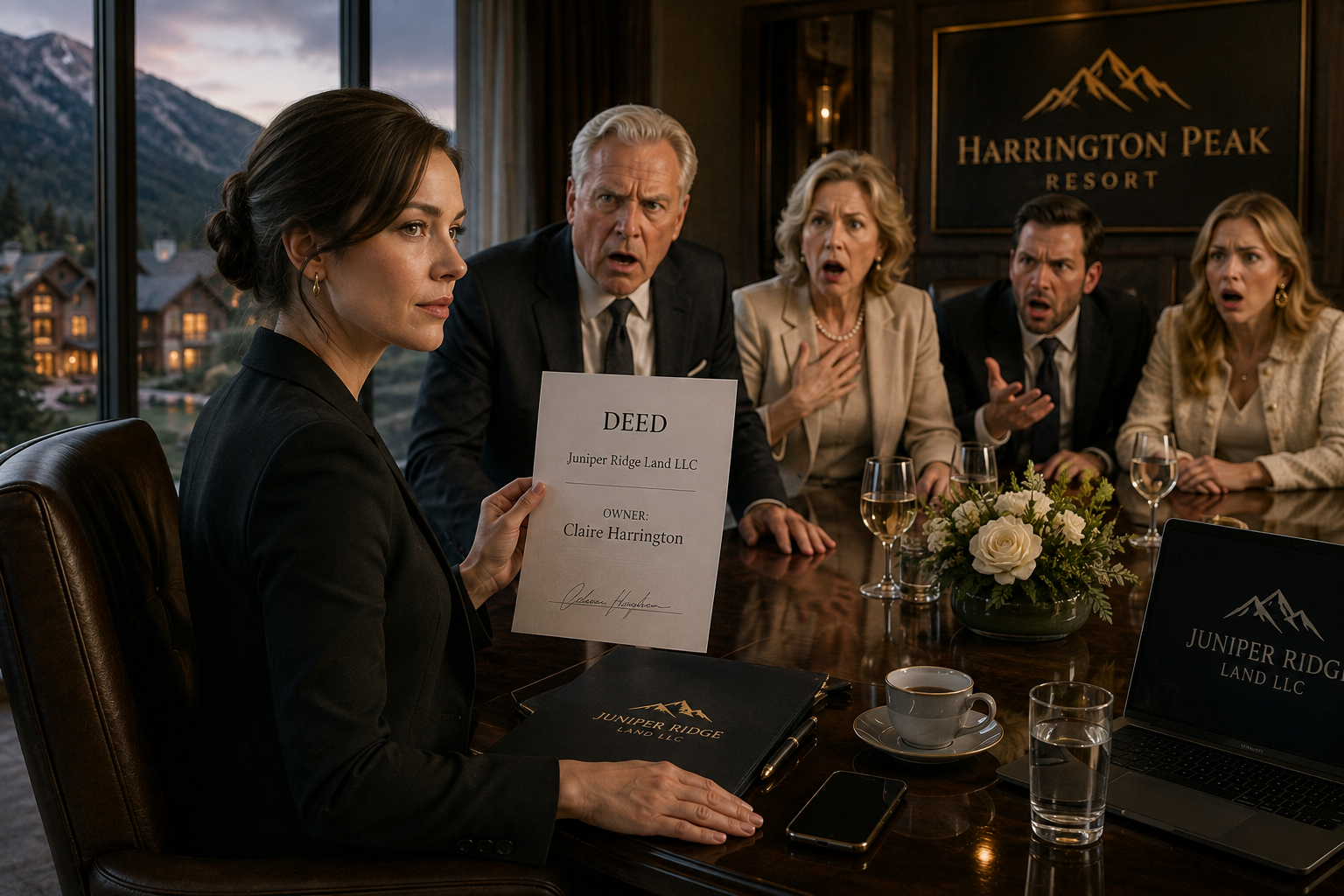
The polished oak doors of Harrington Peak Resort’s private dining room had barely closed behind the staff when the laughter began. Claire Harrington, 34, sat motionless as her father, Richard, tapped a valuation report with the confidence of a man who had never been challenged. “We don’t need your pocket change,” he said, his voice dripping with condescension.
“Our resort is worth $50 million.” Her mother, Evelyn, lowered her eyes in silent agreement. Her brother, Grant, smirked.
 Her sister, Natalie, asked if Claire’s “little property job” had finally paid a bonus. They accused her of running away because she could not survive real business. They called her $250,000 offer a desperate attempt to buy a seat at their table.
Claire did not defend herself. Beneath the table, she unlocked her phone and sent a single message to her property manager: “Decline their land lease renewal. Effective tonight.”
Then she placed the phone beside her untouched plate and listened as her father explained why people like him should handle serious assets. Ten minutes later, the dining room doors burst open so hard they struck the wall. The resort’s chief financial officer, Daniel Cho, rushed in without a jacket, clutching his laptop.
“Emergency board meeting,” he said, his voice cracking. “The landowner refused to renew. We have 11 days before the ground lease expires.”
Evelyn stopped breathing. Natalie’s wine glass froze halfway to her mouth. Richard stood so quickly his chair hit the floor.
“Who owns the land?” he shouted. Claire reached into her bag and touched the deed.
But she did not take it out yet. Ownership, she knew, was only the first shock she had brought to dinner. By morning, every member of her family would understand exactly what their laughter had cost them.
The scene that unfolded in the following hours was one of rapid, cascading crisis. Daniel Cho, the resort’s CFO, opened his laptop with shaking hands to reveal the stark reality. The ground lease, held by Juniper Ridge Land LLC, expired in 11 days.
Formal notice of non-renewal had been sent at 6:12 p. m. that evening.
No extension. No holdover tenancy. No renewal.
Grant, already angry in a way that disguised fear, demanded answers. “That’s impossible. We have renewal rights.”
Daniel swallowed hard. “We had a right of first negotiation if we opened talks 180 days before expiration. Legal sent three reminders.
Operations did not authorize a proposal until last month.” Richard turned on his son. “You told me the renewal was administrative.”
“Because that’s what legal told me,” Grant shot back. “No,” Daniel said quietly. “Legal told you it was urgent.”
The room fractured. Richard ordered Daniel to call outside counsel. Grant accused the finance team of hiding notices.
Natalie demanded to know whether upcoming weddings had to be cancelled. Evelyn whispered that the resort residence—the house she and Richard occupied year-round—sat inside the same 42 acres. Then the first outside call arrived.
The bank’s commercial lending officer wanted proof of site control before releasing the next construction draw for the new spa wing. Without a signed lease, the draw would be frozen. A second call came from the insurance broker.
The resort’s property and liability policies were due for renewal in 14 days, and the carrier would not bind coverage if the company could not prove a legal right to occupy the land. The county’s hospitality permit was tied to the same parcel, and its annual compliance certification was due at the end of the month. “We can buy the land,” Natalie said, forcing a laugh.
“How much could 42 acres be compared with a $50 million resort?” Daniel looked at her for a long moment. “The resort is worth $50 million as an operating business with a long-term ground lease.
Without site control, the buildings are collateral stranded on someone else’s property.” He turned the screen toward Richard. “And section 31 says that when the original lease ends, any permanent improvements not removed by the tenant revert to the landowner unless a new agreement is signed.”
Evelyn gripped the edge of the table. “You mean the lodge?” Daniel nodded.
“The lodge, the spa, the conference center, the staff dormitory, the lifts on the lower slope—everything classified as a permanent improvement.” For 37 years, Richard Harrington had boasted that he owned a mountain empire. In 11 days, the legal document said his empire could become fixtures on another person’s land.
The bank refused Richard’s request for a waiver until it spoke with the landowner. Grant paced, blaming Daniel, the lawyers, and a former assistant. Natalie watched a bridal client ask why spring dates were no longer being confirmed.
Evelyn began to cry with the offended shock of someone who believed consequences happened to other families. Claire remained seated. Richard finally noticed her.
“Claire, why are you so calm?” he asked. Grant spun toward her.
“And why did you reach into your bag when Daniel mentioned the owner?” Claire looked at the four faces that had been laughing ten minutes earlier. Her chest felt tight, but not from triumph.
She had imagined this confrontation more than once, and in every version, she felt powerful. In reality, she felt the old ache of being the only Harrington they had never thought worth knowing. “Call the board,” she said.
“Put your attorney on speaker. Then I’ll answer.” While Daniel sent the emergency notice, Richard moved the family from the dining room into the resort’s private boardroom.
That was when Claire saw the photograph again. It hung between two framed magazine covers. Opening day at Harrington Peak: her parents in front, Grant holding a ceremonial ribbon, Natalie on Richard’s shoulders.
At the far edge was half of Claire’s left arm. The original photograph had included 16-year-old Claire holding the wooden scale model she had spent an entire summer building. Years later, Evelyn had cropped the picture for a publicity campaign.
She told Claire the composition looked cleaner without the empty space on the side. Claire remembered staring at that missing piece of herself and wondering how a family could erase someone so casually. Seven years earlier, after earning an MBA and working on distressed hotels, Claire had asked Richard for a junior acquisitions role.
He never read her proposal. “You take things too personally,” he said. “Grant has the stomach for pressure.
You don’t.” Two weeks later, he promoted Grant to COO. When Claire’s real estate analytics firm later faced a cash crisis, her parents refused a secured bridge loan.
She sold her car, slept in her office, made payroll, and eventually sold the platform to a hotel investment group. After taxes, she had just under $1. 4 million—far more than her family knew, but not enough to buy a resort.
Then a former client sent her an auction packet. The Caldwell Trust owned the 42 acres beneath Harrington Peak and was liquidating. Her family owned the resort company and its improvements, not the ground.
The lease allowed a sale without tenant approval if the buyer honored the remaining term. Funds disliked the parcel because the resort controlled it for seven more years. Banks disliked its complicated easements.
Claire saw predictable rent, irreplaceable land, and a tenant too confident to read its contracts. She formed Juniper Ridge Land LLC, whose public records listed a registered agent, not its sole member. She invested $900,000.
The Caldwell Trust carried $2. 7 million as a note secured by the land, and a private fund supplied the balance for a minority, non-voting interest she later bought back. The sale was recorded.
Her family’s attorneys received notice, and Grant signed the tenant acknowledgement. No one asked who controlled Juniper Ridge because rent still flowed through the same manager and the lease terms did not change. That owner was Claire for seven years.
She approved easements, deferred rent during a weak winter, and funded a wildfire survey. She stayed hidden because she loved the place where she grew up and because she wanted to know whether her family could respect her without first seeing a number beside her name. Her $250,000 offer was not random.
 A quarterly report sent to Juniper Ridge under the landlord’s audit rights showed a $238,000 reserve shortage after Grant accelerated the spa. She offered a low-interest note with no board seat and no public credit. Richard called it pocket change.
Grant called her career pretend. Natalie said she was renting importance by the hour. Evelyn let every word land.
In the boardroom, Richard insisted they had been excellent tenants. Daniel admitted they were late twice and began the spa access road without written approval. “Technical defaults,” Grant snapped.
“Still defaults,” Claire said. Evelyn followed Claire’s gaze to the sliver of her arm in the photograph. Shame crossed her face, then vanished when the attorney confirmed the rejection was enforceable.
Richard lowered his voice. “Claire, if you know the owner, make an introduction. Whatever they want, I’ll negotiate.”
Claire almost laughed at the symmetry. Seven years earlier, she had asked him to read 12 pages of her work. Now he was asking her to save 37 years of his.
She opened her bag. But before she removed the deed, she said, “You should hear the answer with the full board present. This family has done enough important business in rooms where I was not invited.”
Within 20 minutes, the independent directors arrived, and Richard’s attorney, Peter Lang, joined by video. Richard took the head chair. Grant sat beside him.
Claire chose the distant seat usually left for assistants. Peter confirmed the lease expired at midnight on the 30th. The resort had missed its negotiation window, and Juniper Ridge’s rejection was enforceable.
“I see no strong basis for an injunction.” Richard leaned toward the camera. “Who is behind Juniper Ridge?”
Peter hesitated. “A private member.” “Then subpoena it.”
Helen Sloan, the retired banker on the board, cut in. “On what claim? Refusing to renew an expired contract is not misconduct.”
Richard’s palm struck the table. “Someone does not get to take my life’s work because of a missed calendar date.” Claire finally opened her bag.
The zipper sounded unnaturally loud. She removed a navy folder and laid out three documents: the recorded special warranty deed transferring the 42 acres from the Caldwell Trust to Juniper Ridge, a certificate of good standing, and a notarized resolution identifying her as the company’s sole managing member. She turned them toward Peter’s camera first.
Silence followed. Not ordinary silence. It was the kind that seemed to pull the air out of the room.
Peter leaned close to his screen and asked Claire to move the resolution beneath the camera again. He read the recording number aloud. Daniel typed it into the county database.
Helen took off her glasses, cleaned them, and reread Claire’s name. Martin whispered, “Oh my god.” Richard did not touch the papers.
“Who owns the land?” he asked again, but the anger had drained from his voice. Claire placed her index finger beneath the line that read, “Sole managing member Claire Elise Harrington.”
“I do.” Evelyn’s hand flew to her mouth. Richard’s face lost its color so quickly that Claire thought he might fall.
Natalie’s wine glass slipped from her fingers and hit the carpet, staining it red. Grant stood, knocked his chair backward, and said, “No. She doesn’t have that kind of money.”
“You signed the transfer acknowledgement,” Claire told Grant. Daniel displayed the county deed and Grant’s electronic signature. Peter confirmed an LLC could hold title without listing its beneficial owner in the county index.
Grant accused Claire of hiding behind a shell company. Helen corrected him. “A holding company is not fraud.
Your failure to perform due diligence is not concealment by the owner.” Evelyn shook her head. “The Caldwells own the mountain.”
“They sold it. Your office received notice.” Natalie asked the price.
“$5. 6 million, including seller financing. The note is paid.”
Richard finally looked at Claire. “You were 27, and you let us pay rent to you for seven years.” “You paid Juniper Ridge under an existing lease.
I honored every term and approved concessions that saved the resort $1. 8 million.” Daniel found the concessions in his files, all authorized through Claire’s property manager, Elena Ruiz.
Richard had publicly credited Grant for securing them. “So you were spying on us?” Grant said.
“The lease gave the owner quarterly reports. If reading them feels like spying, you signed documents you did not understand.” Richard pushed the deed away.
“This is retaliation over a dinner joke.” Claire’s hands trembled. Even then, he needed her pain to be small.
“Tonight was the last confirmation, not the first injury. You rejected me before I had failed. You gave Grant a company and gave me a lecture about resilience.
I survived, built something you never asked about, and spent seven years protecting this resort while you treated my absence as proof I had achieved nothing.” Evelyn started to say Claire’s name. Claire stopped her.
“You cropped me out of that photograph.” Everyone looked toward the wall. Evelyn stared at the narrow strip of Claire’s sleeve still visible beside the frame.
“It was for the layout,” she whispered. “That is what you always say. There is always a layout, a guest list, a board seat, or a family story that works better when I take up less space.”
Claire’s voice cracked on the final word. She hated that they heard it. She hated even more that some part of her was still 16, waiting for her mother to put her back into the picture.
If you were in her place, what would you feel when the people who had treated you as insignificant discovered that you owned the ground beneath their entire world? She expected satisfaction. What she felt was grief.
The deed proved she had won the argument, but it also proved that her family needed a legal instrument before they would listen to her voice.
Grant recovered first. “Fine. You made your point.
Renew the lease.” He said it like an order to an employee. Claire closed the folder.
 “No.” Richard stared at her. “Claire, enough.”
“The landlord declined renewal. That decision stands tonight.” Natalie’s fear became anger.
“You would destroy $50 million because we laughed?” “The resort is not worth $50 million without my signature,” Claire said. “That was Daniel’s point, not mine.”
Helen asked the question no one else wanted to ask. “Are you willing to negotiate at all?” Claire looked at the three independent faces, then at the four relatives who had never considered her a serious person until she controlled the land.
“I am willing to review a rescue proposal after a full operational audit, lender disclosure, and a board vote removing anyone who ignored the renewal notices from authority over this negotiation.” Grant slammed both palms down. “That means me.”
“For once,” Claire said, “you read the document correctly.” By 8 the next morning, the bank had frozen the spa draw. The insurer demanded proof of occupancy within five business days, and two corporate retreats paused deposits.
A wedding blog posted an internal contingency email. In a town covered with Harrington charity banners and business plaques, one rumor moved faster than any statement. The family that claimed to own Harrington Peak did not own the peak.
Doubt became scandal when Natalie called it a routine negotiation and a reporter quoted Juniper Ridge’s reply: “There is no active renewal negotiation.” Evelyn’s foundation lost a sponsor. A regional hotel operator asked Claire’s manager whether the land would be available after reversion.
Claire did not solicit the call, but she made sure Richard heard about it. The audit exposed why the lease was mishandled. Grant delayed three warnings because a market appraisal could raise rent and reduce the earnings figure tied to his bonus.
He expected Richard to force better terms at the last minute. Natalie had charged $186,000 in events, influencer stays, and private travel to the spa. Richard approved $2.
2 million in family distributions while Daniel asked the board to preserve cash. Evelyn’s residence and vehicles were partly booked as promotion. The crisis did not create their weakness.
It exposed it. They turned on one another. Richard called Grant reckless.
Grant produced emails showing Richard had told him not to waste board time on landlord paperwork. Natalie blamed Daniel for approving her invoices, and Daniel replied that she had used Richard’s authorization code. Evelyn demanded that everyone lower their voices because employees could hear.
From the hallway came the unmistakable sound of department managers arguing about whether they should begin applying elsewhere. Claire wanted her family to feel the cost, not the employees. Juniper Ridge issued a 14-day access license, effective only if the lease expired, allowing staff to maintain essential systems and current guests to leave safely, but no new check-ins, events, construction, or family residents.
She also placed her original $250,000 in escrow for hourly payroll. Richard and Grant could not touch it. Their pocket change became the crisis’s only money protected for workers.
Richard came to Claire’s hotel alone. “Grant will apologize. Natalie will repay some expenses.
I’ll give you a board seat.” “Give me?” Claire asked.
He pleaded that Evelyn had lived in the resort house for 29 years, then accused Claire of enjoying the crisis. She wanted to tell him she had cried because the first honest look he ever gave her was fear. Instead, she said, “Enjoyment would have been being respected before I became dangerous to you.”
He asked what she wanted. She told him the audit had to finish before she named terms. He offered money: first above-market rent, then a personal guarantee, then a share of the spa.
Each offer assumed the problem was the price. “What number makes this go away?” he finally demanded.
“There isn’t one,” Claire said. “The land is valuable. The pattern is the liability.”
When he left, Elena called to report that Grant had contacted her privately and offered a $200,000 consulting payment if she could produce an unsigned renewal draft dated before Claire’s rejection. She had recorded the call on the advice of counsel. Claire forwarded it to the audit committee.
That single desperate act ended Grant’s argument that he had merely overlooked paperwork. He was now trying to manufacture it. The independent directors suspended Grant as COO under emergency conflict rules Richard had approved years earlier.
Grant surrendered his keys before the managers he had blamed. As security escorted him out, he said, “You did this?” “No,” Claire replied.
“I stopped preventing it.” The final negotiation began 48 hours before expiration. Claire’s attorney, Maya Patel, sat beside her.
Grant attended as a shareholder, not an officer. The independent directors, Daniel, and the lender were present. No one touched the coffee.
Maya distributed a 12-page term sheet. Juniper Ridge would offer a 25-year lease at appraised rent, plus two conditional 5-year options. Claire would provide a $3 million rescue facility for insurance, lender reserves, and working capital.
In exchange, the resort would be reorganized under professional governance. Hope appeared until Maya reached the ownership section. Juniper Ridge would receive 51% of voting units in exchange for the lease commitment, discounted first-year rent, and rescue facility.
The family trust would keep 49% but lose control. Claire would hold a permanent seat and veto rights over debt, asset sales, related party transactions, and executives. Helen would chair the board for three years.
Richard would resign as chairman and remain only a non-executive founder. Grant would be terminated for cause with no salary or office. Natalie would resign, repay $186,000, and compete through an outside committee for any future job.
Family distributions would stop for 24 months to rebuild reserves, fund fire mitigation, and protect six months of payroll. A five-year audit would claw back personal expenses with interest. Senior employees, lenders, partners, and minority investors would be told that executive failures caused the missed renewal.
Evelyn stared at Maya. “You want us to humiliate ourselves publicly?” “No,” Claire said.
“I want the people who carried your risk to receive the truth privately and professionally. You made the humiliation public when you lied to the reporter.” Natalie’s voice shook.
“You’re taking our company?” Helen answered before Claire could. “The company is 48 hours from losing possession of its property.
Claire is contributing the land access and liquidity that preserve it. You are being offered 49% of a functioning resort instead of 100% of a tenant in default.” Grant pushed the term sheet away.
“She planned this for seven years.” Maya opened the audit. “Did she make you ignore three notices?
Did she tie your bonus to an inflated earnings calculation? Did she ask you to offer a bribe for a false document?” Grant looked toward Richard, waiting for rescue.
Richard did not meet his eyes.
Richard asked everyone else to leave. Maya waited outside the glass door while Claire and her father sat beneath the cropped photograph. “When you were born,” he said, “you were so small, I was afraid I would break you.
 So you spent 34 years proving I was breakable?” He claimed he was harder on her because they were alike. “You withheld opportunity, then called my survival evidence that you taught me.”
For the first time, Claire saw her father cry. “Please don’t take the resort.” What would you do when the father who never made room for you begged you to preserve the room built around his name?
Part of Claire wanted to sign because children do not stop wanting their parents when they learn to live without them. That was why she had brought terms, not emotions. “I am refusing to return control to those who endangered it.
I could let the improvements revert and lease them to an operator willing to retain most staff. You would lose the business, the house, and the name on the entrance. I am offering you ownership, a founder role, and a path to recover value.
What you are losing is the power to confuse being my father with being entitled to my signature.” He asked whether she could ever forgive him. “That is not in the term sheet,” she said.
“Governance can be fixed in 48 hours. A family cannot.” He looked toward the photograph.
“Your mother chose that crop.” “And you approved every brochure.” He nodded once, as if accepting a verdict.
When the others returned, Richard shocked them. He slid the signature page toward himself. “I will resign as chair,” he said.
Grant stood. “You can’t surrender our company to her.” Richard finally turned on his son.
“You nearly surrendered it to a calendar.” Grant’s face collapsed. “You told me the landlord would bend.”
“And you were paid to know when I was wrong.” It was not courage that made Richard say it. The deadline had stripped him of every easier choice, but accountability often begins after pride runs out of exits.
Natalie received a secured 12-month repayment plan if she sold the resort-funded SUV and paid the first installment within 10 days. She cried, but signed. Evelyn resisted until Daniel confirmed the residence would revert with the other improvements.
Grant demanded immunity. Claire offered only a conditional civil release if he surrendered all records and signed a sworn statement. Any lie would cancel it.
He signed at 11:43 p. m. The next morning, Richard faced 87 department heads, supervisors, lenders, and partners.
“I dismissed repeated warnings, allowed family privilege to replace oversight, and mocked Claire when she offered help. Claire owns the land beneath this resort. Her company protected us for years while we failed to learn who stood behind it.
Our failures endangered your jobs. I am resigning as chairman.” The lease already required disclosure, so the apology could not buy easier terms.
Grant then read his statement. He admitted delaying the renewal to protect his bonus and contacting Elena about a backdated draft. The board announced his termination in the same meeting.
Natalie acknowledged misusing project funds and confirmed her repayment plan. Daniel explained the employee protection fund. Then Helen introduced Claire as controlling director of the new operating company.
Claire carried the same $250,000 commitment letter to the microphone. “This will not buy me a seat. The land and the agreement settled the seats.
It will fund a payroll reserve no Harrington can withdraw. The people who clean rooms, cook meals, maintain lifts, and answer phones will be paid before any owner.” Employees stood and applauded while her family remained seated.
At 4:18 p. m. , they signed.
The lender released funds. The insurer bound coverage. The county received proof of site control.
Harrington Peak survived, but the Harringtons no longer controlled it. Their punishment was living with a thriving resort that carried their name while proving they had lost the right to rule it.
Six months later, Harrington Peak posted its strongest operating quarter in four years. The spa reopened under a fixed budget. Employee turnover fell after the board introduced predictable schedules and a profit-sharing plan.
The audit recovered another $412,000 in personal expenses and vendor overcharges. Every dollar went into the employee fund and fire safety work. For the first time, the resort’s value came from disciplined operations instead of a number Richard repeated at dinner.
The consequences did not soften. Richard remained founder, but Helen ran the board, and his office became a compliance suite. Grant took an assistant operations job at an independent Denver hotel and explained his termination on every application.
Natalie sold her SUV and a vacation share, repaid $186,000, and joined a tourism nonprofit in a non-financial role. Evelyn left the resort residence. She still chaired charities, but sponsors no longer treated the Harrington name as flawless.
The local paper’s correction remained attached to every search for the family. Evelyn eventually mailed Claire the original opening day photograph. On the back, she wrote, “You were always part of it.”
Claire framed neither the photograph nor the note. Being restored to an old picture was not the same as being valued in the present. Richard sent a message after the first profitable quarter.
“I am proud of you. I should have said it before I needed you.” Claire read it several times.
Then she replied, “Thank you. Keep proving it when you need nothing from me.” They meet for coffee once a month in a public place.
They discuss books, weather, and sometimes the resort. Claire no longer hands him her unguarded hope and calls it reconciliation. She won the land dispute.
She gained control of the business. She protected the employees and forced the people who had mocked her to admit what they had done. But victory did not return the years she spent believing she was the defective child in a successful family.
It did something more useful. It ended their authority to define her. The most expensive thing her family lost was not 51% of a resort.
It was the assumption that she would keep making herself smaller just to remain welcome at their table. Sometimes revenge is not burning down what hurt you. Sometimes it is removing the people who played with matches, changing the locks, and making them watch the place thrive under rules they can no longer bend.
Claire’s $250,000 was never pocket change. It was a test of whether they could recognize respect before fear forced them to learn it. They failed the test, and the price was control.
What do you think Claire should do now? Cut her family off completely or keep the safe distance she has built and let their future actions decide. Tell me which choice you would make and why.
We appreciate every viewer who spent time with this story today. This fictional video was created only for entertainment, education, and dramatic reflection. We hope it reminds you that when people keep crossing your limits, the problem is not that your limits were unclear.
Sometimes the problem is that they believed you would never love yourself enough to enforce them.