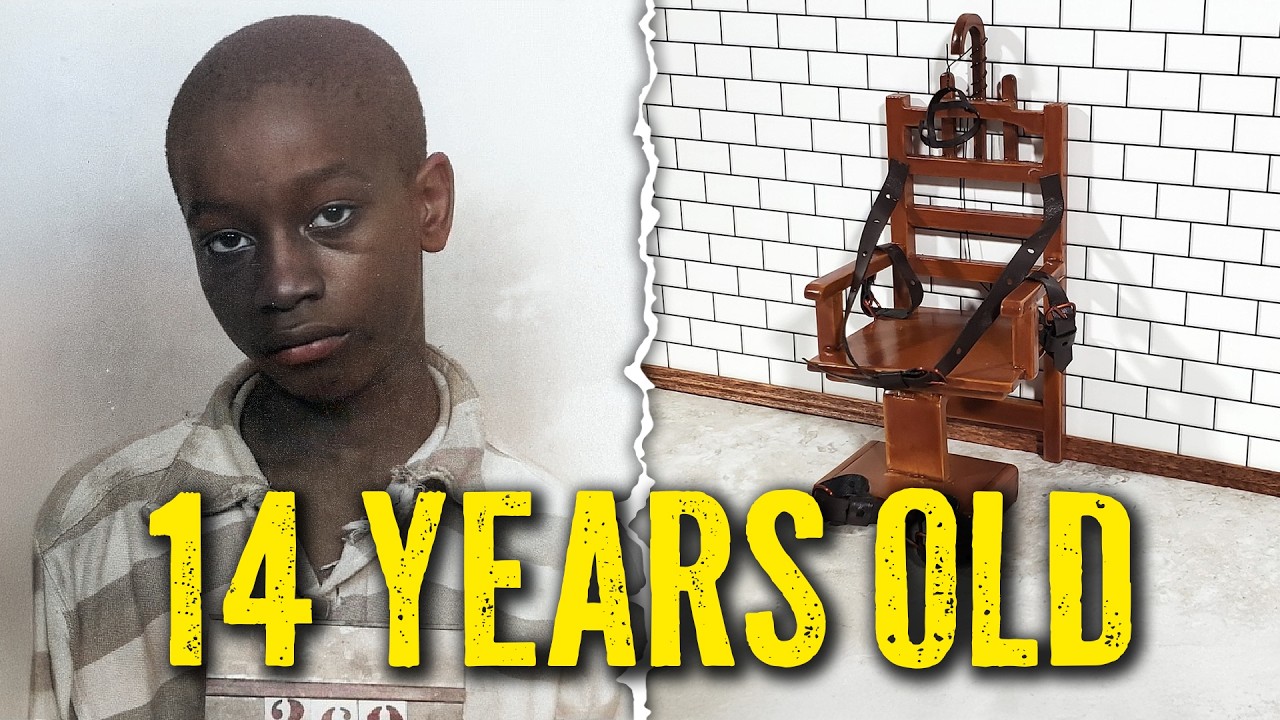
The small brick building known as the death house at the South Carolina State Penitentiary held a secret that even the most hardened guards could not ignore. Inside, a 14-year-old boy named George Stinney Jr. woke to his final 24 hours of life, a child condemned to die in the electric chair for a crime that evidence would later call into question for decades.
He was alone in a six-barred cell, the one closest to the chair, under constant watch day and night, a prisoner of a system that had already decided his fate. Eight days earlier, they had brought him here, a boy too small for the shackles that hung at his ankles, a boy whose youth was a stark contrast to the machinery of death that awaited him. By now, it was certain the execution would happen, with no appeals, no stays, and no hope left for a miracle.
 His court-appointed lawyer, a local tax attorney with zero trial experience, had vanished long ago, never filing an appeal or returning to fight for his client. Clemency petitions poured in from churches, from the NAACP, and from hundreds of citizens begging the governor to spare the kid, but Governor Olin D. Johnston, in the middle of a Senate campaign, did not dare look soft on crime.
He visited George in prison, then wrote a constituent the next day, detailing the boy’s supposed confession, insisting the decision was not his, that the courts had spoken, and even claiming the state had protected the boy from lynching. With that letter, the door shut for good, and the execution was set for tomorrow morning, a date that would mark one of the darkest chapters in American legal history.
Inside the chamber, preparations began in earnest, with officials running tests, checking wires, and making sure Old Sparky was ready for the task ahead. Standard protocol before an execution, but this time it was not standard at all, because the voltage was not the problem, it was the size of the condemned. The chair had been built for grown men, not a 14-year-old, not a boy barely 5 feet 1 inch tall and weighing just 95 pounds, a child among children who was small even for his age.
The question of how someone so young ended up here haunted the proceedings, a story that began just 83 days earlier on March 23, 1944, in Alcolu, South Carolina. Two white girls, Betty June Binnicker, 11, and Mary Emma Thames, 7, were found dead in a ditch just beyond the railroad tracks, their bodies discovered by a search party that included the town’s most desperate residents. The town wanted blood, and George Stinney Jr.
was the first name they found, a black boy in a segregated South where justice was a luxury for the privileged. Earlier that day, he had chatted with the girls outside alongside his sister Amy, a casual encounter that would seal his fate as the last person to see them alive. In cases like this, timing is everything, and by nightfall, police had him in handcuffs, with no arrest, no charges, and no legal process to protect his rights.
He was interrogated for hours, alone, with no lawyer, no parents, no rights read, and no written record of what was said, a confession that was never signed, never recorded, and never verified. By nightfall, police said he confessed, but there was no signed statement, no audio, nothing to prove the words were ever spoken, a gaping hole in the state’s case that would be overlooked in the rush to judgment.
 One month later, his trial began, a single day in a segregated courthouse where his family was not allowed inside, and neither was anyone black, a stark reminder of the racial divide that defined the era. The state’s case rested entirely on a sheriff repeating a supposed confession, with no witnesses, no evidence, and no defense to challenge the narrative. George’s court-appointed lawyer, Charles Plowden, a tax attorney with no criminal trial experience, did not call a single witness, did not cross-examine anyone, and did not fight for the boy’s life, because he had a campaign to think about, running for state office in a climate where appearing soft on crime was political suicide.
Plowden’s goal was to look like he defended the boy without upsetting the crowd, and the crowd was massive, with 1,500 people waiting outside the courthouse for a verdict that was already predetermined. The trial lasted 2 and a half hours, a blink of an eye in the legal system, and the jury deliberated for 10 minutes, a 𝓈𝒽𝓸𝒸𝓀𝒾𝓃𝑔 speed that reflected the lack of due process. On April 24, 1944, George Stinney was sentenced to death, one of the fastest capital convictions in US history, a record that would stand as a testament to the failures of justice.
The clergy came and went, with the first arriving at noon, offering comfort where he could through a short prayer and a quiet voice, hands folded over a worn Bible that George kept beside him every night. These visits were the only human kindness he received, the only ones allowed near him, because his family had been banned from seeing him since the trial, a brief visit at the Columbia jail that was their last connection. After the arrest, George’s father was fired from the lumber mill, and the whole family fled town, hiding from mob threats and lynching rumors that made the danger real and immediate.
So, on his last day, George faced it alone, a 14-year-old boy with no one from home to hold his hand or whisper a final goodbye.
As night fell, they brought him his final meal, but records do not say what it was, because in South Carolina in 1944, it would not have been much, perhaps cornbread, beans, or a scrap of meat, no special request, just another tray from the kitchen. Another chaplain arrived as the sun went down, offering one more prayer before nightfall, and they said George clutched his Bible tight, finding comfort in the pages as the hours drained away. The chaplain sat with him until 11 p.
 m. , then the door closed, and after that, silence through the night, broken only by the muffled crying of a child in a cement box, a 14-year-old waiting for dawn. After a long, emotional night, George Stinney was woken before dawn, having managed a little sleep, but not much, as guards brought him out for final preparations.
They gave him a clean prison shirt and clean pants, then the razor, shaving his head and right leg to make sure the electrode would hold, a dehumanizing process that stripped away his identity. At first light, the chaplain returned for one last visit and one final prayer, and little Stinney sat quietly, his eyes full of tears, a boy who knew his time was up. The room filled fast, with about 50 witnesses packing in, including reporters, the sheriff, the warden, and prison staff, while a doctor stood ready to pronounce death.
Everyone knew why they were there, but the mood was off, because this was not a man, this was a boy, and even the officials looked uneasy, their faces betraying the weight of the moment. The guards came for him, and it was time, as George Stinney Jr. , Bible under his arm, walked out of the death house, witnesses saying he looked dazed and petrified, but he walked on his own, a final act of courage in the face of the inevitable.
In the chamber, the chair loomed, Old Sparky, a monster of metal and leather that had claimed many lives, but never one so young. His Bible was placed on the seat, and he sat on it, a booster to lift his 95-pound frame high enough for the straps to reach, a makeshift solution to a problem that should never have existed. The leather restraints swallowed him, too big for his tiny arms, too loose on his legs, and they struggled to make it fit, a grim dance of adjustment that highlighted the absurdity of the situation.
The electrode was fastened to his right leg, barely, and he trembled as straps were pulled tight around his torso, arms, and legs, binding him to the chair. Then came the headpiece, a metal, sponge, and leather mask that hung low, made for a man, and nearly swallowed his face whole, leaving nothing left to see but a small boy vanishing beneath the machinery of death. The warden raised his hand, and silence fell as he read the death warrant, declaring George Junius Stinney Jr.
 sentenced to die for the murders of Betty June Binnicker and Mary Emma Thames. When asked for final words, George did not answer at first, some said he whispered, others said he just shook his head, but what is certain is that his voice never rose above a whisper, a simple “No, sir” that was barely audible. One chaplain bowed his head and prayed, even he was trembling, as the switch was thrown, sending 2,400 volts surging through George Stinney’s body.
His small frame jolted hard, convulsed, and the leather mask did not hold, flying off as witnesses gasped, his face 𝓮𝔁𝓹𝓸𝓼𝓮𝓭, just a child with terror in his eyes and tears running down his cheeks. The executioner sent another jolt, then a third, and minutes later, the doctor stepped forward, checked for a pulse, and at 7:35 a. m.
, George Stinney Jr. was pronounced dead, a life extinguished in a matter of moments. In just 83 days, he was accused, convicted, and executed, with no evidence, no appeal, and no chance, a story that was barely a headline the next day, buried by World War II and the indifference of a nation.
George Stinney Jr. remains the youngest person executed in the US in the 20th century, a case that raises questions about whether society or the system failed him, a legacy of injustice that continues to haunt the American conscience.