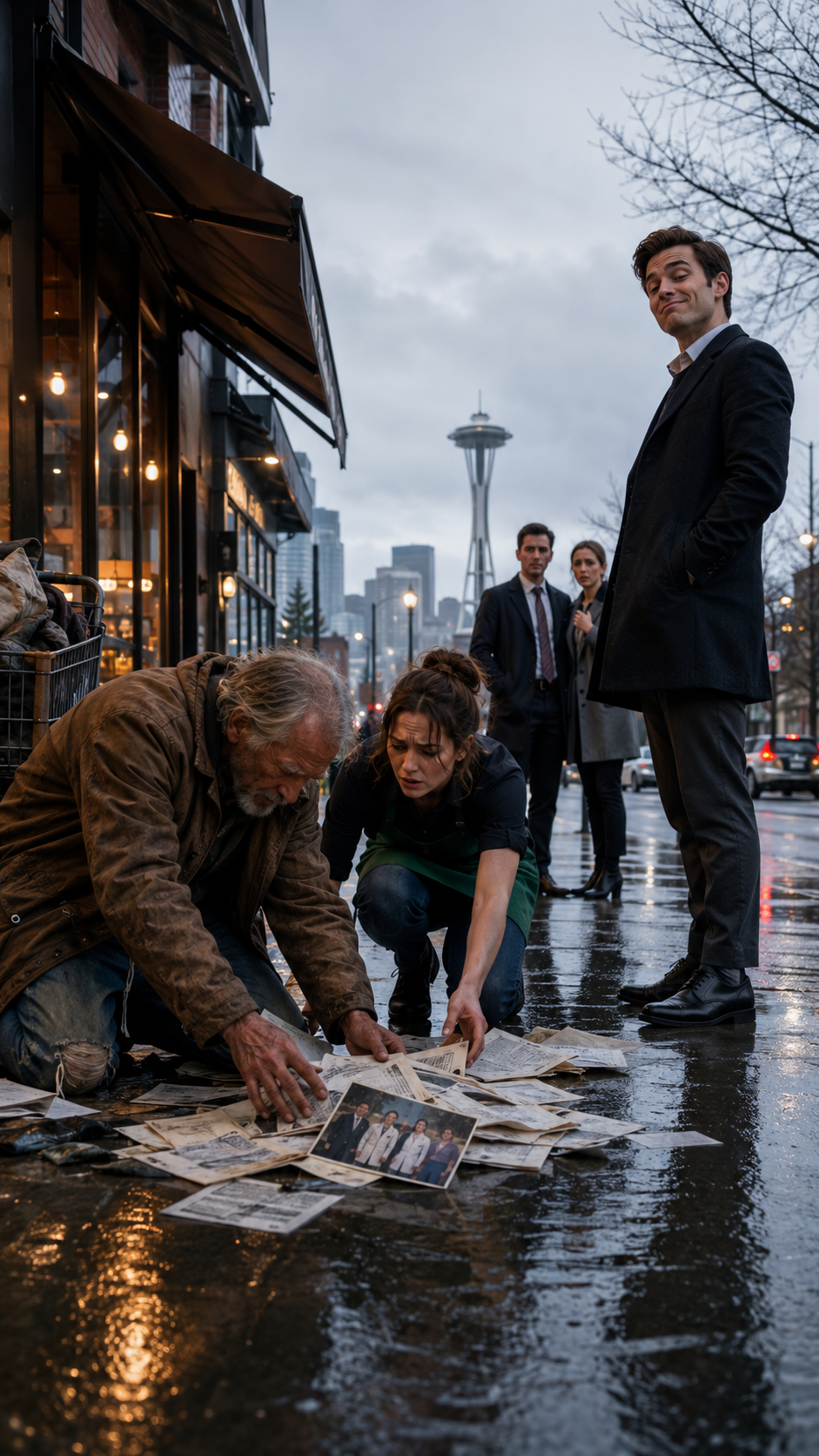
Every morning, a man named Thomas stood outside the same coffee shop in downtown Seattle. He wore an old brown coat, faded jeans, and shoes held together with strips of black tape. Beside him was a small shopping cart filled with blankets, empty bottles, and a worn backpack.
Most people walked past without looking at him.
Some dropped loose change into the paper cup near his feet.
Others moved away as if hardship were contagious.
But a group of young office workers noticed him every morning.
They worked in the glass building across the street and often stopped at the coffee shop before work.
One of them, Brian, enjoyed making jokes about Thomas.
“There’s the mayor of the sidewalk,” he said one morning.
His coworkers laughed.
Another day, Thomas was quietly reading a newspaper someone had left behind.
Brian pointed toward him.
“Look at that. He’s checking the stock market.”
The group laughed again.
Thomas heard them.
But he never answered.
He simply folded the newspaper, placed it inside his cart, and looked away.
A young barista named Lily watched this happen almost every day.
Sometimes she brought Thomas a cup of coffee after her shift began.
Other times, she gave him a sandwich that had not sold the day before.
Brian noticed.
“You know he’ll keep coming back if you feed him,” he told her.
Lily looked at him.
“He comes back because he has nowhere else to go.”
Brian shrugged.
“Everyone has problems. Some people just make better choices.”
Thomas lowered his head.
Lily saw his hand tighten around the coffee cup.
She wanted to say more, but customers were waiting.
One cold Monday morning, rain poured across the city.
Thomas stood beneath the shop’s narrow awning, trying to protect his belongings with a plastic sheet.
Brian and his coworkers arrived wearing expensive coats.
As Brian stepped around the cart, his shoe landed in a puddle.
Dirty water splashed across his trousers.
He stared at Thomas.
“Seriously?”
Thomas looked confused.
“I’m sorry. I didn’t—”
Brian kicked the wheel of the shopping cart.
The plastic sheet slipped, and several papers fell into the rain.
His coworkers laughed nervously.
Brian pointed at the mess.
“Maybe keep your garbage out of people’s way.”
Thomas immediately knelt to collect the wet pages.
Lily rushed outside.
“That was unnecessary,” she said.
Brian looked at her.
“I didn’t touch him.”
“You didn’t have to.”
She helped Thomas gather the papers.
One page was an old photograph.
It showed Thomas many years earlier, standing in front of a hospital wearing a white coat.
Beside him were doctors and nurses.
Brian glanced at it and laughed.
“What is that? Your Halloween costume?”
Thomas took the photograph from Lily’s hand.
For the first time, he looked directly at Brian.
“I was a surgeon.”
The laughter stopped for a second.
Then Brian smiled.
“Of course you were.”
He turned toward his coworkers.
“And I used to be president.”
They walked inside, still laughing.
Lily remained beside Thomas.
“Were you really a doctor?” she asked softly.
Thomas stared at the photograph.
“For twenty-six years.”
“What happened?”
He was silent for a long time.
Then he folded the wet picture carefully.
“My wife became ill.”
Lily waited.
Thomas continued:
“She had cancer. The treatments were expensive, even with insurance. I stopped working to care for her.”
He looked toward the street.
“I sold our house. Then the car. Then everything else.”
“I’m sorry.”
“She died anyway.”
His voice did not break.
That somehow made the words even more painful.
“After she died, I couldn’t return to the hospital. I started drinking. I missed payments. I lost my medical license.”
Thomas placed the photograph back inside his coat.
“I did not lose my life in one day. I lost it one piece at a time.”
Lily felt tears fill her eyes.
“Does anyone in your family know where you are?”
“My daughter lives in Oregon. She tried to help me. But I was ashamed.”
Thomas gave a faint smile.
“Pride can keep a person homeless longer than poverty.”
Over the next several weeks, Lily began helping him in small ways.
She found the address of a local shelter that helped former medical professionals struggling with addiction and homelessness.
She helped Thomas replace his identification.
She gave him access to a phone so he could call his daughter.
At first, he refused.
Then one afternoon, he finally dialed the number.
His daughter answered after the second ring.
Thomas could not speak.
He only whispered:
“Emily?”
There was silence on the other end.
Then a woman began crying.
“Dad?”
Thomas covered his face.
Lily quietly walked away and gave him privacy.
Meanwhile, Brian continued making jokes.
When Thomas disappeared from the coffee shop for several weeks, Brian asked:
“What happened to your sidewalk doctor?”
Lily replied:
“He entered a recovery program.”
Brian laughed.
“So he finally found someone who believed his story?”
“I believed him because I listened.”
Brian rolled his eyes and walked away.
Three months later, Brian’s life changed.
His father suffered a heart attack during a family dinner.
Brian called an ambulance, but the hospital was overwhelmed.
The surgery was complicated.
A senior cardiothoracic specialist was asked to review the case.
When the doctor entered the consultation room, a man was walking beside her.
He wore clean clothes now.
His gray hair had been cut.
His face still looked tired, but his posture was straight.
Brian recognized him immediately.
It was Thomas.
Brian stared in disbelief.
Thomas was not practicing medicine again.
But through the recovery program, he had begun volunteering as a patient advocate and medical consultant.
The surgeon explained:
“Mr. Thomas Reed reviewed your father’s surgical history. He noticed a complication from an earlier procedure that was missing from the current records.”
She placed a scan on the screen.
“Because he identified it, we were able to change the surgical plan.”
Brian’s mouth went dry.
“Will my father be alright?”
“We believe he has a much better chance now.”
The doctor left to prepare for surgery.
Brian and Thomas stood alone in the hallway.
Brian could barely meet his eyes.
“You really were a surgeon.”
Thomas nodded.
Brian looked down.
“I said terrible things to you.”
“Yes.”
“I didn’t know.”
Thomas studied him quietly.
“That was the problem.”
Brian swallowed.
“I judged you before I knew anything about you.”
“You laughed because you thought my suffering made you better than me.”
Brian’s eyes filled with shame.
“I’m sorry.”
Thomas looked through the glass doors toward the operating rooms.
“I hope your father survives.”
Brian nodded slowly.
“Why would you help us after the way I treated you?”
Thomas answered without anger:
“Because your father did not humiliate me.”
The surgery was successful.
Brian’s father survived and began recovering.
Afterward, Brian visited the coffee shop and asked Lily where Thomas was staying.
He went to the recovery center carrying a new coat, shoes, and an envelope of money.
Thomas accepted the coat and shoes.
But he returned the envelope.
“I don’t want payment.”
“Then tell me what I can do.”
Thomas thought for a moment.
“The next time you see someone struggling, do not ask what they did to deserve it.”
He looked directly at Brian.
“Ask what happened to them.”
Brian never forgot those words.
He began volunteering at the same shelter.
At first, some people thought he was only trying to ease his guilt.
Maybe he was.
But guilt can become something useful when it teaches a person to change.
Months later, Thomas moved into a small apartment near his daughter.
He could not return to surgery, but he began teaching basic health workshops at shelters and helping homeless patients understand their medical care.
He had lost his home.
His career.
His wife.
And many years of his life.
But he had not lost his dignity.
People do not always become homeless because they are lazy.
They do not always struggle because they made one bad choice.
Sometimes grief destroys what success took decades to build.
Sometimes illness empties a family’s savings.
Sometimes one accident, one divorce, or one lost job is enough to push an ordinary person over the edge.
Never laugh at someone because they are going through a difficult season.
You may be seeing only the worst chapter of a life that once looked very different.
And one day, you may discover that the person you treated as worthless still had something valuable enough to save someone you love.