A mother of seven is accused of stabbing three of her own children to death and setting her family home on fire in a horrifying attack that has left a Georgia community reeling. Darlene Brister, 40, now faces three consecutive life sentences after pleading guilty to the murders of her 9-month-old, 3-year-old, and 5-year-old children in Paulding County in June 2022.
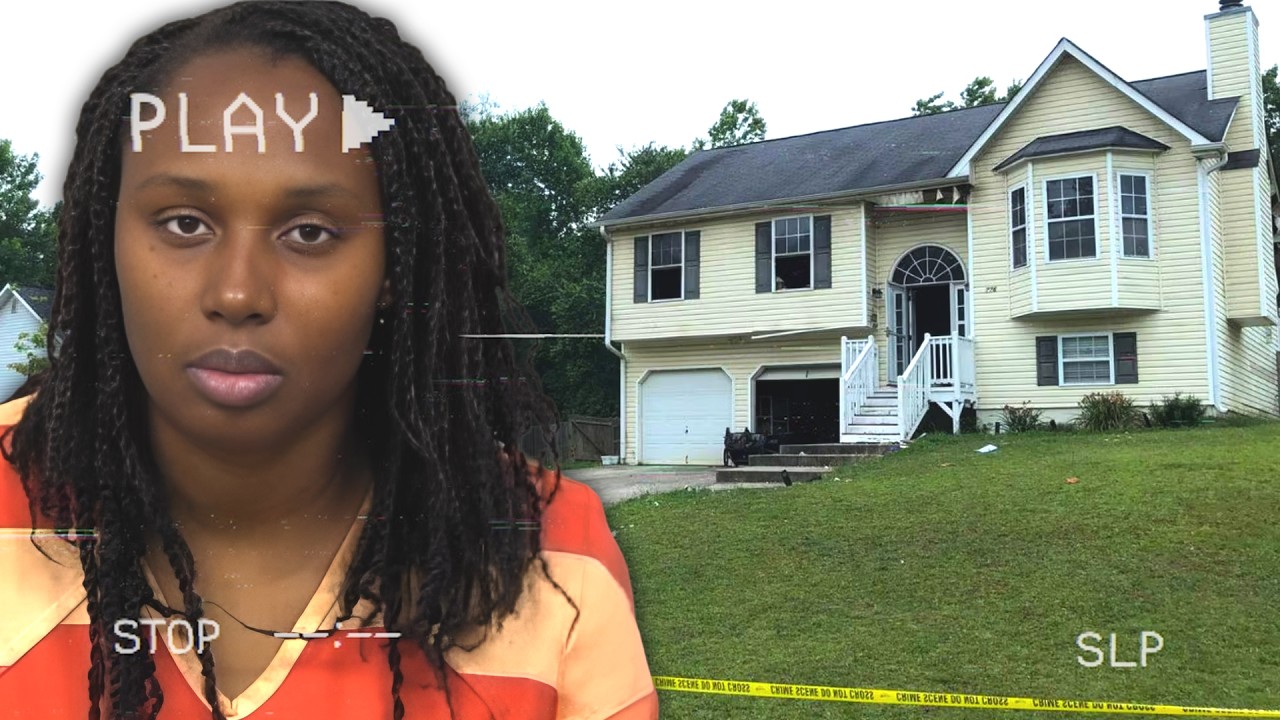
Fire crews rushed to the Brister home on Woodwind Drive just before 9:30 p. m. on June 24 after neighbors reported flames and a disturbance.
Inside, they discovered a scene far more gruesome than the blaze itself. Three children were pronounced dead at the scene, and two more were rushed to the hospital with critical injuries. One of those children, the 5-year-old, later died.
The remaining three children survived by jumping from a second-story window.
Authorities quickly determined that the three youngest victims did not die from the fire. They had been stabbed. The suspect was not a stranger or an intruder.
It was their own mother, Darlene Brister, who was found on the property and taken into custody without incident.
Investigators learned that Brister had allegedly given sleeping pills to her children earlier that day in an attempt to sedate them before setting the fire. One surviving child told a forensic interviewer that her mother gave them blue pills, saying, “She tried to put us to sleep so we wouldn’t know if she was going to leave the house and burn us.” Another child recalled their mother smiling and acting strangely as she poured gasoline on the floors and into vents.
The surviving children described a night of terror. One girl said she smelled smoke and then broke a window to escape, jumping to the ground as flames erupted. Another child told investigators that their mother had a knife and had threatened the baby.
“She pulled it out on the baby,” the child said, describing hearing the infant crying and then screaming.
Neighbors reported that tensions had been building for months. One neighbor recalled seeing the father, Ricky Brister, packing his belongings and throwing a baby car seat onto the driveway just days before the attack. Another neighbor said police had been called to the home months earlier after Darlene threatened her family with a knife.
She was taken for evaluation but returned shortly afterward.
 Ricky Brister, who was not home at the time of the murders, told investigators that his wife had been diagnosed with major depression and postpartum depression after the birth of their seventh child. He said she had stopped taking her medication and that he had been trying to get her help. “It was good for a while until like just recently,” he said.
“She got diagnosed with that but she had also postpartum depression.”
Despite the horror, Ricky Brister publicly stated that he still loved his wife and that he believed the killings were the result of a mental health crisis. “I know it was a mental health situation,” he told a local news station. “There is no hate toward her.”
He said he had already forgiven her.
Other family members painted a darker picture of the couple’s relationship. Darlene’s sister-in-law described Ricky as a controlling narcissist and said the children were kept in a highly restrictive environment, homeschooled and isolated. She noted that all the children had speech delays and that the family lived on government assistance.
“She was a good mother,” the sister-in-law said, but added that the situation was unsustainable.
Darlene Brister initially faced three counts of malice murder, three counts of felony murder, two counts of aggravated assault, arson, and seven counts of cruelty to children. Prosecutors announced they would seek the death penalty, calling the crimes “heinous.” But in February 2024, Brister accepted a plea deal, receiving three consecutive life sentences without the possibility of parole.
She is now incarcerated at the Pulaski State Prison in Hawkinsville, Georgia. The surviving four children were taken into state custody. Their current whereabouts and condition remain largely private, though authorities have said they are receiving mental health support.
The case has raised urgent questions about the warning signs that were missed. Neighbors, relatives, and even Ricky Brister himself acknowledged that Darlene’s mental health had sharply deteriorated, especially after the birth of her youngest child. But despite multiple interactions with law enforcement and mental health services, the system failed to prevent the tragedy.

In the aftermath, the community has struggled to comprehend how a mother could harm her own children in such a brutal way. The children’s grandmother, Vicki Brister, expressed deep regret, saying, “Maybe I made a mistake not bringing them with me when I came home.” She described how one grandchild told her that Darlene had given everyone sleeping pills that morning and then poured gasoline around the house.
One of the surviving children, identified in interviews as FB, told investigators that their mother had previously threatened to kill the entire family, including her husband and a friend. “She said she’s going to kill all of us including her friend too,” the child said. Another child said they did not always feel safe.
“Not all the time,” they admitted when asked if they felt safe around their mother.
The forensic interviews with the children revealed a chilling level of premeditation. The girls described being told to stay in their room while their mother carried out the attack. “She kept telling us to stay in the room because she didn’t know if she wanted to get burned by the fire,” one child said.
Another child recalled hearing the baby scream after their mother pulled out a knife.
The fire itself was set using gasoline that Darlene had poured in multiple rooms, including the boys’ bedroom and the girls’ room. She then ignited the fuel, but the fire did not spread as quickly as she apparently intended. The surviving children were able to escape through a window because they had not taken the sleeping pills, unlike their younger siblings who were sedated.
Detectives determined that the three youngest victims were stabbed before the fire was set. The 5-year-old, the 3-year-old, and the 9-month-old died from stab wounds, not smoke inhalation. The 9-month-old was reportedly stabbed in his crib.
 The case has reignited discussions about postpartum psychosis and the shortage of accessible mental health care for mothers. Experts say that while rare, severe postpartum depression can escalate into psychosis, leading to violent behavior. But in this instance, the warning signs were present for months, and yet no intervention stopped the tragedy.
Ricky Brister told investigators that his wife had stopped taking her medication and that he had tried to get her into counseling. He said they argued frequently, but he never believed she would harm the children. “She would not take her medicine,” he said, adding that he didn’t know how to handle the situation.
Neighbors said they heard bickering but never physical violence. One neighbor said, “It was good for a while until like just recently.” Another neighbor believed Darlene had suffered a mental breakdown.
“It was a complete turnaround,” they said. “She was like insane.”
The prosecution’s decision to seek the death penalty was controversial, given the mental health evidence. But District Attorney Matthew Rollins said the crimes were so severe that the ultimate punishment was warranted. The plea deal that resulted in life without parole came after negotiations that spared the surviving children the trauma of a trial.
Now, Darlene Brister will spend the rest of her life in prison. Her surviving children must learn to live with the memory of that night and the loss of three siblings. The community of Paulding County remains haunted by the question that no one can fully answer: How could a mother do this to her children?
The case serves as a stark reminder of the fragility of mental health and the devastating consequences when help arrives too late. As one family member said, “I would have come down here and gotten her and took her to the hospital myself, but I really feel like she was having a psychotic break. I don’t think she meant to survive.”
But three innocent children did not survive, and the scars of that night will never fully heal.