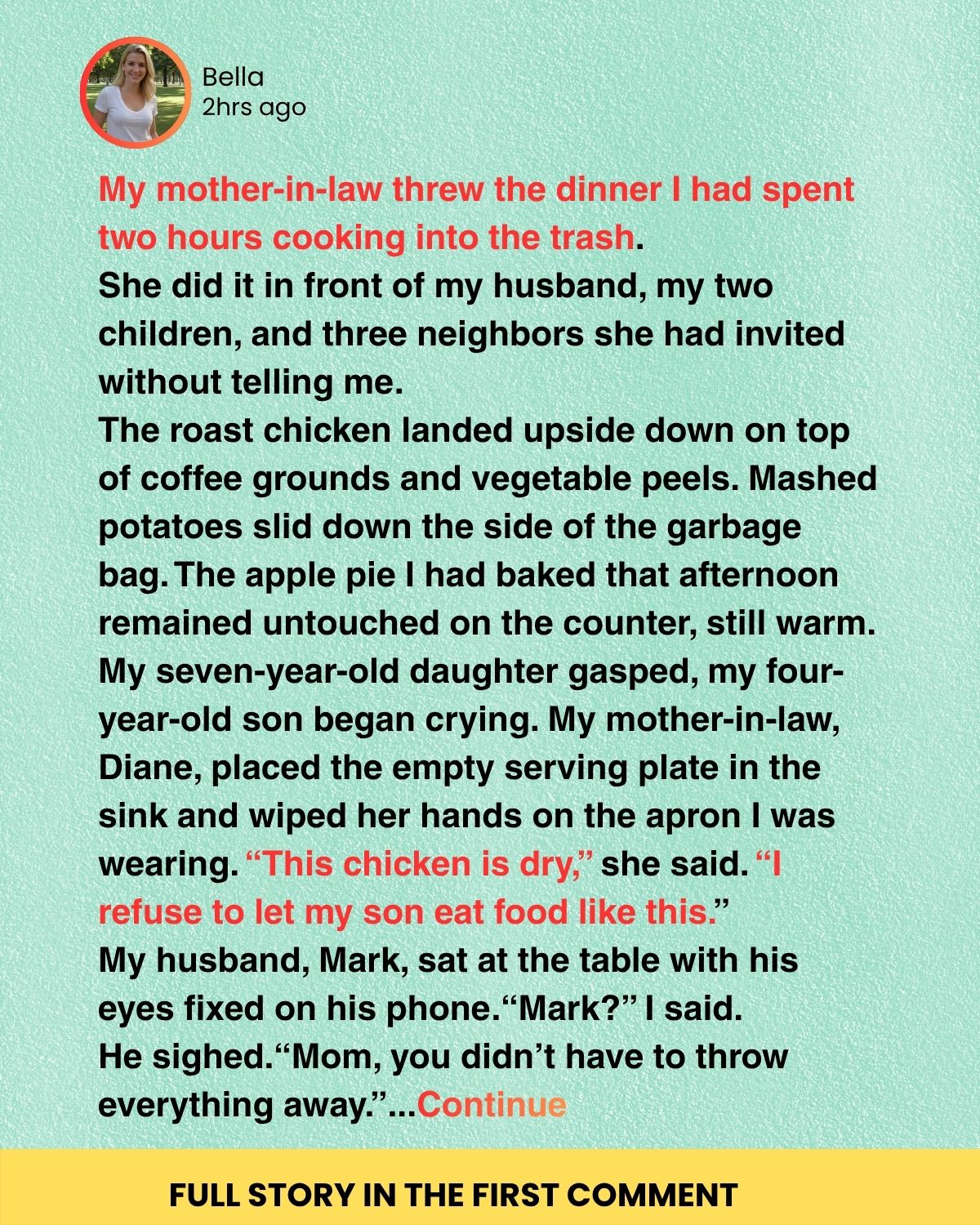
My mother-in-law threw the dinner I had spent two hours cooking into the trash.She did it in front of my husband, my two children, and three neighbors she had invited without telling me.
The roast chicken landed upside down on top of coffee grounds and vegetable peels. Mashed potatoes slid down the side of the garbage bag. The apple pie I had baked that afternoon remained untouched on the counter, still warm.
My seven-year-old daughter gasped.
My four-year-old son began crying.
My mother-in-law, Diane, placed the empty serving plate in the sink and wiped her hands on the apron I was wearing.
“This chicken is dry,” she said. “I refuse to let my son eat food like this.”
I stared at the garbage can.
It was the end of the month. The chicken had been the last meat in our refrigerator.
My husband, Mark, sat at the table with his eyes fixed on his phone.
“Mark?” I said.
He sighed.
“Mom, you didn’t have to throw everything away.”
Diane gave him a wounded look.
“I was trying to protect your stomach.”
One of the neighbors laughed awkwardly.
I looked at my husband again.
He did not defend me.
He did not ask his mother to apologize.
He only said:
“Sarah, just make some sandwiches.”
Something inside me cracked.
Not because of the chicken.
Because I had spent eleven years being told that every humiliation was too small to matter.
Diane criticizing my clothes was “just her personality.”
Diane entering our bedroom without knocking was “because she worried.”
Diane opening our mail was “because she was helping.”
Diane calling me lazy in front of my children was “just a joke.”
Each incident was too small to justify a fight.
Together, they had become my entire life.
I removed my apron.
“There is no sandwich bread.”
Diane opened the refrigerator.
“Then what do you do all day?”
The room fell silent.
My daughter, Lily, looked at me.
She had heard that question before.
I had left my job as a dental assistant after our son, Noah, was born with severe asthma. Childcare cost almost as much as I earned, and Mark’s work schedule changed every week.
We decided I would stay home temporarily.
Four years later, “temporarily” had become the reason his mother believed I had no value.
“I take care of your grandchildren,” I said.
Diane closed the refrigerator door.
“Watching your own children is not a career.”
“No. It’s just the work that makes your son’s career possible.”
Mark finally looked up.
“Can we not do this in front of everyone?”
Diane nodded toward the trash.
“She served bad food to guests.”
“They were your guests,” I said. “You invited them without asking.”
“It’s my son’s house.”
The words hit harder than I expected.
Our names were both on the mortgage.
At least, I believed they were.
I looked at Mark.
“Is that how you see it?”
He rubbed his forehead.
“Sarah, please don’t turn this into something bigger.”
Diane smiled.
That smile told me she had won again.
I picked up my purse.
“Kids, get your shoes.”
Mark stood.
“Where are you going?”
“My sister’s.”
“Over dinner?”
“No.”
I looked at the woman standing beside our garbage can.
“Over eleven years.”
THE HOUSEGUEST WHO NEVER LEFT
Diane moved into our home eight months earlier after telling us the rent on her apartment had become too expensive.
She promised it would be for six weeks.
“Just until I find somewhere smaller,” she said.
I cleaned the spare room, emptied half the closet, and bought new sheets with money from our grocery budget.
Diane arrived with fourteen boxes and a moving truck.
By the second week, she had rearranged the kitchen.
By the third, she had removed my photographs from the living room and replaced them with pictures of Mark as a child.
By the fourth, she began referring to our house as “home” and asking me when I planned to find work.
Every morning, she sat at the kitchen table while I prepared breakfast, packed lunches, found missing shoes, checked inhalers, and signed school forms.
“You spoil them,” she would say.
Then she secretly gave the children candy before dinner.
When they became restless, she blamed my parenting.
She complained that the laundry smelled wrong, the bathroom was never clean enough, and I spent too much money.
Yet she used expensive shampoo, demanded a different brand of coffee, and left every light in the house on.
If I asked for help, she pressed one hand against her back.
“At my age?”
Diane was fifty-nine.
She attended dance classes twice a week and spent Saturday mornings shopping.
But when a dish needed washing, she became elderly.
Mark always asked me to be patient.
“She raised me alone.”
“I know.”
“She sacrificed everything.”
“I know.”
“She has nowhere else.”
“Then help her find somewhere.”
His face would close.
“You just don’t want her here.”
He was right.
But he said it as though wanting privacy in my own home made me cruel.
Diane understood exactly how to use his childhood guilt.
Mark’s father left when he was six. Diane worked two jobs and reminded him of it whenever he resisted her.
“I gave up my youth for you,” she would say.
The sentence turned every boundary into ingratitude.
THE ENVELOPE
The morning after the ruined dinner, I returned home while Mark was at work and Diane was at the salon.
My sister, Emily, came with me.
I intended to pack clothes for the children and myself.
Instead, I found a bank envelope beneath a pile of magazines in the living room.
It was addressed to Mark.
The statement showed a savings account containing $18,400.
I had never seen the account before.
Our joint savings had less than six hundred dollars.
I looked at the deposits.
Eight hundred dollars each month.
Sometimes one thousand.
The money came from Mark’s paycheck before the remainder entered our joint account.
“What is that?” Emily asked.
“I don’t know.”
But I did.
For nearly two years, Mark had told me we could not afford preschool for Noah.
We could not repair the leaking bathroom.
We could not replace my ten-year-old car.
We could not visit my parents for Christmas because plane tickets were too expensive.
Meanwhile, he had hidden more than eighteen thousand dollars.
Then I saw the most recent withdrawal.
Twelve thousand dollars.
The transaction had occurred three days earlier.
I photographed every page.
When Mark came home, I was waiting at the kitchen table.
Diane entered behind him carrying shopping bags.
She stopped when she saw the envelope.
Mark’s face changed.
“Where did you get that?”
“It was under the magazines.”
“You went through my mail?”
I almost laughed.
“That is your first concern?”
Diane placed the bags on the counter.
“Private financial documents are none of your business.”
“I am his wife.”
“You don’t contribute to the account.”
I turned toward Mark.
“Where did the twelve thousand dollars go?”
He removed his jacket slowly.
“Mom needed help.”
Diane lifted her chin.
“For what?”
“She found a condo.”
The room became quiet.
The woman who had spent eight months telling us she could not afford rent had used our hidden savings for a down payment.
“Our savings,” I said.
“My savings,” Mark replied.
I stared at him.
“We agreed I would stay home because childcare cost too much.”
“That doesn’t mean every dollar I earn belongs to you.”
“Who takes care of the children while you earn it?”
“Sarah—”
“Who cooks? Who cleans? Who takes Noah to appointments? Who stays awake when he can’t breathe? Who makes sure you can leave at six in the morning without wondering what happens here?”
Diane stepped forward.
“You live for free in a house my son pays for.”
“I helped pay the mortgage for seven years before leaving work.”
“And now?”
“Now I work here.”
She laughed.
“No one pays you because it isn’t real work.”
Lily stood in the hallway.
I had not heard her come downstairs.
“Grandma,” she said, “Mom works all day.”
Diane’s face softened immediately.
“Sweetheart, adults are talking.”
“You make her cry.”
Mark closed his eyes.
“Lily, go to your room.”
She looked at him.
“Why don’t you make Grandma stop?”
No one answered.
My daughter had asked the question I had been asking for years.
She simply used fewer words.
THE OTHER ACCOUNT
Mark promised we would discuss everything after the children went to sleep.
We never did.
At ten that evening, I found him transferring money on his laptop.
When he saw me, he closed the screen.
“What are you doing?”
“Paying bills.”
“Show me.”
His expression hardened.
“I’m tired of being treated like a criminal.”
“I found a secret account and a twelve-thousand-dollar payment to your mother.”
“She is paying it back.”
“With what money?”
“She’ll sell some jewelry.”
Diane owned no jewelry worth twelve thousand dollars.
I held out my hand.
“Show me the account.”
“No.”
One word.
No apology.
No explanation.
Only no.
I realized then that Diane was not the entire problem.
She was simply the person saying aloud what Mark already believed.
He earned the money.
Therefore, he controlled the family.
My work counted only when it made his life easier.
I walked away.
The next morning, I met with a family-law attorney.
I did not intend to file for divorce immediately.
I wanted to understand whether I truly had nothing.
The attorney, Janet Moore, listened without interrupting.
Then she asked:
“Whose name is on the deed?”
“Both of ours, I think.”
“You think?”
“Mark handled the refinancing.”
“When?”
“Last year.”
“Did you sign anything?”
“He brought papers home. He said the bank needed them.”
Her expression changed.
“What did you sign?”
“I don’t remember.”
She ordered a copy of the property records.
The result arrived that afternoon.
My name was no longer on the deed.
During the refinancing, I had signed a quitclaim document transferring my ownership interest to Mark.
He told me the papers lowered our interest rate.
I had signed while helping Noah with a breathing treatment.
“Can he do that?” I asked.
“You signed it.”
“He lied.”
“That matters, but proving fraud takes evidence.”
I felt sick.
First the savings.
Then the house.
My husband had not merely failed to defend me.
He had quietly removed me from the life we built together.
THE NOTEBOOK
That evening, I began documenting everything.
Every insult.
Every bank statement.
Every bill.
Every day Diane refused to help but claimed I did nothing.
I also calculated the market cost of my unpaid work.
Full-time childcare for two children.
Housekeeping.
Cooking.
Transportation.
Medical coordination.
After-school care.
The total exceeded Mark’s salary.
The number did not suddenly make my work more meaningful.
It proved how expensive it would be to replace me.
I opened a bank account in my name.
My sister gave me two hundred dollars to deposit.
I sold unused baby equipment online.
I began making cakes for neighbors after the children went to sleep.
At first, I earned forty dollars a week.
Then eighty.
Then one hundred and fifty.
Diane mocked the orders.
“You’re turning the kitchen into a bakery.”
Mark complained about the electricity.
But when a local café asked me to provide twelve cakes every weekend, I said yes.
I hid every dollar legally and carefully, with my attorney’s guidance.
Not because I wanted revenge.
Because I needed options.
A woman without money is often told to leave situations she cannot afford to escape.
I would not announce my plan before I could carry it out.
THE SCHOOL FUNDRAISER
Three months later, Lily’s school held a fundraising dinner.
Parents donated food, crafts, and services.
I provided desserts.
The principal placed my cakes on a long table beneath a sign reading:
SARAH’S HOME BAKERY
It was the first time my name had appeared above work I created.
The cakes sold out within forty minutes.
A woman who owned two coffee shops asked whether I could supply both locations.
I felt something I had not felt in years.
Pride.
Then Diane arrived.
She stood beside Mark wearing the new coat she had purchased after receiving our twelve thousand dollars.
She looked at the empty cake table.
“You charged people for homemade food?”
“The money went to the school.”
“How much did you spend on ingredients?”
“I donated them.”
“From Mark’s grocery money?”
Several parents turned toward us.
I kept my voice calm.
“From my business account.”
Diane blinked.
“What business account?”
Mark looked at me.
“You have a separate bank account?”
“Yes.”
“Why?”
“The same reason you do.”
His face reddened.
“That is different.”
A woman beside us slowly lowered her coffee cup.
Diane smiled at the watching parents.
“Sarah becomes secretive when she’s emotional.”
I looked around the school cafeteria.
For years, she had relied on my shame.
She could say anything because I would become embarrassed and leave.
Not this time.
“Diane used twelve thousand dollars from our family savings to buy herself a condo,” I said.
Her smile disappeared.
Mark grabbed my arm.
“Not here.”
I pulled away.
“She calls me lazy while using money I helped make possible.”
“Sarah.”
“She threw food in the trash in front of my children because she believed humiliating me would remind me who had power.”
The principal stepped closer.
“Is everything all right?”
Diane pointed at me.
“You see how unstable she becomes?”
Lily appeared beside the dessert table.
“No, Grandma. Mom is telling the truth.”
Diane turned.
“Stay out of this.”
My daughter’s shoulders tightened.
Then Noah, only four, shouted:
“You threw the chicken away!”
Several parents looked at Diane.
Children are terrible at protecting family lies.
That is one reason controlling adults call them disrespectful when they tell the truth.
Diane walked out.
Mark followed her.
He did not ask me to come.
That night, he sent a message:
You embarrassed my mother. Stay at Emily’s until you can apologize.
I read it twice.
Then I forwarded it to my attorney.
THE LOCKS
The next morning, I went home to collect the children’s medication.
My key no longer worked.
Mark had changed the locks.
Diane watched from the living-room window.
I called the police.
Mark arrived before the officers.
He claimed I had voluntarily left the home and become aggressive at a school event.
My name was no longer on the deed.
He believed that meant he could exclude me.
The officer looked uncomfortable.
“This is a civil matter.”
Then Lily appeared behind the window.
She was crying and holding Noah’s inhaler.
“Mom!”
I moved toward the door.
Diane pulled her back.
The officer’s expression changed.
“Are those her children?”
“Yes.”
“Is there a custody order?”
“No.”
“Then you cannot prevent their mother from accessing them.”
Mark unlocked the door.
Inside, Diane stood with her arms folded.
“You brought police to your own home.”
“No. Your son changed the locks while keeping my children inside.”
Mark looked at the officers.
“She’s twisting everything.”
The sentence no longer frightened me.
I had records.
Photographs.
Bank statements.
Messages.
Witnesses.
And, most importantly, I had stopped trying to make the truth sound comfortable.
I packed the children’s clothes and medication.
Mark followed me upstairs.
“You’re taking them?”
“Yes.”
“You can’t.”
“Watch me leave. Then call your lawyer.”
His face changed.
He had never seen me speak to him that way.
For years, I approached every conflict hoping to preserve our marriage.
He approached every conflict knowing I would.
The difference had given him power.
Not anymore.
THE COURTROOM
Mark requested temporary full custody.
He claimed I had no stable employment, no permanent home, and a history of emotional outbursts.
Diane submitted a written statement describing me as lazy, disorganized, and hostile.
She claimed she had moved in because the children were being neglected.
My attorney asked for evidence.
There was none.
School records showed perfect attendance.
Medical records showed I attended every appointment.
Teachers described the children as clean, prepared, and closely bonded with me.
Then Janet submitted Mark’s financial records.
The secret account.
The transfer to Diane.
The refinanced mortgage.
Messages in which Mark told his mother:
Once Sarah is off the deed, she’ll stop acting like half the house is hers.
Another message read:
She won’t leave. She has no money.
I stared at those words in court.
They hurt more than the secret account.
My husband had not assumed I loved him too much to leave.
He assumed I was too financially trapped.
Diane took the witness stand.
She told the judge I contributed nothing.
Janet asked:
“Who cared for the children while your son worked?”
“Sarah.”
“Who prepared meals?”
“Sarah.”
“Who cleaned the home?”
“Usually Sarah.”
“Who handled school transportation and medical appointments?”
“Sarah.”
“Did your son pay her a salary?”
“Of course not. She is his wife.”
Janet nodded.
“So Mrs. Miller contributed nothing except childcare, cooking, cleaning, transportation, education support, and medical care?”
Diane realized the trap too late.
“That’s what mothers do.”
“Yes,” Janet replied. “It is work mothers do.”
The judge granted me temporary primary custody and exclusive use of the family home while the divorce proceeded.
Mark stared at me.
Diane whispered something furiously to his attorney.
For the first time since moving in, she was the person required to leave.
THE KITCHEN
I returned to the house with the children two days later.
Diane had emptied the guest room but left the kitchen in chaos.
Cabinet doors hung open.
Food covered the counters.
A garbage bag sat beside the sink.
Inside, I found the framed family photograph she had removed from the living room months earlier.
It showed Mark, the children, and me at the beach.
Someone had scratched my face with a key.
Lily saw it.
“Did Grandma do that?”
“I don’t know.”
We both knew.
“Does she hate you?”
“She is angry because she can’t control what happens next.”
“Is that hate?”
“Sometimes people call it love because they don’t know how to love without control.”
Lily looked at the damaged photograph.
“Can we throw it away?”
“No.”
I removed the picture from the frame.
“We’ll print a new one when we’re ready.”
That evening, I cooked spaghetti.
The sauce came from a jar.
The garlic bread burned around the edges.
No one complained.
We ate at the table while Noah told a story that made no sense and Lily laughed until milk came through her nose.
It was not an impressive dinner.
It was peaceful.
Peace, I discovered, had been missing from our house long before I left.
THE DIVORCE
The court restored my financial interest in the home after determining that Mark had misrepresented the refinancing documents.
The hidden savings became marital property.
The twelve thousand dollars given to Diane was counted against Mark’s share of the settlement.
He was furious.
“That money is gone,” he told me during mediation.
“Then you should ask your mother to return it.”
“She used it for the condo.”
“That was your decision.”
“She needed a home.”
“So did I.”
Mark looked away.
For the first time, he seemed ashamed.
“I didn’t think you would actually leave.”
“I know.”
“I thought we were a family.”
“A family is not one person making decisions while another person performs the work.”
He asked whether counseling could save our marriage.
I had begged for counseling two years earlier.
He said discussing private matters with strangers would disrespect his mother.
Now that he faced losing the house, money, and daily access to the children, counseling suddenly sounded reasonable.
“I’m going,” he said. “Even if you don’t come.”
“Good.”
“Does that mean there’s a chance?”
“It means becoming better will help you remain a father.”
He began crying.
I still loved him.
That did not mean I wanted to return.
Love can survive after trust becomes unusable.
It simply has nowhere safe to live.
DIANE’S VISIT
Six months after the divorce was finalized, Diane came to my bakery.
By then, I supplied desserts to three cafés and rented a small commercial kitchen with another woman.
The sign above the entrance read:
SARAH & MAYA — HOME-STYLE BAKING
Diane entered just before closing.
She looked older.
The new condo payments were higher than expected, and Mark had stopped helping after the divorce settlement.
“I need to speak with you,” she said.
I continued wiping the counter.
“About the children?”
“About everything.”
I waited.
She looked around the kitchen.
“So this is your job now.”
“It was my job before. It simply has customers now.”
Her mouth tightened.
“I came to apologize.”
The words sounded painful for her.
I said nothing.
“I should not have thrown away the dinner.”
“No.”
“I was upset.”
“You humiliated me in front of my children.”
“I believed you were keeping Mark from succeeding.”
“I made his success possible.”
She looked down.
“I know that now.”
“Because he struggles on his own?”
Since the separation, Mark had learned how much daily life required. He missed appointments, forgot school lunches, and called me repeatedly during his parenting time.
Eventually, he reduced his overtime hours.
For the first time, caring for his own children affected his career.
Diane sat at a small table.
“My son doesn’t speak to me much.”
“That is between you and him.”
“He blames me for the divorce.”
“You did not make him hide money or remove me from the deed.”
She looked surprised.
“You’re defending him?”
“No. I’m refusing to let either of you avoid responsibility.”
Tears filled her eyes.
“I gave him everything.”
“And taught him that women prove love by giving until nothing remains.”
She wiped her cheek.
“I was alone after his father left.”
“I know.”
“No one helped me.”
“So when you saw me receiving support from your son, you believed I had not earned it.”
Her silence answered.
Diane had not hated me simply because I was lazy in her eyes.
She hated that I was allowed to stay home with my children when she had been forced to work.
She turned her pain into a standard every other woman had to suffer in order to deserve respect.
“I thought I was making you stronger,” she whispered.
“You were trying to make my life resemble yours.”
She nodded.
“I’m sorry.”
I believed she meant it.
But sincerity does not erase consequences.
“You may see the children if Mark is present and they want to see you.”
“Not alone?”
“No.”
“I’m their grandmother.”
“Yes.”
“And you don’t trust me.”
“No.”
Her face tightened, but she accepted it.
That was the first evidence her apology might become change.
ONE YEAR LATER
Mark became a more involved father after the divorce.
Not perfect.
But present.
He learned Noah’s medication schedule.
He attended parent-teacher meetings.
He stopped asking Lily to remind him of everything.
He also continued therapy.
One afternoon, while exchanging the children, he stood on the porch and said:
“I owe you an apology.”
“You’ve apologized.”
“Not for the right thing.”
I waited.
“I kept thinking Mom was the problem.”
“She was part of it.”
“But I let her treat you badly because defending you would have required disappointing her.”
He looked toward the driveway.
“And I thought earning money gave me the right to make the final decisions.”
“Yes.”
“I didn’t understand what you did all day.”
“You didn’t want to understand.”
He nodded.
“That’s true.”
There was a time when those words would have made me return.
Now they only gave me peace.
“You’re becoming a better father,” I said.
“Can I ever become your husband again?”
“No.”
His eyes closed briefly.
“Because you don’t love me?”
“Because I finally love the person I am without begging you to recognize her.”
He nodded.
Then he left.
THE NEW DINNER TABLE
Two years after Diane threw my dinner into the trash, I hosted Thanksgiving.
Not in the old house.
I sold it and bought a smaller home near the children’s school.
The kitchen was narrow, the floors squeaked, and the dining table came from a secondhand store.
My sister brought sweet potatoes.
My business partner brought pie.
Mark came for dessert after spending the morning with his parents.
Diane stood on the porch holding a covered dish.
“Green beans,” she said. “I asked Lily what everyone liked.”
I let her inside.
She no longer rearranged my kitchen.
She no longer opened cabinets without permission.
When Noah spilled juice, she reached for a towel but stopped.
“May I?”
It was a small question.
For a controlling person, asking permission can be a revolution.
During dinner, Lily described a school project about unpaid labor in families.
“My teacher said work doesn’t stop being work because no one gets a paycheck,” she announced.
Diane looked at me.
“Yes,” she said. “That is true.”
We ate the meal I had prepared.
The turkey was slightly overcooked.
No one threw it away.
Later, while washing dishes, Lily asked:
“Mom, are you a housewife?”
“I’m a mother and a baker.”
“But before the bakery?”
“I was a mother who worked at home.”
“Grandma said that wasn’t a real job.”
“She was wrong.”
Lily handed me a clean plate.
“Did you know she was wrong?”
I thought about the years I defended my worth while quietly doubting it.
“Not always.”
“What changed?”
“I stopped asking people who benefited from my work to decide whether it mattered.”
She smiled as though the answer were simple.
Perhaps, for her generation, it could be.
THE LAST PIECE
After everyone left, I found one slice of apple pie remaining.
I sat at the kitchen table and ate it alone.
Not secretly.
Not standing over the sink.
Not after serving everyone else.
I placed it on one of my best plates, made tea, and sat beneath the warm light.
Two years earlier, Diane had told me a woman who earned no money did not deserve to eat.
For a long time, I believed my greatest revenge would be building a successful business.
It was not.
Success still allowed them to measure me in money.
My real victory was understanding that I had deserved dignity before I sold a single cake.
I deserved it while packing lunches.
While scrubbing bathrooms.
While holding a sick child at three in the morning.
While stretching one chicken into two meals.
While doing work no one noticed because everything functioned when I did it well.
The bakery gave me independence.
The divorce gave me freedom.
But neither one created my value.
They only helped me stop handing other people the authority to deny it.
My mother-in-law threw my dinner in the trash because she believed I had no power in my own home.
She was right about the power.
She was wrong about where it came from.
It did not come from the paycheck.
It came from the day I finally picked up my purse, took my children’s hands, and refused to keep serving people who believed my exhaustion was proof that I belonged beneath them.

:max_bytes(150000):strip_icc():focal(999x0:1001x2):format(webp)/colts-neck-fire-tout-2000-3090394713cc4a38b48ba3651f32cf16.jpg)
:max_bytes(150000):strip_icc():focal(999x0:1001x2):format(webp)/Mackenzie-Shirilla-052026-3-56bacba1b8694af2ba0a60fc0c4a63d2.jpg)