The first bruise he left on me disappeared beneath a satin sleeve. The final one would be exposed before four hundred wedding guests.
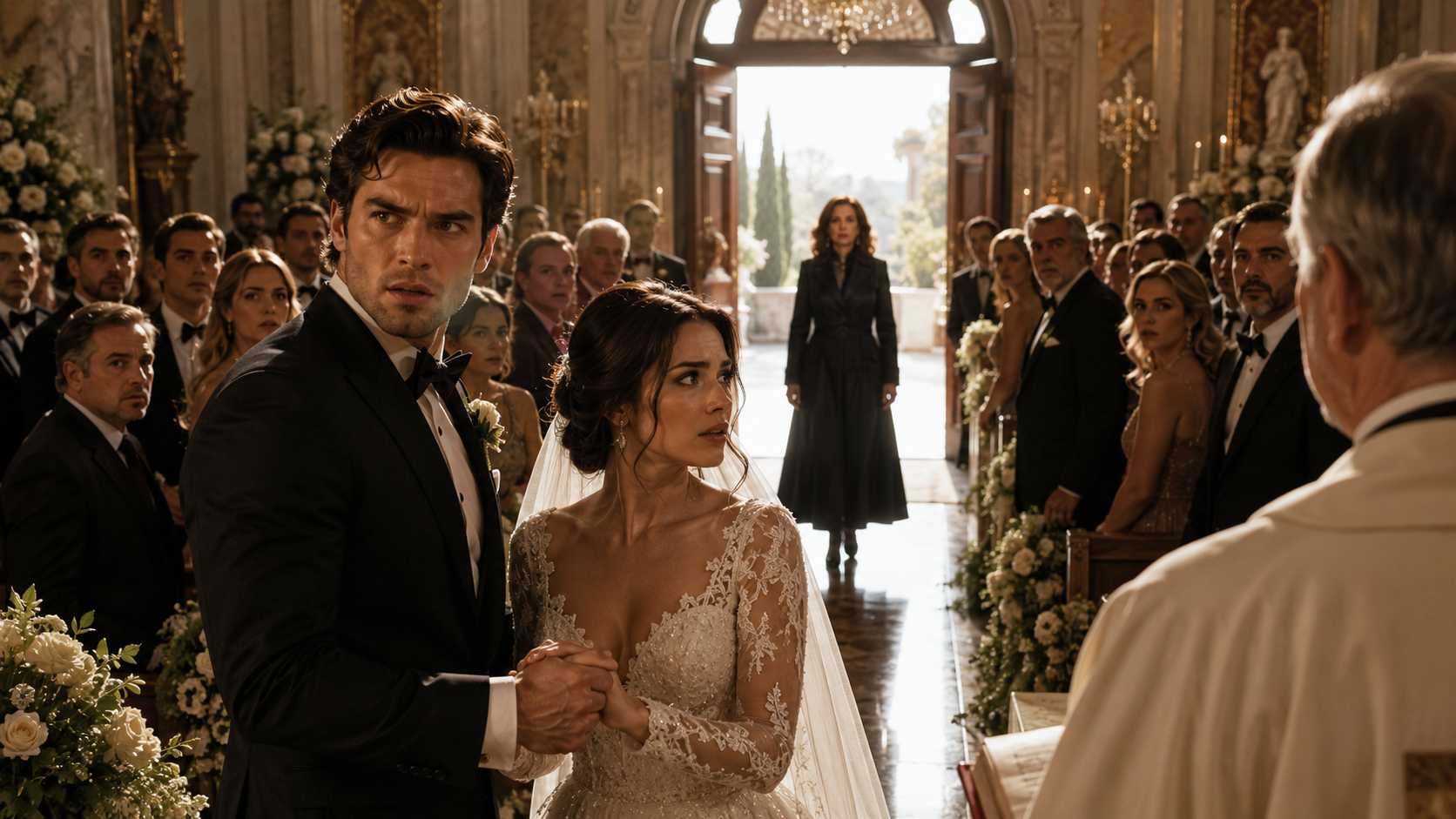
At the altar, Julian Cross tightened his grip around my hand until my rings pressed painfully into the bone. Cameras flashed from every direction. His smile never changed.
“Starting today,” he murmured, “you belong to me. Remember where you stand.”
The minister continued speaking. Julian’s mother, Victoria, sat in the front pew wearing the pleased expression of a monarch surveying territory already conquered.
I smiled.
“You wanted a wife?” I whispered. “Then meet the woman who came to testify.”
For eleven months, Julian had carefully taught everyone around us to believe I was delicate.
He criticized what I wore, tracked every call I made, decided which friends were acceptable, and arrived with diamonds after every violent outburst. When he hit me, he blamed the pressure of running a company. When he locked me overnight in the basement storage room, he called it a lesson.
“You force me to become this person,” he always said.
Victoria was even colder.
“A powerful man requires obedience in his own home,” she told me after noticing finger-shaped marks around my arm. “Do not bring shame to this family.”
They thought I remained because I was terrified.
I stayed because Julian’s empire was a sealed vault, and I needed enough time to discover where he kept the key.
Before I met him, I worked as a forensic financial analyst for a federal consulting firm. Julian told people I had once been “some minor accountant.” He never bothered asking what kinds of cases I handled, what investigative systems I knew, or why I could uncover shell-company fraud faster than most executives could read a quarterly report.
Three months after our engagement, I discovered my signature on a loan guarantee I had never authorized.
Then I found six more.
That same evening, Julian caught me examining one of his corporate statements. He laughed, kissed my forehead, and removed the document from my hands.
“Finance is no longer your concern,” he told me. “Your role is to stand beside me and look beautiful.”
I lowered my gaze so he would not see what his arrogance had just given me.
Confirmation.
Julian had borrowed heavily against Cross Atlantic Group through companies secretly registered under my name. His plan was to marry me, combine our legal interests, and leave me carrying the liability if federal regulators eventually arrived.
So I started gathering everything.
Transfers.
Private audio recordings.
Medical documentation.
Photographs.
Copies of falsified agreements.
A handwritten ledger Julian kept behind a concealed wall panel in his home office.
And one final file.
The file proving that his fortune was not merely built on corruption.
It had been stolen.
At the altar, the minister asked whether anyone present objected to the marriage.
No one answered.
Julian squeezed my hand harder.
“Good girl.”
I turned my eyes toward the side entrance.
The doors opened.
My attorney entered first.
Behind her came two detectives, a federal investigator, and a woman Julian had spent a decade pretending was dead.
She stopped halfway down the center aisle.
Julian’s face drained of color.
Victoria leaped to her feet.
“Who allowed her inside?”
Her name was Cassandra Cross.
Julian’s older sister.
And the lawful owner of the Cross family trust.
Ten years earlier, Cassandra had survived a boating accident off Martha’s Vineyard. Julian told the company’s investors that she had drowned. Victoria organized a private memorial service. No body was ever recovered, yet falsified probate filings transferred Cassandra’s controlling shares directly to Julian.
The truth was far worse.
Cassandra suffered a severe brain injury and spent almost two years in rehabilitation under an assumed name. When she recovered enough to begin asking questions, Julian’s attorneys threatened to have her permanently institutionalized.
Victoria paid a physician to declare her mentally incompetent.
Cassandra eventually fled to Europe to stay alive.
I found her because Julian made one careless payment.
Each month, one of his shell companies wired nine thousand dollars to a private clinic in Barcelona under the description “consulting services.”
I traced the recipient.
I found Cassandra.
Then I showed her the original trust records.
She stared at Julian now with tears burning in her eyes.
“You held a funeral for me without ever finding a body,” she said.
A wave of murmurs passed through the church.
Julian recovered quickly.
He always did.
“This is madness,” he announced. “Rachel has been emotionally unstable for months. She is under tremendous psychological pressure.”
Victoria pointed directly at me.
“She wants his money. That is all this has ever been about.”
Julian turned toward the guests and opened his hands like an injured prince asking for sympathy.
“My fiancée has manufactured a public spectacle on our wedding day.”
Then he leaned toward me.
“Stop this now, or you walk away with nothing.”
I stepped back.
My bridesmaids moved behind me and released the hidden fastenings of the outer wedding gown.
Beneath it, I wore a modest cream slip dress with fitted shorts.
The change revealed fading yellow bruises across my ribs, darker marks circling both upper arms, and a healing wound near my shoulder.
The church became completely silent.
I lifted the microphone.
“These injuries were examined and documented by three separate physicians over the last seven months,” I said. “The dates correspond with audio and video recordings from Julian’s residences and vehicles.”
My attorney, Olivia Grant, raised a tablet.
Julian’s recorded voice filled the church.
“No one is ever going to believe you.”
Then Victoria’s voice followed.
“Make sure those marks are covered before the charity dinner.”
A woman seated in the second row began to cry.
Julian lunged toward the tablet.
One of the detectives stepped between them.
“You cannot detain me,” Julian snapped. “Do you have any idea who I am?”
The federal investigator answered without emotion.
“Yes. That is precisely why we came.”
Several guests slowly lowered their phones.
Others lifted theirs higher.
Julian’s best man backed away as if humiliation could spread through physical contact.
Victoria’s confidence finally cracked.
“Julian, do something.”
He looked at me.
For the first time, I saw fear where rage had always been.
Even then, he believed his money could rescue him.
He did not know Cassandra and I had already secured an emergency court order freezing all activity inside the family trust.
His private banker had agreed to cooperate.
Federal agents had complete copies of every hidden ledger.
And Julian himself had created the perfect audience.
He had invited every board member, investor, lender, political donor, and journalist he hoped to impress.
He had assembled every witness to his collapse inside one building.
I gestured toward the enormous screen behind the altar.
A document appeared.
CONSOLIDATION APPROVAL
My forged signature appeared at the bottom.
“Julian intended to submit this tomorrow morning,” I said. “It would transfer three hundred twelve million dollars of corporate debt into companies legally connected to me.”
Julian shouted from the aisle.
“That is confidential business material!”
“No,” Olivia replied. “It is evidence.”
The screen changed.
Transaction records linked Julian’s companies to bribed public officials, fraudulent nonprofit organizations, and offshore accounts.
Then the original trust amendment appeared.
It named Cassandra as the controlling beneficiary.
It also permanently prohibited Julian from managing the trust after his thirtieth birthday unless Cassandra personally certified him as suitable.
She never had.
Every board vote he cast after turning thirty had been unauthorized.
Every company asset he pledged was legally vulnerable.
Every investor he deceived now had grounds for action.
Cassandra faced the congregation.
“He did not create the Cross fortune,” she said. “He stole control of it.”
The church erupted.
Board members began shouting into their phones.
Investors rushed toward the exits.
Reporters started broadcasting live from the aisles.
Julian grabbed my wrist.
His public mask vanished.
“You worthless little parasite,” he hissed. “I made you.”
I looked down at his hand.
“Remove it.”
His grip tightened.
A detective caught Julian’s arm, forced it behind his back, and placed him in handcuffs.
Victoria screamed from the front pew.
“This family owns judges!”
The federal investigator looked at her.
“That statement will be added to the report.”
Two officers approached.
“I have done nothing!” she shouted.
Cassandra’s voice remained quiet.
“You had me declared insane. You stole my legal identity. You paid people to keep me hidden.”
Victoria searched desperately through the room for support.
No one would meet her eyes.
The minister stepped away while officers placed her in restraints.
Julian struggled against the detectives, his face red and wild.
“Rachel! You are nothing without me!”
I removed the engagement ring and placed it carefully on the marble floor.
“No,” I said. “I was becoming nothing because of you.”
The detectives escorted him through the church doors beneath a shower of white rose petals.
By sunset, the board of Cross Atlantic had removed Julian from leadership.
By midnight, his lenders had frozen his accounts.
Within four weeks, prosecutors charged him with assault, financial fraud, identity theft, money laundering, coercion, and conspiracy.
Victoria was charged with fraud, intimidation of a witness, unlawful confinement, and falsification of medical records.
Their attorneys called me bitter.
The recordings spoke more clearly than I ever could.
Julian eventually pleaded guilty after his banker and three former employees agreed to testify.
He received fourteen years in federal prison, along with additional sentencing for the physical violence.
Victoria received nine.
Cassandra regained full authority over the trust.
She sold every corrupt division, reimbursed defrauded investors, and established a legal fund for survivors trapped by wealthy, influential abusers.
She asked me to direct it.
One year later, I stood in a sunlit office overlooking Seattle’s Elliott Bay.
There were no locked doors.
No one monitored my phone.
A photograph from the wedding hung on the wall.
Not a photograph of Julian.
A photograph of Cassandra walking into the church.
Olivia once asked whether I regretted transforming my wedding ceremony into a criminal investigation.
“It was never really my wedding,” I told her.
Beyond the windows, the water shimmered in the afternoon light.
I closed Julian’s final case file.
I placed it inside the archive.
Then I turned the key.
This time, I was the one who decided what remained locked away.