For generations, the popular image of early humans as brutish cavemen locked in a desperate, daily struggle for survival has been completely wrong. A radical reassessment of the archaeological and anthropological evidence now reveals that our ancestors forty thousand years ago lived lives far richer, more leisurely, and more socially complex than most modern people can imagine.
The new picture emerging from decades of research shatters the myth of prehistoric existence as a constant, brutal fight for food against saber-toothed tigers and starvation. Instead, a typical day for a Homo sapiens forty millennia ago involved only about four to six hours of what we would consider subsistence work: gathering, hunting, preparing food, and maintaining tools and shelters.
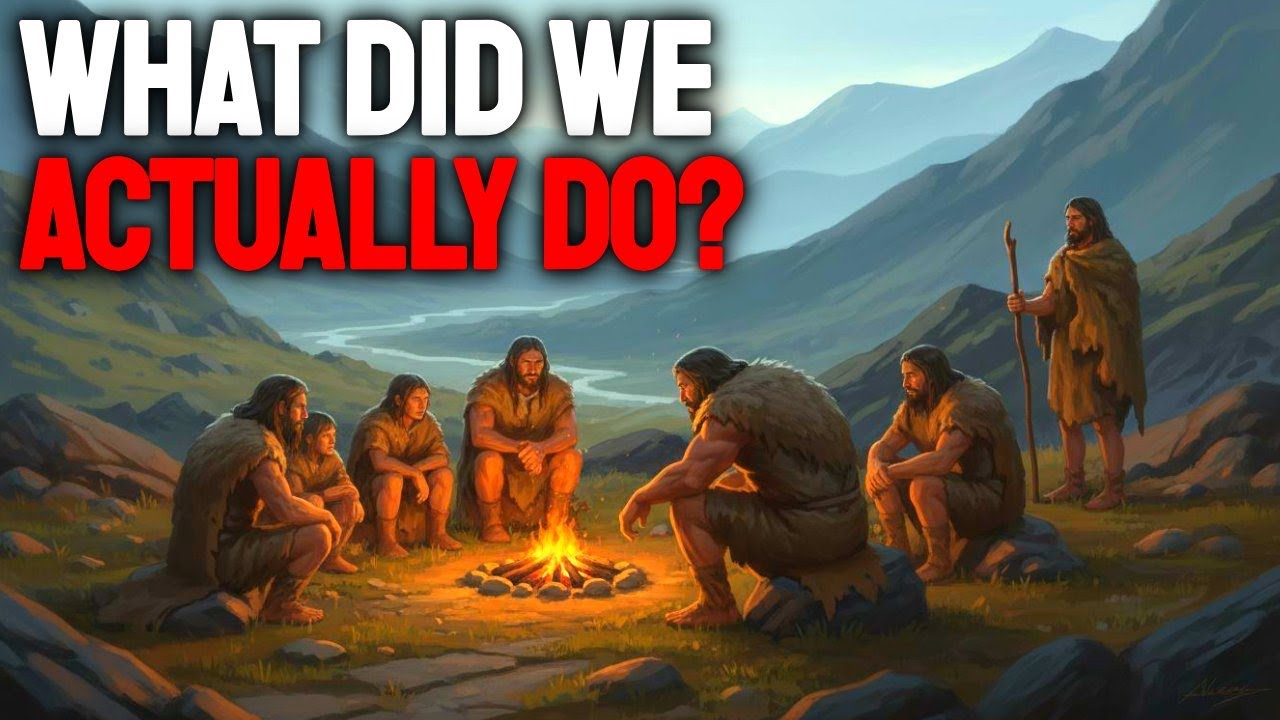 The rest of their waking hours, the evidence suggests, were spent on leisure, socializing, play, art, storytelling, and simply being together. This finding directly contradicts long-held assumptions about progress and challenges modern notions of time poverty. A prehistoric human likely enjoyed more free time in a single week than many modern workers get in an entire month.
Archaeologists now point to a wealth of data from the study of contemporary hunter-gatherer societies, which serve as the best available windows into prehistoric lifestyles. These studies consistently show that people in these societies prioritize rest, social bonding, and creative pursuits once basic needs are met. The pattern appears to be deeply rooted in human evolutionary history.
The evidence is not merely anecdotal. Analysis of fossilized feces, known as coprolites, reveals an astonishing dietary diversity, not a meat-heavy desperation. Early humans consumed a vast array of plants, roots, nuts, seeds, insects, and smaller game, not just mammoth meat.
This dietary flexibility was a key survival strategy, making them less vulnerable to the failure of any single food source.
Similarly, microscopic analysis of dental calculus, the hardened plaque on ancient teeth, shows starches from numerous wild grains, tubers, and berries. This suggests a sophisticated understanding of plant foods, including which were safe to eat after cooking and which were toxic raw. The knowledge required to process these foods, often through roasting or leaching, was passed down through generations.
The nature of hunting itself has been misunderstood. Far from a daily bloodbath, successful big-game hunts were relatively rare events, preceded by hours or even days of careful planning, tracking, and sometimes failed attempts. The most effective hunting technique, persistence hunting, required endurance, not brute strength, and was a cooperative, strategic endeavor.
Perhaps most startling is the role of women in prehistoric life. The old narrative that men exclusively hunted while women gathered is crumbling. Archaeological digs have found female skeletons buried with hunting weapons, and isotope analysis of ancient bones reveals that some women consumed diets as meat-heavy as any male hunter.
The division of labor appears to have been far more pragmatic and flexible.
Gathering, often dismissed as less important than hunting, was actually the cornerstone of survival, providing sixty to eighty percent of daily calories in many regions. It required deep botanical expertise, honed over a lifetime. Gatherers could identify hundreds of plant species, knowing when and where to harvest, and how to avoid poisonous lookalikes.
This was not simple picking; it was a specialized science.
 The material culture of early humans also tells a story of sophistication, not simplicity. Stone tool making, or knapping, was a high-skill craft that took years to master. Blades were produced with geometric precision, and tools were often more beautiful than they needed to be, indicating a sense of pride and aesthetics.
Bone needles allowed for tailored, warm clothing, a technology less than twenty thousand years old.
Evidence of artistic expression is overwhelming. Deep inside caves in Europe, far from living areas, our ancestors painted breathtaking images of horses, bison, and mammoths. These were not casual doodles.
They required organized expeditions into absolute darkness, using torches and scaffolding. Some researchers believe these were ritual spaces or classrooms for teaching hunting strategies.
Personal ornamentation was widespread. Red ochre, an iron-rich pigment, was used for body paint and to color hides for at least one hundred thousand years. Shell beads and carved animal teeth served as jewelry, signaling identity, status, and group membership.
The symbolic communication through adornment was a fundamental part of social life.
Music and dance were also integral. Bone flutes carved from bird wings and mammoth ivory, some over forty thousand years old, have been found. They produce recognizable musical scales.
Shared rhythm and movement likely played a crucial role in bonding groups, reducing anxiety, and creating a sense of collective identity around the fire at night.
Social structures were intimate and sophisticated. Early humans lived in small bands of twenty to fifty people, where everyone knew everyone else. Conflict was inevitable, but it was managed through gossip, reputation, and mediation by elders, not through formal laws.
 A feud could be a death sentence for the group, so pressure to reconcile was immense.
Child-rearing was a community 𝒶𝒻𝒻𝒶𝒾𝓇. Cooperative breeding meant that mothers were not solely responsible for children. Aunts, cousins, and grandparents all played roles, creating a safety net that ensured a child could survive even if its mother died.
This social redundancy is now recognized as a critical factor in human evolutionary success.
Seasonal gatherings of multiple bands were major events, serving as marketplaces, mating grounds, and information exchanges. Shells from the coast ended up hundreds of miles inland through trade networks. Stories, warnings, and technological innovations spread through these connections, creating a kind of prehistoric internet carried by memory and language.
Language itself was a revolutionary tool. By forty thousand years ago, our ancestors almost certainly possessed languages as complex as any spoken today, capable of metaphor, tense, and abstraction. This allowed them to plan complex hunts, share detailed knowledge, and pass down myths that encoded ecological and survival information across generations.
Spirituality and ritual were deeply embedded in daily life. Burials were often elaborate, with bodies arranged in fetal positions, dusted with red ochre, and accompanied by grave goods. This suggests a belief in an afterlife or a continuing relationship with the dead.
Trance states, possibly induced by drumming or psychoactive plants, may have been part of shamanic practices.
The structure of a typical day was very different from ours. People did not wake to alarms or rush through breakfast. The day began slowly, with conversation around the rekindled fire.
Food was not consumed at set meal times; people ate when hungry, sharing whatever was available. The concept of time as a scarce resource simply did not exist.
 The evening was the social and cultural heart of the day. Around the fire, the group would debrief the day, plan for tomorrow, and share stories. These narratives were not just entertainment; they were the repositories of accumulated wisdom.
Myths about animal spirits or cosmic events carried practical lessons about survival, seasons, and social norms.
The critical implication of this new understanding is that our ancestors were not just surviving; they were living full lives. They experienced love, grief, humor, creativity, and community in ways that are immediately recognizable to us today. Their world had dangers that ours largely lacks, but it also had something we have lost.
That loss, researchers argue, is unstructured time and deep social connection. Modern life, with its constant distractions and artificial schedules, has traded the spaciousness of a prehistoric day for efficiency and productivity. The result may be a profound mismatch between our evolved needs and our current environment.
The evidence forces us to reconsider the very definition of progress. Our ancestors worked less, had more leisure, and were embedded in communities that knew every member intimately. They did not suffer from the chronic stress, loneliness, or time anxiety that plague so many modern humans.
Their lives were short by our standards, but they were rich in experience.
As the fires of forty thousand years ago have long since gone cold, their embers still glow in our genes and our minds. The ancient rhythms of waking with the sun, moving through the world with awareness, and gathering in shared light at night are still part of our biological inheritance. We ignore them at our own peril.
Tonight, as you prepare to rest, consider that you are participating in a ritual as old as our species. The same moon that shone on those prehistoric camps now shines on you. The need for safety, for story, for connection, and for sleep is unchanged.
The world can wait until morning. Rest now, under the same ancient sky.