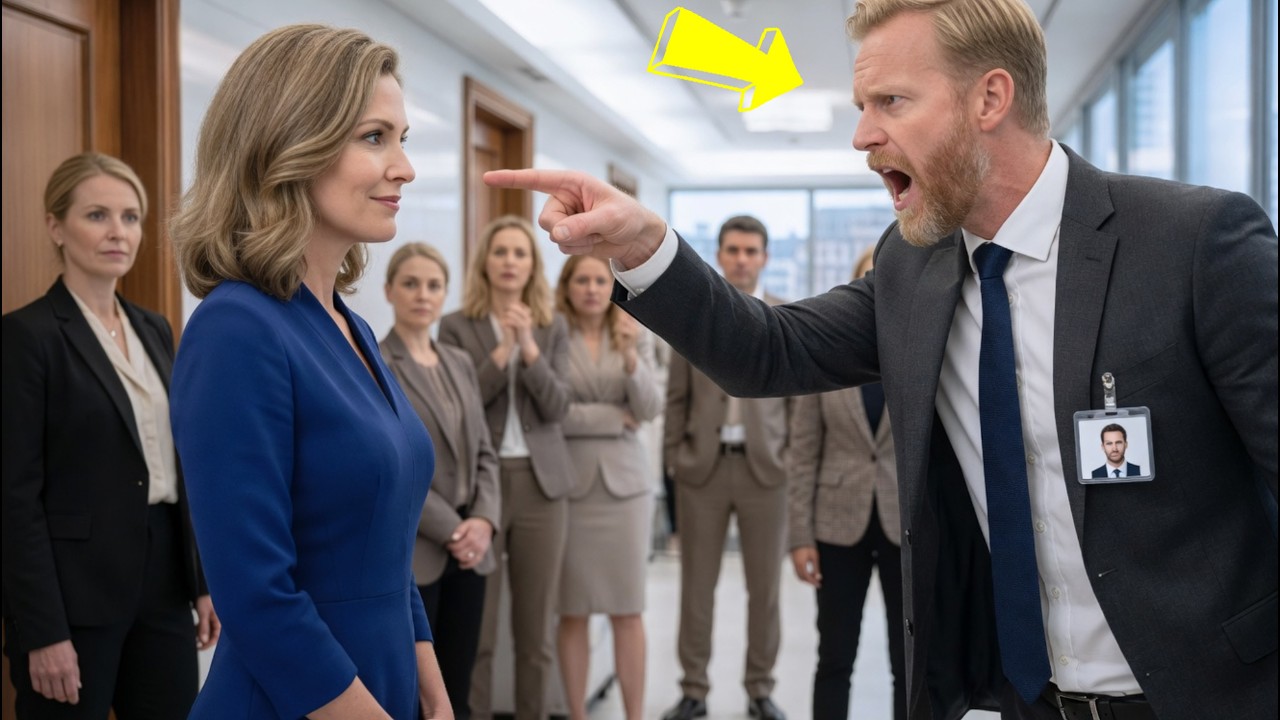
The courtroom was suffocating, the air thick with expensive cologne and disdain, as Richard Sterling smirked at his soon-to-be ex-wife in her plain beige cardigan. He had already won—or so he thought. But the judge’s gavel had not yet fallen, and the real battle was just beginning.
Audrey Kensington sat motionless, her hands folded over a manila folder, her expression unreadable. Across the aisle, Richard leaned back in his mahogany chair, a mocking smile curling his lips. Beside him, his fiancée Chloe stifled a giggle, whispering something cruel behind a manicured hand.
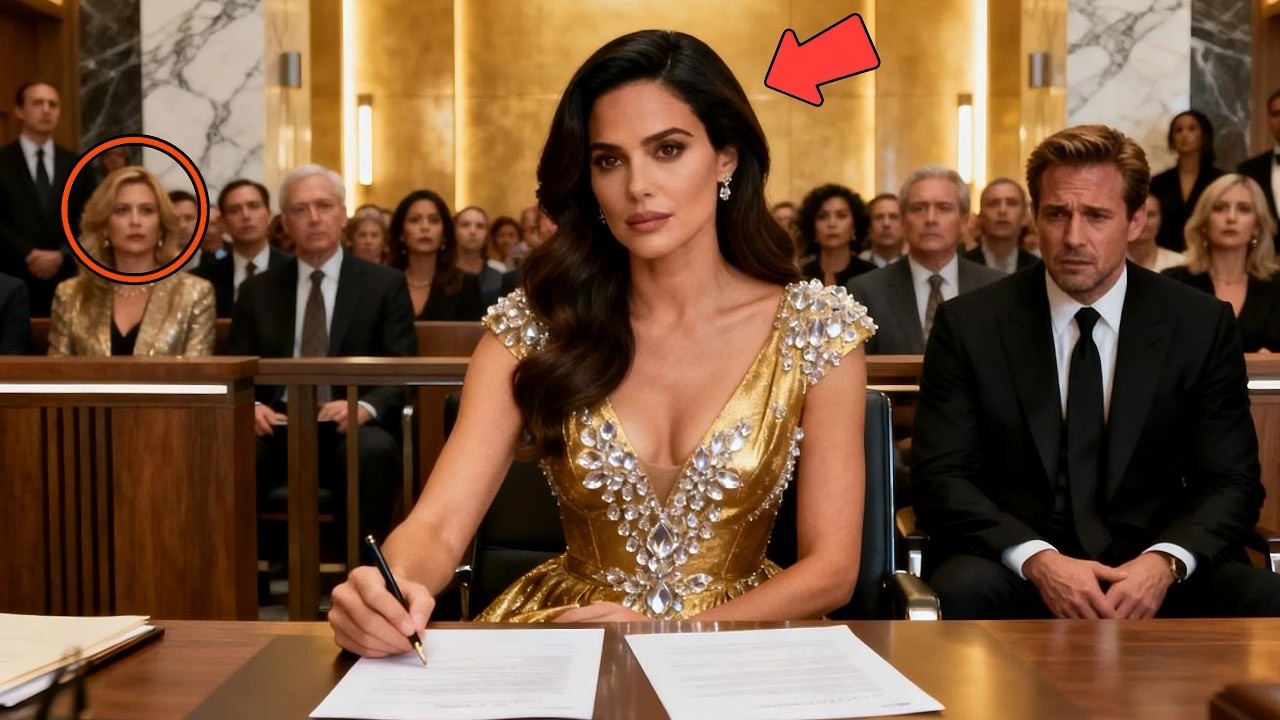 To everyone in courtroom 302, Audrey was a broken, penniless woman about to be steamrolled by Chicago’s most ruthless divorce attorney. None of them saw the trap. None of them realized that the quiet woman in the cheap sweater held a secret that would shatter their assumptions and rewrite the financial landscape of the entire proceeding.
The Honorable Judge Harrison Caldwell peered over his wire-rimmed glasses as Gregory Pierce, Richard’s attorney, launched into his opening salvo. He painted Audrey as a dependent, a woman who had contributed nothing to the marriage, a freeloader who had the audacity to ask for half of Richard’s “hard-earned” four million dollar estate.
Pierce’s voice boomed through the paneled room, his theatrical pacing designed to humiliate. He waved bank statements, tax returns, and credit card records. He pointed to Audrey’s modest checking account balance of $14,200 and contrasted it with Richard’s healthy portfolio.
He demanded she accept a paltry $75,000 settlement and walk away with nothing more.
Audrey’s attorney, Evelyn Reed, looked as unassuming as her client. She scribbled notes on a yellow legal pad, her reading glasses perched on her nose. The courtroom snickered.
Chloe whispered loudly that Audrey couldn’t even afford a decent lawyer. The mockery was a palpable force, pressing down on the petitioner’s table.
Richard mouthed the words “give up” across the aisle. Audrey did not flinch. She did not smile.
Behind her plain exterior, a brilliant, calculating mind was aligning the final pieces of a chessboard Richard did not even know he was playing on. She had been waiting for this moment for years.
To understand the absolute delusion of Richard Sterling, one had to look back seven years to the third year of their marriage. He had just been promoted to director and was obsessed with status. He bought a Porsche he could barely afford and insisted they move into a Gold Coast penthouse, stretching their budget to the breaking point.
Audrey, who held a degree in computer science and applied mathematics from Northwestern, tried to warn him. She showed him spreadsheets, projected interest rate hikes. She pleaded with him to build a safety net.
He waved her off with condescension, telling her she thought like a middle-class clerk while he thought like a wealth builder.
So Audrey did exactly what he asked. She let him handle his money. And she quietly began handling hers.
While Richard was out schmoozing clients, she sat in the spare bedroom writing code. She identified a massive inefficiency in how mid-level logistics companies tracked supply chain overheads and built a proprietary software platform to solve it.
She named the software Ethalgard Logistics and launched it quietly. Within six months, she landed her first major corporate client. Within a year, she had twenty.
Because the software was entirely cloud-based and highly automated, her overhead was virtually zero. Revenue poured in like a tidal wave.
At first, Audrey wanted to tell Richard. She planned a special dinner to celebrate her first million dollars in annual recurring revenue. But that night he came home drunk, furious about a missed bonus, and mocked her clothes, her hobby, and told her she was lucky he kept a roof over her head.
Something inside Audrey snapped. The love she had for him didn’t die instantly, but the trust completely evaporated. She realized that if she told Richard about the money, he wouldn’t celebrate her.
He would co-opt it, use her success to inflate his own ego, and spend her money on more flashy cars.
So Audrey built a fortress. She hired a premier corporate structuring firm in Delaware. She created a blind trust called the Vanguard Oak Trust, which owned a holding company named Horizon Zenith Capital.
Horizon Zenith Capital owned Ethalgard Logistics. On paper, Audrey Kensington was entirely invisible.
She paid herself a modest consulting fee of $30,000 a year, which was deposited into the joint checking account she shared with Richard. He never asked questions because he never cared. He saw the $30,000 on their tax returns and felt vindicated in his belief that he was the superior provider.
By year five of their marriage, a global tech conglomerate took notice of Ethalgard. They made a buyout offer. Audrey negotiated the deal entirely through her legal team in Delaware.
The final purchase price was $850 million cash and restricted stock. She was 34 years old and she was nearly a billionaire.
When the deal closed, Audrey sat at her desk in the spare bedroom, looking at an account balance that defied comprehension. She walked out to the living room where Richard was aggressively playing golf on a VR headset. He didn’t even look at her when she walked in.
From that day forward, Audrey shifted from tech entrepreneur to apex investor. Horizon Zenith Capital began acquiring quiet, highly lucrative assets: massive tracts of commercial timberland in the Pacific Northwest, a series of high-end boutique hotels in Europe, and a fifty percent stake in a revolutionary lithium extraction startup.
By the time Richard handed her divorce papers, Audrey’s net worth had eclipsed $1. 4 billion. She had kept it utterly hidden from a man who shared her bed but never bothered to ask about her day.
He had no idea that the woman he was about to destroy in court was one of the wealthiest people in the room.
Back in courtroom 302, Gregory Pierce was enjoying the sound of his own voice. He called Audrey to the stand for direct examination, a move designed purely to break her spirit early. He grilled her about her car, a leased Honda Civic.
He grilled her about her income, a mere $28,000 from freelance consulting.
He mocked her credit card being declined at a grocery store. He painted a picture of a woman utterly dependent on her husband’s generosity. Audrey answered each question calmly, her voice steady.
She did not defend herself. She did not explain that her card was declined because she had triggered a fraud alert by wiring $35 million to an escrow account in Geneva.
Pierce concluded his examination with a flourish, strutting back to his table like a victorious rooster. He told the judge that the financial dynamics of the marriage were crystal clear. He demanded a clean break: Richard keeps everything, Audrey takes $75,000 and walks away.
Evelyn Reed rose quietly. She handed a thick stack of manila envelopes to the court and to opposing counsel. Pierce barely glanced at them, assuming they were desperate attempts to claim equity in Richard’s Porsche.
He was wrong. Spectacularly, devastatingly wrong.
Judge Caldwell opened the binder. He frowned, adjusted his glasses, and turned page after page. His brow furrowed deeper with every passing second.
He looked up at Pierce with an expression that shifted from impatience to confusion to something approaching shock.
He ordered Pierce to look at the documents immediately. Annoyed, Pierce snapped his fingers for his paralegal to hand him a duplicate binder. He opened it.
He saw a standard financial disclosure form. He looked at the section labeled “Assets, Real Estate.” He stopped breathing.
Listed under Audrey Kensington’s name was not a lease for a Honda Civic. There was a commercial tower in Chicago’s West Loop, valued at one hundred forty-five million dollars. A residential estate in Lake Forest valued at twelve and a half million.
Three boutique hotels in Paris valued at sixty-eight million.
Pierce flipped the page to liquid assets and equities. Account one at JP Morgan Private Bank had a balance of two hundred fourteen and a half million dollars. Account two at UBS Wealth Management in Geneva had a balance of four hundred ten million.
Corporate holdings in a lithium extraction company were estimated at six hundred fifty million.
“What is this?” Pierce croaked, his booming theatrical voice completely gone. He sounded like a man who had just swallowed glass.
“This is fraudulent documentation. This is perjury.”
Richard grabbed the binder from Pierce’s hands. He stared at the numbers. His eyes widened until they looked like they might pop out of his skull.
Four hundred ten million. “What is this, Audrey? What kind of sick prank is this?”
Audrey sat perfectly still. She looked at Richard, her expression serene, almost pitying. Evelyn Reed stepped forward, her demeanor no longer mild.
She announced that the court was looking at verified audited financial statements provided by Goldman Sachs, JP Morgan, and corporate trustees in Delaware.
“My client, Ms. Kensington, possesses a net worth of approximately $1. 42 billion,” Evelyn declared.
“These assets were acquired during the course of her marriage to Mr. Sterling.”
Chaos erupted. Chloe screamed from the gallery, “Billion? You said she was broke!”
She hit Richard on the shoulder repeatedly. The judge bellowed for silence, threatening to have her escorted out. Khloe clamped her hands over her mouth, staring at the woman in the cheap beige cardigan.
Richard was hyperventilating. His perfectly pressed suit suddenly felt like a straightjacket. He grabbed his lawyer, demanding that they tell the court this was 𝒻𝒶𝓀𝑒.
Pierce was sweating now, stuttering that they had no knowledge of these assets. The scope of discovery had just exploded.
But Evelyn Reed was not finished. She walked over to the defense table and dropped another thinner folder in front of Pierce. “This is a detailed accounting of Mr.
Sterling’s financial activities over the past three years,” she said. “While my client was quietly building a billion dollar empire, Mr. Sterling was busy committing fraud.”
Richard’s face drained of all color. “Fraud? I never—I didn’t—”
“You did, Richard.” Audrey spoke for the first time since leaving the witness stand. Her voice wasn’t loud, but in the stunned silence of the courtroom it carried like a gunshot.
“You forged my signature.”
Evelyn opened the folder, pointing a manicured finger at highlighted documents. Two years ago, Richard had taken out a second mortgage on the Gold Coast penthouse. He needed cash to fund luxurious vacations to St.
Barts with his fiancée and to purchase a $300,000 yacht. He had forged Audrey’s signature on the loan documents.
“We have the forensic handwriting analysis to prove it,” Evelyn said, “as well as the paper trail of wire transfers from his private account to a yacht brokerage in Miami.”
Judge Caldwell looked at Richard with absolute disgust. “Mr. Sterling, is this true?”
Richard stammered, looking frantically around the room. The smug, arrogant executive was gone. In his place was a trapped, terrified animal.
He tried to claim it was an investment, that he was going to pay it back. The judge’s voice dripped with venom as he asked if Richard understood he had committed felony wire fraud and forgery.
Evelyn twisted the knife further. She pulled out a final sheet of paper. “We are petitioning the court for an unequal distribution of the marital estate.
Ms. Kensington will retain one hundred percent of her corporate holdings, liquid assets, and real estate. Mr.
Sterling will assume sole responsibility for the $1. 2 million fraudulent mortgage. He will surrender his equity in the Gold Coast penthouse to offset legal fees.”
“You’re taking everything,” Richard whispered, his voice cracking. “You’re leaving me with debt?”
Audrey looked at him, her face completely unreadable. “I’m leaving you with exactly what you built, Richard. Nothing but a house of cards.”
Pierce frantically whispered to Richard to shut up, that he was looking at prison time if the DA got involved. Richard grabbed Pierce’s lapels, screaming that she had a billion dollars and he was entitled to half. The judge warned him to control himself.
Evelyn smiled, a thin, dangerous smile. She handed another document to the bailiff. When Audrey established the Vanguard Oak Trust in Delaware, she had included a standard moral turpitude and fidelity clause.
It stated that any beneficiary or spouse of a beneficiary forfeits all claims to the trust’s assets if they are proven to have engaged in documented financial infidelity or adultery resulting in the dissolution of the marriage.
“We have provided the court with over four hundred pages of text messages, hotel receipts, and photographs documenting Mr. Sterling’s 𝒶𝒻𝒻𝒶𝒾𝓇 with Miss Dupont spanning back two and a half years,” Evelyn announced. “By his own actions, Richard Sterling legally locked himself out of a billion dollar fortune.”
Richard slumped into his chair as if he had been physically struck. He looked at the plain beige cardigan Audrey wore. It wasn’t a symbol of poverty.
It was armor. She had sat there letting him humiliate her, letting him dig his own grave while holding all the cards.
Judge Caldwell slammed his gavel down, the sound echoing like a thunderclap. He announced a thirty-minute recess and pointed a stern finger at Gregory Pierce, ordering him to advise his client on his Fifth Amendment rights because the moment they reconvened, he was forwarding the forged mortgage documents to the Cook County State’s Attorney’s Office.
The crack of the gavel was definitive. The judge swept out of the room, leaving behind a suffocating silence that lasted only a second before the courtroom erupted again. Pierce didn’t even pack his briefcase.
He rounded on Richard, his face purple with rage.
“You forged a signature on a $1. 2 million federal bank loan?” he hissed.
“You lied to me during discovery. Do you have any idea what you’ve done to my firm’s reputation?”
Richard pleaded for help, claiming she set him up, that she hid a billion dollars. Pierce spat back that she hid it legally in a Delaware blind trust, but Richard committed felony wire fraud. He said he was a divorce attorney, not a white-collar criminal defense lawyer, and that he would withdraw from the case.
Pierce stormed out, leaving Richard alone at the defense table, looking like a man who had just stepped on a landmine and was waiting for the click. Chloe was having a full-blown meltdown in the gallery. She pushed past the gate, screaming that Richard had lied about his money, that she didn’t sign up for a man going to jail.
Richard tried to calm her, claiming he still made half a million a year. Chloe laughed hysterically. “You owe more than a million to the bank.
You’re going to jail. I didn’t sign up for this.” She ran toward the exit, shouting that he should never call her again.
Across the room, Audrey was calmly packing her beige canvas tote bag. Evelyn handed her a sealed copy of the transcripts. Neither woman paid any attention to the soap opera at the defense table.
They moved with the quiet efficiency of snipers who had just confirmed their target was neutralized.
Richard broke away from Chloe and blocked Audrey’s path as she turned to walk out. His face was pale, slick with cold sweat. He pleaded with her to talk, to remember that they loved each other once.
He begged her not to let him go to prison.
Audrey stopped. She looked up at him, her dark eyes completely devoid of the warmth he had spent a decade taking for granted. She did not look angry.
She looked utterly indifferent, which terrified him even more.
“We aren’t adults having a conversation, Richard. We are opposing parties in a litigation you initiated. And you didn’t love me.
You loved the convenience of me. You loved having a quiet, unassuming wife at home while you played the big shot.”
Richard whined, calling the loan a bridge loan and the 𝒶𝒻𝒻𝒶𝒾𝓇 a midlife crisis. He told her she had won, that she had a billion dollars. He begged her to drop the forgery claim and give him half the penthouse equity so they could walk away clean.
Audrey tilted her head, studying him as if he were a fascinating, slightly pathetic insect. “You still don’t get it, Richard. I didn’t hide the money to hurt you.
I hid it to protect myself from you. I would have gladly shared my life with you if you had ever treated me as an equal. But you wanted a subordinate.
Well, congratulations. You’re finally the smartest person in the room you can afford.”
She stepped around him, leaving him standing paralyzed in the doorway of courtroom 302. He watched his billionaire ex-wife walk calmly toward the elevators while the woman he had destroyed his marriage for practically ran toward the exit. He felt his chest tighten, a crushing weight pressing down on his lungs.
The descent of Richard Sterling was not a slow decline. It was a free fall. Within seventy-two hours of the explosive hearing, the Cook County State’s Attorney formally opened an investigation.
Subpoenas were issued to Richard’s bank, the mortgage brokerage, and, most devastatingly, to his employer, Sterling and Barrett Commercial Real Estate.
On Monday morning, Richard’s key card flashed red at the office door. He was met by security guards who escorted him to a ground-floor conference room. The CEO, William Barrett, was already seated, flanked by human resources and internal legal counsel.
He did not bother with greetings.
“Save it,” Barrett interrupted when Richard started to explain. “We received a grand jury subpoena this morning demanding all your corporate emails, expense reports, and compensation history. The allegation is that you forged a federal document to secure a million dollar loan.”
Richard lied, claiming innocence, but the sweat pouring down his face told a different story. The internal counsel noted dryly that Gregory Pierce had already dropped Richard as a client. Barrett leaned forward, his eyes cold, and terminated Richard’s employment for cause with no severance.
“You can’t do this,” Richard shouted, slamming his hand on the table. “I brought in four million in commissions last year.”
“We need clean hands,” Barrett corrected coldly. “Security will escort you out.”
Within thirty minutes, Richard was standing on the curb of Wacker Drive, holding a cardboard box containing a framed photo of a golf course and a few expensive pens. He had no job, no lawyer, and a crushing mountain of debt. He hailed a cab back to the Gold Coast penthouse, desperately hoping Chloe had returned.
When he unlocked the heavy oak door, the silence was deafening. He called her name. No answer.
He walked into the master bedroom and froze. The walk-in closet had been entirely gutted on one side. All of Chloe’s designer clothes, handbags, and jewelry were gone.
Worse, she hadn’t just taken her own things. The two original abstract paintings from Miami were missing. The expensive espresso machine was gone.
Even the vintage Rolex he kept in his desk drawer had vanished. She had stripped the apartment of anything she could carry and pawn.
Richard sank onto the Italian leather sofa, burying his face in his hands. His phone buzzed with an automated text from his bank: his primary checking account was overdrawn by $1,450, and an automatic payment to a Miami yacht brokerage had bounced. He had forgotten to stop the autopay for the boat he bought with the forged loan money.
He threw the phone across the room, watching it shatter against the marble floor. Over the next two months, the walls closed in completely. Without his half-million salary, he couldn’t make the payments on the primary mortgage, let alone the fraudulent second mortgage.
The bank initiated foreclosure proceedings.
A week later, he woke to the sound of diesel engines and watched a tow truck haul away his Porsche Macan. He was forced to hire a cut-rate defense attorney named Arthur Pendleton, a man who worked out of a strip mall and constantly smelled of stale cigarettes.
Pendleton took one look at the evidence and gave Richard the brutal truth: they had him dead to rights. The handwriting experts were unanimous. The wire transfers were tracked.
He was looking at five to seven years in federal prison. His only play was a plea deal.
The deal: plead guilty to a lesser charge of bank fraud, receive probation and community service, but pay full restitution to the bank—$1.2 million instantly—plus fines. If he couldn’t pay, the probation deal was off the table and he would do the time.
Richard was trapped. He had no cash. His assets were either repossessed or locked up in the divorce litigation.
There was only one person on the planet who could save him from a prison cell: Audrey. He had to beg.
Six months after the initial hearing, courtroom 302 felt entirely different. The oppressive summer heat had given way to a biting Chicago winter, but inside the atmosphere was chillingly calm. Audrey sat at the petitioner’s table in a tailored black blazer, her demeanor composed, quiet, and utterly immovable.
Across the aisle sat Richard Sterling. The transformation was 𝓈𝒽𝓸𝒸𝓀𝒾𝓃𝑔. He had lost at least twenty pounds, his cheekbones jutting out sharply beneath sallow skin.
His custom Tom Ford suits had been sold to a consignment shop to pay Pendleton’s retainer. He wore a cheap off-the-rack suit that hung loosely on his shrinking frame.
Judge Caldwell took his seat and announced the finalization of the dissolution of marriage. Evelyn Reed stood and explained that after extensive mediation and in light of the parallel criminal proceedings, they had reached a finalized agreement.
“Ms. Kensington will retain one hundred percent of her pre-existing assets, including all corporate holdings under Horizon Zenith Capital, the Vanguard Oak Trust, and all liquid accounts. Mr.
Sterling waives any and all rights to claim spousal support or equity in these assets, per the moral turpitude clause triggered by his documented infidelity.”
Richard stared at the floor, his jaw tight. He did not argue. He could not.
Evelyn continued: “Mr. Sterling is surrendering his fifty percent equity in the Gold Coast penthouse to Ms. Kensington.
In exchange, Ms. Kensington has agreed to assume the remaining balance of the primary mortgage.”
Pendleton stood up and added that his client was agreeing to this total surrender because Ms. Kensington had generously agreed to a secondary transaction outside the marital estate: Horizon Zenith Capital would purchase Mr. Sterling’s fraudulent debt from the bank.
Judge Caldwell raised an eyebrow. Evelyn explained that Mr. Sterling had to pay $1.
2 million in criminal restitution by Friday to avoid a mandatory prison sentence and was entirely insolvent. Horizon Zenith Capital would pay the restitution on his behalf as a structured corporate loan.
“In exchange, Mr. Sterling has signed a legally binding promissory note. He owes Horizon Zenith Capital $1.
2 million at an interest rate of eight percent, to be garnished from his future wages for the rest of his natural life.”
Judge Caldwell let out a low whistle. “He will be an indentured servant to his ex-wife’s corporation.”
“Precisely, your honor,” Evelyn said unapologetically. “My client felt it was a more productive outcome than allowing him to sit in a taxpayer-funded prison cell. He will work and he will pay back every single cent he stole against her name.”
Judge Caldwell asked Richard if he understood the terms. Richard slowly stood up, his hands shaking as he gripped the edge of the table. He looked at Audrey, expecting to see triumph in her eyes, a smirk, a glimmer of the mockery he had subjected her to for years.
But there was nothing. She looked at him the way one looks at a closed book they have no intention of ever reading again. She had outplayed him, outsmarted him, and financially subjugated him, and she wasn’t even gloating.
To her, this was just business.
“I understand, your honor,” Richard croaked. “I accept the terms.”
Judge Caldwell signed the final decree. “This marriage is officially dissolved. Mr.
Sterling, consider yourself exceptionally lucky that Ms. Kensington has a better grasp of leverage than you do. We are adjourned.”
The gavel banged, finalizing Richard’s utter ruin. As the courtroom cleared, Richard lingered at his table, packing his meager papers. He watched Evelyn Reed pack her meticulous binders.
Audrey stood, picking up her simple beige tote bag.
“Audrey,” Richard called out softly. She paused and turned to face him one last time. “Why?
Why didn’t you just let me go to prison? Why buy the debt? Was it just to torture me, to own me?”
Audrey looked at him, adjusting the strap of her bag on her shoulder. The harsh fluorescent lights caught the quiet, unyielding strength in her face. “You give yourself too much credit, Richard.
I didn’t buy your debt to torture you. I bought it because the bank was offering a distress sale and I negotiated the purchase for eighty cents on the dollar. Horizon Zenith Capital stands to make a twenty percent profit on your repayment plus the eight percent annual interest.”
Richard’s mouth fell open. He was stunned into absolute silence.
“You see, Richard, you were never my husband in the end. You were just a bad investment. And I don’t let bad investments cost me money.”
With that, the billionaire turned and walked out of the courtroom, leaving Richard Sterling standing in the wreckage of a life he had arrogantly dismantled with his own two hands.
Today, two years later, Audrey Kensington has not bought a superyacht or a fleet of sports cars. She has not plastered her name across a hospital wing. She remains an invisible force, upgrading from department store cardigans to understated bespoke cashmere but still driving herself to the grocery store.
Her company, Horizon Zenith Capital, has grown into an apex predator in the private equity ecosystem. Operating from a sleek, unlisted office overlooking the Chicago River, she quietly orchestrates billions. Last month she politely declined a joint venture acquisition offer from Ken Griffin, the billionaire founder of Citadel, simply because she preferred to keep her board independent.
Richard Sterling’s life has become a masterclass in irony. Following his conviction for misdemeanor bank fraud, he was entirely blacklisted from commercial real estate. Desperate and broke, he was forced to take a mid-level logistics management job at a regional freight carrier in the grim industrial outskirts of Joliet.
He lives in a cramped studio apartment that smells faintly of boiled cabbage and damp drywall. He drives a rusted 2008 sedan with a broken heater. Chloe predictably never spoke to him again and is now seen on Instagram on a yacht in Monaco with a sixty-year-old hedge fund manager.
But the true poetic justice of Richard’s existence is his daily routine. Every morning at 7:30 a. m.
, he sits beneath a flickering fluorescent bulb, types his password into the employee portal, and is forced to stare at the sleek blue Ethalgard Logistics splash screen. He works for a company that uses the software his ex-wife built.
The woman he belittled, the unambitious wife he financially abused and discarded, is the architect of his entire reality. She owns his debt. She owns the software he uses to scrape together a miserable living.
She owns the very air he breathes in the corporate world.
He is trapped inside the empire she built while he was busy mocking her. About a year ago, he sent an email to Horizon Zenith’s corporate inbox begging to renegotiate the interest rate, claiming he couldn’t afford to fix his car. Audrey forwarded it to an automated customer service desk, which sent him a boilerplate reply about strict corporate debt structuring policies.
The ghost of Richard Sterling no longer haunts her. He is nothing more than a line item on a spreadsheet, a fractional yield in a billion-dollar portfolio. She has an empire to run.
This story is a fundamental exploration of the blinding nature of arrogance and the quiet, undeniable strength of preparation. Richard’s downfall was not merely a result of his financial crimes but a direct consequence of his hubris. He mistook volume and flashy displays of wealth for actual security.
Audrey understood that true power is entirely silent. It does not need to scream for attention or tear others down to validate itself. By mirroring her abuser’s cold, calculating nature but applying it legally and strategically, she transformed her victimhood into absolute autonomy.
Never underestimate the quietest person in the room. They are often the ones carefully designing the chessboard while everyone else is just playing checkers.