Atlanta rapper King Harris, the 20-year-old son of hip-hop mogul T. I. , has ignited a fresh firestorm in the rap community after publicly slamming Lil Baby’s latest collaboration with Pharrell Williams.
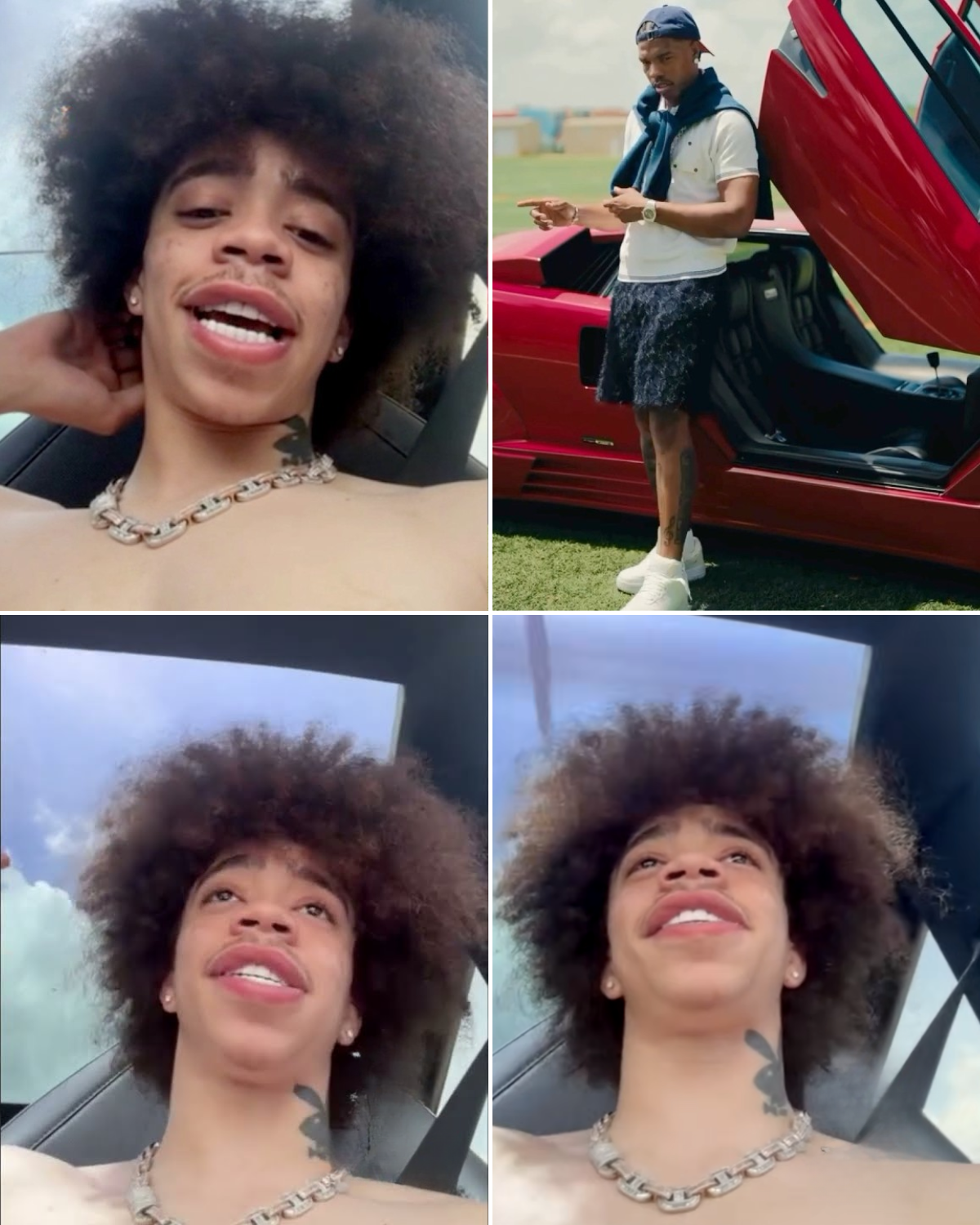
In a candid, expletive-laced video released exclusively to NM Mag TV, King claimed the veteran producer’s involvement “fucked up the swag” of the track, which has been circulating under the rumored title “Dead Fresh.” The outburst came during an unscripted reaction session that quickly spiraled into a broader commentary on masculinity, cancel culture, and the pressures of modern fame.
King, known for his unfiltered opinions and a growing social media presence, did not hold back. “I feel like the song was cool until he said ‘this beat came from Forel’—once he said that, it kind of like it was cool, but it kind of fucked up the swag of it all, you know?” he said, referencing Pharrell by his colloquial nickname.
The remark has already sent shockwaves through fan forums and industry circles, with many interpreting it as a direct challenge to one of hip-hop’s most respected living legends.
The video, recorded in what appears to be a studio or living room, shows King bobbing his head to the track before stopping abruptly and delivering his verdict. “I look at that equivalent to if I do a verse with somebody trying to put their name in the song overly,” he elaborated. “Nah, he ain’t saying it wasn’t a bad bar.
It was just kind of out of nowhere. I think that’s why it probably did it. It felt like that.”
King argued that Pharrell’s credit line disrupted the organic flow of the song, a critique that has drawn both support and backlash from listeners who prize authenticity in hip-hop.
The controversy comes at a pivotal moment for Lil Baby, who has been riding a wave of critical and commercial success since his 2020 album “My Turn.” His collaboration with Pharrell, which reportedly samples or interpolates elements from the producer’s vast catalog, was expected to be a celebratory intersection of old and new school talent. Instead, King’s reaction has turned the spotlight onto a growing generational divide over what constitutes “real” hip-hop and whether outside production credits diminish an artist’s credibility.
King, who has often navigated the shadow of his father’s iconic career, used the platform to expand his critique beyond the specific song. “I look at that equivalent to if I do a verse with somebody trying to put their name in the song overly like I don’t know,” he repeated, emphasizing his frustration with perceived name-dropping. He contrasted it with his own experience working with other artists, noting that he had previously avoided such overt acknowledgments.
The rant quickly morphed into a meditation on masculinity and emotional expression, topics King has touched on before in livestreams and interviews.
“I feel like it’s crazy cuz walked off and cried. It’s like, you know, come on, man. Stand in the pain.
Stand in the pain, man,” King said, referencing an unspecified incident he tied to the broader theme of male vulnerability. While he did not name names, the comment appeared to refer to a recent viral moment in which a male rapper broke down publicly. King argued that men should suppress their emotions in certain contexts, a viewpoint that has drawn fierce criticism from mental health advocates and fans who see it as toxic masculinity.
“But I feel like what’s his name wasn’t trying to do that to him though. I ain’t know. I really think he ain’t know that he like that was going to hurt him like that realistically.
But it’s like, come on, man. We men, man. Don’t nobody care about our feelings anyway, you know?
So, it’s like that’s just a part of being a man.” King’s monologue echoed old-school notions of male stoicism, a stance that feels increasingly out of step with today’s hip-hop scene, where artists like Kendrick Lamar, J. Cole, and even Lil Baby himself have openly explored mental health struggles.
The video, which runs more than 15 minutes, captured King in a stream-of-consciousness flow, touching on cancel culture, respect, and the pressures of growing up in the public eye. “Mind you, my opinion don’t matter. That’s need to understand when they form an opinion.
My opinion don’t matter. I’m just speaking how I feel,” he insisted, a disclaimer that seemed aimed at defusing potential backlash but also highlighted the inherent contradiction in his tirade. He later used the word “diva” to describe certain behaviors, drawing a comparison to female wrestlers from his childhood.
“Like when I personally me growing up when I heard diva I think about female wrestlers personally. I mean to each his own,” King said. “But it’s just like come on, man.
Let’s not let’s not overly like what’s already happening. Cool. Cool.
Don’t got like you know, but like the like trying to make shit like just overly happen. It’s like ah just let it just organically naturally let it happen. Let’s not try to boost nothing, you know, cuz that’s why that’s why.”
This apparent criticism of manufactured hype directly targeted the music industry’s tendency to engineer viral moments—a practice King sees as disingenuous.
The reaction to King’s comments has been swift and polarized. On X (formerly Twitter), fans of Lil Baby have accused King of jealousy and attention-seeking, pointing out that his own music career has struggled to gain traction. Others, however, have praised him for speaking his truth, with some noting that Pharrell’s involvement can sometimes overshadow the primary artist.
“He’s not wrong,” wrote user @HipHopRealist84. “When you bring a legend like Pharrell in, it changes the dynamic. The beat becomes more about him than the rapper.
King just said what a lot of people think.”
Industry insiders have weighed in cautiously. One A&R who requested anonymity told NM Mag TV: “King is tapping into a real resentment that some younger artists feel toward legacy acts. They want to own their sound completely.
But at the same time, Lil Baby chose to work with Pharrell. That’s a business decision. If you feel it fucks up the swag, that’s an opinion, not a fact.”
Another producer, speaking on condition of anonymity due to ongoing business relationships, added: “Pharrell is a GOAT. But he also has a very distinct signature. Some songs benefit from that; others don’t.
King’s critique is valid in that sense.”
The video also saw King delve into cancel culture, arguing that the industry has become too quick to judge artists for past mistakes. “Because what I heard somebody say is right, every one of y’all has did something wild or made a mistake or did some shit that the people didn’t like. And that’s true.
Everybody in life done that. And I feel like it’s some people that wanted to say what he said, didn’t say it, and then just rode with the hate train. Like, come on, man.
That ain’t right.” This segment resonated with fans who feel that social media mobs have stifled artistic freedom.
King’s outburst comes just weeks after he himself faced backlash for controversial statements about women in the music industry. He has not publicly addressed that incident, but his latest video suggests he is doubling down on his persona as an outspoken, no-filter commentator. T.
I. , his father, has not commented on the Lil Baby situation, though sources close to the family say the rapper-producer is aware of his son’s remarks and is “monitoring the fallout.” T.
I. , who has a long history of feuds and headlines, famously clashed with several artists during his own career.
Meanwhile, representatives for Lil Baby and Pharrell have not responded to requests for comment. The song in question, which has not been officially released but was previewed during a private listening session, is said to be part of a larger project Lil Baby is planning for late 2025. Industry insiders speculate that King’s critique may actually boost its commercial prospects by generating buzz, a paradoxical outcome that King himself seemed to acknowledge when he urged the industry to let things “organically naturally” happen.
King’s monologue also touched on the responsibilities of fame, particularly regarding influence on younger listeners. “Nah, but not cool. That’s the only reason I say like grown men do what they want to do.
I’m just saying like it’s kids out there, man. I’m not do what they want to do. I’m just saying, you know, do it in your bubble.
Like, you know, just respect. I think everybody just got to respect everybody, period.” This sentiment, while sincere, seemed to contradict his earlier demand that men “stand in the pain” and not show vulnerability—a tension he did not resolve.
The video concludes with King thanking viewers and promoting NM Mag TV, the platform that hosted the exclusive. “Thanks for tuning in to NM Mag TV,” he says, as the music fades out. But the conversation is far from over.
Across social media, debate rages over whether King is a voice for authenticity or a privileged son trying to carve out relevance. Some have pointed out that King has yet to release a full-length project of his own, while his father T. I.
has collaborated with Pharrell in the past, most notably on the 2008 hit “Whatever You Like.”
“He’s criticizing something his dad has done multiple times,” wrote user @AtlantaRapFan. “T. I.
used Pharrell on ‘Dead and Gone,’ ‘Live Your Life,’ and more. So what’s King really saying? That his father also ‘fucked up the swag’?”
Others countered that King is entitled to his own opinion regardless of family legacy. “If you’re a fan of music, you can critique it. Just because his dad worked with Pharrell doesn’t mean he can’t think a different collab was weak,” posted @RealTalkHipHop.
As the story develops, NM Mag TV has confirmed that King will be releasing a longer, unedited version of the reaction video later this week. The outlet also teased that King may have additional comments about other upcoming collaborations and industry dynamics. Sources say the young rapper has been recording a lot of material in recent months, and this controversy may be a strategic pivot to build anticipation for his own debut album, expected in 2026.
For now, the hip-hop world is watching to see how Lil Baby and Pharrell respond. A direct rebuttal could escalate the feud into a full-blown beef, while silence might be interpreted as indifference. Historically, Lil Baby has not shied away from addressing critics in his music, and fans are eager to see if he drops bars aimed at King on future tracks.
“If I was Lil Baby, I’d write a verse where I name-drop Pharrell ten times just to fuck with him,” one fan joked on Reddit.
The incident also raises questions about the role of legacy in a genre that constantly reinvents itself. King, as T. I.’
s son, occupies a uniquely complicated position: he benefits from his father’s connections and fame but also bears the burden of expectations. His critique of Pharrell, a generational talent who has worked with everyone from Jay-Z to Kendrick Lamar, could be seen as an attempt to carve his own identity by challenging established giants. Yet the execution—rambling, emotional, at times contradictory—may undermine his credibility among those who value polish and professionalism.
Music journalist and author Amy Evans offered analysis to NM Mag TV: “King Harris is effectively doing what many second-generation artists do: attacking the system that created them. But he’s doing it in a way that’s messy and unfiltered, which is both his strength and his weakness. He’s saying things that many in the industry think but won’t say publicly.
But he’s also exposing his own insecurities and lack of filter. The question is whether the public will embrace him as a truth-teller or dismiss him as a spoiled kid.”
Meanwhile, the hashtag #KingHarrisVsLilBaby has trended in several U. S. cities, with clips of the video racking up millions of views on TikTok and Instagram.
Memes have already emerged, many mocking King’s pronunciation of “Forel” or his extended philosophical tangents. One popular edit shows King speaking over Lil Baby’s “Emotionally Scarred,” in a surreal mashup that highlights the irony of his anti-vulnerability stance.
As the dust settles, the central drama remains: a son of hip-hop royalty stepping into the ring with two living legends, armed only with his opinions and a camera. Whether this moment fades into clickbait fodder or becomes a defining chapter in King’s career depends on what comes next. Will he release a diss track?
Will he apologize? Or will he double down, as his father often did? For now, the industry holds its breath, and the beat—delivered by Pharrell or not—keeps playing.
NM Mag TV has confirmed that King plans to appear on several podcasts and live streams in the coming days to expand on his views. His father, T. I.
, has reportedly reached out to him privately to discuss the fallout, though no public statement from the “King of the South” is expected. In the meantime, Lil Baby’s team is said to be considering a preemptive release of the full “Dead Fresh” track to shift the narrative back to the music itself.
This breaking story is developing. Follow NM Mag TV for updates, including exclusive reactions from Pharrell’s camp and a potential interview with King Harris. For now, one thing is certain: in the world of hip-hop, where swag is currency and authenticity is the gold standard, a single comment can upend everything.
And as King himself might say, “This kind of fucked up the swag of it all.” But perhaps that’s exactly the kind of chaos that keeps the culture alive.