The first morning I opened my eyes in my new house, the ocean seemed to go on forever.
Cold blue water stretched beyond the glass, waves folding toward the rocky coast of Washington beneath a pale summer sky. From the balcony, I could smell pine, saltwater, and the faint sweetness of wildflowers growing near the edge of the bluff.
For the first time in years, I felt as though my life truly belonged to me.
My name is Claire Dawson, and the house stood just outside Port Townsend, Washington. It was not a mansion, although to me it felt like one. It had three bedrooms, broad windows, a stone fireplace, and a wooden deck overlooking the Pacific.
I had paid $420,000 for it with the inheritance my grandmother had left me.
Not one dollar had come from my husband.
My grandmother, Margaret Dawson, had never appeared wealthy. She wore plain cardigans, saved grocery coupons, and drove the same green station wagon for nearly twenty years. But for decades, she had quietly and carefully invested her savings.
When she died, she left me a protected inheritance account and a handwritten note.
“Create a life no one can take from you,” she had written.
At the time, I assumed she was talking only about money.
I would soon realize she had also been warning me about people.
I had been married to Blake Carrington for almost eight years.
When we first met, Blake was charming, confident, and overflowing with ambitious ideas. He talked about opening his own real estate agency, purchasing rental properties, and building a secure future for us.
I believed him because I desperately wanted to.
But Blake enjoyed looking successful far more than he enjoyed doing the work required to become successful.
Whenever he received a substantial commission, he spent it almost immediately. He purchased expensive suits, joined exclusive business clubs, and leased luxury vehicles we did not need. Every expense, he insisted, was essential to maintaining his professional image.
Meanwhile, I covered most of our ordinary household expenses with my income as a financial analyst.
Whenever I questioned his spending, Blake accused me of being pessimistic.
“You have to look successful before anyone will believe you are successful,” he frequently said.
His mother, Patricia, agreed with everything he did.
In her opinion, Blake was a brilliant businessman whom the world had never properly appreciated. Every failed investment was someone else’s fault. Every overdue payment was merely a temporary misunderstanding. Every reckless decision was part of a sophisticated strategy ordinary people were incapable of understanding.
Patricia also believed that being Blake’s wife meant serving both of them.
During holidays, she expected me to cook while she remained seated at the table criticizing everything. Whenever she visited our apartment, she reorganized my kitchen and complained about the furniture.
Blake never stood up for me.
“She’s my mother, Claire,” he would say. “Why can’t you make things easier for everyone?”
What he actually meant was that I should make life easier for him.
For years, I did.
After my grandmother’s estate had been settled, I did not tell Blake the complete amount of my inheritance.
I had learned enough about him to understand that money changed the way he saw people. He did not view savings as security. He saw savings as money waiting for someone to spend it.
I kept the inheritance separate and consulted an attorney before purchasing the coastal house. The deed was placed entirely in my name, and every payment came directly from the protected account my grandmother had established.
Blake knew I was purchasing a home, but he assumed we were financing it with a mortgage based on his expected future earnings.
I never corrected him.
Part of me still hoped the house might become a fresh beginning for our marriage. I imagined quiet breakfasts, long walks beside the water, and evenings together in front of the fireplace.
I prepared one of the guest bedrooms for Patricia because I knew she would eventually visit.
I selected soft blue-gray bedding, placed fresh flowers on the dresser, and even purchased the reading chair she had once admired in a catalog.
I was trying to be generous.
Blake and Patricia interpreted my generosity as permission.
Three days after I received the keys, Blake drove into the driveway in his leased black SUV.
Patricia sat in the passenger seat.
The rear of the vehicle was packed with suitcases, storage containers, lamps, framed photographs, and several bags filled with clothing.
I walked outside and stared at everything they had brought.
“Why does your mother have all of her possessions with her?” I asked.
Blake closed the driver’s door and smiled as though he had planned a wonderful surprise.
“Mom’s apartment lease ended sooner than expected,” he explained. “She’ll live here for a while.”
Patricia walked past me without saying hello.
She entered the house, slowly examined the living room, and nodded with approval.
“This is much nicer than I expected,” she said. “Blake, I always knew you would eventually provide a beautiful home for us.”
For us.
The words tightened something in my stomach.
“Blake did not buy this house,” I said. “I did.”
Patricia laughed softly.
“Of course, dear. I’m sure you signed a few documents, but everyone knows Blake’s career is what made this possible.”
Blake avoided my eyes.
Then he placed an arm around his mother’s shoulders.
“Let’s not argue over technical details on our first day,” he said. “Come upstairs, Mom. You need to see the view from the primary bedroom.”
I followed them immediately.
“The guest bedroom is at the end of the hall,” I explained. “I prepared it specifically for her.”
Blake continued toward the stairs.
“Mom needs more room,” he answered.
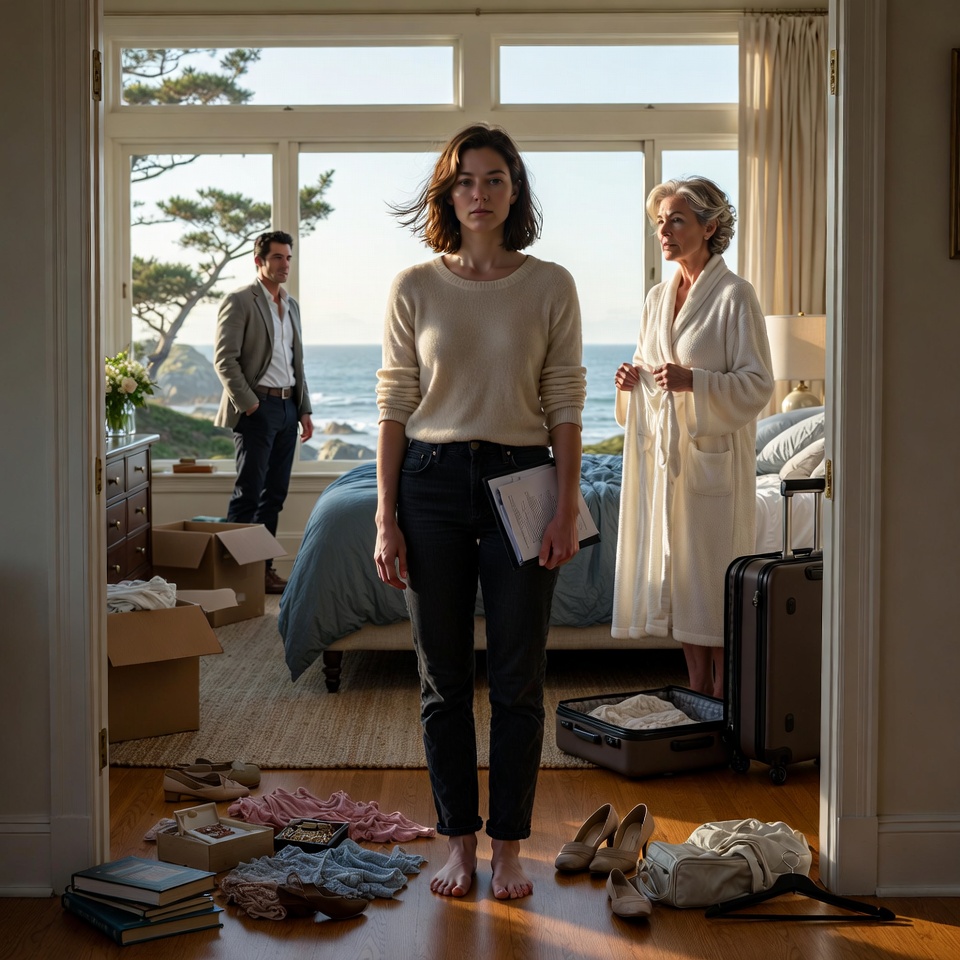
By the time I reached the primary bedroom, Patricia was already opening the closet.
She ran her fingers along the wooden shelves and turned toward the windows overlooking the ocean.
“This room is perfect,” she declared. “I’ll take it.”
For one moment, I honestly believed she was joking.
“No,” I said. “This is the bedroom Blake and I will be using. Your room is across the hallway.”
Patricia looked insulted.
“That room faces the trees,” she complained. “I traveled all this way to live near the ocean. Why would you give me the worst bedroom?”
“It is not the worst bedroom. It has a private bathroom and a large closet.”
Blake sighed dramatically.
“Claire, Mom has been dealing with a great deal of stress. Let her enjoy the better view.”
I looked directly at him.
“Where exactly do you think we are going to sleep?”
He hesitated for only a moment.
“I’ll stay in here so Mom doesn’t feel alone,” he replied. “You can sleep on the downstairs sofa until we work something out.”
I stared at him, waiting for a smile that never appeared.
Patricia began pulling my dresses from the closet.
She draped them across one arm, carried them into the hallway, and dropped them beside the stairs as though they were dirty laundry.
My jewelry box, shoes, books, and overnight bag followed.
“Please handle those carefully,” I said, forcing my voice to remain steady.
Patricia opened another suitcase.
“You own far too many things anyway,” she replied. “A simpler lifestyle would probably be healthy for you.”
Blake stood beside the window, looking out at the ocean.
He did nothing to stop her.
That was the moment something inside me became completely quiet.
I had spent years attempting to explain my feelings to Blake.
I had asked him to respect our financial limits
I had asked him to establish reasonable boundaries with his mother.
I had asked him to treat our marriage like a partnership.
Every conversation ended in exactly the same way. Blake accused me of being difficult, and eventually I apologized for bringing up the problem.
That afternoon, I explained nothing.
I glanced at my watch.
It was 3:20.
“You both need to leave,” I said.
Blake turned away from the window.
“What are you talking about?”
“You have thirty minutes to remove yourselves and your belongings from my house.”
Patricia laughed.
“Your house?”
“Yes,” I said. “My house.”
Blake walked toward me wearing the calm, patronizing expression he used whenever he wanted me to believe I was behaving irrationally.
“Claire, you’re emotional. Go downstairs, sit quietly, and give yourself some time to calm down.”
“I am calm.”
“This is our marital residence,” he continued. “You cannot simply order your own husband to leave.”
I picked up the folder containing the purchase documents from the table in the hallway.
“This property was purchased entirely with money from my grandmother’s protected inheritance account. Your name does not appear on the title, the payment records, the insurance policy, or the ownership documents.”
His expression shifted.
Only slightly.
But I noticed.
“You placed the house solely in your name?”
“I protected what my grandmother left me.”
Patricia moved closer.
“Blake is your husband. Everything you own belongs to him as well.”
“That is not what the legal documents say.”
Blake’s face hardened.
“You did this behind my back.”
The hypocrisy of those words almost made me laugh.
“You brought your mother into my home, gave her my bedroom, and placed my belongings in the hallway without consulting me. Do not lecture me about honesty.”
Instead of packing, Blake and Patricia shut themselves inside the bedroom.
Through the wall, I heard Patricia complaining loudly about me.
“She has always been selfish,” she said. “You should have taken control of her finances years ago.”
Blake lowered his voice, but I could still understand most of his response.
“Don’t worry. She’ll calm down. She always does.”
He was correct about the woman I had once been.
That woman would have cried in the bathroom.
She would have worried about where Patricia would stay.
She would have questioned whether defending her own home somehow made her cruel.
But that woman had finally reached her limit.
At 3:35, I called the neighborhood security office and explained that two visitors were refusing to leave my property.
Then I contacted my attorney.
She had already prepared a formal separation notice because somewhere deep inside, I had known this day might eventually arrive.
“Are you certain you want to move forward?” she asked.
I looked at my dresses lying on the floor.
“I have never been more certain of anything.”
At 3:45, I opened the home security application and deleted Blake’s temporary access code.
At 3:49, he came downstairs holding his phone instead of his suitcase.
“I just spoke with a friend,” he announced. “He says you cannot keep this house after I file for divorce.”
“Your friend is wrong.”
“I contributed to this marriage.”
“You contributed debt.”
His eyes widened.
“You would be nothing without me.”
For years, those words might have destroyed me.
That afternoon, they sounded almost absurd.
“Then leaving should be easy,” I answered. “You clearly believe you created everything. Go create it again.”
At exactly 3:50, two private community security officers arrived.
My attorney joined the conversation through a video call.
Blake immediately became charming.
He explained that we were experiencing a minor disagreement between husband and wife. He said Patricia was merely visiting and claimed I had misunderstood the sleeping arrangement.
Then Patricia came downstairs wearing my white cashmere robe.
That ended his attempt to make the situation appear ordinary.
One of the officers looked at the luggage scattered throughout the house.
“Ma’am, were you invited to move into this property?” he asked Patricia.
“My son invited me,” she said.
The officer turned toward me.
“Did you authorize her to move in?”
“No. I offered her the guest room for a short stay. She claimed my bedroom and removed my personal belongings.”
My attorney confirmed that I was the sole legal owner and that Blake had no ownership interest in the property.
His confidence vanished.
“Claire,” he said quietly, “we should discuss this privately.”
“We have been discussing things privately for eight years.”
“You’re humiliating me.”
“No, Blake. Your decisions are humiliating you.”
The security officers instructed them to gather their essential belongings and leave peacefully.
Patricia argued about the ocean view, the small size of her former apartment, and the inconvenience of moving all her boxes again.
Blake stared at me as if he no longer recognized the woman standing in front of him.
Perhaps he did not.
I barely recognized her either.
That evening, the house became quiet again.
I collected my dresses from the hallway and returned them to the closet. Then I opened every window and let the ocean air move through the rooms.
Near midnight, Blake called.
I allowed the phone to ring twice before answering.
His voice sounded exhausted.
“Mom and I are staying at a motel near the freeway,” he said. “She’s uncomfortable, and the room is far too small.”
I remained silent.
“I admit we handled the bedroom situation badly,” he continued. “But you overreacted. We can still repair this.”
“What exactly would you repair?”
“Mom can stay in one of the other bedrooms.”
“That was already the arrangement before she entered my house.”
“Then we agree.”
“No, Blake. We do not.”
Silence stretched between us.
“You are truly ending our marriage over a bedroom?” he asked.
“I am ending it because you believed I should sleep on a sofa in the house I purchased while your mother replaced me in my own bedroom.”
“I was trying to take care of her.”
“You were willing to erase me to make her comfortable.”
His voice turned cold.
“You’ll regret this when you discover how lonely that house is.”
I looked through the glass doors at moonlight shimmering across the water.
“The house is not lonely,” I said. “It is peaceful.”
Then I ended the call.
The following morning, my attorney discovered something else.
During the previous year, Blake had submitted multiple loan applications listing estimates of my inheritance as potential household assets. He had also told a business partner that the coastal property would soon be available as collateral for a new investment venture.
He had never asked for my permission.
In Blake’s mind, the house had never been simply a place for us to live.
It was an asset he intended to use.
That discovery removed the last trace of guilt I had been carrying.
Blake had not misunderstood me.
He had underestimated me.
When he returned to collect the rest of his belongings, he stood outside the gate beside a rented moving truck.
“I gave you the best years of my life,” he said through the intercom.
“I gave you patience, support, and more opportunities than you deserved.”
“My mother was right about you.”
“Then you should be very happy living with her.”
He stared into the security camera for several seconds.
Behind him, Patricia sat in the passenger seat, looking furious and exhausted.
“You think owning this house makes you powerful,” Blake said.
“No,” I replied. “Owning my choices makes me powerful.”
I opened the storage gate so the movers could retrieve the boxes I had already packed.
Blake was not allowed inside the main residence.
Before leaving, he looked toward the upper balcony.
For the first time, I think he understood that he would never again see the ocean from that bedroom.
Four months later, the divorce was finalized.
Blake received his clothes, personal possessions, and full responsibility for the debts connected to his expensive lifestyle.
He did not receive the house.
He did not receive my grandmother’s inheritance.
And he did not receive access to the financial future he had planned to build with my money.
Patricia returned to a smaller apartment outside Tacoma.
According to a mutual acquaintance, she continued telling people that I had stolen Blake’s dream home.
I stopped caring what she told anyone.
I converted the guest room into a home office.
I replaced the rug in the primary bedroom, changed the curtains, and donated the robe Patricia had worn.
Then I framed my grandmother’s handwritten letter and placed it beside the bedroom window.
Every morning, I read the same sentence.
“Create a life no one can take from you.”
Now I understand what she meant.
A secure life is not built only with money, property, and legal documents.
It is also built with boundaries.
It is built when someone finally stops apologizing for expecting respect.
Sometimes I stand on the balcony and remember the woman I was before that afternoon.
She was not weak.
She was patient.
She was hopeful.
She was loyal.
But she remained too long in places where others treated her kindness like an obligation.
I no longer blame her.
She is the reason I reached this place.
The ocean still appears endless beyond my bedroom window.
The waves rise, break, and return to themselves.
And every night when I close the bedroom door, I remember that no one will ever throw my belongings into a hallway again.
This room belongs to me.
This home belongs to me.
Most importantly, my life belongs to me.
Kindness is a beautiful quality, but when it is given without boundaries, entitled people may begin to believe your generosity is something they automatically deserve.
A loving partner will never demand that you disappear, make yourself smaller, or surrender your dignity simply to keep someone else comfortable.
Financial independence does not make someone cold or selfish.
It gives them the freedom to leave environments where trust, respect, and emotional safety no longer exist.
Sometimes the strongest response is not an explosive argument.
Sometimes it is a calm decision made after years of watching the same pattern of disrespect repeat itself.
A home should be somewhere your heart is allowed to rest.
It should never be a place where you must constantly defend your right to exist.
People who benefited from your silence may call you difficult the moment you begin expressing yourself clearly.
Their discomfort does not mean your boundary is unreasonable.
Love cannot survive when one person is expected to surrender everything while the other treats those sacrifices as proof that they deserve even more.
Leaving an unhealthy relationship does not mean the happier years were meaningless.
It means you finally understood that your future also deserved protection.
The strongest version of you is often created in the moment you stop waiting for someone else to recognize your value and begin honoring it yourself.
Peace may feel unfamiliar after years of conflict.
But once you experience the quiet freedom of living without constant disrespect, you understand why protecting your dignity was worth every difficult choice.