The rain had followed Vivienne Hart from the church to the cemetery and showed no sign of stopping. It slid from the edges of black umbrellas, darkened the shoulders of expensive coats, and turned the narrow paths between the graves into ribbons of mud. Vivienne stood beside the fresh mound of earth where her father’s polished mahogany coffin had disappeared less than an hour earlier, holding a white rose so tightly that the thorns had pressed small red marks into her palm. She barely felt them. At thirty-five, she had believed she understood grief. She had lost her mother as a child, watched friends leave, marriages collapse, and companies fail. None of it had prepared her for the sight of Arthur Hart’s name carved into gray stone while people who had feared him in life spoke gently about his kindness in death.
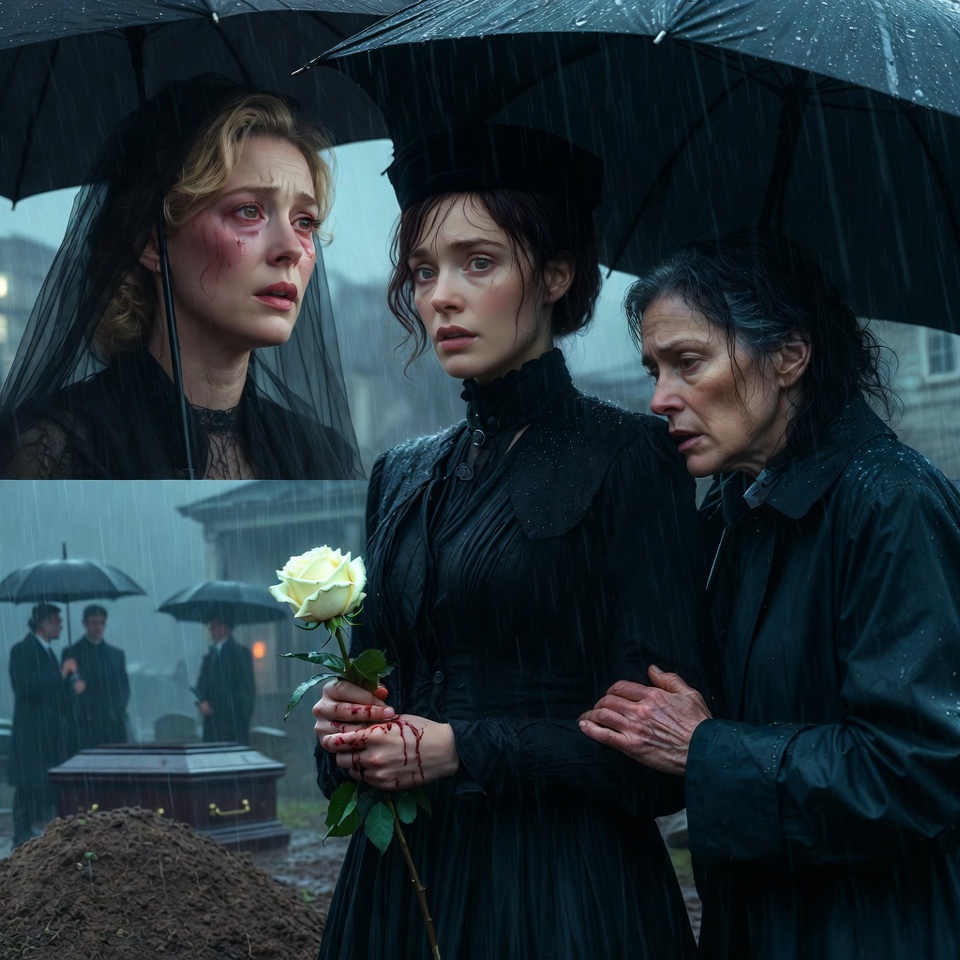
Everyone had cried. Her stepmother, Camille, had cried the loudest. She wore a black veil over perfectly arranged blond hair and collapsed against Vivienne’s half-brother, Preston, as though her body could no longer contain the weight of loss. Preston held her while looking over her shoulder toward the reporters gathered beyond the cemetery fence. He was thirty-one, handsome in the carefully polished way that made strangers trust him quickly, and he had inherited Arthur’s height without inheriting his restraint. During the service, he spoke about loyalty, family, and the responsibility of carrying their father’s legacy forward. His voice trembled in all the right places.
“He would want us united,” Preston told Vivienne after the coffin was lowered.
His hand rested on her shoulder for several seconds too long.
Vivienne looked at him but could not find the strength to reply. She had not slept properly in four days. Arthur had declined quickly, or at least that was what everyone had told her. One month earlier, he had still been chairing meetings at Hart Meridian Group, the private industrial company he built from a regional machine shop into a national supplier of aerospace components, medical systems, and clean-energy equipment. Then came dizziness, weakness, and episodes of confusion. His cardiologist blamed age and stress. Arthur was seventy-three, stubborn, and famous for working through illnesses that would have placed other men in bed. He dismissed the warnings until he collapsed during breakfast.
Three days later, he was dead.
The final hours had been strangely controlled. Camille informed Vivienne that Arthur had taken a sudden turn during the night. By the time Vivienne reached the private medical suite at Hart House, the room had already been cleared. The family physician claimed Arthur’s heart had failed. Martin Vale, Arthur’s attorney and oldest adviser, discouraged an autopsy, saying her father had repeatedly expressed that he did not want his body subjected to unnecessary procedures. The funeral arrangements were completed before Vivienne understood she was being asked to approve them.
She had seen her father only once after his death.
His face had been partly covered beneath the glass lid of the coffin. Camille warned her that the final hours had changed him and encouraged her to remember him as he had been.
Now the funeral guests moved toward the waiting cars. Camille accepted condolences near the chapel steps. Preston spoke quietly with Martin Vale beneath a broad black umbrella. The housekeeper, Mrs. Calder, walked alone with her face lowered and both hands clasped tightly around her handbag. No one appeared willing to meet Vivienne’s eyes.
She turned toward the line of cars.
Someone brushed her sleeve.
Elise Warren stood beside her.
Elise had served as Arthur’s private nurse for nearly two years, though Vivienne had always suspected her father trusted her as much for her honesty as her medical training. She was forty-eight, small and composed, with dark hair streaked prematurely with gray. That afternoon, however, her face looked drained of color. Her fingers tightened around the handle of her umbrella.
“Follow me,” she whispered.
Vivienne frowned. “What?”
“Do not react. Do not look back.”
“Elise, I can barely think.”
“Your father is alive.”
The words reached Vivienne without meaning.
For one strange second, she almost laughed. Grief could distort sound. It could turn ordinary sentences into impossible promises. Perhaps Elise had said his memory was alive or his work would live. Vivienne waited for her mind to correct what she had heard.
It did not.
Elise’s eyes remained fixed on hers.
“Walk,” she said. “If Camille sees us together, everything we did will have been for nothing.”
Vivienne looked instinctively toward the chapel. Camille had turned away from the crowd and was speaking to Preston. Martin Vale stood beside them, one hand inside his coat. From a distance, they looked like a family forming around its loss.
Vivienne followed Elise.
They left through a narrow gate behind the chapel and crossed a maintenance lane where a battered blue sedan waited beneath bare trees. The car looked completely out of place among the luxury vehicles parked near the cemetery entrance. Elise opened the passenger door.
“Get in.”
Vivienne did not move.
“Tell me what you mean.”
“Not here.”
“Did you say my father is alive?”
“Yes.”
“I watched them bury him.”
“You watched them bury a coffin.”
Vivienne stared at her.
“What was inside it?”
“Nothing.”
The ground seemed to shift beneath her feet.
Elise looked toward the cemetery. “We have less than a minute before someone notices you are gone.”
Vivienne climbed into the car.
Elise drove without speaking. They left the wealthy neighborhoods surrounding the cemetery and moved through the outskirts of Wilmington, Delaware, passing storage yards, shuttered warehouses, empty fields, and rows of brick factories abandoned after manufacturing moved away. Rain dragged gray lines across the windshield. Vivienne kept both hands clenched in her lap, afraid that if she relaxed, she would wake in the back seat of a funeral car and discover the entire drive had been a fantasy created by shock.
After twenty minutes, Elise turned onto a narrow road beside an old textile district. The buildings there had broken windows and rusted loading docks. At the end of the road stood a sagging white house behind a chain-link fence. Several windows were covered with plywood. One porch column leaned visibly to the left.
Elise stopped the car.
“This place belonged to my aunt,” she said. “No one has lived here for twelve years.”
Vivienne looked at the house. “My father is inside?”
“Yes.”
She stepped from the car before Elise could open her umbrella.
The front door stuck halfway. Elise pushed it open with her shoulder, revealing a narrow hallway where strips of wallpaper curled from the walls. The air smelled of dust, old wood, and antiseptic. Somewhere deeper inside, a machine emitted a steady electronic hum.
A lamp glowed in the back room.
Vivienne moved toward it.
Arthur Hart sat in a faded armchair with a wool blanket over his knees.
For several seconds, she could not breathe.
He was thinner than he had been during their last dinner together. His skin looked waxy, and his silver hair had been cut unevenly near one temple. A clear tube ran beneath his nose, connected to an oxygen machine beside the chair. Yet his eyes were open.
Alive.
“Dad?”
Arthur tried to stand.
His legs failed almost immediately.
Vivienne crossed the room and fell to her knees beside him. He reached for her face with a hand that trembled badly, and she pressed her cheek into his palm.
He was cold.
He smelled of medicine, wool, and the faint cedar soap he had used for as long as she could remember.
Real.
“Oh, God,” she whispered. “Dad.”
Arthur pulled her toward him.
Vivienne buried her face against his chest. His heartbeat was faint but unmistakable beneath the old cotton shirt. She listened to it until sobs tore through the control she had maintained since the hospital. Arthur held her with what little strength remained.
“I’m sorry,” he said.
She pulled back.
“For what?”
“For letting you stand beside that grave.”
“What happened? Why did they say you were dead? Who was in the coffin?”
“No one,” Elise answered from the doorway. “The coffin was sealed before it reached the funeral home. Martin instructed the staff not to open it because the family wanted a private burial.”
Vivienne looked at her father.
Arthur’s mouth tightened.
“They poisoned me.”
The room became very still.
Vivienne sat back on her heels. “Who?”
Arthur did not answer immediately.
He looked older than she had ever seen him, but the weakness in his body had not reached his eyes. The man who once negotiated with banks during a recession and refused to close a single factory was still there beneath the pale skin and shaking hands.
“Camille,” he said. “Preston. Martin helped them.”
Vivienne’s mind rejected the names even as her instincts accepted them.
“My own brother?”
“Your half-brother.”
“Dad.”
“I know what I said.”
Arthur turned toward Elise. She crossed the room and placed a thick folder on the table beside him.
“Six months ago, Mr. Hart began experiencing unexplained fatigue, nausea, and irregular heart rhythms,” Elise said. “The symptoms appeared after meals and worsened on specific days. His prescriptions were repeatedly changed without my approval. Whenever I questioned the dosage, Dr. Leland told me the instructions came from the cardiology team.”
“Dr. Leland?” Vivienne asked.
“The private physician Camille hired.”
Elise opened the folder. Inside were medication records, laboratory results, photographs of small glass vials, and copies of handwritten notes.
“I began taking blood samples privately,” she continued. “The first toxicology test found traces of digoxin far above the therapeutic range. Your father was not prescribed digoxin.”
Vivienne looked at Arthur. “That can stop the heart.”
“Yes.”
Her father’s voice was rough. “In small doses, it can resemble natural cardiac decline. At my age, few people would question it.”
Vivienne turned another page. The dates extended across nearly four months.
“You knew?”
“Not at first,” Arthur said. “I believed the doctors. I thought age had finally begun collecting its debts.”
“When did you understand?”
“Two weeks ago. Elise showed me the results. I confronted Martin privately because I still believed he was loyal to me.”
Arthur looked toward the boarded window.
“He warned them.”
Vivienne felt cold despite the overheated room.
“What did they do?”
“The dosage increased that evening,” Elise replied. “Mr. Hart collapsed before midnight. Camille called Dr. Leland instead of an ambulance. They told the household staff he had signed a medical directive refusing hospitalization.”
“I never signed one,” Arthur said.
Vivienne looked at Elise. “How did you get him out?”
“I told them he died.”
The sentence sounded impossible.
Elise continued before Vivienne could speak.
“His breathing became almost undetectable after the final dose. Dr. Leland checked him for less than a minute and declared him dead. Camille wanted the body transferred immediately. I volunteered to prepare him.”
“You lied to them?”
“I gave him an injection to counter the poisoning and placed him on portable oxygen beneath the sheet. A former paramedic I trust drove the transfer vehicle. We switched him before reaching the funeral home.”
Vivienne stared at her.
“What body tag did you use?”
“One belonging to a man who died without family at a county facility. The tag was changed only long enough to redirect the paperwork. No body was placed in your father’s coffin. The unidentified man received a proper county burial under his own record.”
Arthur looked at his daughter.
“I would never have allowed another person to be buried under my name.”
Vivienne tried to organize the sequence. “Why fake the funeral? Why not go to the police?”
“Because we did not know how far the conspiracy extended,” Arthur said. “Martin controls the family legal files. Preston has friends in the district attorney’s office. Camille donated to half the hospital board. If I appeared alive without proof, they would claim I was confused, incompetent, and being manipulated by Elise.”
Elise nodded toward the folder.
“We needed them to believe they had succeeded. We needed time to collect evidence while they stopped hiding.”
Vivienne stood and moved away from the chair. She felt unable to remain still.
“At the funeral, Camille acted as if she was destroyed.”
“She has spent twenty years acting,” Arthur replied.
“And Preston told me we had to remain united.”
“He needs you close until the will is read.”
Vivienne turned. “The will.”
Arthur pointed toward the folder.
Elise removed a copy of a legal document.
Vivienne recognized the Hart family seal, Martin Vale’s signature, and her father’s initials on every page. The date was thirteen days earlier.
“The revised will leaves Preston controlling interest in Hart Meridian,” she said.
“And gives Camille lifetime use of Hart House, the Manhattan apartment, and the family investment accounts,” Arthur added.
Vivienne continued reading.
“What do I receive?”
“A charitable trust in your mother’s name.”
Her eyes lifted.
The trust existed, but it held less than two percent of the estate. Vivienne had spent fifteen years helping Arthur expand Hart Meridian’s clean-energy division. She served as chief strategy officer and held three patents connected to the company’s turbine technology. Under his previous estate plan, voting control would have passed jointly to her and Preston, with independent trustees preventing either sibling from acting alone.
The revised will removed her almost entirely.
“They forged your signature.”
“Not exactly,” Arthur said. “They placed the pages beneath documents I signed while heavily medicated. Martin read me different language than what appeared in the file.”
Vivienne’s stomach turned.
“You trusted him for forty years.”
“Yes.”
“Why would he do this?”
Arthur’s expression became bitter.
“Debt.”
Martin Vale had quietly invested in several developments controlled by Preston. Two had failed. Rather than disclose the losses, Martin borrowed against client funds and attempted to recover through riskier deals. Camille discovered the misconduct and used it to control him. In exchange for protection and repayment, Martin altered trust documents, redirected assets, and prepared the false medical directive.
“And Preston?” Vivienne asked.
Arthur looked at her.
“Your brother owes nearly eighteen million dollars.”
She stared at him.
“That is impossible.”
“He used company guarantees for private investments.”
“He did not have authority.”
“Martin created it.”
Vivienne thought of Preston at the funeral speaking about legacy while standing beside a grave he believed contained the father he helped kill.
“What do you want me to do?”
Arthur leaned back, exhausted by the conversation.
“I need you to return to Hart House.”
She shook her head. “No.”
“Vivienne.”
“They poisoned you. I am not walking back into that house and pretending nothing happened.”
“That is exactly what you must do.”
“Why me?”
“Because they believe grief has weakened you.”
The words hurt because they were true.
Arthur continued. “The will is scheduled to be read tomorrow afternoon. Camille and Preston expect you to protest. Martin expects you to threaten litigation. They have already prepared evidence suggesting you are emotionally unstable and financially reckless.”
Vivienne laughed once in disbelief. “They prepared evidence?”
“Emails taken out of context. Project losses assigned to your division. Statements from executives loyal to Preston.”
“They planned this for months.”
“Yes.”
“And you want me to sit through the reading?”
“I want you to accept everything.”
She stared at him.
Arthur’s voice strengthened.
“Let them believe they won.”
Vivienne paced toward the boarded window. Through a narrow crack, she saw rain falling across the empty yard.
“What happens afterward?”
“We watch what they do with power they believe cannot be taken away.”
Elise placed another file on the table.
“Your father activated a dormant oversight clause in the company bylaws three years ago,” she said. “If there is evidence of fraud, coercion, or incapacity involving a controlling shareholder, voting authority transfers temporarily to an independent fiduciary committee.”
Vivienne looked at Arthur.
“Who is on the committee?”
“You.”
Her breath caught.
“You said Martin removed me.”
“From the will. Not from the corporate bylaws.”
Arthur almost smiled.
“Martin forgot that I never allow the same person to control both inheritance and operations.”
For the first time since entering the house, Vivienne saw the shape of her father’s plan.
The funeral had not been the end of his life.
It had been the beginning of their evidence.
The following afternoon, Vivienne returned to Hart House wearing the same black dress she had worn to the cemetery. Camille received her in the west drawing room, where the curtains had been opened to reveal the river beyond the lawn. Fresh white flowers covered every table. Arthur’s portrait stood above the fireplace with a black ribbon draped across one corner.
Camille crossed the room and embraced her.
“My poor girl.”
Vivienne forced herself not to pull away.
Camille smelled of jasmine and the same powder she wore during the funeral.
“Did you sleep at all?” she asked.
“Not much.”
“That is understandable. We are all shattered.”
Preston stood near the bar pouring whiskey before noon. Martin Vale arranged documents across the long table. His face looked gray beneath the chandelier light.
“Vivienne,” he said. “Your father loved you deeply.”
She looked at him.
“I know.”
Martin lowered his eyes.
The will reading lasted forty minutes.
Martin spoke carefully, explaining that Arthur had revised his estate after becoming concerned about the direction of the company. Preston received controlling shares. Camille received the houses, investment accounts, art collection, and lifetime authority over the family foundation. Vivienne received the small charitable trust and an annual stipend.
Preston stared at the table throughout the reading, performing discomfort.
Camille cried quietly into a folded handkerchief.
When Martin finished, everyone waited for Vivienne to react.
She did not.
“Is that all?” she asked.
Martin blinked. “There are several administrative documents.”
“Do I need to sign anything?”
Camille looked at Preston.
Martin cleared his throat. “Only an acknowledgment that the will has been presented.”
Vivienne picked up the pen and signed.
Preston leaned forward. “You are not going to challenge it?”
She looked at him.
“Would that bring Dad back?”
The answer relaxed the room.
Camille reached across the table and touched her hand.
“Arthur worried you would take this personally.”
“My father is dead,” Vivienne said. “Everything feels personal.”
Her voice broke at exactly the right moment.
Camille squeezed her fingers.
That evening, Vivienne remained at Hart House under the pretense that she could not bear returning to her apartment alone. She ate dinner with Camille and Preston, listened to them discuss memorial plans, and allowed herself to appear distracted when company matters arose.
Within three days, they stopped lowering their voices around her.
Preston ordered the finance department to release twelve million dollars for a private acquisition. Camille instructed the foundation to transfer property into a holding company registered in her name. Martin prepared emergency board resolutions granting Preston authority to sell two manufacturing facilities.
Vivienne copied every document she could reach.
Elise communicated through a prepaid phone hidden beneath a loose floorboard in Vivienne’s childhood room. Arthur continued recovering in the abandoned house while a toxicologist prepared an independent report. The former paramedic who helped Elise recorded a sworn statement. Mrs. Calder, the housekeeper, finally agreed to speak after Vivienne learned why she had avoided everyone at the funeral.
She had seen Camille replace Arthur’s medicine.
“I wanted to tell you,” Mrs. Calder whispered in the laundry room. “Mr. Preston said my grandson would lose his scholarship if I caused trouble.”
Vivienne took her hand.
“He will not lose anything.”
The conspiracy began to unravel faster than Arthur expected. Preston became careless once he believed the inheritance was secure. He transferred company funds to cover personal debts, threatened a controller who refused to approve false invoices, and arranged the sale of a factory to a company secretly owned by one of his creditors. Camille removed paintings from Hart House and sent them to a private storage facility. Martin destroyed files but failed to realize the company’s legal servers maintained automatic backups.
Two weeks after the funeral, the Hart Meridian board gathered for an emergency meeting.
Preston had called it to announce the sale of the Delaware manufacturing division. Hundreds of employees would lose their jobs. He described the decision as a necessary modernization strategy.
Vivienne sat near the end of the table wearing a charcoal suit.
Camille attended as executor of the estate. Martin sat beside Preston with a folder of prepared resolutions.
“Before we vote,” Vivienne said, “I would like to invoke Article Fourteen of the corporate bylaws.”
Martin’s face changed.
Preston frowned. “What are you talking about?”
“The fiduciary suspension clause.”
“There is no applicable clause.”
Vivienne placed certified copies of the bylaws on the table.
Martin did not reach for them.
Camille looked at him.
“What is she doing?”
Vivienne continued. “I am submitting evidence of fraud, coercion, asset diversion, and unlawful changes to company control. Under Article Fourteen, all voting authority connected to the contested estate transfers immediately to the independent fiduciary committee.”
Preston laughed.
“You do not control any committee.”
“I chair it.”
The boardroom became silent.
Martin stood. “This meeting is over.”
The doors opened behind him.
Two federal investigators entered with representatives from the state attorney general’s office. Security officers followed.
Camille rose slowly.
“What is this?”
Vivienne looked at her stepmother.
“The part of the funeral you did not plan.”
Preston’s face lost color.
Martin gathered the documents in front of him, but one investigator placed a hand over the folder.
“Leave everything on the table.”
Camille turned toward Vivienne. “You ungrateful little fool. Your father trusted the wrong child.”
A voice answered from the doorway.
“No. I trusted the wrong wife.”
Everyone turned.
Arthur Hart stood between Elise and a medical aide.
He wore a dark suit that hung loosely from his thinner frame. One hand rested on a cane. His face remained pale, but his eyes held the same force that had ruled the company for decades.
Camille gripped the back of her chair.
“No.”
Preston stumbled backward.
Martin sat down without seeming to realize he had moved.
Arthur entered slowly.
Vivienne had imagined this moment repeatedly, but nothing matched the terror on the faces of the people who had buried him.
Camille whispered, “You are dead.”
Arthur stopped across from her.
“You tried.”
Preston looked toward the investigators, then at the windows, calculating escape routes that did not exist.
“Dad, listen to me.”
“I listened while you discussed selling my factory three days after my funeral.”
“You do not understand the debt structure.”
“I understand you poisoned me to inherit enough money to cover it.”
Preston’s mouth opened.
No words came.
Camille recovered first.
“This is Elise’s doing. She manipulated you while you were ill.”
Elise stepped forward with the medical records.
Arthur did not look away from his wife.
“You replaced my medication.”
“I cared for you.”
“You watched me become weaker and told me it was age.”
“I loved you.”
“No. You loved access.”
The investigators separated Camille, Preston, and Martin. Charges would take months to formalize, but the evidence was overwhelming: attempted murder, fraud, conspiracy, theft, coercion, and misuse of company assets. Dr. Leland was arrested later that evening while attempting to board a flight to Canada.
Martin Vale cooperated first.
He surrendered emails, recordings, and account records in exchange for consideration. His testimony showed that Camille designed the poisoning plan after learning Arthur intended to restrict Preston’s access to company funds. Preston had agreed because his creditors were threatening to expose his debts. Martin altered the documents because Camille held proof of his own theft.
At trial, Camille continued insisting she had acted to protect the family.
The jury did not believe her.
Preston avoided looking at Arthur throughout the proceedings. When given the opportunity to speak before sentencing, he blamed pressure, expectations, and a lifetime spent trying to earn his father’s respect.
Arthur listened without expression.
Later, Vivienne asked whether he felt responsible for what Preston had become.
Arthur looked older then.
“Parents build part of their children,” he said. “Not all of them.”
He admitted he had ignored Preston’s insecurity because business success made him impatient with weakness. He admitted he had trusted Camille because she made late life feel less lonely. He admitted he had allowed Martin too much authority because loyalty had become easier than oversight.
None of those failures excused murder.
But surviving betrayal did not erase the need to understand how it entered the house.
Arthur never fully regained his former strength. The poison damaged his heart, and he used a cane for the rest of his life. He returned to Hart Meridian only as chairman emeritus. Vivienne became chief executive and halted the factory sale. She restructured the board, created independent medical and legal oversight for senior executives, and removed every family member from automatic succession rights.
One year after the funeral, Arthur asked Vivienne to drive him back to the cemetery.
Rain had fallen that morning, though the afternoon had turned clear. They walked slowly toward the grave bearing his name. The grass had grown over the mound. White flowers rested beneath the stone.
Arthur stood in silence.
“It feels strange,” he said, “looking at your own grave.”
“Do you want the stone removed?”
“No.”
Vivienne looked at him.
“Why?”
“Because part of me was buried here.”
She understood.
The man who entered the abandoned house had survived physically, but he no longer believed wealth guaranteed loyalty, blood guaranteed love, or history guaranteed truth.
Arthur placed one hand against the stone.
“They thought the funeral ended my story.”
Vivienne slipped her arm through his.
“It ended theirs.”
He looked at her.
“No. Their choices ended theirs.”
Together, they walked back toward the car.
Behind them, Arthur Hart’s name remained carved into the grave of an empty coffin.
It became less a memorial to a dead man than a warning to the living.
Camille, Preston, and Martin believed they had buried the only person capable of exposing them.
They never understood that betrayal had not weakened Arthur’s daughter.
It had simply given her a reason to stop grieving long enough to fight beside him.