A tiny black camera was hidden inside the molding above the kitchen doorway.
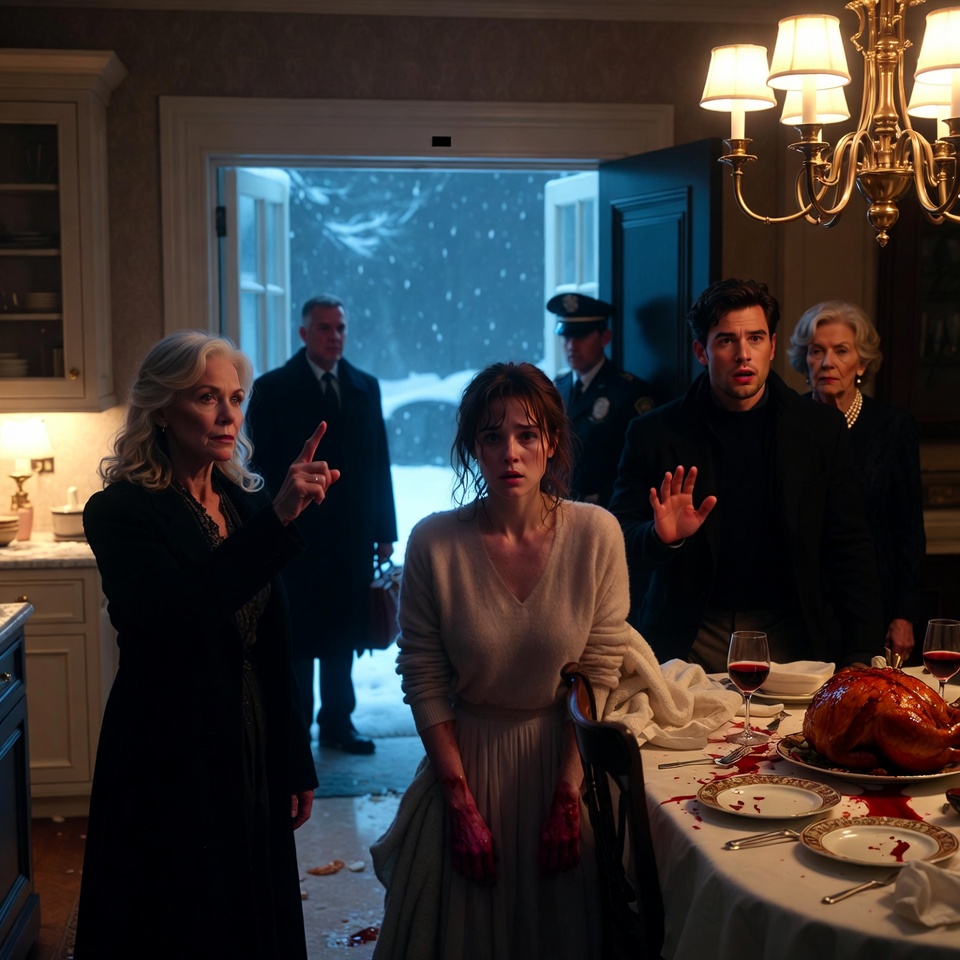
Ethan followed the direction of my finger, and for the first time since I entered the house, the arrogance left his face completely. He looked at the camera, then at Hannah, then back at me, as though one of us might laugh and admit the whole thing was a cruel performance.
No one did.
Mrs. Margaret reached for her wineglass, but her hand missed the stem. The glass tipped against the tablecloth and spilled red wine across the white linen.
“What camera?” she asked.
“The one that has been recording this kitchen for the past six weeks.”
Hannah’s head lifted.
“Six weeks?”
I nodded.
The pain in her face nearly broke me again, because I could see the question forming before she asked it. Had I known? Had I watched? Had I left her here while Ethan and his mother turned her home into a place where she flinched at broken plates?
“I did not know what was happening until yesterday,” I said quickly. “The security system sent an alert after the kitchen window was left open for several hours. Mr. Bennett reviewed the footage because the temperature sensors showed a risk of frozen pipes. He called me this morning.”
Hannah looked toward the open window. The curtain moved in the freezing wind.
Mrs. Margaret’s expression hardened. “This is illegal. You cannot record people inside their home without consent.”
“The camera was installed before the property was occupied. It is listed in the trust agreement, the security disclosure, and the property inventory.”
Ethan moved toward the wall.
“Do not touch it,” I said.
He stopped.
For years, he had built his confidence on the belief that every room would eventually submit to him. He had married a gentle woman, moved into a house he never paid for, and accepted a job arranged through one of my late husband’s business partners. Each favor had become proof, in his mind, that he was more powerful than the people who had helped him. Now he stood in the kitchen with one hand half-raised, afraid of a lens smaller than a coin.
“That camera does not prove anything,” he said. “Hannah is emotional. She twists things.”
Hannah’s face changed.
Not dramatically. She did not shout or step toward him. Her shoulders simply stopped folding inward.
I had watched my daughter make herself smaller from the moment I entered. Now, for one quiet second, she took up her own space.
“You opened the window,” she said.
Ethan looked at her. “What?”
“You opened it this morning.”
“It was warm.”
“It was twenty-eight degrees outside.”
Mrs. Margaret pushed back her chair. “You were being dramatic about the cooking smell.”
Hannah stared at her. “You told me I could close it after I finished cleaning.”
“Because the kitchen needed air.”
“My hands went numb.”
Mrs. Margaret rolled her eyes. “Young women today think discomfort is abuse.”
I felt my fingers close around the edge of my phone.
The front doorbell rang.
Ethan looked toward the hallway.
I did not move.
A second ring followed, then the heavy knock of someone who expected the door to open.
“Who is that?” Ethan demanded.
“People who read what they sign.”
I walked into the hall and opened the front door. Snow had begun falling over Brookline, covering the stone steps and the black iron fence with a thin white layer. Mr. Bennett stood beneath the porch light in a dark overcoat, carrying a leather case. Beside him were a notary public, two private security officers, and Officer Lucas from the local police department.
Ethan appeared behind me.
“You brought the police?”
Officer Lucas stepped forward. “We received a request for a welfare check and possible domestic assault.”
“There was no assault.”
I looked at Hannah’s wrist.
So did the officer.
Hannah pulled down her sleeve automatically. The movement was small, practiced, and devastating.
Officer Lucas’s voice softened. “Ma’am, may I speak with you privately?”
Ethan moved between them. “She does not need to speak to anyone. This is a family disagreement.”
The officer looked at him. “Move aside.”
“I am her husband.”
“That does not make you her spokesman.”
The room seemed to hold its breath.
Hannah looked from the officer to me.
I wanted to reach for her, but I knew that even love could become another pressure if I decided for her. So I waited.
She took one step forward.
“Yes,” she said. “I want to speak with you.”
Ethan’s jaw tightened.
“Hannah.”
She flinched at her own name.
Then she turned back toward him.
“No.”
It was the first time she had said the word since I arrived.
Ethan stared at her.
“What did you say?”
“I said no.”
Mrs. Margaret stepped into the hallway. “This is becoming ridiculous. Ethan, take your wife upstairs until she calms down.”
Hannah did not move.
Officer Lucas gestured toward the sitting room. “We can talk in there.”
Hannah followed him, and one of the security officers remained near the doorway. Ethan tried to follow, but Officer Lucas shut the door before he reached it.
“You cannot separate me from my wife in my own house,” Ethan said.
Mr. Bennett opened his leather case.
“This is not your house.”
Ethan turned toward him. “Who are you?”
“Arthur Bennett. Counsel for the Whitmore Family Residential Trust.”
Mrs. Margaret’s face tightened.
She remembered him.
Mr. Bennett had attended the wedding. He had also supervised the documents Ethan and his mother signed before moving into the property. At the time, Ethan joked that wealthy families loved unnecessary paperwork. Mrs. Margaret complained that the trust language was insulting, but she signed every page after learning the house had no mortgage.
Mr. Bennett removed a thick file and placed it on the entry table.
“The Brookline property was purchased by Margaret Whitmore and her late husband, David Whitmore, eighteen months before Hannah’s marriage. Legal title remains with the family trust. Mr. and Mrs. Cole received conditional occupancy rights, not ownership.”
Ethan laughed, but the sound carried no confidence.
“My name is on the house.”
“Your name is listed as an approved resident.”
“I pay the property taxes.”
“The trust pays them. You transfer a monthly housing contribution equal to less than one-third of the actual expenses.”
“I renovated the office.”
“With twelve thousand dollars advanced by Mrs. Whitmore.”
Ethan looked at me.
I saw the calculation begin. He was searching through every gift, every check, and every favor, trying to find something he could transform into ownership.
“My salary paid for this family,” he said.
Hannah’s voice came from behind the sitting-room door.
“No, it did not.”
The door opened.
She stood beside Officer Lucas, holding several folded pages in her hand. Her face was still pale, but the fear had begun changing shape. It was no longer fear of Ethan. It was fear of what she would have to admit aloud.
She looked at me.
“Mom, he took money from my account.”
Ethan’s face hardened. “That money paid household expenses.”
“You transferred it to your mother.”
Mrs. Margaret stepped forward. “Do not bring me into your marital finances.”
Hannah looked at her. “You used it for the condo deposit in Florida.”
Mrs. Margaret’s mouth opened, then closed.
Hannah unfolded the pages. “I found the bank statements last month. Twenty-seven thousand dollars over nine months.”
Ethan moved toward her.
“You went through my files?”
Officer Lucas stepped between them.
Hannah did not retreat.
“The account was mine.”
“You are my wife.”
“That does not make everything mine yours.”
“You were wasting the money in savings.”
“I was saving it because you told me we could not afford to start a family.”
The words changed the room.
Mrs. Margaret looked away.
Ethan’s anger flickered into something colder. “This is not the time.”
“No,” Hannah said. “This is exactly the time.”
Her voice trembled, but she continued.
“You told me we could not afford a baby. You said the house cost too much, your job was unstable, and I needed to stop talking about it. Meanwhile, you were paying for your mother’s condo.”
Mrs. Margaret lifted her chin. “My son was helping his family.”
Hannah looked at her. “What was I?”
Silence answered.
I had always known Hannah wanted children. She had spoken about them since she was young enough to name dolls after imaginary daughters. When she told me she and Ethan had decided to wait, I believed it was mutual. I believed the hesitation came from caution, not control.
“How long?” I asked.
Hannah looked down at the statements. “Almost a year.”
Ethan turned toward me. “Do not pretend you understand our marriage.”
“I understand purple hands.”
“She refuses to listen. She spends money without discussing it. She embarrasses me in front of my mother.”
Hannah gave a small, disbelieving laugh. “I bought a coat.”
“You already had one.”
“It did not close.”
“Because you gained weight.”
Officer Lucas looked at Ethan.
Even he seemed surprised by the cruelty of the sentence.
Hannah’s face crumpled for half a second, but she did not lower her eyes.
“I gained six pounds.”
“You stopped taking care of yourself.”
“I stopped eating dinner because your mother said I was getting heavy.”
Mrs. Margaret waved one hand. “I gave advice. Women used to appreciate honesty.”
“You locked the pantry,” Hannah said.
I looked at her.
“What?”
Hannah swallowed. “At night. She said I ate when I was anxious.”
Mrs. Margaret’s voice sharpened. “Because you did.”
I felt the air leave my lungs.
The expensive house suddenly looked unfamiliar. The polished floors, high ceilings, and framed wedding photographs had hidden something ugly because I had mistaken beauty for safety. I had visited less often after Hannah asked me to stop arriving without notice. I thought she wanted privacy. Now I understood Ethan had been reducing the number of witnesses.
Mr. Bennett turned toward me. “Mrs. Whitmore, we should proceed.”
I nodded.
He opened the file and removed a notarized notice.
“Under Section Nine of the occupancy agreement, residency rights may be terminated immediately in cases involving violence, coercive financial conduct, intentional property damage, or credible threats against a trust beneficiary.”
Ethan stared at him. “You cannot evict me without a court order.”
“Ordinarily, no. However, you are not a tenant under Massachusetts rental law. You are a conditional licensee occupying property owned by a private family trust. The agreement permits immediate suspension of access pending judicial review.”
“This is my legal residence.”
“You will have the opportunity to challenge the suspension. Tonight, you will collect essential personal belongings and leave.”
Mrs. Margaret laughed bitterly. “And where exactly are we supposed to go on Christmas week?”
I looked at her. “The condo in Florida appears available.”
Her face went white.
Ethan stepped toward Mr. Bennett. “I will destroy this family in court.”
“Then I suggest you retain counsel.”
“You think a camera and a few accusations will be enough?”
Mr. Bennett looked at Officer Lucas.
“The footage includes Mr. Cole grabbing Mrs. Cole by the wrist on four separate occasions, throwing food against the kitchen wall, restricting her access to the thermostat, and threatening to have her institutionalized if she contacted her mother.”
Hannah closed her eyes.
I could barely speak.
“He threatened what?”
Ethan looked at Hannah. “I said you needed help.”
“You said no one would believe me because your cousin worked at the clinic.”
“That was not a threat.”
“You held my phone over the sink and told me to choose.”
“Choose what?”
Hannah’s voice became almost too quiet to hear.
“Calling Mom or keeping my phone.”
Something inside me broke loose.
I moved toward Ethan before I realized it.
One of the security officers stepped between us, but I was not trying to hit him. I wanted him to look at me. I wanted the man who had frightened my daughter into silence to see exactly what his careful cruelty had awakened.
“You used me,” I said.
Ethan stared at me.
“You told her I would think she had failed.”
He said nothing.
“You told her I would blame her for the marriage.”
Hannah began crying.
That confirmed it.
I turned toward her.
She covered her face with both hands.
“He said you warned me,” she whispered. “He said you would say I should have known.”
I remembered the months before the wedding. I had told Hannah to slow down. Ethan was charming, attentive, and always eager to help, but something in him unsettled me. He spoke about success as if kindness were a weakness and praised women who knew how to “support a man’s ambition.” Hannah accused me of judging him because his family had less money. I backed away because I did not want to become the mother who forced her daughter to choose.
Ethan later transformed my caution into a weapon.
I crossed the room and held Hannah’s face between my hands.
“Listen to me. You did not fail because someone lied well. You did not fail because you loved him. You are not responsible for the person he chose to become after he believed no one was watching.”
Her tears moved over my fingers.
“I should have called you.”
“Yes,” I said, because comforting her with a lie would only repeat the damage. “I wish you had called. But I understand why you did not.”
She leaned against me, and for the first time since I entered the house, she allowed her full weight to rest somewhere.
Behind us, Ethan spoke.
“She is manipulating you.”
Hannah turned in my arms.
“No. That is what you told me every time someone cared about me.”
The truth struck him harder than shouting would have.
Officer Lucas informed Ethan that, based on Hannah’s statement and the visible injury to her wrist, he was being detained while the department reviewed the footage. Ethan’s face changed from anger to disbelief.
“You are arresting me because my wife bruises easily?”
Officer Lucas reached for the handcuffs. “Turn around.”
Mrs. Margaret stepped between them. “You will not treat my son like a criminal.”
“Move, ma’am.”
“He is a respected financial adviser.”
“That is not relevant.”
“I know the police commissioner.”
“Then he can explain the process to you later.”
Ethan looked at Hannah one last time.
“If you let them do this, there is no coming back.”
Hannah held his gaze.
“I know.”
For a second, I saw panic enter his face. Not grief. Not love. Panic. The fear of a man realizing the door he had used to control someone was closing from the other side.
Officer Lucas led him out through the front entrance.
Snow blew into the hall before the door shut behind them.
Mrs. Margaret stood beside the dining room with wine staining the front of her blouse. Without Ethan beside her, she seemed smaller, though no less poisonous.
“You have destroyed his life,” she told Hannah.
Hannah wiped her face.
“No. I stopped letting him destroy mine.”
Mrs. Margaret turned toward me. “You raised a selfish daughter.”
“I raised a daughter who survived your son.”
“She married into our family and refused to adapt.”
“She gave you money, cooked your meals, cleaned the house, and allowed you to live here.”
Mrs. Margaret’s eyes narrowed. “I am his mother.”
“And she was his wife.”
“Blood comes first.”
“Then call your own family for somewhere to sleep.”
She stared at me. “You would put an older woman into the street?”
“No. I am giving you one hour to pack. Mr. Bennett has arranged a hotel room for three nights. After that, you may use the condo Hannah unknowingly helped purchase.”
Her mouth tightened. “I will not accept charity from you.”
“Good. The room will be charged against the money taken from my daughter.”
She looked toward Hannah as if expecting shame to force her into kindness.
Hannah said nothing.
Mrs. Margaret climbed the stairs.
Her heels struck each step with enough force to announce that she still considered herself wronged.
When she disappeared, Hannah looked toward the kitchen.
The roasted chicken remained on the dining table. Broken china covered the floor. The sink overflowed with cloudy water, and the open window continued letting snow into the room.
“I should clean that,” she said automatically.
“No.”
“The floor—”
“Will still be there tomorrow.”
She looked at me as if the possibility had never occurred to her.
I closed the window. Warm air moved weakly from the vent, struggling against hours of cold. Then I found a blanket in the sitting room and wrapped it around Hannah’s shoulders.
Her hands were still purple.
Mr. Bennett called a physician who worked with the family. While we waited, Hannah sat at the kitchen table and told us what the cameras had not captured.
The control had begun slowly.
Ethan criticized her friends until she stopped inviting them over. He complained that her job at the museum interfered with the household, so she reduced her hours. When she resigned completely, he told her she lacked discipline. He reviewed grocery receipts, monitored her phone, and transferred money from her savings under the explanation that married couples should not keep secrets. Mrs. Margaret moved into the guest suite after hip surgery and never left. Together, they turned Hannah’s kindness into a system of unpaid service.
Ethan never struck her across the face. He understood visible injuries attracted questions. He grabbed her wrists, blocked doorways, threw objects near her, and kept the house cold because he said heating costs were irresponsible. When Hannah threatened to leave, he reminded her that the deed was in his name.
That lie had trapped her more effectively than a locked door.
“I thought I had nowhere to go,” she said.
“You always had me.”
“I know that now.”
“You knew it then too.”
She looked at me.
I continued gently. “But knowing someone loves you and believing they will still love you after you admit what happened are not always the same thing.”
Her eyes filled again.
I understood because I had once hidden fear in a beautiful house too.
Hannah’s father, David, had never treated me as Ethan treated her, but my first marriage had taught me how shame distorted time. I had stayed with a man who controlled my money and mocked my ambitions because I believed leaving would prove everyone right about my poor judgment. When I finally escaped, I promised myself my daughter would never depend entirely on someone else for shelter. That promise was the reason David and I created the trust before Hannah’s wedding.
I had protected the house.
I had not protected her from believing it belonged to Ethan.
The doctor arrived and examined Hannah’s hands and wrist. There was no fracture, but the cold exposure had damaged the circulation enough to require monitoring. He documented the bruises and recommended she spend the night somewhere else while the heating system recovered.
Hannah refused to leave.
“This is my home,” she said.
The statement sounded fragile but deliberate.
So we stayed.
The security officers changed the locks while Mrs. Margaret packed upstairs. At one point, she attempted to remove two paintings, a silver tea service, and the wedding china that remained unbroken. Mr. Bennett stopped her at the door and compared every item against the trust inventory.
“This is humiliating,” she said.
Hannah looked at the cardboard boxes near her feet.
“Yes,” she replied. “It is.”
Mrs. Margaret left at 9:40 that night.
She did not say goodbye.
After the car disappeared through the gates, Hannah stood in the entry hall for a long time. The house was finally quiet, but peace did not arrive with the silence. Every room still contained the shape of what had happened there.
“I hate this place,” she whispered.
I looked at the staircase, the polished floors, and the family photographs Ethan had chosen for the walls.
“Then we change it.”
Over the next week, we opened every curtain. We raised the thermostat. We moved Mrs. Margaret’s heavy furniture out of the guest suite and donated the dining chairs where Hannah had been ordered to stand while they ate. Emma, Hannah’s oldest friend, came with paint samples and stayed until midnight. We repainted the kitchen from cold gray to pale yellow. The fine china went into storage. Hannah bought six thick ceramic bowls from a local shop because she liked the way they felt in her hands.
The legal process moved more slowly.
Ethan was released pending investigation and immediately challenged the trust’s occupancy suspension. His attorney claimed the recordings violated privacy, Hannah’s injuries were accidental, and the financial transfers were shared marital decisions. He also filed for temporary access to the property, arguing that eviction caused emotional and professional harm.
The judge denied the request after reviewing the footage.
Several clips were difficult to watch. In one, Ethan stood over Hannah while she sat on the kitchen floor and demanded she apologize for embarrassing his mother. In another, Mrs. Margaret locked the pantry while Hannah asked for the key. The most damaging footage showed Ethan gripping Hannah’s wrist and telling her that if she called me, he would tell everyone she was unstable.
He had forgotten about the camera.
He had not forgotten how to smile afterward.
The district attorney charged him with assault, coercive control-related offenses available under state law, and financial fraud connected to the unauthorized transfers. Mrs. Margaret was not criminally charged, but the condo transaction became part of the civil case. Under pressure from her own attorney, she agreed to return the funds rather than risk losing the property entirely.
Ethan lost his job after the financial firm reviewed the allegations. He blamed Hannah publicly, telling colleagues that a wealthy mother-in-law had used influence to destroy him. Several people believed him. Men like Ethan survived by offering explanations that allowed others to protect their own comfort.
Hannah stopped reading the comments.
At first, she slept with the bedroom door locked. Then she stopped sleeping in the bedroom entirely and moved into the sunroom. She kept lights on at night and apologized whenever she cried. Healing did not arrive as a dramatic transformation. It came through small acts that looked unimpressive from the outside: ordering food without asking permission, turning the heat above seventy, ignoring a ringing phone, and allowing dirty dishes to remain in the sink until morning.
Three months after Ethan left, Hannah returned to the museum.
She began with two afternoons a week. On her first day, she stood in the front hall for ten minutes because the noise made her heart race. Her supervisor offered to send her home. Hannah stayed until closing.
Six months later, the divorce was finalized.
Ethan requested a portion of the home’s equity.
There was none available to him.
He requested spousal support, claiming he had sacrificed career opportunities for the marriage.
His own emails proved otherwise.
He requested the wedding china.
Hannah let him have the surviving pieces.
“I never want to see them again,” she told me.
The court awarded Hannah repayment of the stolen funds, though collecting the full amount would take years. She did not receive a perfect ending. There was no single verdict capable of returning the months she spent frightened in her own kitchen. Justice could remove Ethan, restore money, and confirm that the house was hers. It could not teach her nervous system that a raised voice was no longer danger.
That work belonged to time.
The following December, almost one year after I walked into the house, Hannah invited twelve people for dinner.
The table was not formally arranged. Napkins did not match. One of the ceramic bowls had a small chip along the rim, and the roasted chicken came out slightly dry. No one complained. The windows were closed, the kitchen was warm, and Hannah wore thick red socks on the tile.
Halfway through the meal, her friend Emma carried an empty plate toward the sink.
Hannah stopped her.
“Leave it.”
Emma looked at her. “Are you sure?”
“Yes. I’ll wash everything tomorrow.”
The room did not collapse. No one called her lazy. No one pointed toward the kitchen or explained what a proper wife should do.
Emma placed the plate on the counter and returned to the table.
Hannah looked at me.
It was only a plate.
That was why it mattered.
After dinner, we sat in the living room beneath the Christmas tree. Hannah handed me a small wrapped box. Inside was the spare key I had used the year before, now attached to a new brass key ring.
I looked at her.
“Are you sure?”
She smiled.
“In case I burn dinner one day and need you to come save me.”
The words were the same ones she had spoken before the wedding, but neither of us laughed immediately. Too much had happened inside that sentence.
Then Hannah reached across the table and closed my fingers around the key.
“But next time,” she said, “ring the bell first.”
I laughed.
So did she.
It was not the careful laugh she had used when trying to calm Ethan. It was loud, uneven, and entirely her own.
Later, after everyone left, I stood at the front door beneath the porch light. Snow moved softly over the garden, settling on the iron gate and the stone path. Through the kitchen window, I saw Hannah carrying two glasses to the sink. For a moment, fear tightened my chest.
Then she placed them on the counter, turned off the light, and walked away.
The dishes remained there.
The house remained standing.
And my daughter was finally free enough to leave a mess in her own home.