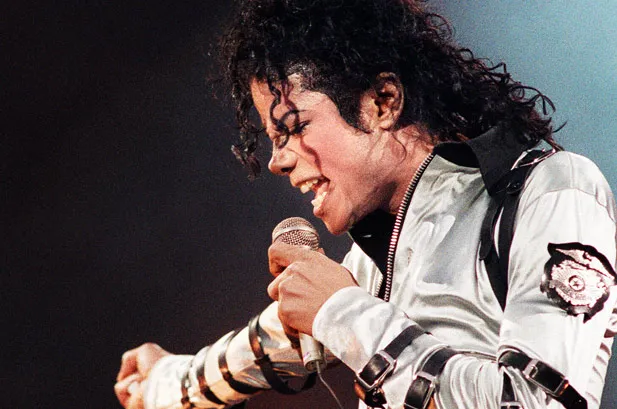
During the HIStory World Tour of 1996 and 1997, Michael Jackson was no longer simply touring as a pop star. He was moving across the world like a cultural event.
The tour stretched across five continents, reaching Europe, Asia, Oceania, Africa and North America. It included 82 concerts in 57 cities across 35 countries and drew about 4.5 million fans. By the time it ended, the HIStory World Tour had grossed about $165 million, making it one of the defining live music events of the 1990s and Jackson’s final full-scale solo world tour.
But among fans, one story about that tour has survived for a very different reason.
It is not about the size of the crowds.
It is not about the military-style gold costume.
It is not about the giant statues, the pyrotechnics, or the almost impossible scale of the production.
It is about ticket prices.
For years, a widely repeated fan account has claimed that Jackson deliberately kept some HIStory World Tour ticket prices unusually low — around $14 to $15 per seat — because he wanted ordinary fans to be able to attend. The same story claims the decision cost him tens of millions of dollars during the early part of the tour.
Mainstream archival confirmation for the exact $14–$15 figure is difficult to establish, and ticket prices almost certainly varied by country, city and venue. But the reason the story has endured is easy to understand: it fits the way many fans remember Michael Jackson.
The HIStory World Tour was not a small production. It was one of the most elaborate concert tours ever staged at the time. Jackson’s team moved a massive stage operation around the world, supported by hundreds of crew members, complex lighting, large video screens, pyrotechnics, special effects and one of the most theatrical openings in pop concert history.

In some cities, enormous promotional statues of Jackson were installed as part of the campaign surrounding the HIStory era. These giant figures became symbols of the tour’s scale and of Jackson’s almost mythic image at the time.
Everything about the production suggested maximum spectacle.
But the ticket-price story suggests something more personal.
If true, it would mean Jackson looked at the demand surrounding his concerts and made a decision few business managers would recommend. He could have charged far more. He had the audience. He had the global name. He had the kind of fan loyalty most artists spend a lifetime trying to build.
Instead, according to the long-running account, he wanted to keep the door open for the people who had supported him from the beginning.
That idea matters because Michael Jackson’s connection with fans was never ordinary. His audience did not simply buy his albums. They grew up with him. Many had watched him as the little boy with the enormous voice in the Jackson 5. They had followed him through Off the Wall, Thriller, Bad, Dangerous and into the turbulent HIStory era.
By the mid-1990s, his fans had not only celebrated his success. They had also defended him through some of the most difficult years of his public life.
So the idea that Jackson would absorb financial losses rather than price those fans out of the stadium feels emotionally believable to many who study his career.
The HIStory World Tour itself was built around more than entertainment. It was also a statement. The album HIStory: Past, Present and Future, Book I was released after a period of intense public scrutiny, and the tour carried that same feeling of defiance, pain and survival. Songs like “They Don’t Care About Us,” “Earth Song,” “Stranger in Moscow” and “HIStory” gave the concerts a heavier emotional weight than a simple greatest-hits show.
Jackson was performing not only as an entertainer, but as someone trying to reclaim his story in front of the world.
That may be why the ticket story resonates so strongly. It presents him not as a distant superstar counting revenue, but as an artist still thinking about the people in the upper rows — the fans who saved money, traveled long distances and waited outside hotels just to feel close to him for a few seconds.
The modern concert industry often moves in the opposite direction. Today, major tours are defined by dynamic pricing, VIP packages, resale markups and premium seats that can cost thousands of dollars. Fans are often forced to choose between seeing their favorite artist and protecting their bank account.
Against that backdrop, the idea of Michael Jackson choosing accessibility over maximum profit feels almost radical.
It also reflects a larger truth about his public image. Jackson was known for extravagance, but he also repeatedly attached his work to ideas of children, healing, charity and global connection. His concerts were massive, but his message often returned to the same emotional center: the world was broken, and people needed care.
That was visible in the HIStory World Tour setlist too. Alongside the explosive dance numbers and legendary hits, Jackson performed “Heal the World” and “Earth Song,” two songs that placed suffering, compassion and responsibility at the center of a stadium show.
Whether every detail of the low-ticket-price story can be verified or not, the fact that fans continue to repeat it says something important.
They believe Michael Jackson cared about whether they could be there.
They believe he understood that a concert ticket was not just a transaction. It was a chance for a fan to stand in the same room — or the same stadium — as someone whose music had shaped their life.
The HIStory World Tour remains one of the biggest chapters in Jackson’s career. It drew millions. It crossed continents. It generated enormous revenue. It confirmed that even during a complicated era, Michael Jackson could still command the world’s attention on a scale almost no artist could match.
But for many fans, the most meaningful part of the story is not the money the tour made.
It is the money he may have been willing to leave behind.
Because if the account is true, Michael Jackson did something rare at the height of global demand. He looked at the people who had carried him from Gary, Indiana, through the Jackson 5, through Thriller, through Bad, and into HIStory — and decided they still deserved a place in the stadium.
Not just the wealthy fans.
Not just the VIPs.
Not just the people who could afford the best seats.
But the ordinary fans too.
And perhaps that is why the story has lasted.
Because behind the spectacle of the HIStory World Tour was a simple idea that still feels powerful today: Michael Jackson did not want his fans priced out of his own history.