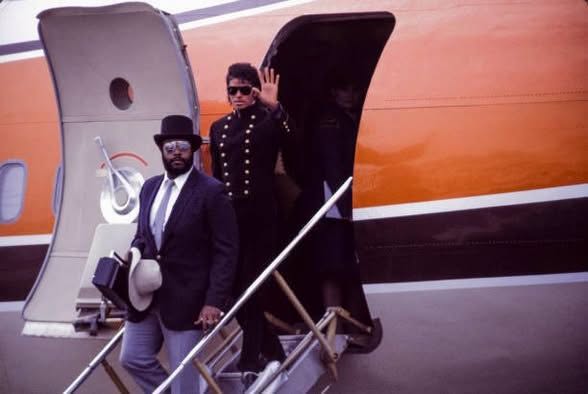
Long before private jets became part of celebrity culture, Michael Jackson was already traveling like a global phenomenon.

In 1984, at the height of Jacksonmania, the Victory Tour became one of the biggest live music events of the decade. From July 6 to December 9, the Jacksons crossed North America in a tour that ended at Dodger Stadium in Los Angeles. Fans remember the glittering glove, the roaring stadiums and the electric power of Michael Jackson at his commercial peak.
But behind the scenes, there was another story moving quietly through the skies.
It was the story of the aircraft that carried Michael Jackson and the Jacksons during parts of the tour — and the pilots who made sure the King of Pop could move from city to city while the world waited below.
Pilot David Rowland later recalled his experience flying during that period, giving rare insight into the private aviation world surrounding one of music’s most famous tours. At the time, Rowland worked for Airmark Corporation, a private aviation department based in Burbank, California. The company had originally operated a Gulfstream II and a Bell Jet Ranger helicopter before expanding into a much larger aircraft: a Boeing 707.
That aircraft, first registered as N138TA and later re-registered as N220AM, was no ordinary jet.
It had once been connected to Tiger Air, which was active in converting aircraft such as BAC-111s, Boeing 727s and Boeing 707s into corporate aircraft. For wealthy individuals and major clients who needed long-range travel, the 707 offered something smaller jets could not: serious distance, space and presence.
The plane chosen for Airmark was a Boeing 707-138B, a model known for its size and fuel capabilities. According to Rowland, the aircraft had been outfitted for only 34 passengers, leaving room for additional fuel tanks in the baggage compartments. Those tanks helped extend its range and made it suitable for demanding long-distance missions.
Inside, the aircraft sounded more like a flying mansion than a tour plane.

The galley was designed for full VIP service, complete with sterling silver utensils and serving tools. Limoges china and Waterford crystal were used in the dining and lounge areas. A four-seat round table sat near the front of the lounge, surrounded by seats covered in expensive pigskin. A brass outline of the world decorated the forward bulkhead, while televisions and then-modern VCR equipment gave passengers entertainment options that felt advanced for the early 1980s.
Even the cockpit had been upgraded for its time, with modern radios, radar and navigation equipment, along with dual Delco Carousel IV-INS units and a GNS-500 VLF backup system.
It was a serious machine built for serious travel.
By June 1984, Airmark had moved the 707 operation to an American Airlines maintenance hangar at Los Angeles International Airport. The company was preparing for worldwide operations, and in July 1984, it received its FAR 121 worldwide operations specifications.
Then came its first major charter.
Michael Jackson’s Victory Tour.
The tour opened on July 6, 1984, in Kansas City, Kansas, and closed on December 9 at Dodger Stadium in Los Angeles. While the Jacksons used road and rail transportation for some parts of the schedule, Rowland said Airmark handled the flying with the 707. Despite the scale of the tour, the aircraft usually carried no more than 10 passengers.
That detail is striking. Outside, Michael Jackson was filling stadiums and creating mass hysteria. Inside the aircraft, the atmosphere may have been far quieter — a small group moving through a massive machine designed for power, comfort and privacy.
One of the most memorable incidents happened in Vancouver.

While the tour was there, two teenagers managed to break into the aircraft while it was parked on the ramp. According to Rowland, airport personnel noticed an over-wing exit open at night and called police, who caught the teenagers. The aircraft was searched thoroughly, including a bomb dog walk-through.
The teens had not damaged anything. They were not trying to steal from the aircraft. They simply wanted to see Michael Jackson’s plane.
The incident could have become a serious legal matter. Instead, it turned into one of those strange stories that only seems possible during the height of Jacksonmania. Rowland recalled meeting the father of one of the teenagers, who was deeply worried that charges would be pressed. They were not. Michael Jackson’s security chief, Bill Bray, was informed of the incident.
The response was surprisingly lighthearted.
According to Rowland, Jackson’s team found the situation funny and even gave the teenagers free passes.
That small moment says a lot about the atmosphere around the Victory Tour. Michael Jackson was not just a pop star. He was an obsession. Fans did not only want to see him perform. They wanted to be close to anything connected to him — the stage, the hotels, the entrances, even the airplane.
During the tour, the aircraft also underwent maintenance. Rowland recalled that N138TA flew to Tramco in Everett, Washington, on August 10 and returned on August 20 with its new registration, N220AM.
After the Victory Tour, the plane continued flying for its owner and other clients, including trips to New Zealand, Japan, France and England. It also served charter clients such as a Saudi prince and executives from the Diamond Shamrock oil company.
But the aircraft’s future was already under pressure.

By the end of 1984, Stage 3 noise regulations created serious problems for older Boeing 707 operations. The aircraft was effectively grounded after December 31, 1984, although Airmark received a temporary exemption allowing limited operations in the United States until May 31, 1985. The exemption only allowed the plane to operate to airports it had served in 1984, making charter operations extremely difficult.
A planned hush kit never materialized, and market conditions made the aircraft hard to keep in service. In January 1985, N220AM was sold to Community Transport in San Antonio, Texas. Rowland personally delivered the aircraft there on a ferry permit.
The jet later found another high-profile life. In August 1986, Saudi Prince Bandar bin Sultan purchased the aircraft as an upgrade from his Boeing 727. The 707 was registered HZ-123 and based at Page Aviation at Washington Dulles International Airport. It remained in service until Prince Bandar later took delivery of an Airbus A340.
For aviation enthusiasts, the aircraft’s story did not end with Michael Jackson. It became part of a larger history of VIP 707s, corporate conversions, noise regulations and the changing world of private long-range travel.
But for fans of the King of Pop, its most fascinating chapter will always be the Victory Tour.
In 1984, Michael Jackson was not just traveling from concert to concert. He was moving through America at the center of a cultural storm. Every city wanted him. Every crowd screamed for him. Every piece of his world became a magnet for curiosity.
And somewhere above it all, a converted Boeing 707 carried the most famous performer on earth through one of the biggest tours of his life.
The Victory Tour is remembered for the music, the dancing and the stadium-sized hysteria.
But behind the roar of the crowd was a quieter image: Michael Jackson’s private aircraft waiting on the ramp, powerful and polished, while fans on the ground dreamed of getting close enough just to see the plane that carried the King of Pop.