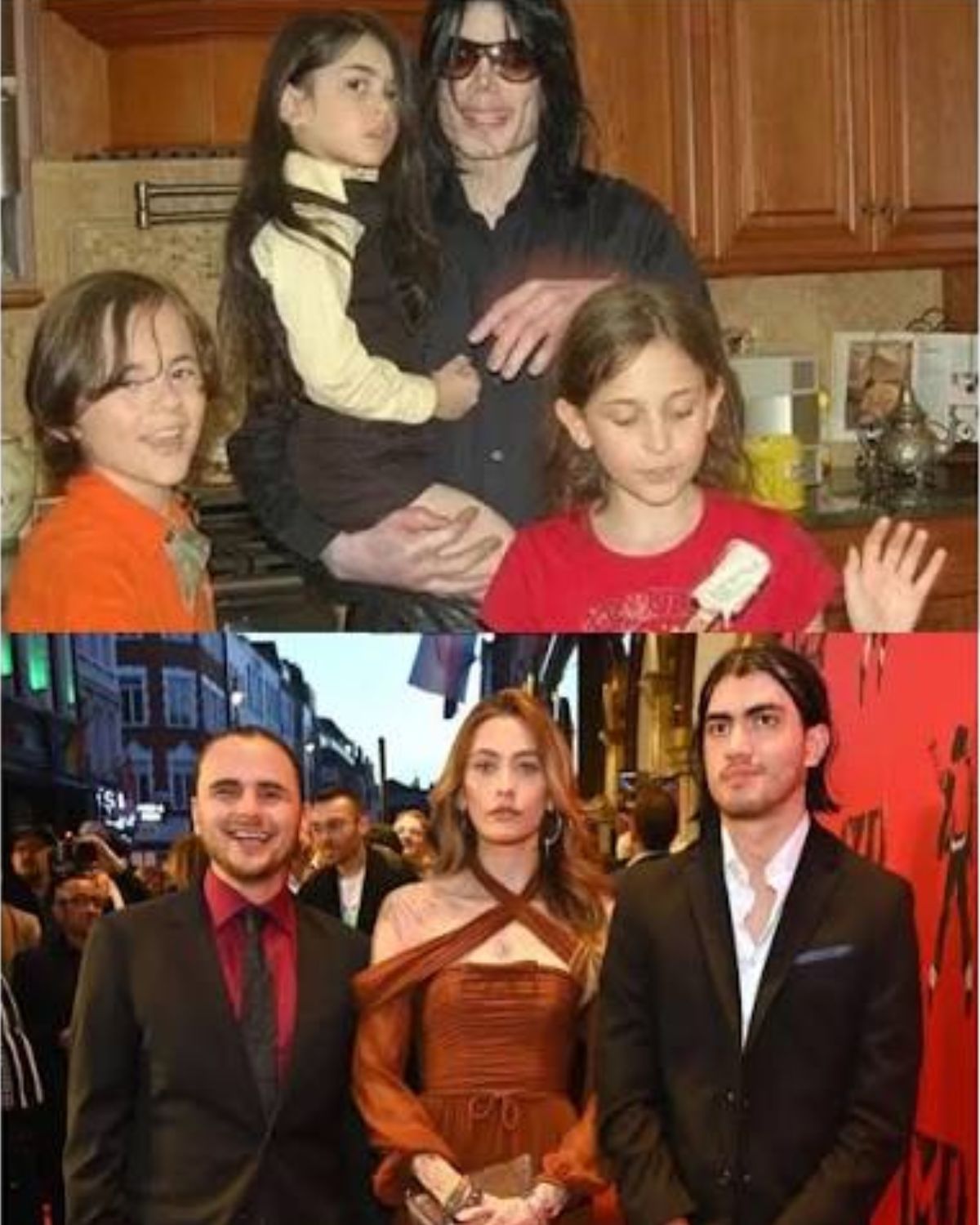
When Michael Jackson died on June 25, 2009, the world mourned the loss of the King of Pop. Fans gathered in shock. Television networks broke into wall-to-wall coverage. Radio stations replayed the songs that had shaped generations.
But inside the Jackson family, the grief quickly centered on a far more fragile question.
What would happen to his children?

Prince Michael, Paris and Blanket were still young when their father died. Prince was 12. Paris was 11. Blanket, whose legal name is Prince Michael II, was only 7. They had lost not only one of the most famous entertainers in the world, but the parent who had raised them and fiercely tried to shield them from public life.
In the days after Jackson’s death, the family’s message was clear: the children had to remain together, protected and surrounded by family.
Michael had already made his wishes known in his will. According to court filings reported at the time, Jackson named his mother, Katherine Jackson, as the preferred guardian for his three children. If Katherine was unable or unwilling to serve, he named his longtime friend Diana Ross as the alternate choice.
That detail mattered deeply. Even after years of fame, controversy and isolation, Jackson’s final legal instructions pointed back to family. He wanted his children in the care of the Jackson matriarch.
The custody question quickly became one of the most closely watched legal issues following his death. Katherine Jackson was initially granted temporary guardianship, and on August 3, 2009, a Los Angeles Superior Court judge granted her permanent guardianship of Prince, Paris and Blanket. Reports at the time said Judge Mitchell Beckloff approved the petition as being in the best interest of the children.
The ruling helped bring stability after weeks of uncertainty.
There was also the question of Debbie Rowe, Jackson’s ex-wife and the mother of Prince and Paris. After Jackson’s death, the possibility of a custody fight drew major public attention. But attorneys later announced that a custody agreement had been reached. Under that arrangement, Katherine Jackson would receive custody, while Rowe would have visitation rights with the two children she bore.
For a family already grieving under the glare of the world, avoiding a long public custody battle was significant. The children had just endured an unimaginable loss. Keeping them together became the priority.
That commitment was visible during Michael Jackson’s public memorial at Staples Center on July 7, 2009. Millions watched as his family, friends and fellow performers paid tribute. But the most unforgettable moment came from Paris Jackson, who stood beside her relatives and tearfully told the world that her father had been the best father anyone could imagine.
In that moment, the mythology around Michael Jackson briefly fell away. He was not just a superstar. He was a father whose daughter was shattered.
The legal arrangements that followed could not erase that loss, but they did give the children a family structure. Katherine Jackson became the steady figure at the center of their lives, supported by other members of the Jackson family. Years later, TJ Jackson, Michael’s nephew, also stepped into a larger guardianship role as the children grew older and Katherine aged.
The story of Michael Jackson’s children after his death has always carried two truths at once.
The first is that they inherited one of the most complicated legacies in entertainment history. Their father left behind music that changed the world, but also a life surrounded by intense scrutiny, legal battles, media obsession and unanswered pain.
The second truth is more human. They were children who lost their father far too soon.
Prince, Paris and Blanket did not ask to become symbols of their father’s legacy. They were pulled into the public eye because of who their father was. After his death, every court filing, family statement and public appearance became part of a global story.
But the Jackson family’s central position was consistent: the children should be kept together and raised within the family Michael trusted.
Over time, each of the three children has grown into adulthood in different ways. Prince has spoken publicly about his father’s lessons and legacy. Paris has pursued music, modeling and acting while also speaking honestly about grief, identity and healing. Blanket, now known publicly as Bigi in many reports, has lived a much quieter life than his older siblings.
Their paths are different, but all three remain tied to a father whose presence still dominates pop culture more than a decade after his death.
Michael Jackson gave the world “Billie Jean,” “Thriller,” “Beat It,” “Man in the Mirror” and “Heal the World.” But to Prince, Paris and Blanket, his legacy was not only the moonwalk, the glove or the records broken.
It was the memory of a father.
That is why the custody battle after his death mattered so much. It was not just about legal guardianship. It was about protecting the last and most personal part of Michael Jackson’s life.
When the world lost him, the Jackson family faced a storm of grief, headlines and legal pressure. But through it all, one message rose above the noise.
The children came first.
And for Michael Jackson, who spent his life trying to control what the world could and could not see, that may have been the final wish that mattered most.


:max_bytes(150000):strip_icc():focal(749x0:751x2)/jay-z-in-8-062526-a1dc433a2d3b477bb828ed3b00bf85a1.jpg)
