The glass facade of the Imperial Crest Hotel shimmered beneath the Manhattan afternoon sun like a monument to money itself.
Everything about the place was designed to intimidate ordinary people. The gold-framed revolving doors. The towering marble columns. The polished black cars gliding in and out of the circular driveway. The scent of imported lilies and sandalwood floating through the lobby. Even the silence inside the hotel felt expensive.
This was not just a hotel.
It was one of the most exclusive luxury properties in New York City, a place where billionaires hosted private dinners, foreign diplomats booked entire floors, and celebrities entered through side corridors to avoid cameras. Every chandelier, every velvet chair, every square inch of white marble screamed the same message:
If you had to ask the price, you didn’t belong there.
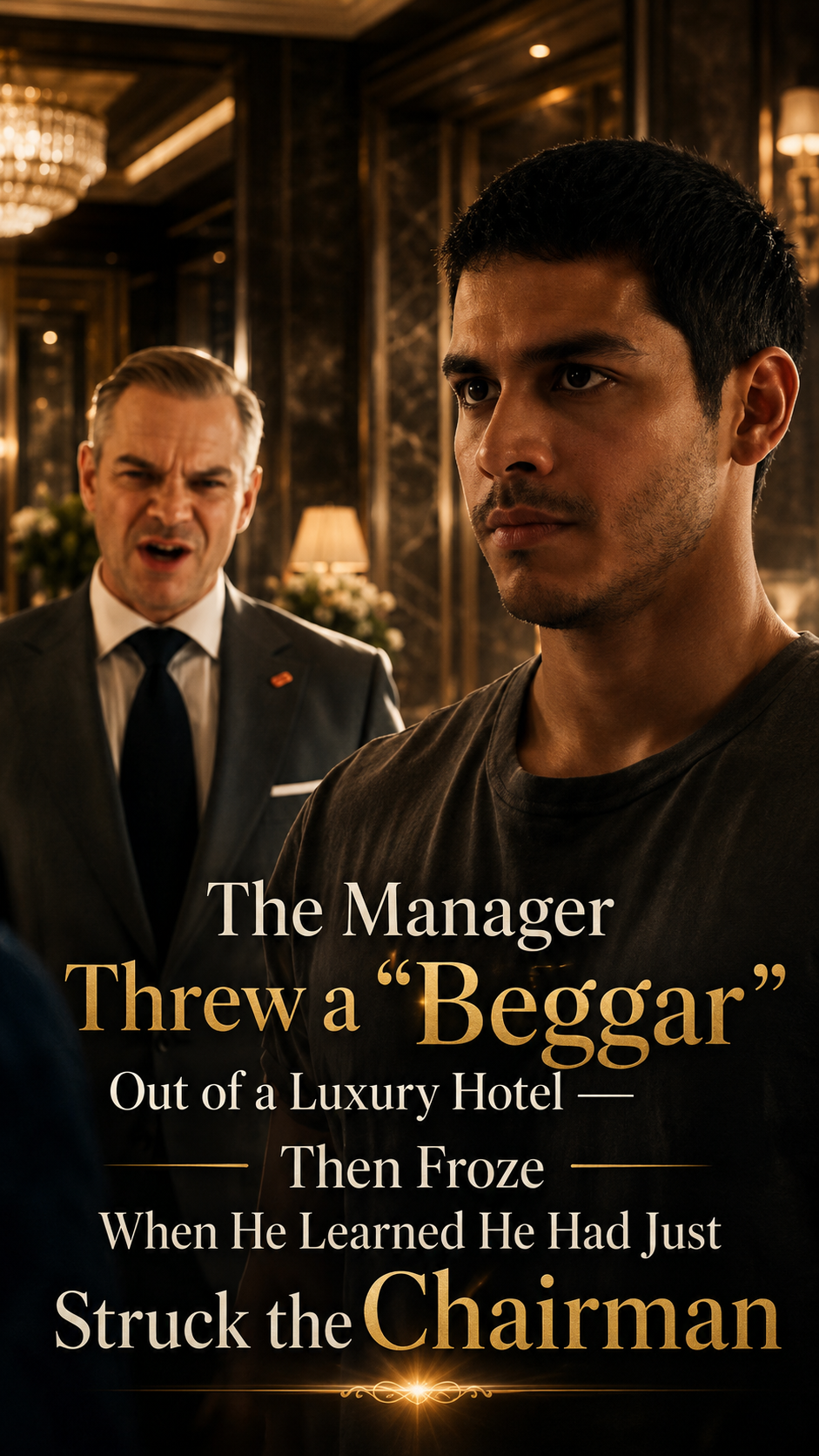
At the center of the lobby stood Daniel Reeves, the hotel’s general manager.
He was the kind of man who believed power lived in posture. His hair was slicked back with military precision. His charcoal suit was so sharply tailored it looked cut from steel. His expression carried the permanent coldness of someone who enjoyed deciding who was worthy and who was not.
Daniel prided himself on protecting the image of Imperial Crest.
He did not simply manage a hotel.
He guarded a kingdom.
And that was why the moment the old revolving door turned and a poorly dressed man stepped inside, Daniel’s entire face hardened with disgust.
The man looked like he had no right to be there.
He appeared to be in his late sixties. His gray hair was wind-tousled, his beard slightly untrimmed, his shoes worn at the edges. He wore a faded brown jacket over a plain shirt, dark trousers that had clearly seen years of use, and carried no suitcase—only a small weathered canvas bag slung over one shoulder.
He did not look drunk. He did not look dangerous.
He simply looked poor.
And in Daniel Reeves’s world, that was offense enough.
Several guests near the reception desk glanced over. A woman in designer sunglasses subtly pulled her handbag closer. A young bellman slowed his steps. A pair of socialites seated in the lounge exchanged amused looks over crystal flutes of champagne.
The older man stood quietly in the middle of the lobby, taking in the room with calm eyes. There was something strangely composed about him. He wasn’t nervous. He wasn’t begging. He wasn’t lost.
He just looked around as if he were remembering something.
Daniel strode forward before the man could take another step.
“Sir,” he said sharply, his tone already dripping with contempt, “this hotel is for registered guests only.”
The older man turned toward him and offered a small, polite smile.
“I’m here for a meeting,” he said calmly.
Daniel gave a humorless laugh.
“A meeting?” he repeated, loudly enough for nearby guests to hear. “At Imperial Crest?”
A few people smirked.
The older man nodded once. “Yes.”
Daniel looked him up and down in the most insulting way possible.
“With who?” he asked.
The man’s answer was simple.
“The board.”
That did it.
A blonde woman near the concierge desk let out a tiny laugh. One of the socialites covered her mouth. Even a receptionist lowered her eyes to hide her reaction.
Daniel stepped closer, his jaw tightening.
“Listen to me carefully,” he said, voice low and venomous. “This is not a shelter. This is not a public waiting room. And it is certainly not a place for street wanderers to come inside and make up stories.”
The older man’s expression did not change.
“I said I’m here for a meeting.”
Daniel’s patience snapped—not because the man was rude, but because he remained calm. That calmness irritated him more than anger would have.
“I don’t care what story you’ve prepared,” Daniel barked. “You are embarrassing this establishment. Leave now.”
The older man still didn’t move.
For one dangerous second, the entire lobby seemed to lean into the silence.
Then Daniel made the worst decision of his life.
He grabbed the man by the arm.
Hard.
Gasps rose from the front desk area as Daniel jerked him toward the entrance.
“I said get out!”
The canvas bag fell from the older man’s shoulder and hit the marble floor with a flat thud.
Still, the man did not fight back.
He only tried to steady himself.
But Daniel, now fully intoxicated by public authority, shoved him again—harder this time.
The older man stumbled backward and crashed against the edge of a decorative console table. A silver tray rattled violently. A vase of white orchids tipped and shattered onto the marble floor.
The sound cracked through the lobby like a gunshot.
A few guests stood up in alarm.
“Oh my God,” someone whispered.
Daniel pointed toward the door, face red with rage.
“Get this bum off the property before I call the police!”
The older man slowly straightened.
A thin scrape reddened the side of his hand where it had struck the broken glass. His jacket sleeve was dusty. His breathing was slightly heavier now, but his face remained eerily calm.
He looked at Daniel with an expression that was not fear.
It was disappointment.
And somehow, that made the room colder.
The manager mistook the silence for victory.
He turned slightly to the onlooking guests and smoothed the front of his suit, eager to reclaim control of the scene.
“My apologies, everyone,” he announced. “We deal with these kinds of disturbances quickly.”
But before he could say another word, a deep mechanical rumble shook the front entrance.
The sound came from outside.
Then another.
Then several more.
Heads turned toward the glass doors.
A convoy of black SUVs swept into the driveway in fast, synchronized formation, tires gliding over the stone with chilling precision. Not one or two vehicles.
Five.
Behind them came a sleek black town car with diplomatic plates.
The doormen froze.
The valet staff straightened instantly.
Inside the lobby, every conversation died.
The SUV doors swung open one after another.
Men in dark tailored suits stepped out, each wearing earpieces, each moving with controlled, military-level discipline. They spread across the entrance in seconds, scanning the surroundings with terrifying efficiency.
This was not normal corporate security.
This was power.
Real power.
Daniel’s face shifted.
His first instinct was confusion. His second was panic.
Then the rear door of the town car opened.
A tall man in his early forties emerged, dressed in a midnight-blue suit, a silver watch gleaming under the afternoon light. He was handsome in the cold, polished way of old-money executives. Two more security men fell in behind him as he entered the hotel with a face so grave that even the air seemed to tighten around him.
Several guests recognized him at once.
Whispers spread like sparks through dry grass.
“That’s Marcus Ashford.”
“Ashford? The billionaire?”
“The CEO of Ashford Global Hospitality?”
“He owns this hotel group…”
Daniel’s throat went dry.
Marcus Ashford was not just some wealthy investor.
He was the public face of the multinational company that owned Imperial Crest and dozens of the most elite properties in the country.
Daniel forced a nervous smile and immediately stepped forward.
“Mr. Ashford, what an honor—if only we’d known you were coming—”
Marcus didn’t even look at him.
He walked straight past the manager.
Straight past the reception desk.
Straight past the shattered vase and scattered orchids.
Straight to the older man in the worn brown jacket.
And then, in front of every guest, every employee, every stunned onlooker in the lobby, Marcus Ashford stopped, lowered his head, and spoke in a voice full of respect.
“Sir… I’m so sorry.”
A silence heavier than stone dropped over the room.
Marcus continued, his eyes flicking to the scrape on the older man’s hand.
“We were delayed in traffic. I should have been here five minutes earlier.”
The old man gave him a calm look. “You’re here now.”
Marcus swallowed, visibly angry—but not at the older man. At the scene around him.
His gaze drifted to the broken vase. Then to Daniel.
Then back to the man in front of him.
“Chairman,” Marcus said clearly, loudly enough for the entire lobby to hear, “are you hurt?”
Daniel went numb.
Not confused.
Not shocked.
Numb.
For half a second, his brain refused to process the word.
Chairman.
His face drained of color so fast it looked as if the blood had physically left his body.
One of the receptionists covered her mouth.
A guest actually dropped his phone.
The two socialites near the lounge stared in open horror.
The older man—the one Daniel had called a bum, a drifter, a disturbance—was not a trespasser.
He was Charles Ashford.
Founder of Ashford Global Hospitality.
Majority shareholder.
Chairman of the Board.
The man whose name was engraved in gold on legal documents, annual reports, and every executive contract in the company.
He was a legend in the industry, famous for building an empire from nothing. In recent years he had largely disappeared from the public eye, rarely attending galas, press events, or board ceremonies. Many employees had never seen him in person.
And Daniel Reeves had just put his hands on him.
The room spun.
Daniel took one shaky step back.
“N-no…” he whispered.
Marcus turned toward him at last.
The hatred in his eyes was cold and surgical.
“You laid hands on him?” Marcus asked.
Daniel’s lips trembled.
“Mr. Ashford, I—I didn’t know—”
“That’s your defense?” Marcus snapped. “That you only assault people when you think they’re poor?”
The words hit harder than a slap.
Daniel’s knees nearly gave out.
Charles Ashford said nothing for a moment. He simply looked around the lobby—at the frightened staff, the shattered orchids, the horrified guests, and finally at the manager whose arrogance had just detonated his own career.
When Charles spoke, his voice was not loud.
That made it worse.
“I came here unannounced,” he said, “because I wanted to see how this hotel treated people when cameras weren’t rolling and executives weren’t in the room.”
No one moved.
No one even breathed.
Charles slowly lifted his scraped hand.
“I did not expect the answer to come this quickly.”
Marcus’s jaw clenched so hard a muscle flickered in his cheek.
Daniel opened his mouth, desperate now.
“Sir, please… please let me explain. I was only trying to protect the hotel—”
“Protect it?” Charles asked quietly.
He took a slow step closer.
“From what? An old man in a worn jacket?”
Daniel’s eyes filled with panic.
“I made a mistake.”
Charles looked him dead in the face.
“No,” he said. “You revealed your standards.”
The line cut through the lobby like a blade.
Marcus turned to the head of human resources, who had just rushed in behind security.
“Effective immediately,” he said, “Daniel Reeves is terminated for physical misconduct, abuse of authority, and conduct damaging to the company.”
Daniel’s mouth fell open.
“No—please—Marcus, sir, please—”
“His access is revoked,” Marcus continued. “His office is to be sealed. Legal will review whether charges will be filed.”
The security staff stepped forward.
Not toward Charles.
Toward Daniel.
Now the manager understood the full, irreversible reality.
His title was gone.
His career was gone.
His reputation was gone.
And worst of all, everyone had seen exactly why.
He looked around the lobby for sympathy, for support, for anyone willing to defend him.
He found nothing.
Only disgust.
The same guests who had watched silently moments earlier now stared at him as though he were filth. The staff who had feared him kept their distance. No one spoke.
No one saved him.
Charles bent down, picked up the worn canvas bag from the floor, and dusted it off himself.
Then he turned to Marcus.
“Let’s go to the board meeting.”
Marcus nodded. “Of course, Chairman.”
As the two men began walking toward the private elevators, Charles paused once more. Without turning back, he said one final sentence that would haunt Daniel Reeves for the rest of his life.
“A luxury hotel is not measured by marble, chandeliers, or room rates.”
He let the silence build.
“It is measured by how it treats the person everyone else thinks does not matter.”
Then he walked away.
The private elevator doors opened.
Marcus Ashford and the security team followed him inside.
The doors slid shut.
And just like that, the most powerful man in the building disappeared from view.
Daniel Reeves stood in the middle of the lobby, pale and shaking, while two security officers approached to escort him out through the same front doors where he had tried to throw the chairman minutes earlier.
The shattered white orchids still lay scattered across the marble floor.
Only now, they no longer looked elegant.
They looked like the remains of a life that had just been crushed by its own arrogance.