Venezuela Earthquakes Kill More Than 1,400 as Rescuers Search Through Collapsed Buildings
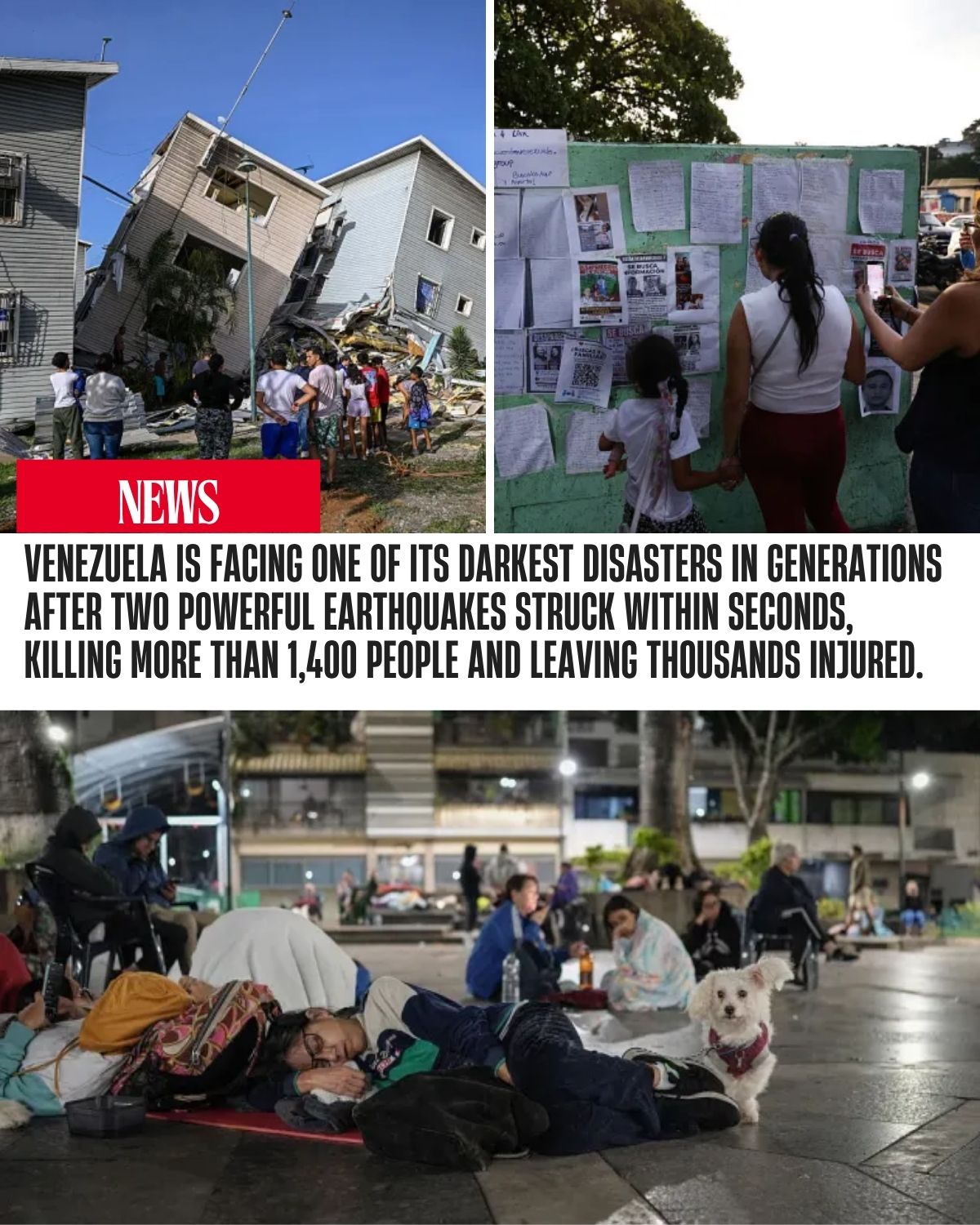
A pair of powerful earthquakes struck Venezuela on Wednesday evening, collapsing hundreds of buildings, damaging critical infrastructure and leaving more than 1,400 people dead as rescue teams continue searching for survivors.
The first quake, measured at magnitude 7.2, struck near San Felipe on Wednesday afternoon. Less than a minute later, a stronger magnitude 7.5 earthquake followed, causing widespread destruction across several parts of the country, including the capital, Caracas.
Venezuelan officials said more than 3,000 people have been injured, while many others remain missing. The death toll is expected to rise as emergency crews continue digging through collapsed homes, apartment buildings and public structures.
State of Emergency Declared
Acting President Delcy Rodríguez declared a state of emergency after the quakes, as damage reports poured in from across the country.
The Caracas International Airport sustained major damage and remains closed, complicating relief operations and the arrival of emergency aid. Footage from the airport showed people running as parts of the building appeared to collapse around them during the shaking.
The coastal state of La Guaira, north of Caracas, has suffered some of the heaviest damage. Satellite images showed collapsed apartment buildings and widespread destruction in the Playa Grande neighborhood.
Residents in Caracas and surrounding areas spent the night outdoors in parks, squares and open spaces, fearful that damaged buildings could collapse during aftershocks.
Thousands Still Missing
Government officials have said hundreds of people remain missing. However, Reuters reported that about 55,000 people were listed as missing on a website promoted by the country’s opposition.
Families gathered at public spaces, including Parque Ali Primera in Caracas, where photos and handwritten lists of missing people were posted as desperate relatives searched for loved ones.
Images from affected areas showed buildings reduced to piles of concrete and twisted metal as volunteers, residents and professional search-and-rescue teams worked side by side.

Experts Warn Older Buildings May Be Vulnerable
Earthquake experts warned that the scale of destruction may be tied to older building standards and vulnerable concrete structures.
“When we talk about the effects of earthquakes, we say, you know, it’s not the shaking that kills people, it’s buildings that kill people,” said William Yeck, a research geophysicist with the U.S. Geological Survey. “It’s really the collapse of those buildings that can lead to the catastrophic loss of life.”
Structural engineer Kenneth O’Dell said many of the buildings showing severe damage were likely constructed under older versions of Venezuela’s building code.
Experts also warned that additional collapses remain possible, especially in structures already weakened by the twin quakes.

International Aid Begins Moving In
Governments around the world have offered financial aid and emergency support, including the United States.
U.S. Secretary of State Marco Rubio said the United States is deploying search-and-rescue teams from Fairfax County, Virginia, and Los Angeles to assist in the search for victims. He also said the U.S. State Department will provide $150 million in aid.
Tsunami advisories were briefly issued for coasts within 300 kilometers of the epicenter, including Puerto Rico and the U.S. Virgin Islands, but were canceled a few hours later.
Strongest Quake in Venezuela Since 1900
According to the U.S. Geological Survey, the magnitude 7.5 earthquake was Venezuela’s strongest since October 29, 1900, when a magnitude 7.7 quake struck northeast of Caracas near the coast.
The country also experienced a magnitude 7.3 earthquake near Carúpano in August 2018, but Wednesday’s event was more powerful and more destructive.
The USGS described the two major quakes as a “doublet,” a term used when two strong earthquakes occur close together in time and location.
Powerful earthquakes of magnitude 7.5 or greater have struck the wider Caribbean region before, but most have occurred along the northern and western edges of the Caribbean tectonic plate boundary.
Survivors Describe Terrifying Moments
Caracas-based journalist Tony Frangie Mawad told CNN he was inside an elevator on his way to watch a World Cup 2026 match when the first quake hit.
“The elevator started to shake from side to side really strongly and go all the way down on a very quick pace,” he said.
At first, he thought the elevator was malfunctioning. Then a friend realized it was an earthquake.
Across the affected region, survivors described moments of panic as buildings shook, walls cracked and people fled into the streets.

Search for Survivors Continues
Rescue efforts are continuing across Caracas, La Guaira and other damaged areas as families wait for news of missing relatives.
Volunteers have joined official rescue crews in digging through rubble, while hospitals treat thousands of injured people.
For many Venezuelans, the disaster has brought back memories of earlier earthquakes and natural disasters, but the scale of Wednesday’s destruction has left the country facing one of its most serious emergencies in generations.
As aftershocks remain a threat and damaged buildings continue to pose danger, officials say the priority is finding survivors before time runs out.