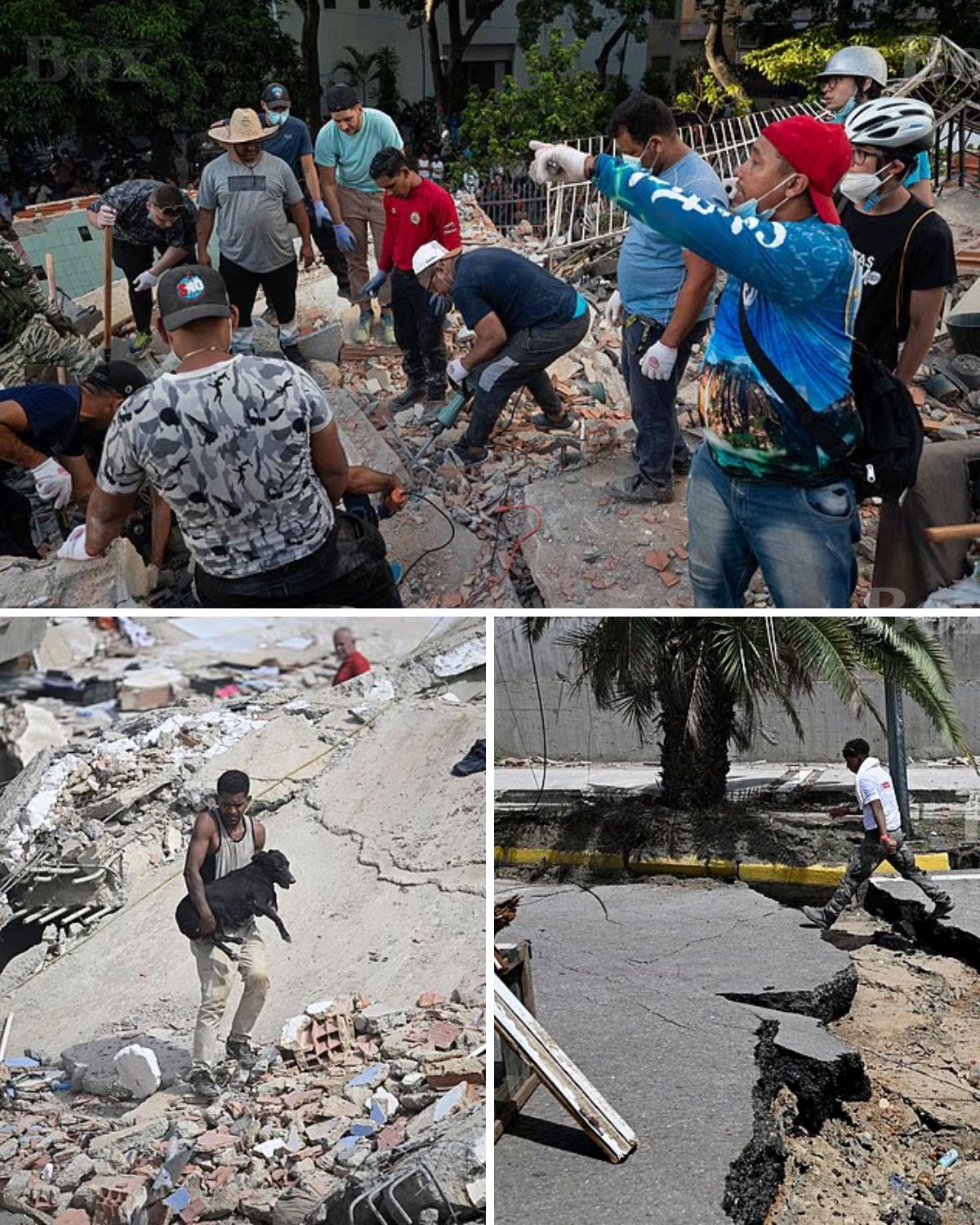
Thousands of people are feared to be trapped beneath collapsed buildings after two powerful earthquakes struck Venezuela, killing at least 235 people and injuring more than 4,300, according to the country’s health minister.
The official death toll is expected to rise as rescue crews continue searching through rubble in some of the hardest-hit areas. Officials and residents fear many people remain buried under collapsed homes, apartment blocks, and public buildings after the twin quakes struck on Wednesday night.
The earthquakes, measured at magnitudes 7.2 and 7.5, were among the strongest to hit Venezuela in more than a century. They were felt across the region and caused widespread destruction, especially in coastal communities north of Caracas.
La Guaira Among the Worst-Hit Areas
The coastal region of La Guaira, located north of the capital, suffered some of the heaviest damage and casualties. The area is home to Venezuela’s main airport, which was closed because of quake damage, creating serious challenges for emergency aid and rescue operations.
In La Guaira, survivors described scenes of devastation as buildings collapsed, streets cracked open, and families searched desperately for missing loved ones.
Residents woke Thursday morning to find apartment blocks reduced to skeletal remains, furniture hanging from shattered windows, and helicopters circling above damaged neighborhoods.
Some families posted missing-person flyers with photos of relatives, while others shared handwritten lists of names in an effort to locate the missing.
Rescue Crews Search Rubble for Survivors
State television showed dramatic rescue efforts, including footage of a woman trapped under a cement slab with only her foot visible before rescuers pulled her out alive.
Children, adults, and animals were carried from the rubble covered in dust and blood. In one area, neighbors carried a rescued man away from a collapsed building, while volunteers searched through debris with limited equipment.
In downtown Caracas, hundreds of residents spent the night outdoors in parks, parking lots, and other open spaces, fearing aftershocks and further collapses.
Dayana Delgado, a mother of three, said she was desperate for answers about her missing eight-year-old son and questioned where the promised heavy machinery was.
“I want to know where my child is, if he’s trapped or in a shelter,” she said.
In another heartbreaking scene, a mother collapsed in grief as the bodies of her three-year-old and 10-year-old children were wrapped in blankets and carried away.
Survivors Say Residents Were Digging With Their Own Hands
Some survivors said residents were forced to search collapsed buildings themselves before more official rescue support arrived.
In La Guaira, Cristian Carreño stood near his damaged apartment building, which was leaning dangerously to one side.
“I lost everything,” he said. “There are people still inside, I imagine, that couldn’t get out. It’s incredibly devastating.”
Retired schoolteacher Juan Alberto Mendaño said he climbed through wreckage and passed a dead body before seeing a trapped woman signaling with her hand for help.
“May God rescue her as quickly as possible,” he said. “When we heard the scream, there was nothing we could do.”
Venezuelan authorities said rescue teams from other parts of the country were being redirected to La Guaira, an area already familiar with natural disaster. In 1999, a deadly mudslide killed thousands there and remains one of Venezuela’s worst disasters.
Government Declares State of Emergency
Acting President Delcy Rodríguez declared a state of emergency late Wednesday and said the government was creating a $200 million reconstruction fund for damaged hospitals and homes.
On Thursday, she appealed to businesses to provide heavy construction equipment for rescue operations.
“We hope to rescue as many living people as possible,” Rodríguez said.
The disaster presents a major challenge for Venezuela, a country already struggling with deep economic problems and weakened infrastructure after more than a decade of crisis.
Interrupted phone and internet service also made it difficult for people inside and outside the country to reach relatives. Venezuelans abroad reported hours of uncertainty as they tried to contact family members in damaged areas.

Why the Earthquakes Were So Destructive
The U.S. Geological Survey said both earthquakes were centered near Morón on Venezuela’s Caribbean coast, about 170 kilometers west of Caracas.
Although Venezuela lies near several fault lines and straddles the South American and Caribbean plates, earthquakes of this strength are less common there than in some other parts of Latin America.
Experts said the destructive impact may have been intensified by the sequence of the two quakes and shallow seismic movement.
Marcos Ferreira, a geophysicist and researcher at the Geological Survey of Brazil, compared the effect to one vibration amplifying another.
“It is as if I am screaming and then someone starts screaming, too,” he said. “That amplifies the vibration and adds to the potential hazard.”
International Aid Begins Arriving
Several countries, including Mexico, Qatar, Brazil, Spain, Portugal, and Canada, pledged to send aid. Rescue teams from Mexico, El Salvador, and the Dominican Republic arrived in Venezuela on Thursday, along with an aid flight from Mexico.
U.S. Secretary of State Marco Rubio said the United States was deploying assistance immediately after speaking with Rodríguez, though he noted that the closure of Venezuela’s main airport created logistical difficulties.
“We have a whole-of-government response,” Rubio said. “It’ll be big; it’ll be fast; and it’ll be effective.”
Dominican Air Force Major Carlos Olivares said the scale of the disaster required international support.
“No country is prepared to provide the response that’s needed,” he said. “That’s what neighboring countries are there for.”

Venezuelan Diaspora Rallies to Help
Venezuelans living abroad have also begun organizing aid and donations. In Ecuador, business owner Félix Rodríguez said his store was collecting supplies from Venezuelans and Ecuadorians who wanted to help.
“My business is always ready for whatever Venezuela needs,” he said.
In Spokane, Washington, Gabby Graham said she normally sends money to relatives in Venezuela through a local business, but since the earthquakes she has been unable to locate the business owner.
She said her family now urgently needs funds for food, water, medication, and toiletries.
“I think it hasn’t been easy for them for years,” Graham said. “Just now it’s just even worse.”


A Nation Faces a Long Recovery
As rescue efforts continue, Venezuela is facing both an immediate humanitarian emergency and a long reconstruction challenge.
Families are still searching for missing loved ones. Hospitals are treating thousands of injured people. Entire neighborhoods remain unstable, and damaged infrastructure is slowing the arrival of aid.
For now, the country’s priority is finding survivors before time runs out.
But as the rubble is cleared, the scale of the disaster is likely to become clearer — and the death toll may continue to rise.

News compilation from: dailymail