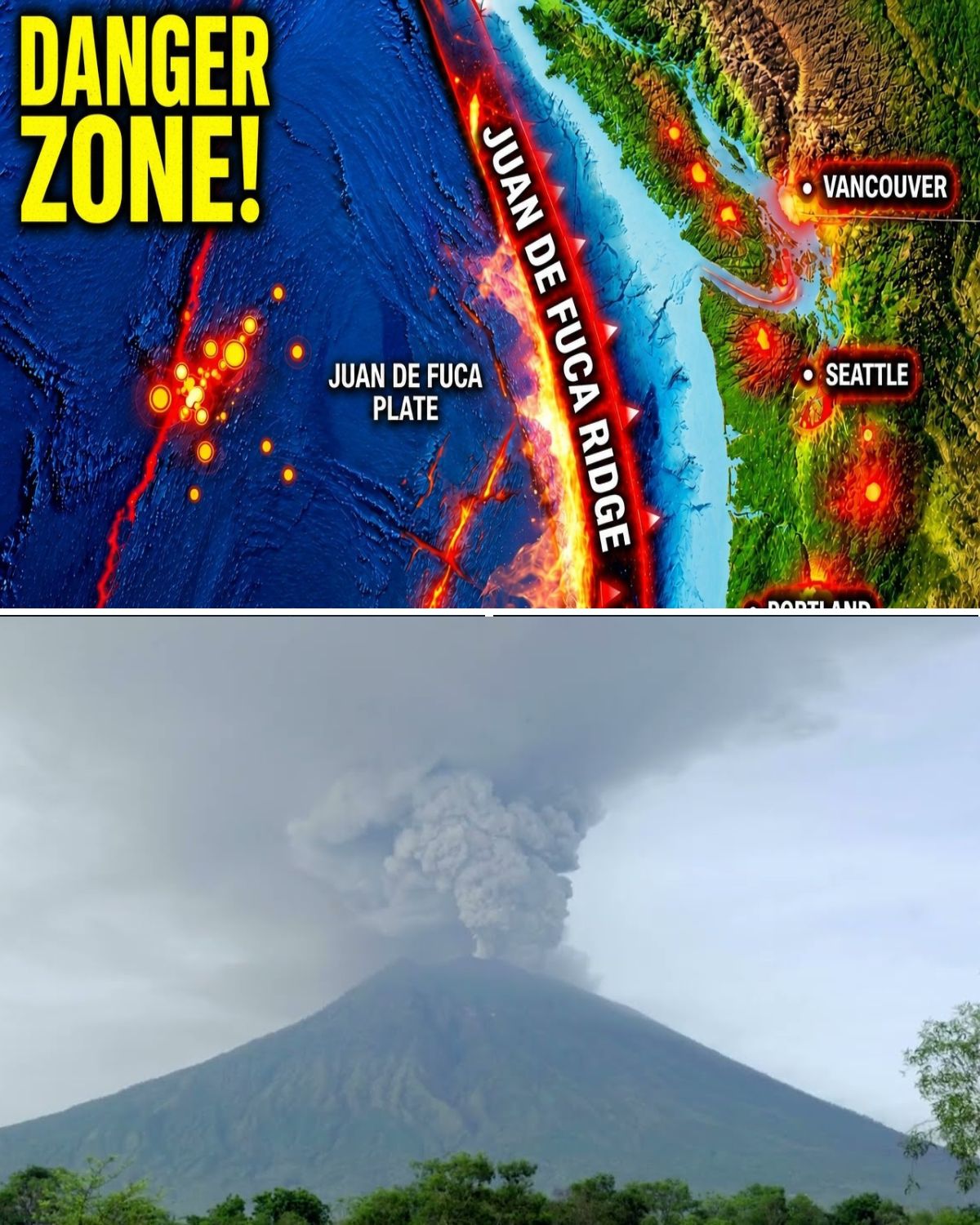
Something monumental is brewing beneath the waves off the Oregon coast, and scientists are on high alert. The Juan de Fuca Ridge, a mid-ocean ridge system, is awakening, signaling a potential volcanic eruption that could reshape our understanding of seismic activity in North America.
 Located about 300 miles offshore, the Juan de Fuca Ridge is a geological marvel stretching roughly 500 kilometers along the ocean floor. This underwater boundary separates the massive Pacific Plate from the smaller Juan de Fuca Plate, which is slowly being pushed beneath its neighbor. As these tectonic plates diverge, molten rock rises to fill the gap, creating new oceanic crust and a dynamic environment ripe for geological activity.
At the heart of this ridge lies Axial Seamount, the Pacific Northwest’s most active underwater volcano. Rising nearly 3,600 feet from the seafloor, Axial has a history of eruptions, with three significant events occurring in the last three decades alone. Researchers have been closely monitoring this volcano using the Regional Cabled Array, a groundbreaking system of over 660 miles of undersea cables and sensors designed to provide real-time data.
 In recent months, scientists have observed alarming signs of inflation around Axial, reminiscent of the activity leading up to its last eruption in 2015. With thousands of earthquakes occurring daily, researchers are bracing for what could happen next. According to volcanologist Bill Chadwick from Oregon State University, the magma is moving, and the eruption threshold could be reached as early as mid-to-late 2026.
This moment is particularly historic because scientists plan to live stream the eruption, allowing viewers around the world to witness a volcanic event unfold in real time. While Axial’s eruptions pose no direct threat to coastal communities, the implications for the Juan de Fuca Plate are significant.

The Cascadia Subduction Zone, where the Juan de Fuca Plate dives beneath the North American Plate, has been locked for over 325 years. The last major rupture in 1700 unleashed a magnitude 9+ earthquake, causing a tsunami that reached as far as Japan. As pressure continues to build, the potential for a catastrophic event looms, with researchers warning that when the Cascadia fault finally gives way, the consequences could be dire.
 Residents of the Pacific Northwest should be aware that the Juan de Fuca Ridge is not just a geological curiosity; it is a crucial component of a larger system that could lead to significant seismic events. The ongoing research into this underwater landscape is vital for understanding the risks and preparing for the future.
As scientists continue to monitor this dynamic environment, one question remains: how will we respond when the forces beneath the ocean finally unleash their power?