“I’m a Black American. I am proud of my race. I am proud of who I am. I have a lot of pride and dignity.” That wasn’t the statement of a man trying to explain away his skin color. It was the statement of a man who had grown tired of constantly having to explain who he was.
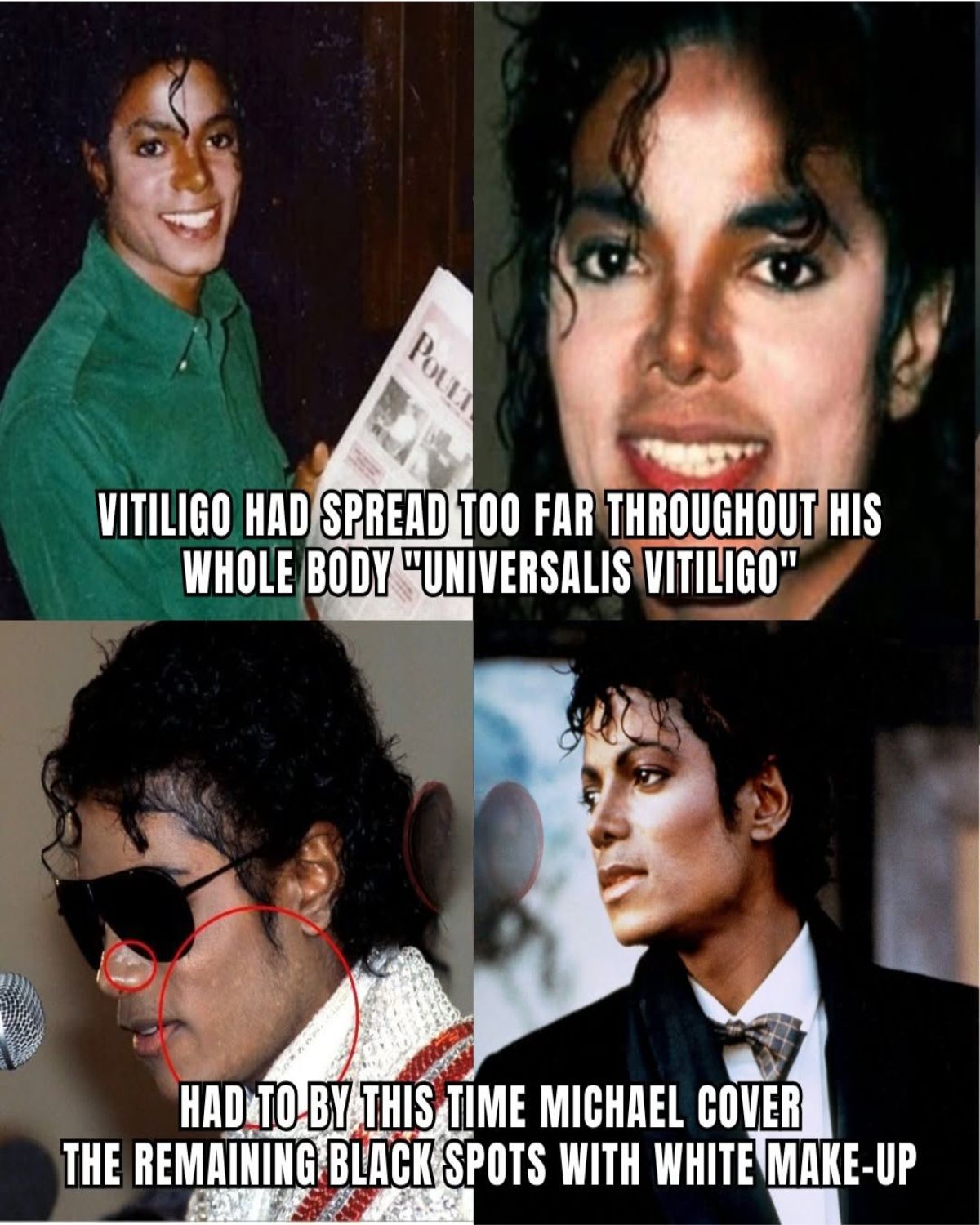
For years, people claimed Michael Jackson changed his skin because he wanted to be white.
The truth was far more painful.
Michael spent years trying to hold on to his natural skin color.
Not erase it.
Look closely at these photos.
In the early stages of vitiligo, the white patches appeared only in small areas across his face and body.
At that point, Michael wasn’t trying to make himself look lighter.
He was doing the exact opposite.
He used darker makeup to cover the depigmented spots and preserve the appearance of the skin tone people had always known.
That’s the part of the story that rarely gets told.
Because it never fit the narrative the tabloids wanted to sell.
But the disease kept spreading.
Year after year.
Patch after patch.
By the early 1990s, most of Michael’s skin had lost its pigment.
And eventually, he faced a reality he could no longer avoid.
When more than 80 percent of your body has turned white, covering everything with dark makeup becomes nearly impossible.
So Michael had to reverse the process.
He began using lighter makeup to blend the remaining darker patches into the rest of his skin.
Not because he wanted to become white.
But because he wanted his skin to appear even.
That’s all.
What has always stayed with me about this story is not the disease itself.
It’s the way the world responded to it.
People saw a changing appearance.
They didn’t see a medical condition.
People saw photographs.
They didn’t see the anxiety of living under a microscope while your body changed in ways you couldn’t control.
Imagine that for a moment.
You’re the most famous person on the planet.
Millions of cameras are pointed at you.
And every morning you wake up not knowing how much further the condition may spread.
Every new patch becomes a headline.
Every physical change becomes a joke.
Every public appearance becomes another opportunity for strangers to speculate about your life.
While in reality, you’re simply a patient trying to live with an illness.
There is one image in this collage that always makes me stop.
The close-up photo of Michael’s neck and jawline.
The one where a small area of makeup has worn away.
Beneath it, you can still see patches of his original darker skin.
It’s a tiny detail.
But it tells a much larger story.
A story that directly contradicts the claim that he was trying to abandon his identity.
His body was fighting a disease.
That’s what was happening.
Nothing more.
Nothing less.
What makes this even harder to look back on is that when Michael finally addressed vitiligo publicly during his 1993 interview with Oprah Winfrey, many people still refused to believe him.
They trusted rumors more than the person actually living with the condition.
And it wasn’t until after his death—when medical records and the autopsy confirmed he indeed had extensive vitiligo—that many critics were forced to acknowledge what he had been saying all along.
By then, the damage had already been done.
The thing I remember most isn’t Michael’s changing skin color.
It’s the fact that he spent years defending a truth that should never have required a defense in the first place.
A man living with vitiligo.
A man who repeatedly said he was proud to be a Black American.
A man who carried the weight of relentless scrutiny while battling a condition he never chose.
And maybe that’s the most heartbreaking part of this story.
Not that Michael’s skin changed.
But that so many people were willing to believe he hated himself before they were willing to believe he was hurting.