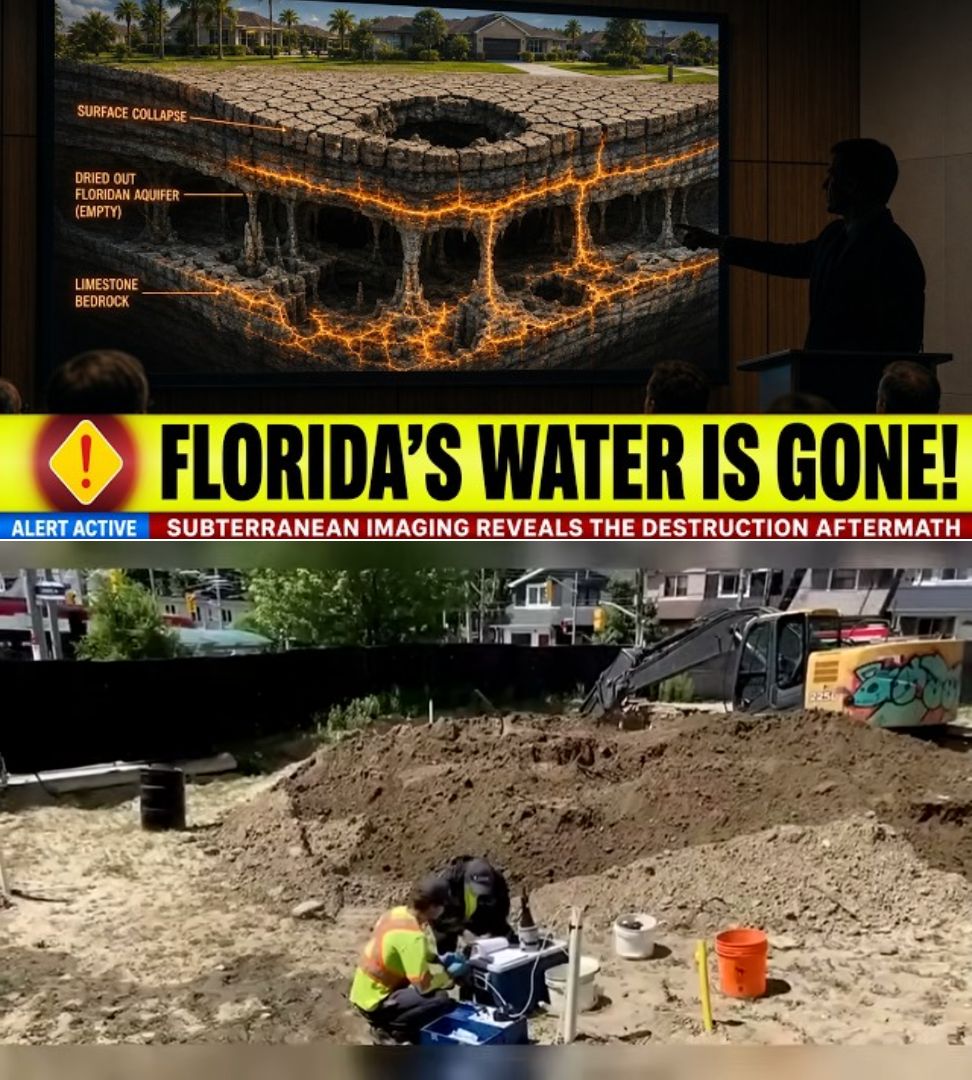
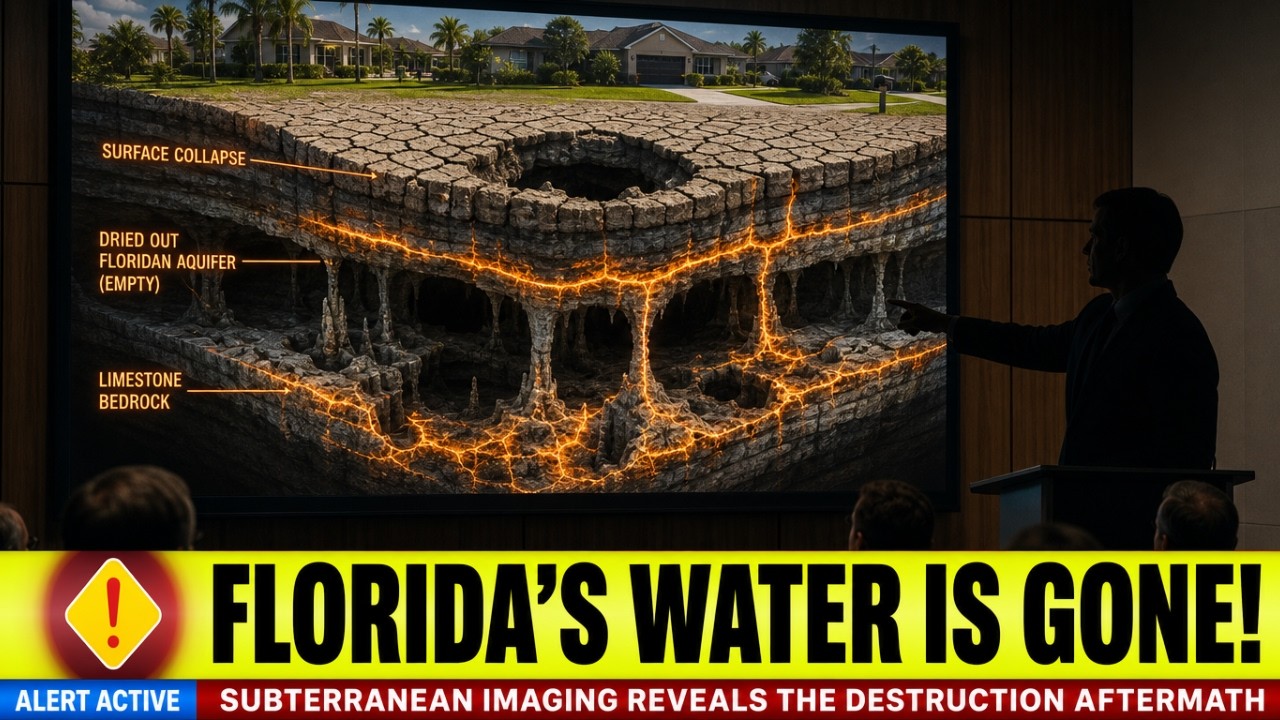
The ground beneath Central Florida is collapsing, the famous crystal-clear springs are drying up, and an ancient, invisible enemy is creeping toward the wells that supply millions of people. This is not a distant warning. It is happening now, documented in stunning new footage captured from deep within the Florida aquifer, revealing a crisis that experts say has been quietly building for decades. The video, obtained exclusively by this news organization, shows the stark reality of a hidden underground reservoir being drained faster than the rain can refill it, a reality that threatens to reshape one of the fastest-growing regions in the United States.
 Florida is one of the rainiest places in America, a peninsula surrounded on three sides by the ocean, pounded by summer thunderstorms, drenched by tropical downpours, and soaked by hurricanes. It is famous for its wetlands, swamps, thousands of lakes, and crystal-clear natural springs. On a map, it looks like the last place on Earth that could ever run short of water. Yet beneath the booming heart of the state, something alarming is unfolding. The hidden underground reservoir that millions of Floridians drink from every single day, the source of nearly all their fresh water, is being drained faster than nature can replenish it.
The signs are already written across the landscape for anyone who knows how to read them. Famous springs that once gushed have seen their flow cut in half. In some heavily developed areas, the water level deep underground has dropped by as much as 90 feet. The ground itself occasionally collapses without warning, swallowing roads and homes. And rising up from far below, an ancient invisible enemy is creeping steadily toward the wells that supply the cities. Salt water is pushing in to poison what fresh water remains. This is the strange and unsettling story of how one of the wettest regions in America quietly ran up against the hard limit of its own water supply, how more than 3 million people came to depend on a source that experts now say is nearly maxed out, and how a hidden threat rising silently from beneath their feet could turn a shortage into something far worse.
To understand the danger, you first have to understand where Florida’s water actually comes from. It is not where most people think. When we picture a water supply, we imagine lakes, rivers, reservoirs, water you can see. But the lifeblood of Central Florida lies out of sight, deep underground in something called the Florida aquifer. An aquifer is not an underground lake. It is a vast layer of porous, water-soaked rock, in this case limestone, that holds and slowly moves enormous volumes of fresh water through its countless cracks and pores. The Florida aquifer is one of the most productive aquifers on the entire planet, a colossal formation stretching across roughly 100,000 square miles, underlying all of Florida and reaching into parts of Georgia, Alabama, and South Carolina. Some of the water held within it fell as rain thousands of years ago and has been stored down there ever since.
For generations, this aquifer was Florida’s quiet miracle. It fed the famous springs that draw tourists from around the world. It filled the wells that watered the orange groves. It supplied the taps in millions of homes, the lawns, the golf courses, the theme parks that built the modern state. You drilled a well and clean fresh water came up seemingly without end. It felt limitless. It is not limitless. And Central Florida is now discovering exactly where the limit is. Here is where we need to be honest about the numbers, because this is a topic where the headlines tend to outrun the facts and where the real truth is actually more revealing than the exaggeration. You may have seen it claimed that the aquifer has dropped 90 percent. That is not accurate. The aquifer has not lost 90 percent of its water. But the real figures are sobering enough on their own and they tell a clearer story.
In some heavily pumped urban areas of Florida, the water level within the aquifer has fallen by as much as 90 feet, not 90 percent, 90 feet of decline in the height of the water table, which is a staggering drop for a system this size. The effect on the springs has been just as dramatic. Silver Springs, one of the largest springs fed by the Florida aquifer, has watched its output collapse from around 500 million gallons a day down to roughly 200 million gallons a day, a decline of about 60 percent. Springs that ran powerfully for thousands of years are weakening before our eyes because the underground pressure that drives them to the surface is fading. But the single most important number is this one. Central Florida currently pulls approximately 800 million gallons of water out of the aquifer every single day. And water management experts after careful study have concluded that only about 50 million additional gallons per day remain available to be pumped sustainably.
 Do the math and it is chilling. The region is already drawing roughly 94 percent of all the groundwater it can take without causing lasting harm. There is almost no headroom left. The tank for all practical purposes is nearly full to its safe limit and the demand is still climbing. That demand is enormous because of who depends on this water. The region we are talking about, formally grouped together as the Central Florida Water Initiative planning area, covers Orange, Osceola, Seminole, and Polk counties along with southern Lake County. This is the booming Orlando metropolitan region, one of the fastest growing areas in the entire country. Its population has now climbed past 3.5 million people. And it keeps rising, swelling by the hundreds of thousands as newcomers pour into the Sunshine State. Nearly every one of those millions of people drinks from the Florida aquifer. And every new subdivision, every new shopping center, every new business and resort expansion comes with the same request, permission to pump just a little more water from a source that is already running at its limit.
Cities, counties, and companies keep lining up, asking for more. While the experts keep delivering the same uncomfortable answer, there isn’t much more to give. This isn’t only a Central Florida problem either. The state has formally designated about two-thirds of all of Florida as what’s called a water resource caution area. These are regions where the existing water supplies are not expected to be able to meet the demands of the next 20 years. The squeeze is spreading across nearly the entire state. And people in their homes are only part of the demand. Florida’s farms are enormous water users. Agriculture across the state draws well over a billion gallons a day from the ground to irrigate crops, citrus, and pasture. Add in industry, power generation, and tourism, and the total water pulled from Florida’s aquifers and surface waters reaches into the billions of gallons every single day, the overwhelming majority of it coming from the Florida system.
This sets up a quiet but intensifying competition. Farmers need water to grow food. Cities need water for their swelling populations. Businesses need water to operate. The theme parks and resorts need water for the tourists who fuel the economy. And every one of them is reaching into the same finite underground supply. As the aquifer tightens, these users are increasingly pitted against one another and against the springs, lakes, and wetlands that also depend on that water to survive. There is only so much to go around and the line of people wanting a share keeps getting longer. The strain on the aquifer is not some distant theoretical worry. It is already doing visible physical damage to Florida, damage you can stand in front of and see. Start with the springs. Those iconic glass-clear blue pools that define so much of natural Florida are powered by the aquifer. The water rises to the surface because of the immense pressure built up underground. As overpumping bleeds that pressure away, the springs respond by shrinking, slowing, and in some cases going still.
Research has shown that a drop of just 10 to 20 feet in the underground water level can be enough to stop a spring from flowing entirely. As the aquifer declines, Florida is slowly losing some of its most beautiful and ancient natural features. The springs are far more than scenery. They are the beating heart of entire ecosystems, home to manatees that shelter in their warm, constant waters through the winter, to fish, turtles, and countless other species found nowhere else. They are also an economic engine. Silver Springs was Florida’s very first tourist attraction, drawing visitors long before the theme parks ever existed. Across the state, the springs support a tourism economy worth a great deal to the communities around them. When a spring weakens, it is not just a loss of beauty. It is the slow unraveling of a living system and a local economy that grew up around water everyone assumed would flow forever. Some springs that fed glass-bottom boat tours and swimming holes for generations now run visibly lower, their famous clarity clouded, their flow a shadow of what it was.
Then there are the sinkholes. Perhaps the most dramatic and frightening symptom of all, Florida sits on a foundation of limestone that is riddled with cracks, cavities, and hollow spaces like a giant stone sponge. The water within the aquifer helps support that honeycombed rock from below, holding the structure up. But when overpumping lowers the water table, that internal support can weaken and give way. The ground above loses its footing and collapses, sometimes slowly, sometimes in a sudden terrifying instant, opening a pit that can swallow a road, a car, or an entire house. Sinkholes are, in a very real sense, the depletion of the aquifer made violently visible at the surface. Florida already leads the nation in sinkholes. The danger is not abstract. Over the years, the state has seen sinkholes open up beneath homes in the dead of night, swallow sections of highway, gulp down cars, and force the evacuation of entire neighborhoods. In the most horrifying cases, sinkholes have opened directly under bedrooms while people slept. Heavy groundwater pumping is one of the known triggers that can tip a slowly forming cavity into a sudden collapse. The more aggressively the aquifer is drawn down, the more the very ground that millions of Floridians live on is quietly destabilized beneath their feet.

Beyond the springs and sinkholes, the lakes are dropping, the rivers are running lower, and the wetlands are degrading. In Florida, all of this water is connected, part of one vast interlinked system. Pull too hard on one part and the whole web begins to fray. But all of that, the falling levels, the dying springs, the sinkholes, is only half the danger. There is a second hidden threat and it is the one that can turn a manageable shortage into a genuine catastrophe. It is called saltwater intrusion. Here is the situation deep underground. The fresh water of the Florida aquifer does not sit on solid dry rock. Beneath it and around its coastal edges lies ancient trapped salt water, the remnant of seas that covered Florida long ago and the influence of the ocean that surrounds the peninsula today. For thousands of years, that salt water has been held in check, kept down and kept back by a single thing, the weight and pressure of the fresh water sitting on top of it. Picture it as a delicate balancing act, a lens of fresh water floating on top of a heavier sea of salt. As long as there is enough fresh water pressing down, the salt water stays put, sealed away below and offshore.
Now start pumping that fresh water out faster than it can be replaced. The fresh water level drops. The pressure holding the salt water in place weakens and the salt water does the only thing physics allows it to do. It rises and it migrates inland, creeping into the spaces the fresh water used to occupy. The consequences are severe and in many cases permanent. Once salt water seeps into a freshwater well, the water from that well becomes too salty to drink. You cannot simply pump the salt back out. Once the intrusion happens, that well can be ruined, sometimes for good. The only options are to treat the water at great expense or to abandon the well entirely and drill a new one farther inland away from the advancing salt. This is not hypothetical. It is already happening in coastal areas of Florida and especially in the southern part of the state. Communities and utilities have been forced to relocate entire wellfields inland, an enormously costly and disruptive process specifically to escape the salt water pushing into their old water sources. Scientists who monitor the wells across Florida report a consistent and worrying trend. They are measuring higher and higher concentrations of salt in more and more wells and the speed at which it is spreading has been described by one researcher as more than a little frightening.
South Florida offers a stark preview of where this can lead. There, in low-lying Miami-Dade and Broward counties, much of the drinking water comes from a shallow aquifer that sits just a few feet above sea level, making it extraordinarily vulnerable to the encroaching salt. Utilities there have already had to move wells, build costly treatment, and fight a constant creeping battle against the sea seeping into their supply. With land elevations of just four or five feet in places, experts there describe sea level rise as perhaps the single most threatening force facing their entire water future. What South Florida is living through now is in many ways the leading edge of what the rest of the state’s coastal and low-lying areas may face as the aquifer drops and the ocean climbs. Worse still, this process is being accelerated by another force entirely. Sea levels around Florida’s vast low-lying coastline are rising, and as the ocean climbs, it presses harder against the edges of the aquifer, pushing the saltwater boundary further inland and speeding up the intrusion. The aquifer faces a two-front assault. It is being emptied from above by all those wells and pumps, and it is being invaded from below and from the coast by the relentless rising sea.
All of which raises an obvious and maddening question. How on earth does any of this happen in a state that gets more than 50 inches of rain a year? If Florida is so wet, why is it running short of water? The answer lies in the difference between rain falling and water actually reaching the aquifer, a process called recharge. Yes, Florida is drenched. But of all that rain that falls, only a small fraction ever makes it down into the deep aquifer. The vast majority of it, around 70 percent, either evaporates back into the air under the hot Florida sun or is soaked up and breathed out by the state’s lush plants and trees. Only a relatively thin slice of the rainfall manages to seep down through the sandy soil and porous rock to recharge the groundwater far below. The aquifer refills slowly, patiently, on nature’s own unhurried timetable. But the demands placed on it run on a very different schedule. The fast, ever-growing, around-the-clock schedule of more than 3 million people, plus agriculture, plus industry, plus tourism, all drawing water out at high speed. When the rate of extraction outpaces the rate of recharge, year after year after year, the water level falls. It doesn’t matter how impressive the afternoon thunderstorms look. If you are taking water out faster than the ground can put it back, the aquifer drops. Add in the modern pressures, hotter temperatures that drive more evaporation, longer and harsher droughts, and a population that simply will not stop growing, and that gap between what we take and what nature returns only grows wider. The rain never stopped falling. Floridians just learned to drink faster than the sky could pour.
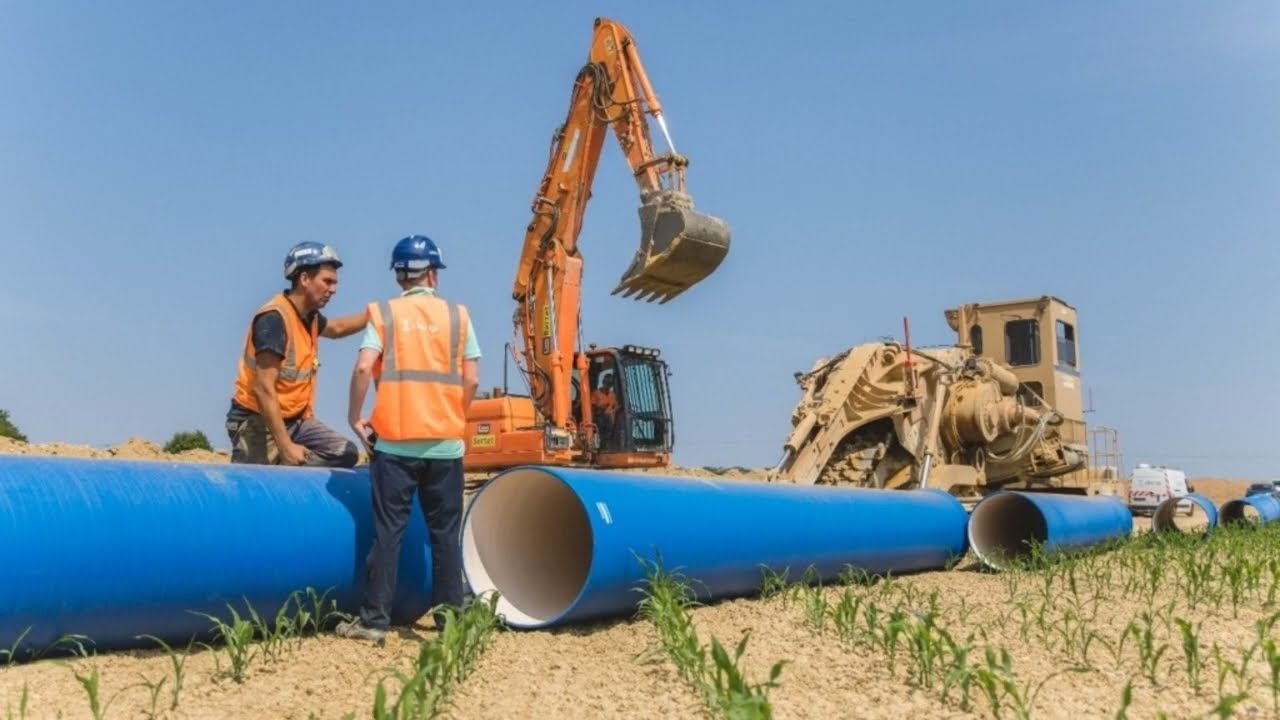 So, is this a hopeless situation? Not entirely. And this is where there’s some genuinely encouraging news alongside a hard dose of reality. Florida is not ignoring the problem. After years of study and collaboration, in late 2025, the region’s water managers formally approved a comprehensive long-term water supply plan for Central Florida. A detailed road map designed to keep the region supplied with water for the next 20 years and beyond. The plan’s central conclusion is delivered without flinching. The age of simply drilling another well and pumping more groundwater is over. The aquifer cannot give more. The water of the future will have to come from somewhere else. The plan lays out a whole portfolio of alternatives, well over a hundred separate projects. The largest source they are turning to is surface water, drawing water from the St. Johns River and from certain lakes and treating it to make it safe to drink rather than leaning entirely on the overtaxed aquifer. Another major piece is reclaimed water, taking wastewater, treating it to a very high standard, and reusing it. Today, that recycled water is mostly used for irrigation and industry, but Florida has begun opening the door under strict safety rules to eventually treating it all the way up to drinking quality.
The plan also calls for desalination using reverse osmosis to strip the salt out of brackish water from the deeper saltier layers of the aquifer and potentially from the sea. It also includes capturing stormwater before it runs off and even artificially recharging the aquifer by storing treated water underground for later use. Each of these comes with its own hurdles. Recycling wastewater into drinking water, sometimes bluntly called toilet to tap, faces a stubborn wall of public squeamishness, even though the treated water is rigorously cleaned to exacting standards. Desalination is one of the most energy-hungry ways to make water there is, and it leaves behind a concentrated salty brine that has to be disposed of carefully to avoid harming the environment. Drawing from rivers and lakes means competing with the ecosystems and the people downstream who also depend on that flow. There is no free, easy, abundant new source waiting to be switched on. Every option is a trade-off and every option costs real money and real years to build. But here is the hard part, the catch that hangs over every one of these solutions. They are all significantly more expensive than the cheap, easy groundwater that Florida has relied on for a century. Treating river water, recycling wastewater to drinking standards, building desalination plants, all of it costs far more money and takes years to design and construct.
In Polk County alone, local governments have identified something on the order of $600 million in needed alternative water projects, including desalination facilities and dozens of miles of new pipeline. Many observers warn that the funding the state has committed so far is only a small fraction of what the full scale of the problem actually demands. So, the fixes exist, the plan is real, and it’s serious, and it’s a genuine reason for hope. But turning those plans into pipes and plants in the ground and paying the enormous bill before the region’s relentless growth outruns its shrinking margin of safety, that is the real race now underway. It is a race against time, against population growth, and against the rising salt. There is one piece of the puzzle that often gets overlooked, even though it may be the cheapest and fastest of all, using less. A significant share of Florida’s water doesn’t go down anyone’s throat. It goes onto lawns. Outdoor irrigation, keeping grass green under the hot sun, accounts for an enormous portion of residential water use in the state. Simple changes such as smarter irrigation, drought-tolerant landscaping, fixing leaks, and tighter watering restrictions can save staggering volumes of water without a single new plant being built. Conservation advocates argue with good reason that the region still has a great deal of room to simply waste less before it spends billions chasing new supply. Every gallon not pulled from the aquifer is a gallon that stays in the ground propping up the springs and holding back the salt. In a crisis of limits, restraint itself becomes a kind of water source.
The most important thing to understand is what the danger actually is. It is not that the taps in Orlando are going to run dry next Tuesday. The whole point of the new water plan is to make sure that never happens. The real danger is something quieter, slower, and in its own way more insidious. And it carries a warning for the entire country. Groundwater depletion is invisible. That is what makes it so dangerous. When a reservoir runs low, everyone can see it. The shrinking shoreline, the cracked mud, the boat ramps stranded high and dry, the famous bathtub ring climbing up the canyon walls. The crisis is right there in front of your eyes, impossible to ignore. But an aquifer empties in total darkness, hundreds of feet underground, where no camera and no casual observer will ever see it. The water level falls silently. The springs fade a little each year. The wells slowly turn salty. The ground occasionally caves in. But the heart of the crisis stays hidden beneath the surface. That makes it terribly easy to look away from, to assume everything is fine right up until the moment it very much is not. Florida is a warning about the danger of treating any water source as though it were infinite. Here is one of the rainiest places in America, a peninsula ringed by ocean, sitting on top of one of the greatest freshwater aquifers on the entire planet. And even it has run up against the wall. Even here, the water has a limit. As that limit is reached, the sea itself begins to creep in from below, threatening to ruin what fresh water remains with an irreversible flood of salt.
Florida is far from alone. Across the United States, the great aquifers that quietly sustain modern life are being drawn down faster than nature can refill them. Beneath the Great Plains, the vast Ogallala aquifer, which waters a huge share of America’s farmland, has been dropping for decades, with some areas already pumped close to exhaustion. In California’s Central Valley, one of the most productive agricultural regions on Earth, so much groundwater has been extracted that the land itself has sunk in places by dozens of feet. All over the world, from India to the Middle East, ancient underground water reserves that took millennia to fill are being emptied in a matter of generations. Florida’s crisis is one chapter in a much larger story, the story of a civilization that built itself on top of hidden water it could not see and is only now beginning to reckon with how quickly that water can run out. The water beneath Florida was never truly unlimited. It only seemed that way because it was hidden so well, so far underground that for generations almost no one bothered to count it. Now the counting has begun in earnest. The numbers are in and they are sobering. The aquifer is nearly maxed out. The springs are weakening. The salt is rising. More than 3 million people are now learning in real time the oldest and hardest lesson there is, that even in the wettest of places, fresh water is one of the most precious and finite things on Earth. The taps are still running today. The plan to keep them running is real, and there is still time to act. But the margin has never been thinner, and the warning has never been clearer. The next time the afternoon rain hammers down on Florida, remember that almost none of it reaches the water that matters, and that the true measure of a place’s water isn’t what falls from the sky, but what’s left in the ground far below where no one is looking. In Florida, that hidden number is finally being read aloud, and it should give every one of us pause.
https://www.youtube.com/embed/C7dG5WIpxcs