For most of my marriage, my in-laws believed I did something vague and unremarkable in hospitality. When they asked what I did for work, I said I was in hospitality consulting, and they nodded politely before changing the subject, the way people do when they’ve already decided a topic isn’t worth exploring. I never corrected them. I let them believe whatever they wanted because I’d learned long ago that explaining yourself to people who’ve already made up their minds rarely changes anything.
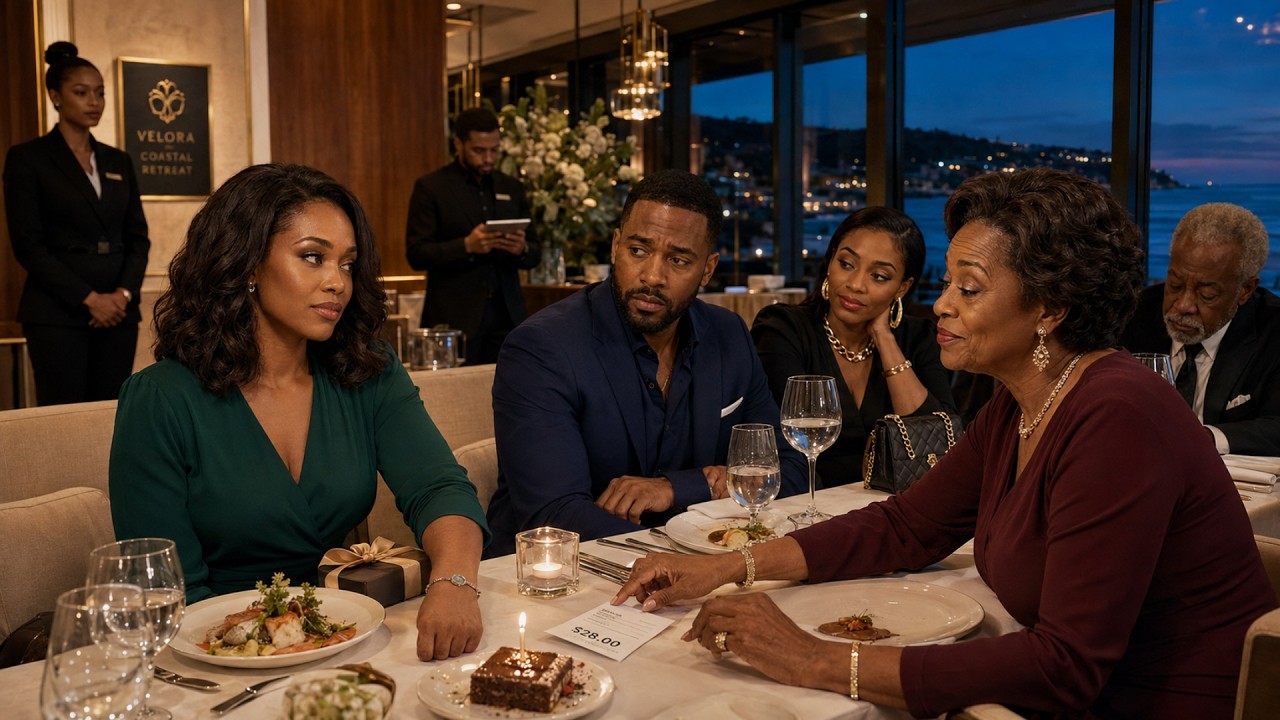
My mother-in-law, Ottilie Rook, looked at the twenty-eight-dollar bracelet my husband gave me for my birthday and told the entire table that some women just aren’t meant for nice things. She said it while sitting inside a hotel restaurant she didn’t know I owned. Let me back up, because the full picture matters. Seven years before my thirty-fourth birthday, my grandmother passed away and left me a small, struggling hotel on the edge of a coastal town.
It had been losing money for over a decade under management that had stopped caring long before she did. Most people would have sold it immediately and moved on. I couldn’t. My grandmother had raised me during summers at that hotel, teaching me how to fold linens properly, how to greet guests by name, how to notice the small details that made people feel cared for rather than simply housed.
So I spent nearly every dollar of my savings and took out loans I wasn’t sure I’d ever pay back to renovate the property from the ground up. It took three years before the hotel turned a real profit, and another four before I understood I had built something far bigger than I’d intended: a small boutique hospitality group with four properties, three of which I owned outright and one I managed under a partnership with local investors. I kept my name off most of the promotional material deliberately. My philosophy was simple.
If people respect you only after they learn what you own, they never actually respected you in the first place. I wanted the people in my life to value me for who I was, not what I’d accumulated. That philosophy worked well enough with friends and strangers. It became considerably more complicated once I married into the Rook family.
My husband, Leander, is thirty-seven, successful in his own right as a mid-level executive in a logistics firm. He’s kind, thoughtful, and genuinely loves me. None of what I’m about to describe changes that fact. But Leander has one significant flaw: he hates conflict with his parents more than almost anything else in his life, and that avoidance has cost both of us more than he realizes.
His mother, Ottilie, is sixty-one, elegant in the way that comes from decades of careful attention to appearances, and deeply status-conscious. She measures people through a consistent set of criteria: career titles, clothing brands, car models, house sizes, social connections. She rarely asks about someone’s character. She asks questions designed to place them on a scale she’s already constructed in her head.
His father, Bramwell, is sixty-five, quieter than his wife, and rarely initiates the sharper comments that come out of Ottilie’s mouth. But he almost never stops them, either, which over time started to feel like its own kind of participation. Then there’s Leander’s younger sister, Calpurnia, thirty-two, the unquestioned favorite of the family. She lives extravagantly, funded largely by her parents, and she has always viewed my modest lifestyle as evidence that I’m not doing much with my life.
She’s never been cruel in an obvious way. It’s always been smaller than that, comments wrapped in the appearance of concern or curiosity, the kind that leave you wondering afterward whether you’re overreacting to notice them at all. For years, I absorbed these comments without much resistance, partly because I genuinely didn’t need their approval, and partly because Leander would inevitably tell me after these gatherings to just ignore them. “You know how my mother is,” he’d say, as if that explanation was supposed to soften the discomfort rather than simply describe it.
That friction became considerably harder to manage the week of my thirty-fourth birthday. Leander had planned a small family weekend to celebrate, gathering everyone at a hotel property along the coast for dinner and an overnight stay. He’d found the place through a colleague who recommended it as an underrated boutique option, and he’d booked it without any idea that the property belonged to me. I hadn’t told him which properties I personally held title to, partly out of habit and partly because those conversations had simply never come up in the natural rhythm of our marriage.
When he mentioned the name of the hotel while planning the trip, I felt a small private jolt of recognition, but I said nothing. I was curious to see what an ordinary weekend there would look like through my family’s eyes. We arrived on Friday evening. Ottilie complained almost immediately about the drive, the traffic, and the fact that the lobby wasn’t as large as she assumed it was for what she assumed was an expensive property.
Calpurnia walked in wearing a designer outfit I recognized from a boutique that didn’t exist in this small coastal town, clearly having planned her arrival for maximum visual effect. I wore a simple green dress I’d owned for three years, comfortable and unremarkable, exactly the kind of clothing that had become part of my long-standing habit of blending into rooms rather than commanding them. The birthday dinner took place the following evening in the hotel’s restaurant, a space I’d personally redesigned two years earlier, choosing the lighting fixtures and the color of the banquettes myself during long weekends spent overseeing the renovation. Sitting at that table, surrounded by my in-laws, watching them comment on the ambiance without any idea of my connection to it, felt strange in a way I hadn’t fully anticipated.
Leander gave me my gift near the end of the meal, a small wrapped box he’d clearly put thought into based on the careful way he’d folded the paper himself rather than having a store do it. Inside was a handcrafted bracelet, simple silver wire wrapped around a single polished stone, the kind made by an independent artisan rather than mass-produced in a factory. It cost twenty-eight dollars, a number I only knew because the small handwritten receipt had slipped out of the box along with the bracelet. I genuinely loved it, not because of what it cost, but because I could tell exactly how much thought Leander had put into choosing something that reflected who I actually was.
Calpurnia noticed the receipt before I did. “That’s it? ” she said, picking it up and reading the number aloud before anyone else at the table could react. She said it with the kind of exaggerated surprise designed less to express genuine confusion and more to invite everyone else into the joke she was clearly building toward.
A few relatives laughed, the polite, uncomfortable kind of laughter that happens when people aren’t sure whether something is meant to be funny or cruel, so they simply decide to treat it as funny to avoid the discomfort of naming it otherwise. Ottilie picked up the bracelet next, turning it over in her fingers with the same expression she might have used to examine something she suspected had come from a discount bin. “Twenty-eight dollars,” she said, mostly to herself, before looking directly at me. “Even the gift bag probably cost more than that.
”
I felt my husband shift slightly beside me, uncomfortable but silent, exactly the reaction I’d learned to expect from him over the years. Ottilie wasn’t finished. She set the bracelet down gently on the white tablecloth, almost delicately, as though handling something slightly beneath her, and added, “Some women just aren’t meant for nice things. ”
The table went quiet in a different way than before.
Not the uncomfortable laughter kind of quiet, but the kind where everyone suddenly becomes very interested in their plates, unsure how to respond to something that had crossed clearly from teasing into something sharper. I looked around the table slowly, taking in my husband’s discomfort, Calpurnia’s barely concealed amusement, Bramwell’s practiced silence, and Ottilie’s satisfied expression, the look of someone who believed she’d made a point rather than caused harm. “You’re right about one thing,” I said finally, keeping my voice even and calm. Ottilie raised an eyebrow, clearly expecting some kind of defensive explanation to follow.
“You don’t know what I own,” I said. I let that sentence sit in the air for a moment before picking my fork back up and continuing my meal as though nothing unusual had happened. Nobody at the table understood what I meant. I wasn’t entirely sure myself whether I intended to let the truth come out that weekend or simply needed to say something that reflected the confidence I actually felt underneath the quiet exterior I’d maintained for years.
The rest of the dinner continued with a strange, brittle politeness, the kind that settles over a table after someone has said something everyone privately recognizes as sharper than intended, but nobody wants to address directly. I finished my meal, thanked Leander quietly for the bracelet once we were alone in the elevator afterward, and told him I loved it, which was entirely true regardless of everything that had happened at that table. The following morning, my in-laws’ complaints about the property continued, seemingly unrelated to the previous night’s comments, but connected in a way I found increasingly difficult to ignore. Ottilie complained about the water pressure in her room.
She complained that the breakfast selection wasn’t extensive enough for what she assumed was an expensive property. She complained about a server who she felt had been slow refilling her coffee. Each complaint came wrapped in some version of the same sentiment: “For what they’re charging, you’d think the owner actually cared. ”
I sat there, coffee in hand, listening to my mother-in-law criticize a business I had personally built from a failing property into a profitable one, without the faintest idea that the person she was describing as careless and absent was sitting directly across the table from her.
Later that afternoon, when the family gathered near the pool, one of my regional managers happened to be visiting the property for a scheduled inspection, something I’d arranged weeks earlier without connecting it to the timing of this family trip. She spotted me from across the lobby and approached me, professional but warm, the way she always was. “Ms. Vieira,” she said, “the regional report is ready whenever you’d like to review it before you head back.
”
Ottilie, sitting nearby, overheard the exchange and turned toward me with a puzzled expression. “Ms. Vieira,” she repeated, clearly assuming she’d misheard something. “Are you working here this weekend?
”
“Thank you,” I told my manager, ignoring Ottilie’s question for the moment. “Please leave it in my office. I’ll look at it before we check out. ”
“Your office?
” Ottilie asked, her confusion deepening. I simply smiled and didn’t elaborate further, mostly because I wanted to see how much longer this particular thread would take to fully unravel on its own without me forcing the reveal before it was ready. The unraveling came faster than I expected, and it came from Calpurnia rather than Ottilie. That evening, Calpurnia found a minor issue with the temperature in her room, and rather than contacting the front desk quietly the way most guests might, marched down to the lobby and demanded to speak to the manager directly, loud enough that several other guests turned to look.
The evening manager on duty explained politely that the general manager was currently not available, but that he’d be happy to help resolve the issue himself. Ottilie, following behind her daughter with the same energy, wasn’t satisfied with that answer. “Get the owner,” she said, her voice carrying across the lobby in a tone that suggested she expected this demand alone to produce immediate results. I was standing a few feet away, having come downstairs to grab a coffee before dinner, and I watched this entire scene unfold with a strange mixture of amusement and exhaustion.
I walked over calmly, positioning myself beside my mother-in-law. “I’m the owner,” I said. For a moment, nobody responded. Then Ottilie laughed, assuming, understandably given everything she thought she knew about me, that I was making some kind of joke to diffuse the tension.
That’s when the general manager, alerted by one of the front desk staff, walked into the lobby and spotted me. His face shifted immediately into the professional warmth reserved for the person who ultimately signed his paychecks. “Good evening, Ms. Vieira,” he said.
“I apologize for the confusion. What can I help resolve for your guests? ”
Silence spread through the lobby the way it does when a sentence takes a few seconds to fully process before its meaning lands completely. Ottilie’s expression moved slowly from confusion to disbelief to something that looked almost like panic, the look of someone rapidly recalculating every assumption they’d built about a person over the course of several years.
The general manager, unaware of the personal complexity he’d just introduced into this family gathering, continued speaking, referring to me twice more as the owner while walking us through the resolution for Calpurnia’s room temperature issue. He mentioned, almost in passing, the property’s strong quarterly performance and asked if I wanted to schedule time before checkout to review the numbers for the other locations as well. Ottilie stood frozen through this entire exchange. The sharp, confident posture I’d grown accustomed to over the years visibly deflating in real time.
The woman she had spent years describing as ordinary, unsuccessful, and cheap owned not just this hotel, but, as the manager’s comment about the other locations had just revealed, several more beyond it. I could see the moment the full picture assembled itself in her mind. My modest wardrobe, my ordinary car, my deliberately vague answers about working in hospitality. None of it had been evidence of struggle or failure.
It had been a choice, one she’d spent years misreading entirely. Once the manager stepped away to handle the actual room issue, Ottilie turned to me, her voice noticeably smaller than it had been minutes ago. “You own this place? ” she said, not quite a question, not quite a statement, somewhere caught between disbelief and the beginning of understanding.
“I do,” I said simply. “And the others you mentioned? ”
“Three more properties. This one is the flagship.
”
The silence that followed felt different from anything that had happened at that birthday dinner. It wasn’t the uncomfortable silence of an insult landing. It was the heavier silence of someone realizing how completely they’d misjudged a person they thought they understood. Ottilie recovered enough to ask the question I suspect had been building since the previous night’s dinner.
“Then why,” she said slowly, “would you let your husband give you something that costs twenty-eight dollars? ”
I looked down at the bracelet still on my wrist, where I’d worn it since Leander gave it to me the night before, and felt something settle inside me, a clarity I’d been circling for years without quite landing on the words until that exact moment. “Because I liked it,” I said simply. “And because I don’t measure love by receipts.
”
Nobody at that table had anything to say to that. The designer handbag Calpurnia had brought for herself under the guise of an early birthday gift suddenly felt smaller in the room than it had the night before, not because of its price, but because of what it represented in contrast to the plain, thoughtful object still sitting on my wrist. Leander, who had been standing slightly apart from the group during this entire exchange, finally spoke. His voice was quieter than usual.
“I didn’t know,” he said, although I wasn’t entirely sure whether he meant the hotel ownership or something deeper, something about the pattern of silence he’d maintained through years of these small, accumulating humiliations. Later that night, once we were alone in our room, Leander apologized, not for the bracelet, which he had no reason to apologize for, but for everything surrounding it. For years of staying quiet while his mother made comments designed to diminish me. For telling me to simply ignore behavior that had been building toward exactly this kind of moment.
I told him I appreciated the apology, but I also told him something I needed him to understand clearly. “I never needed you to defend my money,” I said. “I needed you to defend me. Those aren’t the same thing, and they never were.
”
He sat with that for a long moment before nodding, understanding, I think, for the first time the actual distinction I was drawing. It wasn’t about wealth at all. It had never been about wealth. It was about whether the person who loved me most was willing to stand beside me when his family treated me as though I were worth less than everyone else at the table.
In the weeks that followed, Ottilie’s behavior toward me changed noticeably. She became more careful with her comments, more deliberate in her questions, treating me with a kind of caution that hadn’t existed before. I noticed it immediately, and I want to be honest about what that shift actually represented. It wasn’t respect.
It was something closer to fear, an awareness that the woman she’d spent years underestimating held more influence and resources than she’d ever accounted for. I addressed that directly with her a few weeks later during a quieter conversation away from the rest of the family. “You don’t owe me an apology because I own a hotel,” I told her. “You owe me one because you treated me like I was worth less than you long before you knew anything about what I had built.
That was true before this weekend, and it would still be true even if none of this had ever come out. ”
She didn’t have a satisfying response to that, and I didn’t need one from her. What mattered wasn’t extracting an apology built on newfound respect for my finances. What mattered was making sure everyone understood, finally, that the standard for how I deserve to be treated had never been contingent on what I owned in the first place.
Calpurnia’s relationship with me shifted more slowly, and honestly less completely than her mother’s did. Some patterns are harder to unlearn than others, especially for someone whose entire sense of comparison had been built around measuring herself against the people around her. But even she grew noticeably more careful, more hesitant to offer the casual cutting comments that had once come so easily. Leander, to his credit, became different in a way that mattered far more to me than any change in his parents’ behavior.
He started establishing boundaries with his mother directly, quietly correcting her when old patterns resurfaced, no longer content to let comments slide simply because confronting them felt uncomfortable. That change didn’t happen overnight, and I won’t pretend our marriage transformed instantly the moment he apologized in that hotel room. It took months of smaller moments, him choosing to speak up in situations where he once would have stayed silent, before I felt the shift fully settle into something I could trust. I still own that bracelet.
I kept it in a small jewelry box alongside a few other pieces that mean something to me for reasons that have nothing to do with their cost. Months later, I wore it to an important business meeting, the same simple silver wire and polished stone paired against a tailored blazer. Leander noticed it immediately when I came downstairs that morning. “You still love that thing?
” he asked, smiling. “More than ever,” I told him, and I meant it completely. Looking back on that birthday dinner now, I understand something I probably needed years to fully articulate. For most of my marriage, my in-laws believed the things I didn’t have were proof that I wasn’t successful.
They measured my worth by what I could show them rather than asking what I actually valued. And because I never gave them a clear answer, they filled that silence with their own assumptions, most of which turned out to be entirely wrong. I didn’t need them to know I owned a hotel. What I needed, and what took me far too long to fully recognize, was that I didn’t have to prove anything to them in the first place.
Their approval had never been the thing standing between me and a life I felt secure in. It had simply been noise I’d allowed to sit closer to me than it deserved. The bracelet cost twenty-eight dollars, but the lesson it gave me was worth far more than anything money could purchase.
And I don’t think I would have understood that lesson quite as clearly without watching an entire room full of people slowly realize how badly they’d misjudged the value of both the gift and the woman wearing it.


