Three days after my emergency surgery, my new husband’s son called me from the CEO office of the company my late husband and I had spent decades building. “Your time is over, old lady,” he sneered. “Dad says I’m in charge now. I even threw your dead husband’s nameplate in the trash.
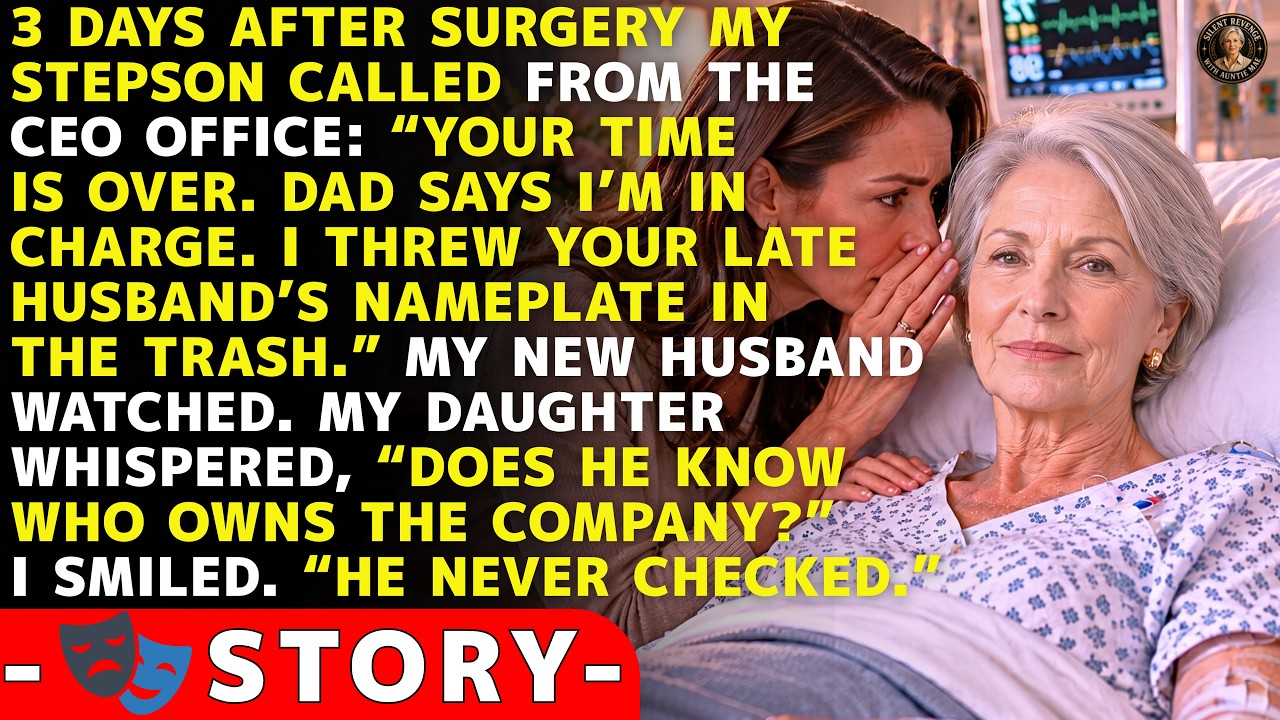
” My new husband stood behind him and let it happen. I stayed silent. Then my daughter leaned beside my hospital bed and whispered, “Mom, does he actually know who owns the company? ” I looked at her and smiled.
Apparently, he never checked. The heart monitor beside my bed had been beeping for three days straight, and I had memorized every pause between its pulses. Day three after emergency surgery—an appendix that had decided, without any consideration for my schedule, to give out on a Tuesday afternoon in October. The surgeon said I was lucky I came in when I did.
I told him luck had nothing to do with it. My daughter Sable had called me twice that morning because I sounded off on the phone, and she had driven me to the hospital herself. One hand on the wheel, the other gripping mine across the center console. That was the kind of woman she was.
She noticed things before you said them out loud. The room was quiet now. A pale Ohio morning pressed against the window, the kind of gray that couldn’t decide whether to rain or just threaten it all day. On the bedside table sat a vase of flowers Merritt had brought on day one.
Yellow chrysanthemums. They were already starting to droop at the edges, petals curling inward like they were trying to protect themselves from something. The chair beside my bed was empty. Merritt had promised to stay through the night.
He had held my hand in the hallway before they wheeled me in. His voice low and warm, his eyes doing what they always did when he wanted me to feel taken care of. “I’ll be right here when you wake up,” he’d said. “Right here.
” The chair had been empty when I opened my eyes on day one. It was empty again this morning. I had known Merritt Voss for four years and been married to him for three. In that time, I had paid credit card statements I never questioned, swallowed comments I should have made, and given his son Ledger a position at my company that neither of them had earned.
I told myself it was compromise. I told myself it was the work a second marriage required. What it actually was, I understood now, was postponement. I had never changed my name.
Not legally, not on paper, not anywhere it counted. I was Wren Calloway the day I married Merritt Voss, and I remained Wren Calloway every day after. The name belonged to me and to Gideon and to the company we had built from nothing, and there were certain things I had decided quietly and without announcement that I would not give away. Merritt had never asked about it.
That told me something. I was reaching for the plastic cup of water on my tray table when the door cracked open and a small sneaker appeared at the bottom of it, followed by the rest of my granddaughter. Sophie was eight years old and had her mother’s eyes, which meant she had Gideon’s eyes, too. That particular shade of dark brown that caught light from the side and looked almost amber.
She was carrying a folded piece of construction paper in both hands, holding it the way children hold things they have made themselves—carefully, like it might fall apart if she breathed wrong. “Grandma Wren. ” She crossed the room and climbed up onto the edge of the bed beside me without asking because she never needed to ask, and pressed the paper into my hands. I unfolded it.
A house with a red roof, three figures standing in front of it—one tall, one medium, one small. And beside the small one, a golden dog with a round head and stick legs. We did not have a dog. “That’s you,” Sophie said, pointing to the tall figure.
“And that’s Mom, and that’s me, and that’s the dog we should get. ” I looked at the drawing for a long moment. The figures were holding hands—all three of them—a chain of crayon strokes that crossed the whole bottom of the page. Something moved behind my sternum, not quite pain, closer to recognition.
Gideon would have loved this drawing. He would have put it on his desk at the office right next to his coffee mug and pointed it out to every contractor and supplier who came through the door for the next six months. He would have said, “My granddaughter made that,” with the particular pride of a man who had built things his whole life and understood that some things you built could not be measured in board feet or square footage. He would not have let any of this happen.
I folded the drawing carefully and held it in my lap. Sophie was already telling me about her science project, something involving vinegar and baking soda. Her small hands moving to illustrate an explosion, and I nodded and asked the right questions and kept my hand flat over the drawing the whole time. She stayed for forty minutes.
When her mother’s neighbor, who had dropped her off, came to collect her, Sophie hugged me around the middle with both arms, careful of the IV line, and said into my hospital gown, “Get better fast, Grandma Wren. The dog needs you. ” I laughed, the first real laugh in three days. It pulled at something in my abdomen and I winced, but I kept laughing anyway.
After she left, I set the drawing on the bedside table propped against the water pitcher where I could see it. Then I lay back and looked at the ceiling and let the quiet settle. The phone rang eleven minutes later. The screen read, “Ledger Voss, Sales Director.
” I let it ring twice, then I answered. “Good morning, Ledger. ” The sound that came back through the line was not a greeting. It was a chair.
My chair, the leather executive chair behind the CEO desk at Oakridge Supply. The one I had sat in for more than a decade, creaking under the weight of someone who had decided it now belonged to him. Then his voice. “Listen up, old lady.
Stop pretending you’re still in charge around here. ” I said nothing. I reached for the half-eaten apple slice on my tray table. “I’m telling you straight, Wren, your time is done.
This company needs a real man running it, not some fifty-five-year-old woman lying flat on her back in a hospital bed. Dad says I’m taking the CEO seat starting right now. That dead husband of yours, I threw his nameplate straight in the trash where it belongs. The door has my name on it now—Ledger Voss, CEO.
So, go ahead, keep leeching off that hospital bed and crawl off into retirement, you useless old woman. ”
The heart monitor kept its rhythm, steady, indifferent. I looked at the water-stained ceiling tile above my bed. I had memorized that tile over three days.
There was a faint brown ring near the upper left corner, old water damage shaped vaguely like the state of Ohio if you tilted your head. I took a bite of the apple. Gideon’s nameplate, the one that had sat on that desk for more than twenty years. The one with the small dent in the lower left corner from the time a supply crate fell against it during the renovation of our second warehouse.
I had kept that nameplate on the desk after he died because it reminded everyone who walked through that door what this company was built on. His name. His hands. His word, which he had never once broken to a client, a supplier, or a single one of the forty-three people who worked for us.
And this boy had thrown it in the trash. I felt something move through me then. It was not anger, exactly. Anger was too hot, too fast, too likely to make you say the wrong thing to the wrong person.
What I felt was cooler than that. More deliberate. The particular clarity that comes when someone removes all remaining doubt. “Ledger,” I said.
My voice was even. “Before you had that nameplate made, did you actually check the ownership records in the company files? ” A pause. Then a short laugh, the kind that meant he thought I was reaching.
“Already checked. You own forty percent. You don’t have majority control. This afternoon, I’m calling an emergency shareholder meeting and voting you out of the chairmanship.
Enjoy your IV drip, old woman. ” The line went dead. I held the phone in my hand for a moment, then I set it face down on the tray table beside Sophie’s drawing—the house, the three figures, the dog we did not have—and took another bite of my apple. He bit the hook.
The most expensive bite of his life. I had known this moment was coming. Not this exact version of it. Not a Tuesday in October.
Not a hospital room in Columbus. Not chrysanthemums wilting in a vase while my husband’s son sat in my chair and threw away the name of the man who had built everything Ledger Voss had ever benefited from. But I had known something like it was coming. You do not spend three years watching a person and miss what they are.
I picked up the phone again. Not to call Holt, not to call the bank, not to call any of the dozen people I could have called in that moment. I called Sable. She answered on the first ring.
“Mom. ” Not a question. She already knew from the sound of my breath. “Baby,” I said.
“It started. ” One beat of silence. Then, “I’m already on my way. ”
Sable arrived forty minutes after I called her, which meant she had been on the road before I even picked up the phone.
She came through the door carrying a paper bag from the diner two blocks from the hospital, the one that made the kind of oatmeal you actually wanted to eat—with brown sugar and real cream, not the powdered version that came on the hospital tray. She set it on my table without announcing it, pulled the chair close to the bed, and sat down. Not the chair Merritt had left empty—a different one, closer to the window. She looked at Sophie’s drawing propped against the water pitcher.
“She made you a dog,” Sable said. “She made us a dog,” I said. “Apparently, we need one. ” Sable almost smiled.
Then she looked at me and the almost smile became something else, something steadier and older than twenty-eight. “Tell me what he said. ” So I did. I repeated Ledger’s words as close to verbatim as I could manage because I had already committed them to memory the way you commit a thing to memory when you know you will need it later.
Sable listened without interrupting. Her hands were folded in her lap, very still the way they got when she was thinking hard beneath a calm surface. When I finished, she was quiet for exactly four seconds. I counted.
“He checked the forty percent,” she said. “He checked the forty percent and stopped there. ” She nodded slowly, the way her father used to nod when something confirmed what he already suspected. That particular motion—chin down, one measured dip—was so purely Gideon that it stopped my breath for half a second, the way it always did, the way it had been doing for six years now without any sign of stopping.
“Then we’re fine,” she said. “We are,” I said, “but I want you to understand all of it. Because after today there won’t be room for any confusion about what this company is and who it belongs to. ”
I had never told this story to Merritt.
Not the full version. I had told him pieces—that I co-founded Oakridge with my first husband, that I’d been running it since Gideon died, that it was doing well. What I had not told him was the architecture of it. The bones.
Merritt had never asked. That more than anything was what had kept me from trusting him entirely. A man who married a woman who owned a company and never once asked how it was structured was either supremely incurious or supremely confident that it would eventually belong to him anyway. Either way, it was information.
So I told Sable. And in telling her, I told myself again, because there are things that bear repeating out loud just to confirm they are real. Twenty-two years ago, Gideon Calloway and I opened Oakridge Supply out of a leased warehouse on the eastern edge of Columbus. We had a truck, a used forklift, two accounts, and the kind of stubbornness that looks like optimism from the outside.
The first people Gideon called were the Braddocks. Clement was the oldest, fifty now, a man who had been built somewhere along the way out of equal parts patience and iron. Roy was four years younger, quieter, the kind of man who solved problems before you knew they existed. Dex was the youngest of the three, fast-talking and sharp-eyed, with a talent for logistics that bordered on mathematical.
They had grown up two streets over from Gideon, and they had been in business together in smaller ways for years before Oakridge. When Gideon called and said he was doing something real this time, all three of them showed up the next morning. We started with six employees. By year five, we had twenty-three, two warehouses, and more contracts than we could comfortably service.
In that fifth year, Gideon sat me down at the kitchen table one evening and pushed a folder across to me. “I want to do something,” he said. The folder contained the outline for an employee stock ownership plan—an ESOP—a structure that allowed a company to grant ownership shares to its workers over time, giving them a financial stake in the business they were helping to build. It was not uncommon in American manufacturing and supply.
It was the kind of thing that required a good attorney, a patient accountant, and genuine commitment, because it meant that some of what you built would belong to the people who built it with you. “If someone spends twenty years inside these walls,” Gideon said, “they ought to have something to show for it that isn’t just a paycheck. ” That was how the ESOP began. Over the years, it had grown to encompass twenty-five percent of the company’s equity, distributed among nine employees.
Janet Pruitt, our controller, who’d been with us since year two. Cal Morrow, our yard and production supervisor, who had started as a forklift operator and learned every inch of the operation. Seven others who had come up through the company and stayed. When Gideon died of a heart attack six years ago on a Wednesday afternoon in March—the kind of death that arrives without warning and leaves everything unfinished—the ownership structure of Oakridge Supply was as follows.
I held forty percent. Sable held fifteen, inherited from Gideon and restructured through Holt Deever’s office after I remarried, specifically to ensure that no future change in my marital status could affect her stake. The Braddock brothers held twenty percent collectively, a share Gideon had formalized in writing in the company’s seventh year because he believed that the people who had built something deserved to own a piece of it. And the ESOP held twenty-five.
Ledger Voss had looked at forty percent and seen a minority position. He had not asked who held the rest. He had not checked the shareholder registry beyond the first line. He had done what people who assume they are winning always do.
He had stopped reading when he found the answer he wanted. Holt Deever had been our corporate attorney for fourteen years. He was a careful man in the specific way that good lawyers are careful—not slow, not overly cautious, but precise. He knew every clause of our operating agreement, every line of the shareholder registry, every provision of our corporate bylaws, including section four, which required seventy-two hours advance notice for any shareholder meeting.
When I called him the morning I went into the hospital before the surgery, when I still had the presence of mind to make the calls I needed to make, his answer had been the same as it always was. “I’ll handle it,” he said. “You focus on coming back. ”
Sable had made the second call that morning to Miles Ashford.
Miles was sixty-one years old, a second-generation commercial developer who had been doing business with Oakridge for nearly fifteen years. He and Gideon had met at a trade conference in Cincinnati and discovered they shared an approach to business that had become increasingly rare. They did what they said they would do. They said so in plain language, and they did not renegotiate after a handshake.
Miles had stood at Gideon’s funeral in the front row, and afterward he had taken Sable’s hand in both of his and said, “Your father was the straightest man I ever did business with. I hope you know that. ” Sable had been twenty-two years old. She had known.
Miles had agreed to be her godfather when she was born, which meant he had watched her grow up, watched her spend her high school summers learning the supply chain at Oakridge, watched her study business administration at Ohio State and come back to the company knowing more about its operational structure than most people twice her age. What Ledger had never bothered to learn about Sable was that she had been doing the real work of Oakridge for the past three years—managing vendor relationships, overseeing logistics, sitting in on every significant contract negotiation—while appearing to the outside world, and to Merritt, as simply the owner’s daughter who helped out when needed. She had been careful about that. The invisibility had been deliberate.
When Sable had called Miles the night before my surgery, she had kept it brief. “There might be a situation at the company while Mom’s recovering,” she’d said. Miles had asked one question. “Do you need me to be available?
” “Possibly. I’ll call you if it becomes necessary. ” “Then I’m available,” he said. “Tell your mother I’ll be ready.
”
Now Sable sat in the hospital chair and looked at her hands, and I watched her the way I had watched her since she was small, looking for Gideon in the angle of her jaw, the particular way she held her shoulders when she was carrying something heavy and pretending she wasn’t. “He’s going to call a shareholder meeting this afternoon,” I said. “I know,” she said. She looked up.
“Holt’s already on it. ” As if on cue, my phone buzzed on the tray table—Holt Deever’s name on the screen. I answered and put it on speaker. “Wren.
” His voice was unhurried, which meant everything was under control. “Ledger just sent a meeting notice to all shareholders. Emergency session, two o’clock this afternoon. ” “How much notice?
” “Four hours. Section four of your bylaws requires seventy-two. Any resolution passed at today’s meeting is legally unenforceable. ” A brief pause.
“He doesn’t know that. ” “No,” I said. “He doesn’t. ” “I’ll be in that room at two.
Do you want me to stop it before it starts, or let it run? ” I looked at Sable. She gave me the smallest nod. “Let it run,” I said.
“Make sure the Braddocks know. ” “Already called Clement,” Holt said. “He said, and I’m quoting directly, ‘Tell Wren we’ll be there. ‘”
After I ended the call, Sable stood and straightened her jacket.
She had things to do and places to be, and we both understood that the next several hours would require her to be somewhere other than a hospital room. At the door, she paused and looked back at me. “Mom. Do you want me to—” “Go,” I said.
“I’ll be here. ” She held my gaze for one moment longer than necessary. Then she left. I lay back against the pillow and looked at Sophie’s drawing on the bedside table.
The house with the red roof. The three figures holding hands all the way across the page. Four hours until two o’clock. I reached for the oatmeal Sable had brought, still warm, and took a slow spoonful.
There was nothing left to do now but wait. And I had always been better at waiting than anyone gave me credit for. The conference room at Oakridge Supply had a long oak table that Gideon had picked out himself at an estate sale in Worthington, hauled back in the company truck, and refinished over a long weekend with Roy Braddock’s help. It seated fourteen.
It had hosted contract negotiations, quarterly reviews, difficult conversations about money, and at least one argument that had nearly ended a twenty-year friendship before Gideon talked everyone back down. Ledger Voss walked in at 1:58 carrying a leather portfolio he had not owned last week. He took the chair at the head of the table. Nobody said anything.
Not because the room accepted it, but because everyone in that room had been told in one way or another to let him go first. Sable sat midway down the left side, hands folded on the table, expression composed. Janet Pruitt had her laptop open, but her fingers nowhere near the keyboard. Cal Morrow sat with his arms crossed, jaw set the way he looked when a delivery arrived short and someone was going to have to answer for it.
Clement Braddock sat to Sable’s left, straight-backed, both hands flat on the table. Roy was beside him, studying the grain of the wood. Dex had his eyes on Ledger, tracking him the way you track something you weren’t sure was going to behave. Holt Deever sat in the corner chair, the one without a nameplate in front of it.
Ledger glanced at him once and looked away. “I’ll keep this brief,” Ledger said. He opened the portfolio. “As of this morning, I’ve assumed executive leadership of Oakridge Supply in my father’s capacity as—” “Your father is not a shareholder,” Holt said.
His voice was the same temperature as the room. “He has no capacity here. ” Ledger’s jaw tightened. “As the acting CEO—” “You weren’t appointed CEO,” Holt set a single sheet of paper on the table and slid it toward the center.
“This meeting was noticed at ten o’clock this morning for a two o’clock start. Section four of Oakridge’s corporate bylaws requires seventy-two hours advance notice for any shareholder meeting. You gave four. Every resolution passed in this room today is legally unenforceable.
” Ledger stared at the paper. A muscle moved in his cheek. “This is a family matter,” he said. “Not a procedural one.
” “Oakridge Supply is a corporation registered in the state of Ohio,” Holt said. “Not a family matter. The bylaws apply regardless of who is related to whom. ” Ledger looked around the table, recalibrating.
His eyes landed on Sable. “You’re a minority shareholder—fifteen percent. ” “Yes,” Sable said. Her voice was even, almost gentle.
“I am. ” He turned to the Braddocks. “And the three of you hold twenty percent combined. I’ve done the math.
If we—” Clement Braddock moved. Not fast, not dramatically. He placed both palms flat on the table and pushed himself to his feet the way a man stands when he’s decided something, and the deciding is already finished. His hands were the hands of someone who had spent thirty years moving materials, managing yards, solving problems that required more than a leather portfolio to fix.
He looked at Ledger for a long moment without speaking. “Then your father married into this table, son,” his voice was low and unhurried, the way it always was when he meant something past argument. “He didn’t build it. ” Roy stood.
Then Dex. No words from either of them, just the physical fact of three men rising in the same moment, which in that room at that table said everything that needed saying. Sable placed her palm flat on the oak surface. The same gesture, quieter, final.
Janet Pruitt closed her laptop with a soft click. Cal Morrow uncrossed his arms and set both hands on the table. Ledger looked at the ring of faces around him and understood for the first time that he had walked into a room where not a single person was on his side. “You can’t remove me,” he said.
His voice had lost something. “I’m the sales director. I have a contract. ” “The shareholders can terminate an officer position,” Holt said.
“Your employment contract addresses compensation, not permanent tenure in a specific role. The board will conduct a proper vote at a validly noticed meeting seventy-two hours from now. Based on what I’m seeing in this room, I don’t anticipate a different outcome. ” He paused.
“HR will reach out about available positions within the company should you wish to continue your employment in another capacity. ” The offer hung in the air between them—decent, formal, and devastating in its reasonableness. Ledger pushed back from the table. The leather portfolio stayed where it was.
He left without picking it up. After his footsteps faded down the hallway, nobody moved for a moment. Then Janet Pruitt reopened her laptop and turned it toward Holt. “Before you go,” she said, “there’s something you need to see.
” On the screen, an email Ledger had sent that morning to First Commerce Bank, attached to a one-page authorization document bearing Wren Calloway’s signature. Janet had pulled the signature against the verified sample in the company files. They did not match—not in the pressure of the pen, not in the angle of the capital W, not in the looping tail of the Y. Holt studied it for eight seconds.
“Save everything,” he said. “Forward it to me in the next ten minutes. ” He was already reaching for his phone as he walked out of the conference room, because some things could not wait, and a forged signature sent to a federally regulated financial institution was one of them. Back in my hospital room, I did not know yet what Holt had found, but I knew what Clement’s hands on that table meant.
I knew what it meant when Roy and Dex stood without being asked. I set down my cup of water and looked at Sophie’s drawing on the bedside table. The house, the three figures, the dog. We built something real, I thought, and it held.
The Mercer Steakhouse sat on the corner of High Street and Broad, the kind of restaurant where the lighting was low enough to make bad news look expensive. Ledger had made the reservation that afternoon, forty minutes after walking out of the conference room without his portfolio. Rex Muldoon arrived at seven o’clock on the dot. Rex was the kind of man who showed up exactly on time as a form of communication.
It meant he was interested enough to be punctual and experienced enough not to be eager. He had been running Muldoon Construction for twenty-six years, and in that time he had learned to read a room before he sat down in it. He read this one in approximately four seconds. Ledger was already at the table, jacket pressed, posture arranged into something that was trying hard to look like confidence.
The wine list was open in front of him. He stood and extended his hand. “Rex, good of you to come. ” Rex shook it and sat.
He accepted the menu from the server and studied it without speaking, because he had found over the years that silence in the early minutes of a dinner told you a great deal about the person across the table. Ledger filled it immediately. “I wanted to connect directly,” he said. “There’s been a leadership transition at Oakridge.
I’m stepping in as CEO, and I want our key partners to hear it from me personally. ” Rex looked up from the menu. “How’s Wren? ” “She’s taking some time,” Ledger smiled the smile of a man delivering managed information.
“Her health situation means she needs to step back. I’m making sure there’s no disruption to our partnerships. ” “Mhm. ” Rex returned to the menu.
Ledger ordered the wine without asking—a Napa Valley Cabernet that the list priced at $2,010. The server brought it with the particular deference reserved for bottles in that range, and Ledger accepted the pour with the ease of a man who had been doing this for years, rather than approximately four hours. Rex covered his glass with two fingers. “I’m fine with water,” he said.
The dinner moved through its first course. Ledger talked about expansion plans, new market opportunities, a possible office in Indianapolis. Rex ate his salad and asked one or two questions that were short enough to be polite and pointed enough to be meaningful. He watched Ledger’s hands move when he talked, the gestures of a man performing fluency rather than possessing it.
When the entrees arrived, Ledger reached for the check folder out of habit. He slid the company card into the sleeve and handed it back to the server without looking at it. The server returned two minutes later. He looked down at the card in the sleeve, then back up at Ledger with the professional blankness of someone trained to handle exactly this situation.
“I’m sorry, sir. This card is being declined. ” Ledger’s hand went to his jacket pocket. “Run it again.
” “I’ve run it twice, sir. ” Wren had called the bank at 3:15 that afternoon, twenty minutes after Holt left the conference room. As the primary authorized account holder on the Oakridge Supply corporate card, she had reduced Ledger’s spending limit to $50. The $2,000 bottle of wine alone had ended the transaction before the steaks were even ordered.
Ledger’s face did something complicated and brief that he almost managed to control. “Technical issue,” he said, to Rex, not the server. Rex set his fork down. He placed his napkin beside his plate with the deliberate care of a man who had made up his mind some time ago and was now simply completing the motion.
He stood, buttoned his jacket, and extended his hand across the table. “Call me when things settle down over there,” he said. Then he left. His steak untouched, the $2,000 wine undrunk, the table still set for a partnership that was not going to happen tonight or any night that Ledger Voss sat at the head of it.
Ledger sat alone for ninety seconds. Then he reached up and unclasped the watch from his wrist. A Rolex Submariner—or rather, a version of one that he had purchased online for $200 and that a trained eye would identify as such within approximately ten seconds. He left it with the manager as collateral and called Merritt to come and pay the bill.
The following morning, Rex Muldoon called Wren’s cell. He did not mention the dinner. He confirmed the renewal of Muldoon Construction’s supply contract and asked her to get well soon. The next morning, while Ledger was sleeping in the apartment Wren had been paying for since he joined the company, Merritt let himself into the main house on Elmwood Drive with the key on his ring.
He moved through the bedroom with the focused efficiency of a man who had been thinking about this for longer than he would admit. The jewelry box was where it always was, on top of the tall dresser—a flat velvet case in dark navy. He tucked it under his arm and drove to Rourke’s Pawn and Jewelry on Fifth Avenue, the largest shop of its kind on the East Side. Clive Rourke had been buying and appraising jewelry for thirty-one years.
He opened the case on his counter, selected his loop, and bent over the first piece. Eight seconds. He straightened up. He looked at Merritt over the top of his glasses.
“Sir,” he said with the measured tone of a professional delivering unwelcome news, “these are acrylic—decorative plastic. I can show you where to purchase them online if you’d like. They run about $10 a set. ” The color moved up Merritt’s neck in a slow wave that started somewhere below his collar.
Six months before her surgery, Wren had sat on the edge of the bed with Sable beside her, lifting each piece from the case and placing it into a soft cotton bag. Sable had asked only once, “Mom, are you sure? ” And Wren had looked at her daughter and said without any particular drama, “I’ve been sure for longer than you know, baby. ” The real pieces had been in a safe deposit box at First Commerce Bank since that evening.
What Merritt had taken was the costume replacement, purchased in a set, $10 delivered in four business days. The security guard at Rourke’s held the door. Merritt stood on the sidewalk outside, the navy case in his hands, the Ohio morning cold against his face, and stared down at the street. He called Ledger.
“My account,” he said when Ledger picked up, “I need to check something. Meet me at First Commerce. ”
Patrice Wells had worked the customer service desk at First Commerce Bank on Morse Road for eleven years. She had a gift for delivering bad news in a voice that made it sound almost reasonable.
“Mr. Voss,” she said after pulling up the account, “this account has been frozen pending legal review. I’m not able to process any transactions at this time. ” Merritt leaned forward.
“What legal review? ” “I’m not able to share the details of the filing, sir. You’d need to speak with your attorney. ” Holt Deever had filed the petition for dissolution of marriage and the motion for a temporary restraining order on Wren’s behalf at 8:45 that morning.
An Ohio family court judge had reviewed the motion by eleven and granted the freeze, citing documented evidence of dissipation of marital assets—a legal term for the pattern of spending marital funds irresponsibly in anticipation of divorce proceedings. Merritt asked to speak with the manager. The manager said the same thing Patrice had said, only in a slightly lower register. The security guard near the entrance shifted his weight and made eye contact with Merritt in the way that security guards do when they want to communicate availability without making a formal offer.
Merritt walked out. In the parking lot, he stopped beside his car and opened his wallet. Two twenties, three ones, a gas station receipt—$23 and some change. He called Ledger.
“The account’s frozen. ” “So is my card,” Ledger said. A pause that had no comfort in it. “I still have the Porsche and my access card to the yard.
” “Then use it,” Merritt said. There is a particular kind of person who, when cornered, does not retreat. They escalate. Not because escalation is working—it clearly is not—but because stopping would require them to sit with what they have done.
And that is the one thing they cannot bring themselves to do. Ledger Voss pulled the Porsche Cayenne into the loading yard at Oakridge Supply at half past two in the afternoon, parking it lengthwise across the main access lane, the way a person parks when they want everyone to know they have arrived. Cal Morrow was at the far end of the yard checking a delivery manifest when he heard the engine. He looked up, noted the vehicle, noted the driver, and went back to his clipboard.
He had been managing this yard for nineteen years. He’d seen worse entrances. Ledger crossed the gravel toward him, keys swinging from two fingers. “Cal.
” He held the keys out. “There’s tree sap on the hood. Use the strongest cleaning chemical you have in this yard. I want it spotless.
” Cal took the keys. He looked at the car—a gray Porsche Cayenne registered to Oakridge Supply, not to the man standing in front of him. Then he looked at Ledger. “Give me an hour,” he said.
He waited until Ledger had disappeared through the side door into the break room. Then he called Sable. She answered on the second ring. “He just handed me the keys to the company Porsche,” Cal said.
“Wants me to use the strongest chemical in the yard. ” A beat. “What’s the strongest chemical in the yard, Cal? ” “Cement remover—industrial grade.
We use it on epoxy coatings, cured concrete adhesive, and equipment with mineral scale build-up. It will take the paint off a vehicle in under an hour. ” Another beat. Then Sable said, “Do exactly what he asked.
” Cal documented the instruction in writing before he touched anything—date, time, exact words of the request, name of the person who gave it. He signed it. He had the yard foreman countersign it as a witness. Then he retrieved the cement remover from the chemical storage unit and went to work.
Forty-five minutes later, Ledger came back out with a cup of coffee. He stopped walking. The Porsche’s paint had not merely been damaged. It had been lifted from the surface in long bubbling sheets, the gray finish peeling back from the roof and doors in curling strips, exposing the raw steel beneath in pale matte patches.
It looked less like a car that had been washed and more like a car that had been processed. “What did you do? ” Not a question. His voice had gone very flat and very quiet.
Cal held up the incident report on his clipboard. “You requested the strongest cleaning chemical in the yard. I used the cement remover as specified. Vehicle is registered to Oakridge Supply.
” He turned the clipboard so the signature line was visible. “You authorized the procedure. ” Ledger’s coffee cup cracked in his grip, the plastic lid giving way under the pressure of his hand, hot coffee running down his fingers. He did not seem to notice.
“I’ll sue. ” “The car isn’t yours to sue over,” Cal said, “and the instruction was yours. ” He tucked the clipboard under his arm. “Mr.
Deever’s office has already been notified. They’ll be arranging pickup. ” Ledger stood in the gravel yard with coffee dripping from his hand and said nothing that was fit to repeat. He sent the email at 4:17 that afternoon from his company account, which IT had not yet deactivated because the request had come in at the end of the previous business day and the queue had not been processed.
It went to all forty-three Oakridge employees. The subject line read, “Important Leadership Update. ” The body instructed everyone to disregard any directives from Wren Calloway, citing her health-related incapacity, and confirming that Ledger Voss was assuming operational authority effective immediately. Janet Pruitt read it, forwarded it to Holt Deever with the subject line “FYI” three minutes ago, and returned to her spreadsheet.
Holt called Wren at 4:22. “He just sent an all-staff email,” Holt said, “telling your employees to ignore you. ” “I know,” Wren said. Sable had already texted her a screenshot.
“What does it give us? ” “Tortious interference with business relations. It’s paper trail number two, and it’s a clean one. ” A pause.
“He’s doing our job for us, Wren. ” “He always was thorough,” she said, “in the wrong direction. ”
By nine o’clock that evening, Merritt had made the most of what he had. He had called Ronnie Gault, an old friend from the years before Wren—the kind of friend who showed up when there was something in it—and borrowed $300 cash.
With it, he had purchased enough food and mixers to justify opening Wren’s wine cellar for the rest. There were six people in the living room of the Elmwood Drive house when the doorbell rang at 9:58. Ronnie was there. Pete Skaggs, who had known Merritt since they were both selling used equipment out of a lot in Hilliard.
Dana Spears, twenty-six, who had met Merritt at a fundraising dinner four months ago and had not yet learned the full shape of what she had walked into. The three people at the door were wearing full hazmat-adjacent protective suits—white Tyvek, respirators, face shields. The one in front was holding a clipboard. “Reston Pest Control,” he said.
“We have a report of a type three bed bug infestation in the wall cavities of this property. We need to begin treatment immediately. Everyone needs to vacate the premises. ” Ronnie looked at the suits.
“Can’t we just—” The second technician began unrolling a chemical hose from a large yellow tank on a dolly. Pete Skaggs was already looking for his jacket. The evacuation took four minutes. Dana Spears came out last, moving quickly in heeled boots that were not designed for gravel driveways, her expression arranging itself into something that would become a decision later tonight but was not quite there yet.
Merritt stood on the sidewalk in front of the house he did not own, in a neighborhood where he knew no one well enough to knock on a door at ten o’clock on a weeknight. The porch light was off. The street was quiet. The temperature was thirty-eight degrees.
He looked at Dana. She was looking at her phone. “Merritt. ” She did not look up.
“Do you actually own anything? ” He opened his mouth. She walked to her car. Ronnie called a taxi, paid for it, and went home.
Pete had already gone. Merritt stood alone on the sidewalk and called Ledger. Ledger picked up on the fourth ring, sounding irritated and exhausted. “Dad, I’m dealing with something.
” “I have nowhere to sleep. ” A pause that had no sympathy in it. “Find a hotel. I can’t help you tonight.
” Merritt ended the call and looked at his wallet. $23, a gas station receipt. The night air coming off the Scioto River a few blocks west, cold enough to remind him that October in Columbus did not negotiate. He found the cheapest hotel within a two-mile radius.
Ronnie’s $300 covered one night, barely. He lay on top of the bedspread without undressing, staring at the ceiling of a room he could not afford in a city where every account with his name on it was either frozen or empty. Down the hall from Wren’s hospital room, the heart monitor kept its rhythm, steady, patient, entirely indifferent to the plans of men. That was the end of day four.
What happened on day five, I could not have scripted it better myself. The best business lesson Gideon ever taught me was this: the most dangerous person in any negotiation is the one who has already decided they have nothing left to lose. Ledger Voss arrived at Oakridge Supply at 6:48 in the morning, before the first shift clocked in, before the coffee finished brewing in the break room, before anyone who might have stopped him was at their desk. His employee access card still worked.
IT had flagged the deactivation request, but the overnight queue had not processed, and he walked through the side entrance and down the corridor to the records room without passing a single person. The Ashford commercial renovation file was in the third cabinet, second drawer, labeled in Janet Pruitt’s precise handwriting. $1,400,000 in contracted millwork cabinetry and custom interiors for a medical office complex on the north side—the largest active project in Oakridge’s history. Ledger pulled the folder and walked out the same way he came in.
Janet arrived at 7:15. She went to make coffee, passed the records room, and noticed the second drawer of the third cabinet sitting an inch open. She knew every drawer in that room. She went back to her desk and called Sable before she took her coat off.
Sable called Miles Ashford at 7:22. “He took the Ashford file,” she said. Miles was quiet for three seconds. “What time do you think he’ll be here?
” “He’ll want to look prepared. Nine, maybe nine-thirty. ” “I’ll be ready,” Miles said. “Tell your mother to keep her phone close.
”
Miles Ashford’s office occupied the top floor of a converted brick building on Fifth Street that his father had purchased in 1971 and that Miles had renovated twice since inheriting it—once in the ’90s and once after a pipe burst during the winter of 2008. The conference room had tall windows that looked south toward downtown Columbus, and on clear mornings the light came through them at an angle that made everything in the room look considered and permanent. Ledger arrived at 9:14. Miles met him at the door himself, which Ledger took as a good sign.
He should not have. Miles met everyone at the door. It was a habit left over from his father, who had believed that how you greeted a person told them everything about how you intended to do business with them. They sat across from each other at the conference table.
Ledger set the folder between them and opened it with the deliberate care of a man presenting credentials. “Mr. Ashford,” he said, “I wanted to come to you directly out of respect for the relationship you’ve had with Oakridge. There’s been a leadership change.
Mrs. Calloway’s health situation has affected her capacity to speak. ” “What health situation? ” Miles asked.
“She’s been hospitalized, and frankly, at her age, with the stress of the business—” Ledger paused, choosing his next word carefully. “There are concerns about her judgment going forward. ” Miles looked at him for a moment. His expression did not change.
He reached forward and pressed a button on the console built into the conference table. The screen on the wall behind Ledger came to life. Wren Calloway was sitting in her hospital bed. Her hair was pulled back.
She was wearing the reading glasses she hated but needed, pushed up on her nose the way she always pushed them when she was paying close attention to something. A bunch of green grapes sat in a bowl on her tray table. She looked, by any observable measure, completely and entirely well. She looked at Ledger.
Ledger turned around in his chair slowly, the way a person turns when they already know what they are going to see and are simply confirming it. “Hello, Ledger. ” Her voice came through the room speakers with perfect clarity. “Thank you for bringing those project files to Mr.
Ashford personally. That saved my assistant a trip across town. ” Ledger’s hand was still on the open folder. He did not move it.
“Effective immediately,” Wren continued, “your employment with Oakridge Supply is terminated for cause. The documentation covers theft of company property, misrepresentation of executive authority, submission of a forged authorization to a federally regulated financial institution, and interference with employee business relations via unauthorized communications. Mr. Deever will have the formal notice delivered to your address by end of day.
Security will meet you in the lobby of this building when you’re ready to leave. ” The room held the particular silence of a moment that has completed itself. Miles looked at the screen. “Coffee’s still warm if you want to finish the meeting, Wren.
” “Love to,” she said. “Give me five minutes to call my daughter. ” The screen went dark. Ledger sat without moving for four seconds.
Then he stood, left the folder on the table, and walked out. He did not say goodbye to Miles. He did not collect the folder. He left it the way he had left the portfolio in the Oakridge conference room two days earlier—as evidence of a performance that had not landed.
In the Oakridge lobby at eleven o’clock that morning, the HR coordinator handed Ledger a single sheet of paper. It outlined an available position—entry-level yard associate, $12 an hour, starting Monday. Per the board’s direction. Ledger read it once.
Then he tore it in half with both hands and dropped the pieces on the floor. Holt Deever was standing six feet away, which was not a coincidence. He crossed the lobby and handed Ledger a sealed envelope. “The shareholders voted to terminate your sales director position at a validly noticed meeting held earlier this morning—the one your own notice made possible, seventy-two hours after you sent it,” Holt said.
“That resolution is now legally binding. The envelope contains a copy of the resolution, the board’s formal termination notice, and a letter from the Franklin County District Attorney’s office confirming receipt of the forgery complaint filed on behalf of Oakridge Supply and Wren Calloway. ” Ledger took the envelope. He did not tear this one.
That afternoon, from the parking lot of a Sunoco station on Cleveland Avenue, Ledger opened his laptop and composed an email to Floyd Dunmore, the owner of Dunmore Materials LLC, a mid-sized building supply operation out of Muncie, Indiana. He had found the name through an industry contact list he had taken from the Oakridge files that morning, along with the Ashford folder. The email offered, for $15,000, a complete client roster and proprietary pricing schedule belonging to Oakridge Supply. Floyd Dunmore read it, recognized Oakridge Supply’s name from twenty years of industry crossover with Clement Braddock, and forwarded the email to Clement’s personal address at 4:17 that afternoon with a single line above it: “Clem, is this what I think it is?
” Clement called Holt Deever at 4:31. Holt called the FBI field office on Lizelle Road at 4:45. In her hospital room, Wren set down the phone after Holt’s update and looked out at the gray Columbus sky. The parking lot below was nearly full.
People moving to and from their cars, carrying flowers, carrying coffee, carrying the ordinary weight of ordinary days. She’d been right about Ledger from the beginning. She had hoped, in the particular quiet way that hope sometimes persists against evidence, that she was wrong. She was not wrong.
She reached for a grape, looked at Sophie’s drawing propped against the water pitcher, and felt something settle in her chest that was not satisfaction and was not relief, but was close to both—the specific exhaustion of a person who has carried a truth alone for a long time and can finally, at last, set it down. Day six began quietly. That lasted until eight o’clock in the morning. Merritt called Ledger from the hotel room at 7:58, sitting on the edge of the bed in yesterday’s clothes, the television on low because silence had started to feel like pressure.
“I need $200,” he said. “Just to get through the week. ” The pause on the other end was not the pause of someone considering. “I don’t have $200, Dad.
” Merritt’s hand tightened around the phone. “You always have—” “I don’t have anything. ” Ledger’s voice was flat and tired in a way Merritt had never heard before. “Check your own account.
” The line went dead. Merritt called back. Voicemail. He called Ronnie Gault.
Full voicemail box. Pete Skaggs. Nothing. Two other numbers he had not dialed in over a year.
Nothing and nothing. He set the phone face down on the bedspread and stared at a woman in a red blazer on the morning news discussing the Columbus forecast. Partly cloudy. High of forty-four.
In twenty-three years of adult life, he had never had a morning where not one person picked up. He understood now that the list of people who helped him had always been the list of people he could offer something to. When the something ran out, so did the list. $23 in his wallet.
He got dressed and went to find coffee he could afford. Ledger’s interview at Hensley Building Products was at 9:30. He had introduced himself in the email as a senior industry professional. He had not mentioned the district attorney or the federal trade secrets complaint.
Brock Hensley listened for three minutes. Then he set his pen down. “What’s the current market rate for a yard of washed concrete sand in central Ohio? ” Ledger’s expression held for one second.
“Around $40 a ton, give or take. ” Brock’s face did not move. The actual rate was between eighteen and twenty-two dollars. Any yard foreman would have known that.
“Standard lead time on a domestic structural steel order. ” Ledger looked toward the window. “Depends on the order size. ” “Moisture content threshold for kiln-dried dimensional lumber before it’s out of spec.
” The room answered before Ledger could. “Thank you for coming in,” Brock said. He walked Ledger to the door, returned to his desk, and sent the automatic recording to the Ohio Building Materials Association group thread—seventy-three members—with one line: “Cleaning up the talent pool. ” By 11:15, Wren had received the same clip from four separate contacts.
She listened once, set her phone down, and looked out the window at the gray Columbus skyline. She thought about Gideon, thirty years of honest transactions, one at a time. She felt something release in her chest. Not triumph, not anger, just the quiet closing of a door that had needed closing for a long time.
She looked at Sophie’s drawing—the house, the three figures, the dog they did not have. She almost called Sable. Then she decided not to. Some things were better kept small and private, the way certain kinds of relief are.
Merritt found Dana Spears at Riverside Mall at two o’clock in the afternoon. She selected a Tory Burch tote, $380. Merritt handed his card to the register attendant with the practiced motion of a man who had been performing financial confidence for three years. The machine beeped once.
“I’m sorry, sir. It’s been declined. ” They stepped into the mall corridor. Dana was holding a strawberry smoothie she had bought at the food court.
She looked at it. She looked at Merritt—at the shirt that needed pressing, the shoes that needed resoling, the expression of a man who had been borrowing against a future that did not exist. She threw the smoothie. It hit him full in the face and chest, the red-pink spreading down his white shirt in a shape that had no dignity in it whatsoever.
A couple walking past stopped. One of them reached for a phone. Dana dropped the empty cup on the floor between them. “Don’t call me again,” she said, and walked toward the parking structure without looking back.
Five days after Holt filed the federal complaint, two FBI agents knocked on Ledger’s motel door. Polite, credentialed, conducting a preliminary inquiry under the Defend Trade Secrets Act—not there to arrest him. Just questions. Ledger answered four before asking if he needed a lawyer.
The criminal defense attorney’s assistant quoted $3,500 to retain. Ledger called Merritt. No answer. Called again.
Again. On the fourth attempt, Merritt picked up. Ledger explained what happened, his voice tight in the way of someone trying very hard not to sound frightened. Merritt was quiet for a long moment.
“I don’t have $3,500. ” “Ledger. ” His voice was very tired. “I don’t have $350.
” He ended the call. Outside the motel window, the Ohio sky had gone the particular gray that meant winter was coming and was not planning to be polite about it. That night, Sable called. “Merritt called me,” she said.
“He wants to end things quietly. ” Wren looked at Sophie’s drawing on the bedside table—the house, the three figures, the chain of hands across the bottom of the page. “Tell him I’ll have Holt reach out,” Wren said. “Mom.
” Sable’s voice was careful. “Are you okay? ” Wren thought about it honestly—not the answer she was supposed to give, but the true one. “I will be,” she said.
“I think I will be. ” She set the phone down and looked at the drawing until the heart monitor beside her found its rhythm again—steady and even, patient as the truth. The day I was discharged, it rained the way October rains in Columbus—not hard enough to cancel anything, just steady enough to make everything feel considered. Sable was at the entrance with a yellow umbrella, standing in exactly the right spot so I could walk through the sliding doors and step directly under it without breaking stride.
I had not asked her to do this. She had simply calculated where I would need her to be and been there. We did not talk much on the drive. She had the heat on low, the radio off, and both hands on the wheel.
I watched the wet streets go by and felt, for the first time in two weeks, that I was moving towards something instead of waiting for it. Oakridge Supply looked the way it always looked on a Tuesday morning—trucks in the yard, the forklift running somewhere in the back, the smell of cut lumber that had been part of the air of this place for twenty-two years. The nameplate on the CEO office door was gone. In its place, a single sheet of white paper, taped at each corner: “W.
Calloway, majority shareholder. Office under restoration. ” Clement Braddock was standing at the end of the hallway when I turned the corner. He had his hands in the pockets of his work jacket, the one with the Oakridge patch on the left shoulder that he had been wearing in various states of fading for as long as I could remember.
He looked at me. He nodded once. I nodded back. Twelve words did not pass between us, and everything necessary was said.
Cal Morrow leaned out of the yard supervisor’s office as I passed. “Good to have you back, Mrs. Calloway. ” I thanked him and kept walking, because some welcomes are best received in motion.
Janet Pruitt had a folder on my desk. Current orders, delivery schedule, vendor confirmations for the week. Normal things. The kind of paperwork that meant the company had kept breathing while I was away.
I opened the bottom drawer. The photograph of Gideon, taken at the grand opening of our second warehouse—him in his good flannel shirt, laughing at something someone had said just off camera—was face down where Merritt had put it months ago. I lifted it and set it upright against the pencil holder where it had always lived. Then I noticed Sophie’s drawing already taped to the wall beside the window.
Sable had put it there before I arrived. The crayon figures were still holding hands across the bottom of the page, the same as they had been in the hospital room, the same as they always would be. I sat down and got to work. Merritt came to the house on Elmwood Drive on a Thursday afternoon, unannounced, wearing a jacket I had not seen before—something he must have bought in the last two weeks on credit he did not have, from a store that did not yet know it.
He stood on the porch and did not try to come inside. “I think we both know this is finished,” he said. “Yes,” I said. “I want to handle it quietly.
No courtrooms, no drama. ” He put his hands in his jacket pockets. “I just want what’s fair, Wren. Three years.
I was your husband. ” I looked at him for a moment. Then I turned back into the house and said, “Marcus. ” Marcus Webb came from the hallway carrying a cardboard box, the standard size, the kind used for office moves.
He set it on the porch between Merritt and the door. Merritt looked at the box. He opened it. Inside: three pairs of worn underwear, a flannel shirt with a fraying collar, a pair of athletic shoes with a separated sole on the left foot, and a bi-monthly membership card for a billiards club on Henderson Road, expired fourteen months ago.
The things he had brought to my house three years ago. “This is all you think I am. ” His voice had something raw in it. Not grief, exactly, but the sound of a man confronting the gap between how he had seen himself and how the evidence described him.
“No, Merritt,” I said. “This is all you brought. ” Holt stepped out from the sitting room, where he had been waiting with the paperwork. He explained, in the measured language he used when he wanted someone to understand without feeling lectured, that the prenuptial agreement was ironclad—signed by both parties with independent counsel present, meeting every requirement of Ohio Revised Code Section 3103.
06. Merritt would receive no portion of Wren’s premarital assets, which included Oakridge Supply, the Elmwood Drive property, and all investment accounts established prior to the marriage. He also explained, very quietly, that any attempt to contest this in court would require the case to become a matter of public record, at which point the proceedings involving Merritt’s son would inevitably surface alongside it. Merritt signed.
He picked up the box and walked down the porch steps. He did not look back, and I did not watch him go, because there was nothing in that direction worth either of us looking at anymore. Four months later, on a gray Wednesday morning in late winter, Ledger Voss sat on the front steps of the Muskingum County Courthouse and signed his name to a plea agreement. He accepted responsibility for one count of forgery under Ohio Revised Code Section 2913.
31. Two years of probation, full restitution of damages. A separate civil settlement with Oakridge Supply included a non-compete clause covering the building materials industry in Ohio for the next five years. He had walked in alone, and he walked out alone, down the courthouse steps in a light drizzle that had been falling since dawn.
He sat on the bottom step and looked at his feet. He was wearing the Cole Haan shoes—brown leather, slightly worn at the heel, the left toe showing a faint scuff he had not gotten around to polishing. Wren had handed them to him across her desk on his first day at Oakridge, in a shoe box with a note on top that read, “You represent this company every time you walk through a client’s door. Dress like you know that.
” He had kept wearing them through everything. He was wearing them still. Nobody came to sit beside him. After a while, he stood up, turned his collar against the drizzle, and walked toward the parking lot.
Some mornings I come in before everyone else. Before the forklift starts up in the yard, before the coffee finishes in the break room, before the first truck rolls through the gate. I sit at my desk and look at the photograph of Gideon. He is laughing at something just off camera, wearing his good flannel shirt, standing in front of the second warehouse on the day we opened it.
He did not know I was taking the picture. That is why it is the best one I have. You cannot stage that kind of laugh. You can only catch it when someone is not thinking about being watched.
On the wall beside the window, Sophie’s drawing is still taped where Sable put it on my first day back. The house with the red roof, the three figures, the dog we still do not have but which Sophie has begun referring to as an inevitability rather than a suggestion. Last week she informed me she had already picked a name. I told her to give me until spring.
She said that was not a no. She was right. It was not. In March, the board voted to appoint Sable Calloway as executive vice president of Oakridge Supply.
Clement Braddock read the resolution aloud, his voice the same low, unhurried instrument it had always been—the voice of a man who had spent thirty years saying important things in rooms where important things needed to be said without embellishment. When he reached her name, he looked up from the page and looked directly at her, the way he had looked at Gideon thirty years ago across a different table when a different resolution was being read. Sable signed the board minutes with a blue pen. Her signature was clear and unhurried.
Her hand did not shake. I watched her write her name and felt something move through me that I did not try to name. I thought of Gideon, of a night when Sable was twelve years old, sitting at the kitchen table doing her homework while he went over invoices beside her. He had looked up at some point, watched her work for a long moment, and said to me quietly, so she would not hear, “That girl is going to run something great someday.
” He was right. He usually was about the things that mattered. I had not told Sable he said that. Some things you carry for the right moment, and some moments turn out not to need the words at all.
After the meeting, Janet Pruitt crossed the room and shook Sable’s hand. Janet had been with us since year two, had seen everything this company had been through, and was not a woman who offered gestures she did not mean. “Welcome to the table,” Janet said. Two words, the right ones.
Sable looked at me across the room. I gave her the smallest nod, the same nod Clement had given me in the hallway when I came back from the hospital. The one that meant: I see you, and I am not surprised, and we do not need to say anything more than this. She understood it immediately.
She always did. In June, Oakridge Supply was awarded the primary contractor position on the Richmont Commercial Complex, a mixed-use development on the north side of Columbus—the largest single contract in the company’s history. Sable and I drove to the site on a Thursday morning to sign the groundbreaking paperwork. She had the project schedule on her clipboard and was already on the phone with our lead vendor about steel delivery windows before we got out of the car.
I listened to her work while I drove and thought about Gideon, who had done the same thing—talked through logistics on the way to a job site. One hand on the wheel, one hand moving through the air to illustrate a point the person on the other end could not see. I parked. Sable kept talking.
I got out and stood in the gravel lot and looked at the cleared land. The survey stakes, the temporary fencing that marked the edges of something that did not exist yet but would. Gideon had loved moments like this. The before.
The empty space that was already, in every way that counted, full of what it was going to become. He used to say that the most important pour was the foundation—invisible once you were done, but everything else depended on it holding. I was thinking about that when I heard a van pull into the lot. White cargo van.
Green block letters along the side: Greenway Sanitation Services. The driver climbed down from the cab with a clipboard in one hand, head bent, reading the delivery address. He was wearing a green uniform with the company name above the left breast pocket. His shoulders were broader than I remembered—the kind of broad that comes from lifting and hauling, not from a gym.
His hair was shorter. He looked up. For a moment he did not move. His eyes went to my shoes first, a habit from three years of sales meetings—reading the room from the floor up, the way Ledger had always done before he said a word.
Then the ring on my right hand. Gideon’s emerald set in yellow gold, which I had worn every day since 1998, through two marriages, one funeral, one surgery, and everything in between. Then my face. I walked to the delivery point and signed the receipt he held out.
My pen moved across the line without hesitation. Then I opened my bag, found my wallet, and took out a single dollar bill, folded twice, worn soft at the creases—the kind of bill that has been in a wallet long enough to become part of it. I reached over and tucked it into the breast pocket of his uniform. The fabric was stiff with dried clay and yard dust.
The pocket sat just above the Greenway Sanitation logo, above the name of a company that was not Oakridge and never would be. I did not hold his gaze longer than necessary. “Good work,” I said. “Buy yourself some water.
” I turned and walked back toward Sable, who had finished her call and was flipping through the delivery schedule on her clipboard, checking something against her phone. She did not look up when I reached her, but she moved slightly to the left so I could stand beside her in the shade of the site trailer. Behind me, I heard nothing. No footsteps, no voice, no sound of the clipboard being set down or the van door opening.
I did not look back. Later, driving home, Sable said, “He stood there for a long time after you walked away. ” I kept my eyes on the road. “I know.
” “He was still standing there when we pulled out. ” I did not say anything to that. There was nothing that needed saying. Some things resolve not with a conversation, but with a moment—a dollar bill pressed into a dusty pocket, a receipt signed without ceremony, four words spoken in the flat Ohio sun, and then let go.
Gideon used to say that a building is only as strong as what holds it from the inside. He was talking about materials—joists, load-bearing walls—the things hidden in the structure that nobody sees but everything depends on. But I think he was also talking about people. I did not set out to teach anyone a lesson.
I set out to protect what he and I built and what belongs by right to the people who showed up every day and did the work. The hardest part was not the meeting or the paperwork or the morning I walked back through that door. The hardest part was lying in a hospital bed and choosing not to make a call I did not need to make. Choosing to wait.
Choosing to trust that what was true would hold. Silence, when you choose it, is not weakness. It is patience with teeth. If someone has mistaken your kindness for permission, you already know what to do.
And if this story found you at the right moment, leave a comment. Tell me what it reminded you of. If you want to hear the next one, you know where to find me. I’m Wren Calloway, and Oakridge is still standing.
I have told you my story. Now, let me tell you what I learned from it. For three years, I called my silence patience. It was not.
It was fear wearing a quiet face. Don’t do what I did. Don’t let kindness become permission. Don’t let love become the reason you postpone the one conversation that changes everything.
Say the hard thing. Say it clearly. Say it while you still can. I believe God sees what we carry alone, and He also sees the exact moment we finally set it down.
These revenge stories with Mom are not about anger or winning. They’re about protecting what was built with real hands, real years, and real sacrifice. Every family drama I have lived through taught me the same thing: the wound was never the confrontation. The wound was always the silence that came before it.
My personal belief: a boundary spoken clearly is the most honest act of love you can offer anyone, including yourself. If this family drama moved something in you, drop a comment below and tell me your story. Share this with someone who needs permission to hold their ground. Subscribe so the next revenge story with Mom finds you at exactly the right moment.
Thank you for staying with me until the very end. It means everything. The stories ahead include fictional elements crafted purely to educate and inspire reflection. If that is not for you, no judgment at all.
But if you are staying, I am truly glad you are here.


