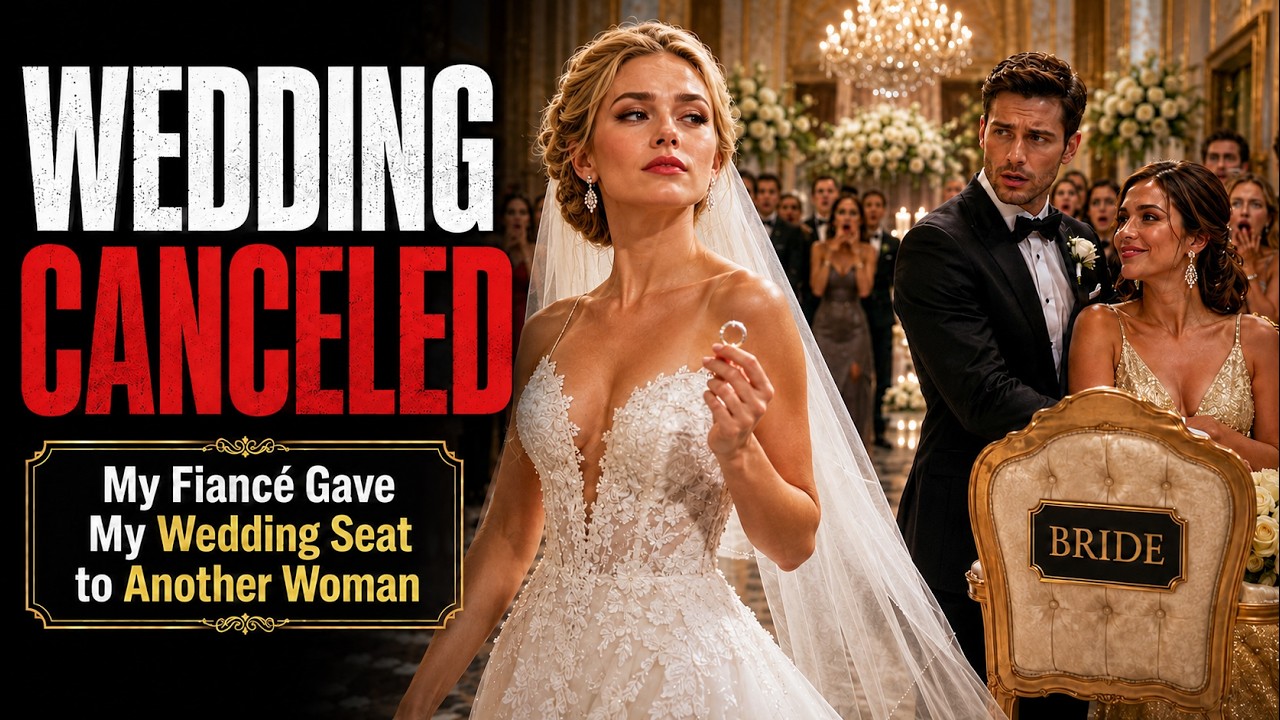
To understand how my sister ended up wearing my wedding dress, you need to know what happened the night she first opened my closet. Stick with me while I share my story. I’m Olivia Bennett, 32 years old. And to understand why watching Madison wear that dress felt like such a violation—and why her wedding eventually collapsed through no doing of mine—you need to understand the history that dress carried, and the pattern my sister and I had been living in for most of our adult lives.

I spent months visiting boutique after boutique across the city until I finally found the exact silhouette I’d pictured since getting engaged. My grandmother, who passed away two years earlier, had set aside money specifically to help pay for my wedding dress. During one of our last conversations, she told me how much she hoped I’d find something that made me feel beautiful. When I found that dress, I felt her presence in every stitch, and I knew I couldn’t let anything touch it.
Madison, my younger sister, was beautiful and naturally charismatic, the kind of person people gravitated toward. But for years, she’d had a habit of borrowing my clothes without asking, copying the hairstyles I tried, and even using my engagement photos as inspiration for her own. Whenever I brought it up, my mother, Patricia, would always say the same thing: “She’s your sister. ” That was my role—the easy daughter, the one who didn’t cause conflict or demand accountability.
I didn’t realize then how much envy sat beneath Madison’s casual borrowing. She didn’t just want my clothes; she wanted the life I was building, piece by piece. The breaking point came a few weeks before my wedding to Daniel. I came home from a long shift to find my bedroom door wide open and the closet empty where the dress had hung.
My heart dropped. I knew instantly where it was. When I went to Madison’s apartment, the door was unlocked, and there she was, standing in front of her mirror, wearing my grandmother’s dress. It wasn’t borrowed.
She’d taken it without asking. “What are you doing? ” I managed to say, my voice shaking. Madison turned, casual as anything.
“Oh, I just wanted to see how it looked. It’s stunning, honestly. ”
“That dress was made for me,” I said. “It has meaning you can’t replace.
”
She shrugged. “Relax. I’ll give it back before your wedding. ”
I stood frozen, but just then my mother walked in.
I waited for her to see the seriousness of the moment, to finally take my side. Instead, she looked at the scene and said, “It’s just a dress. ”
Those words stayed with me. That day, I finally began to understand something I’d spent years refusing to see: Madison didn’t just want my things.
She wanted to be me. And our mother had spent a lifetime making sure she got exactly what she wanted at my expense. I took the dress back, but I couldn’t shake the feeling that something had shifted permanently between us. Madison looked at me with something cold, something that felt like resentment.
But I told myself it was over, that she’d crossed a line and I wouldn’t let it happen again. I was wrong. A few days later, Madison showed up at my apartment with a bouquet of flowers and a story that seemed sincere. She said she felt terrible, that she’d been under a lot of pressure planning her own wedding, and that she missed the closeness we’d once shared.
The Madison I’d grown up with, the one I used to braid her hair and confide in, was standing there again. So I let myself believe her apology was real. But by the time her wedding weekend came around, I had already decided I wouldn’t attend. I couldn’t stand another day of watching her take what was mine and pretend it didn’t matter.
I told Daniel I wanted to focus on our own wedding and that I’d made my peace with Madison, even if I hadn’t really. What I didn’t know was that Madison had already made her own plans. On the morning of his wedding, Ethan texted me, asking if we could talk. He said Madison wasn’t answering her phone and that he was worried.
I told him I had nothing to say to her, that she’d made her choices. But he kept calling. Finally, I picked up, and he told me he’d found the dress—my dress, my grandmother’s dress—in Madison’s closet, hidden in a garment bag with the tags still attached from a boutique we both knew. He asked if I had any idea why she’d have it.
I felt the floor drop. She’d taken it again. And this time, she’d planned to wear it. I stood in my own kitchen, the phone pressed to my ear, and I didn’t know what to say.
Part of me wanted to fly to her city and take the dress back. But another part, the part that had been worn down by years of being told to be the bigger person, finally hesitated. I told Ethan the truth. “That’s my dress,” I said.
“I don’t know why she has it. ”
Ethan didn’t ask anything else. I could hear the silence on the other end of the line, the way his breathing changed. He asked why she would do that.
I told him I didn’t know. But I knew exactly what I had to do next. Instead of going after the dress, I let Madison have it. I sent her a message saying I wasn’t going to fight her over fabric anymore.
I told her I hoped she’d find happiness on her wedding day, and that I was done competing with her for something that was never a competition to begin with. And for the first time in years, I felt the weight lift off my shoulders. On the day of Madison’s wedding, I stayed home. I imagined her walking down the aisle in my grandmother’s dress, and I felt nothing.
No anger, no sadness. Only relief that it wasn’t mine to carry anymore. The call came that evening. It was my mother, her voice thick with something I couldn’t place.
“Olivia,” she said, “something happened. ”
“What do you mean? ”
“Madison’s wedding. It fell apart.
”
I didn’t understand at first. She explained that during the reception, a photographer Madison had hired approached Ethan and asked about the dress. The photographer noticed a distinctive alteration in the bodice, a modification he recognized from the original designer’s work. He’d helped several brides order custom pieces, and he remembered that particular alteration because it had been commissioned months earlier by a client whose name was still documented in the designer’s records.
That client’s name was mine. Ethan asked Madison how she’d come to wear a dress that had been custom-made for me. Madison tried to talk her way out of it, but the truth unraveled from there. Ethan didn’t scream.
He didn’t make a scene. He simply pulled her aside and asked, “What else have you lied to me about? ” Everything cascaded after that—months of half-truths, borrowed clothes, copied photos, and the dress she’d secretly taken not once, but twice. I didn’t orchestrate any of it.
I didn’t expose her. The photographer’s comment was coincidence, the kind of thing that happens when you live long enough without lying. But the cracks that opened were Madison’s own. She had spent so many years pretending to be me that she’d never built anything real for herself.
And when the truth finally surfaced, there was nothing left to hold onto. Ethan called me later that night. He said Madison had told him she “borrowed” the dress, that she’d always loved it. But he knew the truth now.
“I don’t know if I can trust anything she’s ever said,” he admitted. “I’m sorry she did this to you. ”
“You didn’t do it,” I told him. “You just asked the right question.
”
Madison’s wedding never happened. She postponed it indefinitely, and then, a few months later, she and Ethan quietly ended their engagement. I didn’t gloat. I didn’t call her.
But I did feel something I hadn’t expected: pity. For years, Madison ran toward a life she thought I had, never noticing that the only reason it looked so effortless was because my grandmother helped build it, and because I’d learned to let go of what didn’t serve me. The dress eventually came back to me, still intact. I had it restored, and when I married Daniel months later, I wore it with the knowledge that it stood for something far stronger than bruises.
For a long time, I thought being the good sister meant forgiving everything, giving everything, and staying quiet whenever Madison hurt me. But that afternoon with the photographer’s question, and the quiet unraveling that followed, taught me something different. Sometimes the kindest thing you can do for someone who keeps taking from you is simply step aside and let them meet the consequences of their own choices. Madison didn’t ruin her own wedding because of anything I did.
She ruined it because, for the first time in years, nobody was there to clean up after her. And when the truth came out, it finally freed us both. I don’t know if Madison and I will ever be close again. But I know that I’m done carrying the weight of her life, her envy, or her borrowed dreams.
I’m wearing my own dress now, standing in my own choices. And for the first time, that’s enough.