Space heaters only, because Vanessa’s father needed my bed for his back. That was the first crack, though I didn’t see it then. Then came the request to take down the family photographs from the dining room, Ruth’s photograph, the one from our 30th anniversary, because, in her words, they made the room feel “private. ” I should have noticed the pattern sooner.
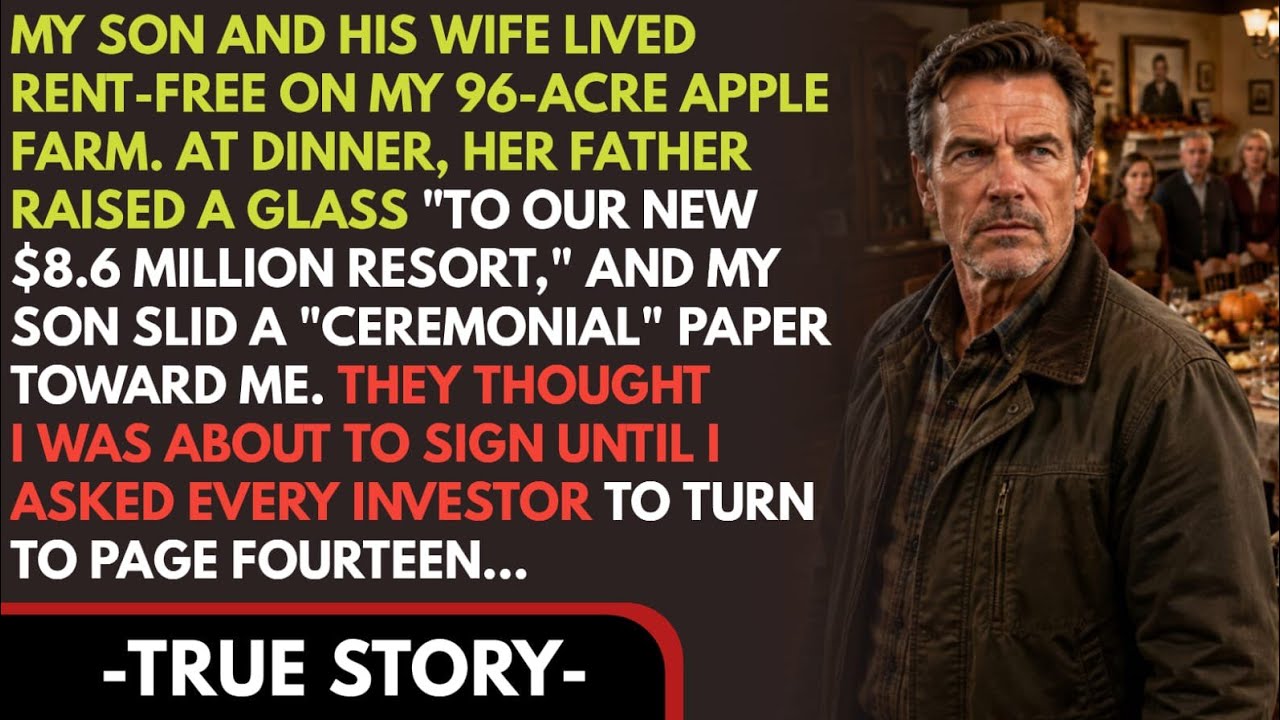
By the time I did, it was already November, and 40 people I’d never met were coming to my table for Thanksgiving. It started with an invoice. A $22,000 invoice from a design firm, coded as if it were bottle labels, paid from Cedar Run’s own accounts. I didn’t recognize the vendor.
I didn’t recognize the project. Then a banker named Audrey Collins called, asking if I understood the terms of a loan secured against my orchard. I told her I hadn’t contributed land to anything. She read me the signature page.
My name. My date of birth. My social security number, all correct. I pulled the records myself.
11,000 apple trees, most of them never met me. That was the phrase Vanessa used when she tried to explain why she’d transferred my trees into her own name. She wanted me to believe the orchard was never really mine, because a tree doesn’t care whose name is on the deed. But the deed was mine.
The debt was mine. The signatures were mine, or at least they looked like mine. The first investor meeting was a blur of handshakes and promises. I didn’t sign anything, but my attorney later found a document with my signature on it, dated June, five months before anyone told me about a resort.
Billed to Cedar Run Retreats, delivered to my address. My son had priced my life’s work at $10 and put his name where mine should have been. Investor units at $25,000 apiece, sold on the promise that they controlled land they had never owned, using my house, my orchard, and photographs of my wife’s rose garden as collateral for other people’s trust. 41 names on the investor list.
Almost all of them Vanessa’s relatives. All 40 of them were coming to my table for Thanksgiving. The bank stopped the transfer before it could close. The account was frozen, but not before $98,000 disappeared.
The notary’s own signed statement said I had never appeared before her. But when I asked Vanessa about it, she was crying before I even asked. She hadn’t watched me sign anything. She had backdated the stamp two days after the fact.
In exchange, she and her husband had been given a $5,000 credit toward a founder unit and had put in $20,000 more of their own money on top of it. My attorney, Owen, told me to keep quiet. He said, “Keep them up if you spoke to me directly before investing. ” The answer was no.
I hadn’t spoken to anyone about a resort, not once. But my voice was on recordings, the same phrase used in investor calls, the same tone, the same inflection. The file was downloaded from our system using Owen’s login. I asked who had heard me approve anything.
No one answered. The bank froze $742,000. $161,000 was unaccounted for, $60,000 of it a deposit on a Richmond condo titled in Vanessa’s name alone. The condo was purchased before the freeze, before my signature appeared on any document.
I asked where the first $380,000 went. No one could tell me. Frank was supposed to be the one who would inherit everything. He’d always assumed it, never asked, just assumed.
When I finally sat him down, I told him the truth as plainly as I could. He would never manage this farm while I was alive, and he shouldn’t build his future around inheriting it when I died. He stared at me for a long time. Then he said something that cut deeper than any of the fraud: “You keep dying things because they have a story.
”
He meant the orchard. He meant the land. He meant me. I wasn’t a father to him, I was a plot of ground with a will attached.
That night, someone tried my locked bedroom door at 11:20. I didn’t move. I just listened to the click of the handle, the soft footsteps retreating down the hall. The legal battle took months.
Owen told me I was 72 and asked how long I planned to hold on to everything. I told him long enough to decide what happens to what I built. I told him I’d built it with people whose names were on paychecks, not just a family tree. In the end, the court found that my signature had been forged, but the damage was done.
The equity was gone. The trust was gone. The family was gone. I went to the Thanksgiving dinner anyway.
I cooked for 40 people I’d never met, because if I canceled, they’d tell everyone a confused old man had gotten cold feet. I set the table with the good china, the silver Ruth had saved for, and the centerpiece from our wedding. I served the turkey, the stuffing, the pies. I watched them eat, and I watched them talk about the resort, about the investment, about the future they thought they were buying.
At the end of the meal, I stood up. I told them the truth. I told them about the forged signatures, the missing money, the frozen accounts. I told them about the notary’s statement, the backdated stamp, the $5,000 credit, the $380,000 that vanished.
I told them about Owen’s login, the recordings, the condo in Vanessa’s name. I told them that their investments were gone, not because of my age or my grief, but because of greed. The room went silent. Some of them cried.
Some of them got up and left. Others sat there, staring at their plates, trying to understand what they’d just heard. Vanessa didn’t say a word. She just looked at me, her face pale, her hands trembling.
Then she pushed back her chair and walked out the door, her husband following close behind. By the time the last guest left, the house was quiet again. I stood in the kitchen, looking at the dirty dishes, the half-eaten pies, the remnants of a family that had never really been mine. I thought about Ruth, about the 30th anniversary photograph, about all the years I’d built something that they tried to take.
I thought about Frank, about the red mitten in the hall drawer, about the 40 people who would never come back. I didn’t clean up that night. I just sat at the table, in the dark, and listened to the house settle around me. The next morning, I started making calls.
Not to forgive, not to reconcile, but to make sure the truth was written plainly for once. I hired a new attorney. I filed the papers. I told my story to anyone who would listen, not out of anger, but out of necessity.
Because if I didn’t, they would tell it for me, and they would get it wrong. The last thing I did was put Frank’s letter in the hall drawer, next to the red mitten. He’d written to me after the trial, asking for a place at the next Thanksgiving. Not forgiveness scheduled in advance, not a place held open, just the truth written plainly for once.
I didn’t know if I could give him that. But I knew I had to try. That following Thanksgiving, 18 people came instead of 40. They sat at the table, ate the food, and talked about the farm, about the orchard, about the future.
Some of them were strangers, some of them were family, some of them were both. I didn’t ask about the resort. I didn’t ask about the money. I just carved the turkey and passed the gravy, and for the first time in a long time, I felt like I was home.
Life would never be the same. But I was still here, still standing, still holding on to what was mine. And that was enough.