I was sitting at my dinner table when my mother-in-law looked me straight in the eyes and said, “I think you’re exaggerating this illness because you just don’t want to work. ”
My husband sat beside me in silence. Then his father added, “We know people who fake things just to get attention. ”
Daniel didn’t defend me.
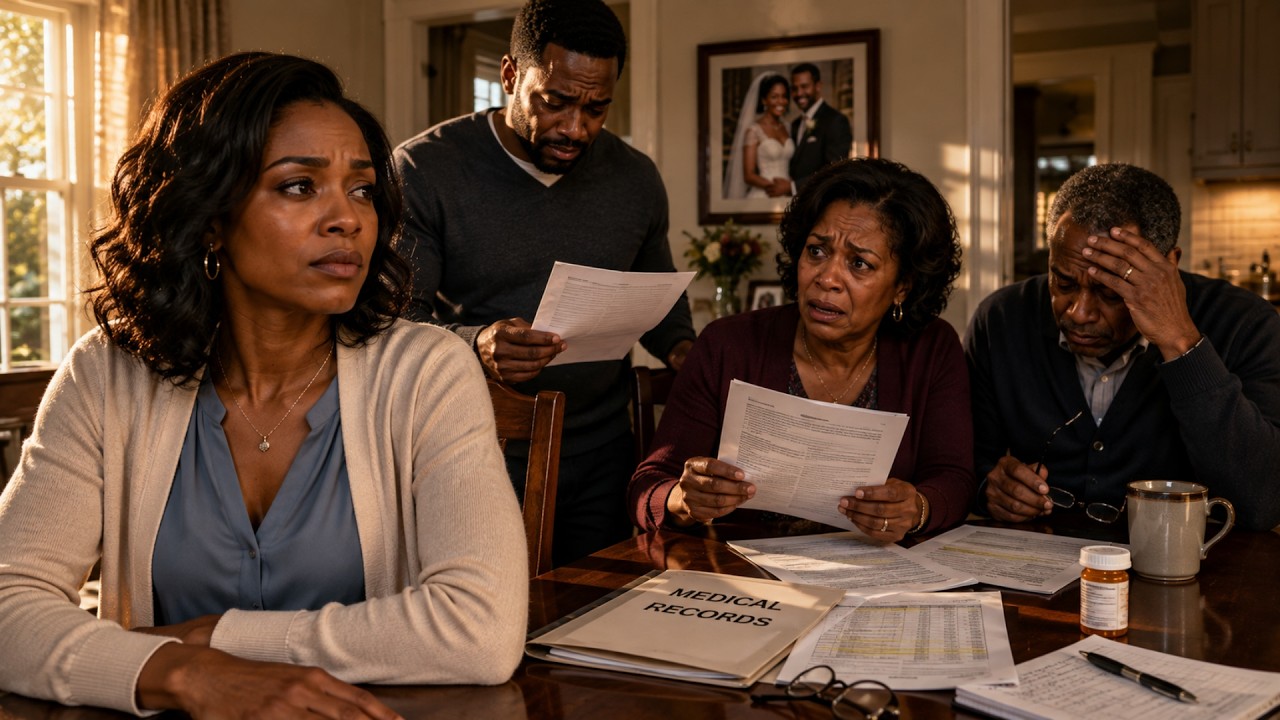
He just stared at the table. In that moment, I realized something far worse than the accusation itself. My husband had been telling his parents about my health condition without ever asking my permission. Three days later, my doctor sent my medical records to my in-laws.
What they read in those pages changed how they saw me forever. But they weren’t the only ones with explaining to do. My name is Sofia Bennett, and I’m thirty-two years old. I work as a student counselor at an elementary school here in Nashville, Tennessee.
My job requires me to show up every day for children who need stability, patience, and reassurance, no matter what I’m silently dealing with myself. I want to understand why my family, the people who were supposed to stand beside me during the hardest stretch of my life, needed proof of my suffering before they would believe me. I had been married to Daniel for five years when everything I’m about to tell you happened. We lived a comfortable, ordinary life.
Nothing extravagant. Just a modest house, a steady routine, the kind of quiet stability most people hope for in a marriage. I’ve always been the type of person who shows up for everyone around me. I went to work even on days when exhaustion weighed heavy on my bones.
I made dinner even when I was so tired I could barely stand at the stove. I remembered birthdays. I sent thoughtful gifts to Daniel’s parents on every occasion. I helped smooth over any small tensions that came up in his extended family.
I rarely complained. Not because I never felt frustrated or worn down, but because I’d spent most of my life believing that complaining makes you a burden. And being a burden was the one thing I worked hard to avoid. Daniel’s parents, Richard and Carol, seemed warm enough during the first years of our marriage.
They welcomed me into family gatherings. They complimented my cooking. They treated me with what appeared to be genuine affection. But there was a pattern underneath that surface warmth that I only noticed gradually over time.
They had no tolerance for weakness. In anyone. Early in our marriage, I watched Richard dismiss his own brother’s back injury at a family gathering. He insisted the man just needed to walk it off.
It struck me as harsh at the time, but I filed it away as a family dynamic I wasn’t used to. Nothing more meaningful than that. Carol would often make comments like, “You just have to push through it,” whenever anyone mentioned feeling unwell. Or, “People these days are too quick to turn everything into a medical condition.
”
She’d say these things with such casual confidence that it was hard to challenge the judgment underneath. At first, these comments seemed harmless. The kind of old-school toughness some families carry as part of their general outlook on life. I never realized how deeply those beliefs would come to shape the story I’m about to tell you.
The fatigue started creeping in around November of last year. It began as a vague heaviness that I justified as nothing more than end-of-year burnout. Working with kids all day is exhausting. I told myself I just needed more sleep.
Better meals. More discipline. But it kept getting worse instead of better. I started waking up in the morning feeling like I’d barely slept at all.
Every step felt like I was wading through water. I had to mentally prepare just to get out of bed. Some mornings, the thought of making coffee felt like an impossible hurdle. I didn’t tell Daniel right away.
That was my first mistake. I didn’t want to worry him. I didn’t want to seem weak. I’d spent so long being the person who held everything together that I didn’t know how to ask for help when I actually needed it.
The symptoms expanded from there. It wasn’t just exhaustion anymore. My joints began aching in ways I’d never experienced before. My hands swelled up for no reason I could explain.
I started having episodes where I felt dizzy and disconnected from my own body, like the world was happening to me from behind a glass wall. I pushed through it. Of course I did. That’s what I’d always done.
I showed up at school every day. I sat with kids in my office who needed someone to listen. I held their hands through panic attacks. I helped them navigate their own small worlds falling apart.
All while my own body was quietly falling apart right underneath me. One afternoon in early December, I was walking across the school parking lot when my vision suddenly blurred. I stopped walking and grabbed the nearest car door to steady myself. I stayed there for a few long moments, waiting for the world to come back into focus.
The principal’s assistant happened to walk past at that exact moment. She stopped and looked at me with obvious concern. She told me I looked pale and asked if I needed to sit down. I told her I was fine.
I told her I just needed to catch my breath. She didn’t look convinced, but she didn’t argue. She just reminded me that the flu was going around and that I should take it easy. I drove home that afternoon with my heart pounding in my chest and my hands shaking on the wheel.
I kept replaying what had just happened. Something was wrong. I knew something was wrong. But I didn’t have a name for it yet.
When I finally told Daniel that I’d been experiencing these health problems, his first reaction was nothing like what I’d hoped for. “Maybe you’re just stressed,” he said. “You’ve been working too hard. ”
I nodded.
I wanted to believe he was right. I wanted to believe that rest would fix everything. That if I just pushed through for a little longer, my body would go back to being normal. But it didn’t.
By January, I could barely function. I was leaving school early at least twice a week because I couldn’t keep my eyes open. I’d come home and collapse into bed without even eating dinner. The house started falling apart.
Dishes piled up in the sink. Laundry went unfolded for days. Daniel noticed. But he didn’t ask me what was wrong.
He just started spending more time at his parents’ house. Looking back now, I can see that was when the distance between us began to widen into something more permanent. He was telling them things about me without my permission. He was painting a picture of our marriage and my health that I never got to see or correct.
I finally went to see my doctor in February. She ran a full panel of blood work, then sent me for more specific testing. The results came back with a word I’d heard before but never imagined would apply to me. Lupus.
Systemic lupus erythematosus. An autoimmune disease where my own immune system had turned against my body. The fatigue. The joint pain.
The swelling. The confusion. All of it was my body attacking itself, and there was no cure. Only management.
The doctor explained that treatment would involve medication, lifestyle adjustments, and learning to listen to my body’s limits. She warned me that stress could trigger flare-ups. She told me to prioritize rest and to be gentle with myself. I felt like the floor had dropped out from underneath me when I heard those words.
Not just because of what the diagnosis meant for my future. But because I knew, deep down, that the people around me weren’t going to understand. I drove home from the clinic and sat in the car for a long time before going inside. Bright red paper in my hand.
A future I hadn’t asked for. I waited two days before telling Daniel. When I finally told him, he sat quietly on the couch for a long time, looking at the floor. Then he asked, “Are you sure?
”
I told him yes. That the doctor had run multiple tests. That it was a confirmed diagnosis. “Lupus,” he repeated.
Like he was tasting the word. “Isn’t that something old people get? ”
I explained that it could affect anyone. That it was an autoimmune disease.
He didn’t say anything else. He just stood up, told me he needed some air, and walked outside. I sat there alone in the living room, processing the reality that the person I’d married couldn’t even sit with me in my fear for more than a few minutes. The financial weight of the diagnosis made everything worse.
My medication alone cost a small fortune. My health insurance covered part of it, but the copays, the specialist visits, the follow-up blood work, it all added up quickly. We were bleeding money just trying to keep me stable. I started asking Daniel if we could adjust our budget.
I said we should cut back on non-essentials. He told me it was my job to cover my own medical expenses since I was the one requiring the care. I was so shocked I didn’t even respond at first. I was drowning.
And he was telling me it wasn’t his problem. I said to him, “Daniel, I’m your wife. Your partner. When did my problems stop being our problems?
”
He replied, “I’m just saying, you’re the one with the condition. I didn’t sign up for this. ”
I didn’t have words for what that statement did to me. It felt like a door slamming shut between us.
A final answer to a question I hadn’t even fully asked yet. Word got back to Richard and Carol through Daniel. I never confessed how much that stung. He’d taken my diagnosis, my private medical information, and handed it to his parents without asking me if it was okay.
Within days, my in-laws started making comments. Carol called me one evening and said she’d heard I was “getting a lot of attention lately. ” She said it with a laugh that didn’t feel friendly. Then came the dinner where everything changed.
It was a Sunday evening in April. Daniel had suggested we go over to his parents’ house for the regular weekly dinner. I was exhausted that day. I’d had a flare-up two days earlier, and my body still felt like it was recovering.
My jaw ached. My hands were stiff. I just wanted to rest. But Daniel insisted.
He said his mother had been asking why I wasn’t coming around as much. He made it sound like I owed her an explanation. So I went. I sat at their dining table, forcing myself to smile and make conversation while the physical toll of the day pressed down on me.
I pushed food around my plate because the thought of eating made me nauseous. Carol watched me from across the table. Then she said it. “I think you’re exaggerating this illness because you don’t want to work.
”
The room went quiet. I felt my face go hot. I opened my mouth to respond, but no words came out. Richard added, “We know people who fake things just to get attention.
”
I turned to Daniel. I needed him to say something. Anything. To stand up for me.
To correct them. To tell them the truth. He looked down at his plate and said nothing. The silence stretched on for what felt like an eternity.
Then Carol smiled and changed the subject like nothing had happened. I sat there in a daze for the rest of the meal. My hands were shaking under the table. I just kept thinking, He didn’t defend me.
He didn’t say anything. The drive home was silent. I waited until we pulled into the driveway before I finally spoke. I said to Daniel, “You heard what they said to me tonight.
Those were your parents accusing me of faking my illness. ”
He replied, “They’re just old-fashioned. They don’t understand. ”
I said, “That’s not okay.
I needed you to stand up for me, and you didn’t. ”
He got defensive. He said I was being too sensitive. That I was making drama out of nothing.
“Making drama out of nothing? ” I repeated. “I have a chronic illness. I can’t control it.
And your parents called me a liar, while you sat there and watched. ”
He didn’t answer. He just got out of the car and went inside. I sat alone in the dark car, feeling like my marriage had just shown me its true face.
He chose them. He had always chosen them. The worst part came three days later. I got a call from my doctor’s office.
The receptionist said my in-laws had requested my medical records. She asked if I was aware of the request, since they’d stated they had my husband’s authorization. I nearly dropped the phone. I called Daniel immediately.
I asked him if he had told his parents they could access my medical records. He said, “They just want to understand what’s going on with you. They wanted to hear it directly from the doctors since you haven’t been doing a great job explaining it. ”
“Explain how this is legal,” I said.
“You gave them access to my private medical information. That’s a violation. ”
“Relax,” he said. “It’s not that big of a deal.
They were just trying to help you. ”
I felt my blood run cold. I realized that every branch of my life that touched Daniel had been compromised without my consent. The records were sent anyway.
Richard and Carol received my full medical history, including every test result, every doctor’s note, every private detail about my condition. I don’t know exactly what they read that day. But I know it changed something inside them. A week later, Carol showed up at my front door.
She looked different. Softer somehow, like a weight had been placed on her shoulders that she didn’t know how to carry. She said, “Sofia, I want to apologize. I read your records.
I didn’t understand how serious this was. ”
I was too tired to feel relieved. I just said, “You shouldn’t have had to read them to believe me. ”
She nodded and looked down at the ground.
She said, “My sister had MS. Years ago. We never believed her either. We thought she was dramatic.
We told her she was fine. She died before she could forgive us. No one ever took her seriously. ”
I didn’t know what to say.
I stood there, hearing the cracks in her voice, seeing the guilt in her eyes. She said, “I treated you the way I treated her. I’m so sorry. ”
It felt real.
It felt like the beginning of something that might be honest between us. But it didn’t erase what had already happened. It didn’t bring back the trust that had been shattered in my marriage. Daniel and I went to counseling after the records incident.
Actually, I forced him to go. He didn’t want to. He went because he knew it would look bad if he refused, not because he wanted to rebuild anything. In our sessions, he kept repeating the same patterns.
He minimized my illness. He made excuses for his parents. He described his own needs as more important because he was “healthy” and I wasn’t. “I didn’t know what I was getting into when I married you,” he said once during a session.
“No one expects their wife to suddenly be disabled. ”
Hearing him say that word about me stopped my heart. Disabled. I’d never thought of myself that way.
I was just me. Living with a new condition. But to him, that’s all I was now. A burden.
A bad surprise. The therapist suggested he attend support groups for spouses of people with chronic illness. He said he’d think about it. He never went.
By the end of the summer, we were barely living as partners. We shared a house, but not a marriage. He slept on the couch by his own choice. He stopped asking me about my doctor’s appointments.
He stopped asking me anything at all. One night in September, I found a text message on his phone. I hadn’t been looking for it. His phone buzzed on the table, and I saw her name.
You probably know how that revelation feels. The stomach-drop recognition that there’s a version of your life you didn’t know about. It wasn’t just one text. It was months of them.
Messages he’d sent to a woman from work. He’d been telling her everything. About my illness, my exhaustion, how I was “no fun anymore. ”
And then came the words that ended everything between us.
“She’s become a burden. I don’t know if I want to stay anymore. ”
I read those words over and over. I couldn’t believe my husband, my partner, the person I had chosen through every hardship, had written that about me.
I didn’t confront him that night. I didn’t sleep either. I sat in the kitchen with a cup of coffee growing cold in front of me, replaying our entire marriage in my head. I thought about the years I’d spent showing up for him.
For his family. For everyone. I thought about the times I’d swallowed my own pain to keep the peace. And I thought about how all of it had bought me nothing.
He came into the kitchen the next morning, pretending everything was normal. He asked what I was doing up so early. I said, “We need to talk. ”
I asked him directly.
I told him I’d seen the messages. His face went pale. His mouth opened and closed a few times. Finally he said, “It wasn’t what it looked like.
”
I asked him if he meant to say those words, with no judgment, no manipulation. He wouldn’t answer directly. He said it was complicated. He said he was stressed.
He said he didn’t know what he wanted. “Do you want a divorce? ” I asked. He didn’t respond.
And that silence was the loudest answer of all. I moved out of the house three weeks later. I found a small apartment near the school. It wasn’t much, but it was mine.
Daniel didn’t fight it. He didn’t ask me to stay. He didn’t even seem sad when I left. He just told me he’d have a lawyer contact me about the paperwork.
I signed those papers with a hand that didn’t tremble. Because I was done crying for him. In fact, I was surprised by how calm I felt. How at peace.
The divorce was finalized in late November. Almost a full year after my symptoms first started. Richard and Carol didn’t attend the mediation. Richard didn’t call once.
But Carol showed up at my apartment a few weeks later. She brought a casserole. “Are you okay? ” she asked.
I told her I was learning to be. She said, “I want you to know, I believe you. I believe you about everything. And I’m ashamed that we didn’t show up for you when you needed us most.
”
I thanked her for saying that. I meant it. It didn’t fix everything, but some part of me needed her to know she was forgiven. She said, “My sister never got to hear those words from me.
But I wanted you to hear them from me now. ”
I spent Thanksgiving alone that year, in my tiny apartment, eating a plate of food I’d made only for myself. And for the first time in what had felt like forever, I wasn’t pretending to be fine. I was just fine.
The winter passed slowly. I attended regular medical checkups. I found a specialist I trusted. I started taking my medication on a schedule that actually worked for my body.
I learned to pay attention to my limits instead of pushing past them. I found a support group for people living with lupus. We met twice a month. For the first time, I sat in rooms with people who believed me without needing proof.
In January, I started a gratitude list. Not because some well-meaning person told me to, but because I needed to remember what I still had. My job. My colleagues.
My health was unstable, but I was managing. I was rebuilding. I took a long hard look at my life and realized how much I’d been carrying that was never mine to carry. The guilt.
The shame. The need to prove my own suffering was real. I spoke to a therapist regularly too. She helped me reframe how I saw myself.
Not as a burden. Not as someone who needed to be perfect to deserve love. But as someone who deserved compassion simply because she was human. I felt myself waking up.
Slowly. Like a landscape emerging from morning fog. In March, Carol asked if I wanted to get coffee. I said yes.
We met at a small café near my apartment. She told me she’d left Richard. She said years of his dismissal, of his refusal to accept her own growing health concerns, had finally pushed her out. One morning she’d woken up with a strange ache in her chest and he told her it was probably indigestion from her “anxiety.
”
She said, “I finally saw it clearly. He never believed any woman in his life when she said something was wrong. ”
She looked at me across the table and said, “I’m sorry it took so long. For all of it.
”
I reached across the table and took her hand. We’ve been building something new ever since. Something without the old patterns. A relationship that lives in the present, not in the shadows of who we used to be.
The spring came early that year. I remember because I started walking. Every morning, before work, I’d go a little further than the day before. My body couldn’t do what it used to, but it finally listened to me.
I thought a lot about what it meant to be considered useless by the person who had promised to love me. And I realized it had never been about my worth at all. It was about his inability to see it. Daniel tried to reach out once after the divorce was final.
He sent me a text saying he was sorry. He said he was seeing a therapist now. He wanted to know if we could meet for coffee. I looked at the message for a long moment.
Then I turned off my phone and put it away. Some apologies are for the other person, not for you. And some doors stay closed because that’s where peace lives. I don’t know if Daniel ever actually changed.
I don’t know if Richard ever learned to accept the parts of life that can’t be conquered or explained. But I don’t need to know. Because the most important lesson I learned from all of it is this: I was never the problem. I was never too much.
I was never simply a burden. I was always the one who showed up. Even when I was the one who needed someone to show up for me. Healing isn’t always loud.
Sometimes it’s just you, quietly learning to believe in yourself again.