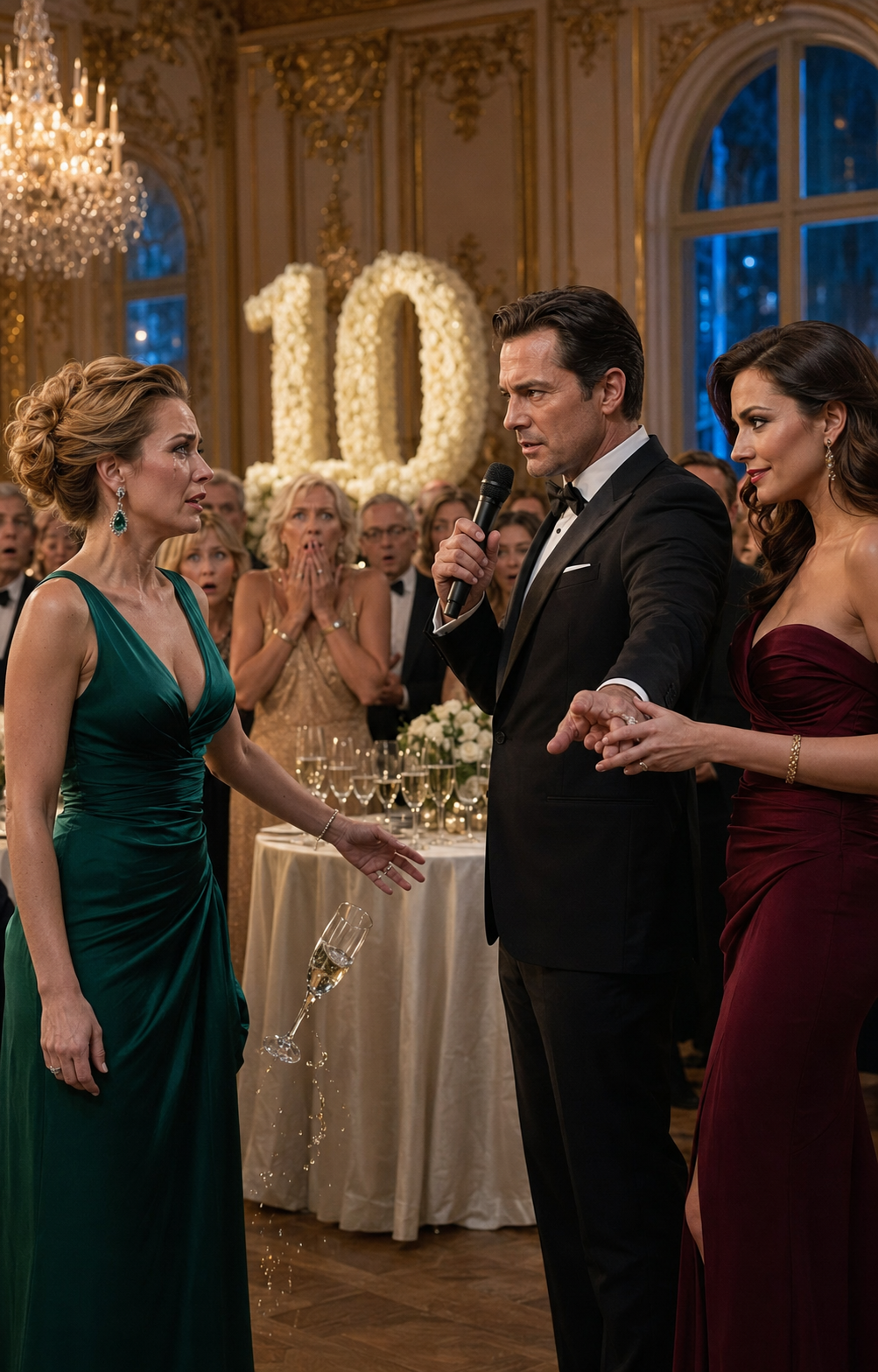
One week after I buried my wife of forty years, my son and his wife called an inheritance meeting. They sat across from me in the boardroom built on my sweat and Carol’s soul. My daughter-in-law, Brenda, smiled a smile colder than a Chicago winter. “Now that the old woman is gone,” she said, “you’ll sign the company over to my husband and learn to fend for yourself.

”
I smiled right back. She had no idea that my lawyer was about to walk in with a sealed envelope that would unravel a forty-year-old secret and burn her entire world to the ground. When Kenji Ishikawa entered the room, Brenda’s confidence flickered. This was supposed to be her ambush, a clean strike against a grieving old man.
“This isn’t a family meeting,” I told her. “This is business, and Kenji is company counsel. ”
My son, Ryan, shifted uncomfortably, but Brenda cut him off before he could speak. “Jake, let’s be practical,” she said.
“Carol is gone. The company needs stability. Ryan’s been COO for ten years. It’s what Carol would have wanted.
”
Hearing her use my wife’s name to justify her greed lit something in me, but I buried it. Carol had taught me that. Never let them see you sweat. Let them see you think.
“I have given my entire life to this company,” I said, standing. “I am still CEO and chairman. Ryan remains COO. I own 51% of the voting shares.
This meeting is over. ”
Brenda’s mask slipped into pure venom. “You’re a relic, Jake. Relics belong in museums.
”
She stormed out, dragging a stunned Ryan behind her. Alone in that room, I understood something. This wasn’t the end. It was the beginning of a war—one Carol, in her own brilliant way, had already prepared me to win.
I didn’t go home. I drove to a small coffee shop across town and met Kenji. “Start with any vendors hired without my approval,” I told him. “Any new accounts opened in the last eighteen months.
Let Brenda think I’m too broken to notice anything. While she plans her coronation, build her gallows. ”
Sitting there, I remembered something Carol had said a year earlier, watching the sunset from our porch. “It’s Brenda.
I don’t trust her, Jake. She looks at Ryan and doesn’t see a husband—she sees a stock option. ”
I had dismissed it as an overprotective mother’s worry. Now her words felt like prophecy.
She had seen the vulture long before I did, and I had let her down by not listening. Three days later, Kenji called, his voice stripped of warmth. “I found something. It’s bad.
”
He’d uncovered a shell company, B&R Consulting, registered in Delaware. Brenda and Ryan. For twenty-two months, it had billed Peterson Freight for vague consulting services that never existed. Each invoice kept just under the threshold requiring my signature, approved solely by Ryan.
Total stolen: $812,450. A down payment on a ski chalet in Aspen. A brand new Porsche registered to Brenda. Credit card debt paid off.
All while I was holding Carol’s hand through chemotherapy, through her final days. The number was staggering, but it felt incomplete—a symptom, not the disease. Carol had been suspicious before the stealing even started. I needed to know what she knew.
I drove to see Maria Sanchez, Carol’s private nurse, in her small brick home in Pilsen. Over chamomile tea, she told me the truth Carol swore her to protect. “She changed in her last two months,” Maria said. “Private calls with Mr.
Ishikawa. She had me bring down old boxes from the attic—ledgers, papers from years ago. She’d sit up late with a magnifying glass, muttering, ‘It doesn’t add up. ‘”
Then Maria went inside and returned with a small tarnished key.
She said if I ever needed to fight, this would be my shield and my sword. It belonged to a safe deposit box at First National Bank, opened in 1979—before Carol and I were even married. The next morning I opened box 31B. Inside: an old photograph of young Carol looking sad.
A birth certificate for Ryan Peterson—father Jacob Peterson, mother a name from a life I thought I’d buried forty-five years ago. Adoption papers transferring parental rights to Carol. And a leather diary. I read it in the cold vault, and my world tilted.
In her own hand, Carol had written about discovering, two months before our wedding, that I’d fathered a child during a drunken mistake with another woman. She’d followed me, found the mother—broken, desperate, willing to trade the baby for cash—and made a choice. *He is my son. I am building our family on a foundation of forgiveness.
*
She adopted Ryan, raised him as her own, loved him fiercely, and vowed he would never know the truth. Later entries revealed her unease about Brenda. *There’s something calculating about her, like Ryan is a stepping stone. Maybe I made him too soft to see it.
*
I wept in that vault for her strength, my blindness, and the son I was about to lose. Three days later, Brenda and Ryan showed up at my house, furious that their accounts had been frozen. Brenda accused me of trying to burn the company down out of spite, of dishonoring Carol’s memory. I looked past her, straight at Ryan.
“I’m just protecting your mother’s legacy,” I said quietly, “the parts you know about and the parts you don’t. Are you sure you know what that legacy is, son? ”
The question landed somewhere Brenda’s rage couldn’t reach. I left them standing in the foyer.
The next morning I summoned an emergency board meeting. Brenda thought it was a desperate old man’s last stand. She had no idea she was walking into an ambush. In the boardroom, she delivered a rehearsed speech painting me as a grieving relic unfit to lead, praising Ryan’s vision.
Then I handed the floor to Kenji. Folder by folder, screen by screen, he laid it bare. The shell company. The invoices Ryan approved.
The Aspen chalet. The Porsche. The shifted funds. The final number: $812,450.
Our CFO gasped. Our operations chief turned red with fury. Ryan crumbled, sobbing that he hadn’t known the dates lined up with his mother’s final months. Brenda turned on him, hissing that he’d loved every dollar.
“While my wife was dying,” I said, my voice cold and clear, “you were building your life in Aspen. This is the legacy you were trying to protect. ”
The board voted unanimously. Ryan terminated.
Brenda barred from every property. Kenji authorized to pursue full criminal and civil prosecution. Security escorted them out. Brenda walked out with her head high, playing queen to the end.
Ryan had to be lifted from his chair, sobbing my name as the door closed on him. Alone afterwards, staring at Ryan’s empty chair, I finally understood. This hadn’t been my counteroffensive. It was Carol’s.
Every step—Kenji’s private calls, the ledgers from the attic, her warning about Brenda—had been breadcrumbs she’d laid before she died. Knowing grief would blind me, and love would make me vulnerable. She had armed me from the grave. I wasn’t avenging her.
I was finishing what she started. A week later, Kenji arranged one final meeting to discuss separation terms. I knew Brenda would come expecting to negotiate, still believing this was only about the stolen money. She arrived in a cheap approximation of her old power suit, Ryan a hollow shell beside her.
“What’s it going to take to make this go away? ” she demanded. “There is no offer,” Kenji said. “This is about the will.
”
He opened Carol’s final testament, executed two months before her death. Liquid assets to me—simple, expected. Brenda relaxed. Then came article four.
Carol’s controlling 51% of Peterson Freight, her separate property under our pre-nup, placed into the Peterson Legacy Trust, transferable only to an heir who could prove direct biological bloodline. Brenda laughed it off, just a dressed-up way of saying it goes to Ryan, her son. She demanded a DNA test to prove it, certain of the outcome. Kenji had already run it.
Carol, in her final months, had quietly obtained Ryan’s DNA during a routine physical and compared it to her own. The result: zero common genetic markers. Probability of maternity: 0%. Ryan wasn’t Carol’s biological son.
He never had been. Brenda’s mind cracked trying to fit the fact into her world. “Then who inherits? ” she screamed.
The door opened. A woman in her forties stepped in—dark hair, quiet intelligence, Carol’s exact eyes. Dr. Ann Wallace.
A cardiothoracic surgeon from Philadelphia. Carol’s biological daughter, given up for adoption at nineteen, long before she’d ever met me. Reunited with her mother in secret over the past six months. The verified sole heir to the Peterson Legacy Trust—and now owner of 51% of Peterson Freight.
Brenda’s world collapsed in on itself. She accused us of fraud, of hiring an actress, until Kenji calmly confirmed the DNA was already certified and appended to the will. There was nothing left to fight. She sank into her chair, sobbing not from grief, but from total, absolute loss.
Ryan sat frozen, whispering that the mother he’d worshipped for forty years had never been his mother at all. The aftermath came slow but certain. The civil suit was filed before they’d left the parking garage. Criminal charges followed: grand larceny, wire fraud, conspiracy.
Facing prison, Brenda turned on Ryan instantly, filing for divorce and painting herself the victim. She walked away with nothing but debt and a criminal record. Ryan pleaded guilty to everything. Broken, cooperative, and perhaps because of a quiet word from his father to the D.
A. , he avoided prison. Sentenced instead to five years probation, community service, and a lifetime of restitution. At forty, he took a job at a warehouse, learning for the first time what real work felt like.
Months later, spring had thawed the Chicago winter. I walked the depot grounds with Ann, the daughter I was only beginning to know. “She would have been so proud of you,” I told her. “What you do, saving lives.
”
“She told me she was proud of you, too,” Ann said softly. “She said you were the only man she ever knew who built an empire and kept his soul. ”
Ann had no interest in running the company. Her calling was in Philadelphia.
She’d serve as chairwoman from afar while the board hired a professional CEO. “She planned all of this,” I said. “She saved her company. ”
“I think she saved me, too.
” Ann looked up at the Peterson Freight sign. “She saved all of us, Jake. She gave us a chance to build something new, something based on truth. ”
The grief never fully leaves.
But for the first time in a long while, it wasn’t the only thing I felt. I felt peace. I felt hope. Carol’s legacy wasn’t just steel and concrete and boardroom votes.
It was standing right beside me, and it was only just beginning. This story teaches us that a legacy built on deceit and entitlement is a house of cards waiting to collapse. True strength isn’t only what you build—it’s the wisdom to protect it. Carol’s greatest power wasn’t just her forgiveness forty years ago.
It was her cold, clear understanding that truth, however painful, is the only foundation that lasts. This is a fictional story created for entertainment purposes. Any resemblance to real people or events is purely coincidental.