Garrett Dawson snatched Tiana’s wrist and jerked her under the spotlight. Five hundred guests roared as he shoved her forward, her mop clattering against the stage floor. “I caught this trash humming in my hallway while she scrubbed my toilets,” he announced, disgust dripping from every word. “This filthy nobody thinks she has a voice.
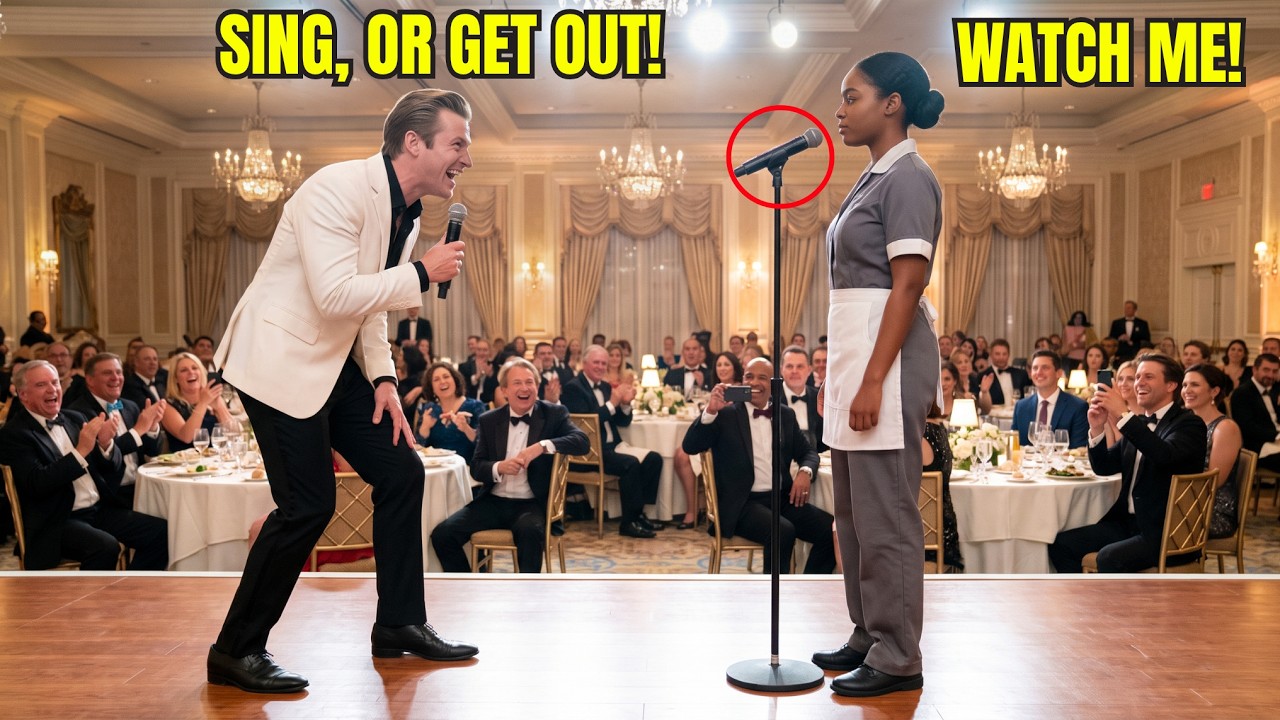
” Phones rose across the crowd. A woman in the front row giggled into her palm. Tiana’s chin quivered, but her eyes burned. “I was just cleaning,” she whispered.
“Did I say you could speak? ” Garrett slammed the microphone against her chest. “Sing the song no one alive can sing. When you fail, scrub this stage on your knees while the world watches.
” Her fingers wrapped around the mic, shaking. What came out of her mouth next didn’t just silence the room. It ended a man’s entire career. Back to where it started.
Tiana Ingram was nineteen, living in a one-bedroom apartment on the east side of Nashville with her grandmother, Ruth. The radiator clanked louder than the TV. Dinner was sometimes rice and gravy, sometimes just rice. Ruth had been a gospel singer once—not famous, but the kind who could make an entire church fall silent with one note.
Emphysema took her stage, but never her ear. She started teaching Tiana when the girl was five, just the two of them at the kitchen table, Ruth humming a line, Tiana repeating it night after night, year after year. “God gave you something, baby,” Ruth would say. “Something that don’t belong to this world.
Don’t you ever let nobody steal it. ”
Tiana believed her. She just didn’t believe it mattered. Talent didn’t pay rent.
So at seventeen she dropped out of school, and at eighteen she got a job: night shift custodial staff at the Harrington Concert Hall, the most prestigious music venue in Nashville. She showed up every night, clocked in, pulled on her uniform, pushed her cart down the same hallways where Grammy winners walked hours earlier. Nobody looked at her. Nobody spoke to her.
But Tiana had a secret. Every night after the last light went off, she’d leave her mop by the wings and walk to center stage. The seats were empty. The spotlight was cold.
And she would sing. Not for anyone. Just because it was the only time in her life she felt like she existed. Her voice filled that empty hall like water filling a cathedral.
No microphone. No audience. Some nights she’d hit notes so high the crystal chandelier above the balcony would hum in response. But someone else heard her.
Eddie Collins, the night shift sound engineer, had listened to her over a hundred times from the booth. He never told her. He just pressed record one night and kept that recording on his hard drive for eight months, untouched, a secret he knew could either be stolen or destroyed if the wrong person heard it. He was right about that.
Garrett Dawson had six platinum records, two world tours, forty million followers. But his fans didn’t know he hadn’t sung a single live note in over three years. Every concert, every TV appearance—pitch corrected, auto-tuned, engineered by a team of six audio technicians who signed NDAs thicker than phone books. Garrett’s real voice was thin, flat, the kind that wouldn’t survive an open mic night at a dive bar.
But the image was flawless, and the image was everything. When Garrett booked the Harrington for his exclusive VIP concert—500 guests, industry elite, journalists, influencers—the venue manager pulled Tiana aside. “You stay backstage. You stay invisible.
You do not go anywhere near the main hall. ” Tiana nodded. She understood. She always understood.
She didn’t know that in six hours she’d be standing on that same stage, not with a mop, but with a microphone. Thirty minutes before showtime, Tiana was on her hands and knees scrubbing a scuff mark off the baseboard in the corridor behind the main stage. Her earbuds were dead, just worn so people wouldn’t talk to her. She started humming low, a hymn about grace that Ruth used to sing while washing dishes.
Her voice floated through the corridor like smoke—soft, warm, impossible to ignore. Garrett heard it first. He stopped mid-step. His manager, Phil Bradshaw, nearly walked into him.
“What the hell is that? ” Garrett said. Phil looked down the hallway. “That’s the cleaning girl.
” For three seconds, Garrett didn’t speak. His jaw tightened. Something flickered behind his eyes—not amusement, not curiosity. Recognition.
He knew what real talent sounded like. And he knew it was everything he’d been faking for years. He walked toward her slowly. “The mop girl thinks she’s Whitney Houston.
” Two assistants laughed behind him. Tiana said nothing, lowered her eyes, reached for her bucket. “No, no, don’t stop on my account. ” He crouched down to her level.
“Sing for me, sweetheart. Right here on the floor, where you belong. ” She didn’t answer. Her knuckles whitened around the scrub brush.
Garrett stood up, turned to Phil with a grin that had nothing warm in it. “Keep this one close tonight. I just had an idea. ”
The concert started at eight.
Tiana heard it through the walls, backstage emptying trash cans, wiping down counters. The bass thumped through the concrete. The crowd screamed on cue. But Tiana had spent two years in this building.
She knew what live vocals sounded like through these walls—imperfect, textured, alive. What she heard tonight was too clean, too smooth, too perfect. Like someone had ironed every wrinkle out of a human soul. He was faking it.
Every note. Every run. Every high she’d heard on the radio—manufactured. She stood still in that dim corridor and knew.
The door burst open. Phil Bradshaw walked in with two security guards. “You. Come with us.
” “I didn’t do anything. ” “I didn’t ask. Move. ” They grabbed her arms and marched her through the corridor toward the side entrance of the stage.
She could hear the crowd now, through a thin curtain. “Wait, what’s happening? Where are you taking me? ” Phil didn’t answer.
He just held the curtain open. And that’s when the light hit her face. Five hundred people. Five hundred phones.
Her chest locked. Her legs went soft. Every instinct told her to turn around, run, disappear. She could disappear.
She was good at that. Then she heard it, a voice from somewhere deep, like warm water and Sunday morning: Don’t you ever let nobody steal it. Tiana stopped pulling. Her spine straightened.
She didn’t walk onto that stage. She stepped. The laughter started before she reached the microphone. Garrett was already at center stage, one hand raised.
“All right, all right. I’ve got a surprise for you tonight. ” He paced, letting the silence build. “Now, you all paid a lot of money to be here.
Champagne, caviar, the best sound system in Nashville. But sometimes, sometimes real entertainment shows up where you least expect it. ” He snapped his fingers. The spotlight swung.
And there she was. The crowd murmured. Then someone said it loud enough to carry: “Is that the janitor? ” Garrett grinned.
“Ladies and gentlemen, I caught this one singing in my hallway tonight while she was mopping. Now, she thinks she actually believes she has what it takes to stand on this stage. ” The room crackled with laughter—not polite, the kind that pushes down. A man near the bar raised his glass.
“Let her try. This should be good. ” A woman three rows back whispered to her date, “This is cruel. ” Her date shrugged and kept filming.
Garrett walked to Tiana slowly, circled her once, the way you’d circle something found on the bottom of your shoe. “You want to sing, fine. Let’s give her the real thing. Not some gospel hymn from the back of a bus.
” He looked at his sound engineer. “Pull up track nine. ” Everyone in the industry knew track nine. It was the song that had broken three professional vocalists in live competition—a four-octave monster that demanded control, power, and precision most human throats simply could not produce.
The highest note sat in a register so extreme that vocal coaches used it as a cautionary tale. It was the song Garrett had recorded in studio with seven layers of pitch correction and never once attempted live. “Sing this,” Garrett said. He didn’t look at her; he looked at the audience.
“The whole thing. Start to finish. No backing track. No help.
Just your little voice and this microphone. ” He held the mic out with two fingers, like handing a toy to a child. “And when you can’t—when your voice cracks and the whole room hears it—you’re going to walk to that closet backstage, get your mop, and clean the stage. On your knees in front of everyone here.
Deal? ” He pressed the mic into her hand and walked to the side of the stage, arms crossed, leaning against a speaker like a man watching a bonfire. Tiana held the microphone. It was heavier than she expected.
The track intro played—soft piano, a slow build. She had eight bars before the vocal entry. She looked out at the crowd. Five hundred faces, some grinning, some pitying, some already bored.
Phones glowed like a field of cold stars. She thought about running. Her legs knew the way. Back through the curtain, down the hallway, out the service exit, into the Nashville night.
She could disappear. She was good at that. Four bars left. She closed her eyes.
And for one second, she wasn’t on a stage. She was in Grandma Ruth’s kitchen, five years old, standing on a step stool. Ruth’s hand on her shoulder. The melody simple, unbreakable, infinite.
Two bars. She opened her eyes, lifted the mic, and began. The first note came out thin, fragile, like a candle flame in a drafty room. A few people shifted uncomfortably.
Someone coughed. Garrett smiled. The second note was different—deeper, fuller, like a door opening in a room everyone thought was sealed shut. The murmuring stopped, not all at once, in patches spreading outward from the front row.
By the third line, Tiana’s voice had found the floor—the foundation beneath the melody, where breath becomes sound, and sound becomes something that lives inside your chest. She climbed, line by line, note by note, each one higher, wider, more impossible than the last. Her voice didn’t strain. It expanded the way a river fills a canyon.
The audience stopped filming. Not because they chose to. Because their hands forgot what they were doing. The man who’d raised his glass set it down and didn’t pick it up again.
And then came the note. The one that shouldn’t exist in a human throat. The one that vocal coaches call a myth. The one Garrett had autotuned eleven times in studio and still couldn’t get right.
Tiana hit it the way the sun hits the horizon—effortless, inevitable, like it was always supposed to be there. The note filled the Harrington from floor to ceiling. It rattled the chandelier above the balcony, the same chandelier that had hummed for her in the dark, alone, a hundred nights before. But tonight it wasn’t humming.
Tonight it was ringing. Garrett’s smile was gone. His arms had uncrossed. His hands hung at his sides like they’d forgotten their purpose.
His eyes, for the first time in his career, were not performing. They were witnessing. He knew. She was everything he’d pretended to be.
Tiana held the last note for six full seconds. Eyes closed, hands at her sides, the microphone barely touching her lips. Her body completely still, like the song was holding her up. Then silence.
One second. Two. Three. The first person to stand was the woman who’d said, “This is cruel.
” She stood with tears running down her face and her hands already moving. Then the row behind her. Then the balcony. Then the entire hall.
Five hundred people on their feet, not clapping—roaring. The sound crashed over the stage like a wave breaking against a cliff. Tiana opened her eyes. She didn’t bow.
She didn’t smile. She blinked slowly, like someone waking up from a dream she wasn’t sure was real. In the fourth row, a man who’d been sitting quietly all evening rose to his feet slower than everyone else. He didn’t clap.
He just stood there, hands folded in front of him, watching her with the kind of stillness that only comes from people who’ve spent fifty years listening for exactly this. Nobody in that room knew his name. Not yet. But they would.
The applause wouldn’t stop. Garrett stood at the edge of the stage, six feet from Tiana, and he could feel it. The room had shifted. The five hundred people who’d paid to see him weren’t looking at him anymore.
They were looking at her. The girl he’d put there as a joke—and the joke had eaten him alive. He moved fast. Two strides.
He plucked the microphone from Tiana’s hand before she could blink. “Well,” his voice boomed with manufactured cheer, “how about that, folks? A little surprise entertainment from our hard-working staff. ” He threw an arm around Tiana’s shoulders, casual, performative.
“Let’s give her a hand and get back to the show. ” But the crowd didn’t follow his lead. “Let her sing another one! ” The shout came from near the balcony.
Then another voice, then another. A rhythm started—palms hitting thighs, feet stomping floors. “One more! One more!
One more! ” Tiana stood frozen. She didn’t understand what was happening. Fifteen minutes ago, these people had laughed at her.
Now they were calling her name, a name most of them didn’t even know. Garrett’s jaw clenched so hard the muscles in his neck twitched. He turned his back to the audience and locked eyes with Phil Bradshaw in the wings. The look said everything.
Fix this. Now. Phil disappeared. Garrett faced the crowd again.
The grin was back, wider, sharper, emptier. “She’s got an early shift tomorrow, folks. Floors don’t clean themselves. ” He laughed alone.
The audience didn’t laugh with him. For the first time in his career, a room full of people stared at Garrett Dawson in silence. Tiana felt a hand close around her elbow. Another on her opposite arm.
Two security guards, the same ones who dragged her out here. “Ma’am, you need to come with us. ” “What? But I didn’t—” “Now.
” They pulled her off stage, not gently, not carefully. The curtain swallowed her, and just like that, the light was gone. Backstage, Phil was waiting. “Badge.
” No greeting, no explanation. “I don’t understand. He told me to—” “You went on stage during a live event without authorization. That’s a category one violation.
Badge. Now. ” Tiana’s hands were shaking. She unclipped her employee badge—the one with her photo, the one she’d carried for two years—and placed it in Phil’s hand.
He dropped it into his jacket pocket like it was a receipt. “Your final check will be mailed. Don’t come back to this building. ” “But he dragged me.
” “I don’t care what happened on stage. You’re done here. ” She stood in that hallway, the same hallway where she’d been scrubbing a scuff mark ninety minutes ago. The bass from the concert still thumped through the walls.
Garrett was back on stage. The show was continuing as if she’d never existed. A security guard walked her to the service exit and held the door open. The Nashville night poured in—warm air, distant sirens, the hum of a city that didn’t know her name.
She stepped outside. The door locked behind her. It started to rain before she reached the bus stop. She walked the rest of the way home, forty minutes, no umbrella, no phone—she’d left it in her locker, and her locker was inside a building she’d never enter again.
When she reached the apartment, the porch light was on. Grandma Ruth was sitting in the chair by the window. She always sat there when Tiana worked late. Ruth took one look at her granddaughter—soaked, trembling, empty-handed—and didn’t ask a single question.
She just opened her arms. Tiana collapsed into them. What neither of them knew was that five hundred phones had already done what no record label could stop. The videos were uploading, and the internet doesn’t sleep.
By six the next morning, Tiana Ingram was the most searched name in America. She didn’t know it. She was asleep on the couch, still in last night’s clothes, her grandmother’s blanket pulled up to her chin. But outside those walls, the internet was on fire.
The first video hit Twitter at 11:47 p. m. —forty-three seconds of shaky footage. Within an hour, it had two million views.
By dawn, the number had passed twenty million. #CleaningLadyVoice trended in every English-speaking country on the planet. The comments came in waves: “I’ve been to three of Garrett Dawson’s concerts. This girl just made all of them feel like a lie.
” “She’s standing there in a work uniform hitting notes that trained singers can’t touch. ” “Watch his face at 0:38. That’s not confidence. That’s fear.
” That last comment became its own thread. People slowed the footage down, frame by frame. The moment Tiana hit the impossible note, Garrett’s expression collapsed—not surprise, not admiration, terror. The kind that only comes when you realize the thing you’ve been hiding has just been exposed by the thing you tried to destroy.
News vans started arriving in East Nashville before noon. Reporters knocked on doors. Neighbors pointed down the street. Nobody knew her last name.
Inside the apartment, Ruth turned off the TV when the first story aired and let her granddaughter sleep. Meanwhile, across the city, Garrett’s PR machine went to war. Not against another celebrity. Against a nineteen-year-old girl who cleaned floors for a living.
First came the statement: “During last night’s exclusive event, an unauthorized individual disrupted the performance by accessing the stage without permission. The individual, a temporary custodial contractor, has been terminated. ” Temporary custodial contractor. Not even her name.
Then came the whisper campaign—bots, burner accounts, seeded narratives. “Heard she had a pitch corrector hidden in her clothes. ” “It’s all staged. She’s an actress.
” Then Garrett made it personal. He went on a late-night podcast and laughed about the whole thing. “Look, I feel bad for the girl. I really do.
But let’s be real. She’s a cleaner. She cleans toilets. And people want to give her a record deal because of one viral moment?
That’s not how this industry works. Talent isn’t enough. You can’t just mop your way to a Grammy. ” The comment section didn’t laugh.
“Mop your way to a Grammy” hit the internet like gasoline on a fire. It became the rallying cry for everyone who’d ever been told they weren’t good enough because of where they came from. Back in the apartment, Tiana sat on the bathroom floor with the door locked. She’d borrowed her neighbor’s phone.
Twenty minutes of scrolling. Twenty minutes of strangers calling her a fraud, a liar, a nobody who got lucky. She couldn’t breathe. Ruth knocked.
“Baby, open the door. ” “They’re saying I faked it, Grandma. ” “I know what they’re saying. ” “They’re saying I don’t deserve—” “Open this door.
” Tiana did. Ruth stood there, steady, unmovable. She took her granddaughter’s face in both hands. “Listen to me.
They took your job. They took your badge. They put your name in the dirt. But they cannot take your voice.
Not him. Not his lawyers. Not a million strangers on the internet. Your voice belongs to you.
And it always will. ” Tiana closed her eyes. Tears ran down her cheeks. She nodded.
The first call came on a Tuesday. Tiana was stirring a cup of coffee she hadn’t tasted. The neighbor’s phone buzzed. “Tiana.
My name is Eddie Collins. I was the night shift sound engineer at the Harrington. ” She didn’t say anything. “You don’t know me, but I know you.
I’ve heard you sing on that stage over a hundred times. After midnight, when you thought nobody was listening. ” Her throat tightened. “And the night of the concert when Garrett pulled you on stage, I was in the booth.
The mic they gave you was dead. The house system wasn’t routed to it. You wouldn’t have been heard past the third row. ” Silence.
“I turned it on. I patched you into the main speakers. That’s why your voice carried through the entire hall. ” Tiana closed her eyes.
“I have something else—the raw audio from that night, unprocessed, no filters, no effects, no pitch correction. Just your voice, pure. I can prove to anyone who asks that what came out of that microphone was 100% real. ”
That was the first domino.
The second came from Claire Sanderson, a music journalist who’d been chasing a story no editor would let her publish: the story of Garrett Dawson’s manufactured voice. She had fragments, anonymous tips from former audio engineers, metadata showing impossible vocal corrections. But no proof. The concert videos gave it to her.
She ran spectral analysis on the audio, comparing Tiana’s raw vocal signature against Garrett’s studio recordings. The results weren’t even close. But she still needed the masters—the original studio files that would show the correction layers. That’s when the third domino fell.
A number she didn’t recognize, a voice she’d never heard, someone who’d been sitting in a room when Phil Bradshaw said something he shouldn’t have: “If anyone pulls the raw masters from the last album, if anyone finds the pitch correction layers, we’re done. All of us. Make sure those files are locked. ” He said it to four people in a closed room.
One of them was already thinking about who to call. “I can get you the files,” the voice told Claire. “The raw masters from the last three albums. Every track.
Every correction layer. Everything. ” “Why? ” “Because I watched that girl stand on a stage and sing the truth while the man who pays my salary has been lying for a decade.
I can’t do this anymore. ” Claire had her story. Meanwhile, a local Nashville podcast, The Unrehearsed, reached out to Tiana through Eddie. The host didn’t want drama.
She just wanted to hear Tiana sing. Tiana almost said no. Ruth said yes. They drove to the studio in Eddie’s truck.
No manager, no label, no contract. Just a conversation, a few questions, and then at the end, the host asked, “Would you sing something for us, anything? No track, no accompaniment, just you. ” Tiana closed her eyes.
And she sang a cappella, unfiltered—the same voice that had filled the Harrington. The episode went live that afternoon. By evening, it had been downloaded three million times. The debate was over.
There was no hidden device, no trick, no studio magic. Just a voice that didn’t belong to this world. And in a hotel suite across the city, a man named Wallace Pemberton picked up his private line, the one only fifteen people in the music industry had the number to. “Get me Eddie Collins,” he said.
The Nashville Music Awards aired live on a Sunday night. Thirty-eight million viewers. Claire Sanderson’s article dropped six hours before the broadcast. The headline alone shook the industry to its foundation: “The Voice That Never Was: Inside Garrett Dawson’s Decade of Deception.
” Fourteen pages. Spectral analysis. Raw studio masters showing correction layers stacked so deep the original vocal was unrecognizable. Testimony from three former audio engineers.
Internal communications. It wasn’t an allegation. It was an autopsy. By the time the red carpet opened, every phone in every pocket was buzzing with the same story.
Reporters shouted questions at Garrett’s SUV as it pulled up. His team hustled him inside through a service entrance. His face was tight, gray, stripped of every performance he’d ever given. The ceremony began.
Garrett’s category came third: live performer of the year. The irony was so heavy, the air tasted like metal. His name was read. The applause was thin.
He walked to the podium, reached for the trophy. The host stepped forward. “Before we present this award, the academy has a request. In light of recent reporting, we believe the public deserves clarity.
Tonight, we’re asking both nominees in this category to perform live. The same song. No backing track. No pitch correction.
No audio processing of any kind. ” The host looked directly at Garrett. “Just the voice. And the truth.
” A murmur swept through the hall like wind through a canyon. Garrett’s hand was still reaching for the trophy. It froze. “Mr.
Dawson, you’ll perform first. ”
The band started—a stripped arrangement, piano and strings, nothing to hide behind. Garrett took the microphone. Years of performing had given him a steady hand.
But his throat hadn’t performed in a decade. Not without the invisible hands of six technicians holding every note in place. He began. The first line was passable—tight, controlled.
The second line cracked. Not badly. Just enough. A hairline fracture in a glass wall.
The audience heard it. He heard it. He pushed harder. His jaw locked.
Sweat rolled down his temple. The third line broke. The note—the one that defined the song, the one that separated professionals from legends—came out flat, hollow, like a bell struck too many times. He tried to recover, pushed higher.
His voice splintered into something thin and desperate and unmistakably human. He stopped mid-phrase. The microphone dropped to his side. Thirty-eight million people watched him stand there, silent, finished.
The host stepped forward again, quiet, respectful. “Miss Ingram, whenever you’re ready. ” Tiana walked out from the wings. No entourage.
No stylist. No team of handlers. Just her. She took the microphone, looked out at the audience, looked at the cameras, looked at Garrett still standing at the edge of the stage, unable to leave, unable to look away.
She didn’t say anything. She just breathed. And then she sang the same song—the same notes, the same impossible architecture of melody that had broken Garrett sixty seconds ago. But from her, it wasn’t a test.
It wasn’t a performance. It was a conversation between her voice and every empty seat she’d ever sung to at two in the morning. She climbed through the verses like someone walking up a staircase in her own home—familiar, certain, unhurried. And when she reached the note, she didn’t attack it.
She didn’t reach for it. She opened her mouth, and it was already there. The note filled the auditorium the way sunrise fills a valley—not sudden, not violent, just inevitable. Total.
Everywhere at once. The first person to stand was a cellist in the orchestra pit. Then a cameraman. Then an entire balcony.
Thirty-eight million people watching, listening, crying. Garrett’s head dropped. His hand pressed against his mouth. His eyes were red, not from anger, from recognition—the same recognition he’d felt in that hallway, the one he’d tried to bury with lawyers and trolls and a podcast punchline.
She was real. She had always been real. And he had never been anything close. Tiana held the final note.
Eyes closed. Still. When it ended, the silence lasted four seconds. Then the world broke open.
A man rose from the second row. Wallace Pemberton—fifty years in the music industry, more Grammys on his shelf than most people had books. He walked to the stage, past security, past the host, straight to Tiana. He extended his hand.
She took it. And in front of thirty-eight million witnesses, he said five words into the nearest microphone: “Welcome to Pemberton Records, Tiana. ”
The fall of Garrett Dawson didn’t happen all at once. It happened the way a building collapses after the foundation cracks—floor by floor, in full view of everyone who ever stood inside it.
His label dropped him first. Meridian Records released a statement seventy-two hours after the awards ceremony. Four sentences. No apology.
“Effective immediately. ” The tour was next—thirty-six dates across North America, refund requests crashing the ticketing servers within a day. Venues pulled out one by one. Sponsors disappeared.
Not because of the music. Because of the lie. Consumers don’t forgive deception. They especially don’t forgive deception that came wrapped in cruelty toward a nineteen-year-old girl.
Phil Bradshaw disappeared from public life. Garrett himself gave one final interview, pre-recorded, no live audience. “I made mistakes,” he said. His voice was flat, rehearsed.
Even now, even at the end, he couldn’t stop performing. He never said her name. Not once. The internet noticed.
Now Tiana. The week after the awards, Wallace Pemberton sat across from her at a diner in East Nashville—not a boardroom, because Eddie told him that’s where she’d be comfortable. Pemberton slid a contract across the table. Tiana looked at it, looked at Ruth sitting beside her, looked at Eddie two booths away pretending to read a menu.
“I don’t want to be famous,” Tiana said. Pemberton nodded. “I don’t want you to be famous. I want you to be heard.
” She signed it with a pen Ruth pulled from her purse—the same pen Ruth had used to write hymns in the margins of her Bible for forty years. The first album was recorded at the Harrington Concert Hall. Tiana requested it specifically. Not because she had something to prove, but because that building held every midnight melody she’d ever sung to empty seats.
It held the echo of every note she’d offered to no one. And she wanted to give those ghosts an audience. Eddie Collins ran the soundboard—officially hired, officially credited, officially part of the team. Ruth sat in the front row of the empty hall during every session.
She didn’t give notes. She just sat there with her eyes closed, listening to her granddaughter’s voice fill the room the way it had filled their kitchen for fourteen years. Sometimes between takes, Tiana would look out from the stage and see her grandmother’s lips moving. Not singing.
Praying. The album debuted at number one. But that wasn’t the part that mattered most. Six months after the concert that changed everything, the Harrington unveiled a new addition: a rehearsal room on the third floor, open to the public, free to use, available to any musician—signed or unsigned, trained or untrained, known or unknown—who needed a space to practice.
The plaque on the door read, “The Tiana Ingram Room. ” And below it, in smaller letters, “Don’t you ever let nobody steal it. ” The cleaning staff at the Harrington received a raise that year. A real one.
Their break room was moved from the basement to the second floor. Their names were printed in every concert program under a new section: “With gratitude to the team that makes the stage possible. ” Tiana insisted on that last part. Pemberton made it happen.
Late on a Thursday night, long after the last audience had filed out and the stage lights had cooled, a door opened at the back of the Harrington Concert Hall. Tiana walked in alone. Not through the service entrance—through the front doors. The ones with the brass handles and etched glass.
The ones she used to polish every Tuesday. The hall was dark. The seats were empty. The chandelier hung silent above the balcony—the same one that had hummed for her in the quiet.
The same one that had rung for her in front of five hundred strangers. She walked to center stage. No microphone. No spotlight.
No audience. She stood exactly where she’d stood on the worst night of her life. And exactly where she’d stood on the best one. She closed her eyes.
And she sang the same song Grandma Ruth had taught her at the kitchen table. The one about grace. The one that started with a hum and ended with something that sounded like the whole world breathing in at once. Her voice filled the empty hall the way it always had.
No applause. No cameras. No millions watching. Just her.
Just the sound. Just the ghost of a woman who’d told a five-year-old girl that her voice didn’t belong to this world. She was right. When the last note faded, Tiana opened her eyes.
She looked at the empty seats. And for the first time, she smiled. Not for the cameras. Not for the record deal.
Not for the thirty-eight million people who’d watched her prove a liar wrong. For herself. Because she’d always had the voice. She just needed the world to shut up long enough to hear it.
If you were standing on that stage in a uniform you didn’t choose, in front of people who already decided you were nothing—would you have opened your mouth, or walked away? There’s one detail most people miss. Go back to the moment Garrett first heard Tiana sing in that hallway. Don’t listen to what he said.
Watch what his face did. That’s the moment he knew. If this story stayed with you, share it with someone who needs to hear it. And subscribe.
There are more voices out there the world hasn’t heard yet.