The champagne flute shattered against the ballroom floor at exactly 9:47 p. m. I knew the time because I’d been watching the clock above the bar for the past hour, counting the minutes until I could leave without making a scene. I shouldn’t have even been there.
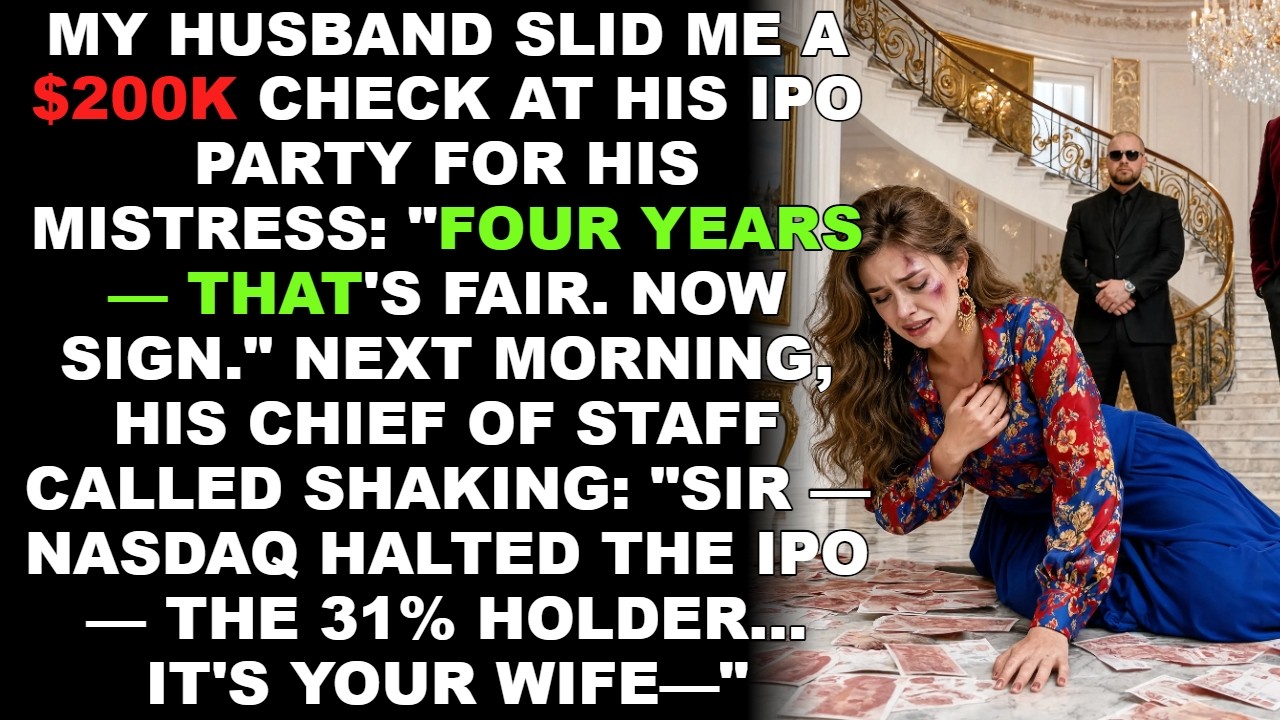
My husband had made that clear enough in the car ride over. “Don’t monopolize my time tonight. There are investors to work,” he’d said, adjusting his cufflinks in the rearview mirror without looking at me. “Just smile and stay out of the way.
”
I smiled. I stayed out of the way. That had been the arrangement for a while. The ballroom at the Langham was everything Knox Beaumont had spent three years dreaming about.
Crystal chandeliers throwing fractured light across two hundred of Chicago’s most powerful people. The Beaumont Capital logo projected in gold above the stage. The kind of room where careers were confirmed and legacies started. The public offering had closed that afternoon, forty-eight dollars a share.
By morning, my husband would be worth north of six hundred million dollars on paper. And everyone in this room was there to celebrate a man they believed had built something from nothing. He had. Just not from nothing.
I was standing near the bar in a cocktail dress I’d bought on clearance, holding sparkling water because Knox didn’t like me drinking at his functions, watching the man I’d spent four years loving from across the room with his arm around Tatum Voss. I’d known about Tatum for five months. A receipt in his jacket pocket, a hotel in the Loop, charged to the corporate card he kept for emergencies. I’d said nothing.
I was waiting, though I couldn’t have explained for what, except that some part of me needed to see it all the way through before I made a move. At 9:47, Tatum crossed the ballroom toward me with the kind of walk that says she owns the floor and everything standing on it. She was wearing red. “You must be the wife,” she said, loud enough that the couple nearest us turned to look.
She had a smile like a paper cut. Thin, deliberate, designed to sting. “Knox talks about you. He says you make a really good pot roast.
”
Something cold and settled moved through my chest. Not shame. Not rage. Something quieter and more final than either.
“Tatum,” I said. “You even know my name. ”
She tilted her head. “Did it take you long?
”
“About forty seconds. The receipt had your initials on the room service charge. ”
Her smile flickered. Just once.
Then Knox was there. He’d moved across the room fast, his hand landing on my arm, fingers pressing hard enough that I’d have a bruise by morning. His smile was still in place. His eyes were not smiling.
“What’s happening over here? ” he said. Not a question. “Your wife was introducing herself,” Tatum said with warmth she didn’t mean.
“She was making a scene. ”
He looked at me with the specific flatness I’d learned to recognize. The look that meant I was the problem. That I was always the problem.
That the most reasonable thing I could do was agree. “On the most important night of my career,” he said. “I’ve had enough. ”
I hadn’t said a word.
“I want a divorce. ”
He said it that easily. Like it had been sitting in his mouth for months and tonight was simply the occasion he’d selected for it. “I’ve had the papers drawn up for two weeks.
I was waiting until after the offering closed. I’m done waiting. ”
He reached into his jacket, the same jacket I’d taken to the dry cleaner eight days earlier, and pulled out a cream envelope. “There’s a check inside.
Two hundred thousand. That’s fair. ”
Two hundred thousand dollars. For four years of cooking his dinners and learning every investor’s wife’s name and their food allergies and their preferred wines.
Hosting thirty-one dinner parties in our apartment on the forty-second floor. Listening to his pitch decks at ten at night, telling him what wasn’t working, fixing it for him. Giving up a career and a city and a version of myself I’d been building since I was twenty-three. I took the envelope.
I held it for a moment, feeling the weight of the thick paper. Then I handed it back. “Keep it,” I said. I walked out of the Langham into a December night cold enough to make your eyes water.
The valet brought our car. In my name, for insurance purposes. One of those small logistical kindnesses that meant nothing and everything simultaneously. I sat in the driver’s seat with the heat running and called the only number in my phone I hadn’t dialed in three years.
It rang twice. “Miss Hargrove. ”
Walter’s voice was exactly as I remembered. Steady, warm, with that slight formality he’d carried since I was a child and could never entirely set down.
In the background, I heard a chair moving, something set down quickly. “I’ve been hoping you’d call. ”
“Walter,” I said, “I’m in Chicago. I need you to come get me.
”
A brief pause. Then, very quietly, “I’ll have the plane in the air within the hour. ”
I sat back and closed my eyes. Three years before I met Knox Beaumont, my father had tried to hand me something I didn’t know how to accept.
He’d built Hargrove Energy Group from a regional Texas oil operation into a company that moved natural gas through six states, held federal renewable contracts worth three billion dollars, and owned a real estate portfolio covering one hundred and twelve million square feet across twelve cities. He’d done it all in thirty years, mostly alone, after my mother died, with me sitting at the end of his conference table doing homework while he took calls at night. When he handed me the keys to the executive floor in Houston, not metaphorically but literally, a physical set of keys, I told him I needed time. What I meant was: I need to know if someone can love me without knowing any of this.
I understand how naive that sounds. I understood it then, too, in an abstract way that didn’t stop me. Because when Knox handed me a glass of wine at a benefit in Chicago and said I had the most interesting face he’d ever seen, I wanted to find out. So I became Mia Prescott.
Prescott, my mother’s maiden name. The name I could keep something of her in. A woman with a marketing background and a modest savings account and no family to speak of. Knox never asked too many questions about my past.
For a long time, I thought it was because he was respectful. Later, I understood it was because he wasn’t that curious about me. I married him eighteen months later. I moved into his apartment and learned that he liked his coffee black and needed fifteen minutes of silence after work before he could have a conversation.
I gave him the fifteen minutes every day for four years. I gave him the fifteen minutes and anything else he needed. And I watched the way he looked at me change slowly from something warm to something that had forgotten warmth was ever there. When I found the hotel receipt, I didn’t cry.
I sat on the bathroom floor for a while, and then I made dinner. That same week, I made a quiet call to Houston. I asked Walter to pull some documents I had a right to. What I learned was this: Knox’s entire operation, the real estate fund, the venture arm, the IPO vehicle he was about to take public, was critically and structurally dependent on a single limited partnership relationship.
Hargrove Energy Group. Thirty-one percent of the general partner entity Knox had built for the offering. My family’s capital was the foundation his empire stood on. And for four years, he’d treated me like a piece of furniture.
The Hargrove family plane landed in Houston at 2:00 a. m. Walter was at the bottom of the steps with an umbrella even though it wasn’t raining. He looked at my dress.
He looked at my face. He put his hand briefly on my arm, said nothing, and walked me to the car. My father was in his study when I arrived, still in his shirt and tie, a glass of bourbon beside him. He looked at me for a long moment.
“How bad? ” he said. “He handed me divorce papers in front of his investors and his girlfriend,” I said, “with a check for two hundred thousand and a speech about what’s fair. ”
He set down his glass very carefully, with the particular deliberateness of a man deciding how angry to allow himself to be.
“Tell me what you need,” he said. Here’s what most people don’t understand about how real money moves. It doesn’t make noise. It doesn’t have to.
When Hargrove Energy Group’s legal team sent a formal notice to Beaumont Capital’s fund administrator at 8:03 the morning after the IPO, citing a material breach of the limited partnership agreement, specifically a clause covering reputational conduct and undisclosed conflicts of interest, it arrived as a single PDF attached to a routine-looking email. By 8:45, Knox’s chief of staff had called three times. By 9:15, Knox himself called. I was in Houston at my father’s conference table with a cup of coffee, Walter on my left and three attorneys on my right.
I let it ring. The Hargrove stake wasn’t just equity. Because of how Knox had structured the vehicle to satisfy SEC requirements, the stake was tied to a key person provision. If Hargrove exercised its right to withdraw under the material breach clause, the fund administrator was to halt trading in the newly published shares pending resolution.
This was on page 214 of a four-hundred-page agreement Knox had signed three years ago, when he was running out of options and not reading the fine print carefully enough. By 9:30, Beaumont Capital stock was halted on Nasdaq. By noon, The Wall Street Journal had a reporter making calls. Knox flew down on a charter that afternoon and arrived at the Hargrove Energy building at 3:47.
He told the receptionist he needed to speak with whoever was handling the Beaumont Capital matter. She made a phone call, listened, set down the receiver. “Someone will be right down,” she said. The elevator opened.
I stepped out. I was wearing a gray suit my father’s tailor had made for me years ago, the kind that doesn’t call attention to itself because it has no reason to. My hair was up. I wasn’t carrying anything except my phone.
Knox stared at me. The lobby was full of people. Everyone kept moving. No one looked at us.
“Mia,” he said. Something was wrong with his voice. “What are you doing here? ”
“I work here,” I said.
He looked past me at the Hargrove Energy Group logo on the wall behind the reception desk. Polished brass letters, eight inches high. “What do you mean, you work here? ”
“I mean this is my company.
My father built it. I run it. My name is Mia Hargrove, and I’ve been Mia Hargrove for thirty-four years. The Prescott version was a temporary arrangement.
”
The silence that followed was very complete. I watched it happen on his face. The cascade of realizations arriving in the wrong order. Each one shifting something that couldn’t shift back.
The IPO, the trading halt, the limited partnership stake, the key person provision, the four years of dinners and dry-cleaned jackets and dinner parties and pitch deck feedback. All of it rearranging into a picture he’d been too incurious to see. His mouth opened slightly, then closed. “The Hargrove stake,” he said.
“That was… that was your family. ”
“That was my capital, yes. Which I authorized three years ago when you came to us through a finder because you were out of options and needed an anchor investor badly enough to sign whatever was in front of you.
”
I let that land. “You never asked who the beneficial owner was. I thought that was interesting. ”
“Mia.
”
“The legal team will be in touch with your counsel about the process. It’ll take some time to work through. I’d recommend being transparent with your other investors. It tends to go worse when they find out on their own.
”
“You can’t do this. ”
His voice broke on the last word. Not the performed version he used when he wanted me to feel responsible for his moods. Actual fear, stripped of its usual casing.
“I have employees. I have people who depend on me. ”
I looked at him. “You handed me a divorce envelope in front of two hundred people and told me two hundred thousand was fair for four years of my life.
Think very carefully before you explain to me what’s fair. ”
I pressed the elevator button. The doors opened. I stepped in.
The lobby continued its quiet business around him as the doors closed. What followed was not fast, and it was not clean, and I don’t think it was supposed to be. The partnership dispute took eleven weeks. Knox’s legal team pushed hard, but the agreement was what it was, and what it was had been written by attorneys who had spent thirty years building ironclad language for exactly this kind of moment.
Three of Beaumont Capital’s four senior partners resigned during the process. Knox stepped down as CEO in a statement that described the move as pursuing new opportunities. The fund was restructured. The flagship vehicle was wound down.
Investors recovered a portion of what they’d put in. Tatum called me from a blocked number the week after Knox stepped down. She said she had connections. That she’d make noise.
That I’d used a legitimate business relationship as a personal weapon. “Tatum,” I said, “Hargrove Energy has been a United Way board sponsor for twenty-two years. Our attorneys have more partnership litigation hours than most firms carry in everything combined. And you’re going to call a reporter?
Go ahead. I’ll wait. ”
She didn’t call a reporter. What I found out later, through people who talked to people, the way you find things out in these circles, was that three weeks after the story ran, Tatum was photographed leaving Knox’s bankruptcy attorney’s office with him.
The photograph ended up in a column that mostly covers real estate closings and charity galas. She was gone by spring. I didn’t know where she went, and I didn’t try to find out. The two hundred and nineteen million Hargrove recouped from the Beaumont stake, the returns that had accrued over three years while I was in Knox’s apartment memorizing people’s wine preferences, I put into a fund.
We called it the Prescott Foundation. After my mother. Its work is specific. We help women in the middle of leaving.
Not women who have left and landed somewhere soft. Women who are still in it. Who want out but can’t see a door because their names aren’t on the bank accounts. Because they gave up careers and let the degrees go stale and the professional contacts fade.
Because the money is his and the apartment is his, and nobody told them that “we” was always a provisional arrangement. We don’t ask a lot of questions. We don’t require anyone to justify themselves to a committee or tell their story to a stranger on the first meeting. Legal fees, transitional housing, emergency income, job placement.
If you need it, you call. That’s the whole policy. In our second year, a woman named Renata came to our Houston office. She’d been a teacher before she married.
When she left, she had forty dollars in a checking account and a restraining order she was still waiting to have enforced. Within eight months, she was employed again, in her own apartment, teaching second grade at a school three miles from where she grew up. She sent us a card. It said: “I didn’t think anyone would just help without wanting something back.
”
That’s the thing I think about most. How low the bar had gotten for so many of us, that basic unconditional help had started to seem like something that couldn’t be real. My father came to the opening of the Prescott Foundation’s Chicago office. He sat in the front row in a dark suit and listened to me speak.
When it was over, he put his arm around me and held on for a few seconds without saying anything. Then: “Your mother would have loved this. ”
I nodded. Didn’t trust my voice.
Walter drove us back to the hotel. Chicago in April was cold and bright, the lake throwing light at everything. I sat in the back seat and let the city move past the window, and I thought about a ballroom and a cream-colored envelope, and a man telling me two hundred thousand was fair. I’d spent four years trying to make someone see me as worth seeing.
I should have saved the effort. Not because I wasn’t worth it. I always was. That was never in question.
But because the problem was never mine to solve. The only one in that arrangement who could unfind me was him, and nothing I cooked or learned or gave or quietly endured was ever going to change that. The Prescott Foundation has offices now in Houston, Chicago, Atlanta, and Phoenix. Denver opens next spring.
We’re not hard to find. If you need us, come find us.