For seven weeks, the same minivan had occupied the far corner of the McDonald’s parking lot on International Boulevard. It wasn’t a customer’s car, and it wasn’t an employee’s. Its windows were always fogged from the inside, and a blanket was pinned across the rear glass to keep out prying eyes. Six spaces away, in a Mercedes with the engine off, Malcolm Davis had been watching for the third night in a row.
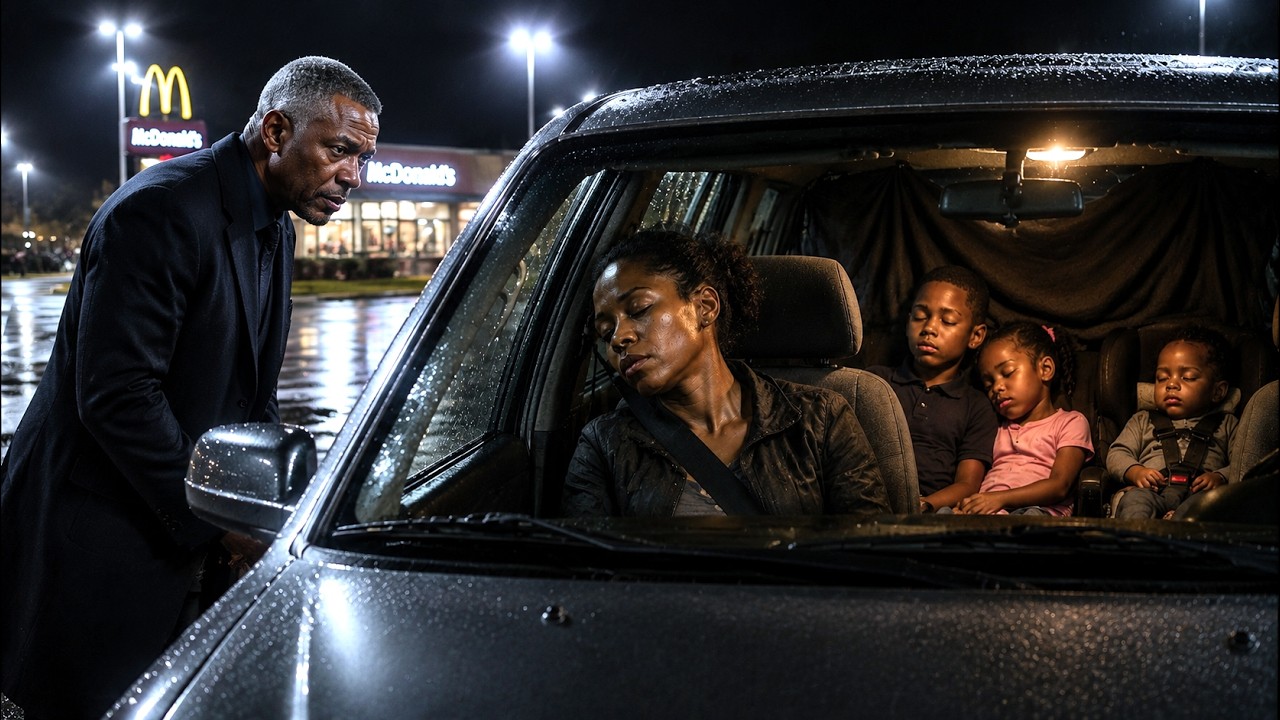
He didn’t know who lived in that van, and he didn’t know why he kept coming back, but he was determined to find out before the night was over. Malcolm drove at night the way other people drink—not to go anywhere specific, but just to keep moving. It was a habit he’d had since he was twelve years old, when his own mother, Dorothy, navigated the South Side of Chicago in a beat-up Honda Civic. She’d drive in loops at two, sometimes three in the morning, because the shelters were full, and sitting still in a parked car felt too much like giving up.
Now, at fifty-two, Malcolm lived in a penthouse in the Oakland Hills with floor-to-ceiling windows, but the insomnia hadn’t left him. When sleep wouldn’t come, he drove, and tonight, his driving brought him back to this lot. The first night he noticed the van, it was just an observation. The second night, he noticed the position—backed against the fence in the darkest corner, but still within the angle of the security camera above the drive-thru.
It was deliberate, chosen with a purpose he didn’t understand yet. On the third night, he saw the hand. A small hand, a child’s hand, pressed against the fogged glass of the passenger window. It dragged downward, clearing a streak through the condensation, and for less than two seconds, he saw the outline of a small face looking out.
Then the hand disappeared, and the fog closed back over the streak. Malcolm didn’t get out of the car. He didn’t call anyone. He just sat there for four more minutes before driving home, where he stood at his window, looking west toward the flatlands.
The image of that hand stayed with him, not as a picture in his mind, but as a weight in his chest. He didn’t sleep that night, but that wasn’t unusual. What was unusual was the reason. He went back the next night, telling himself it was just the drive.
He arrived before the van, at 9:15 PM. The driver pulled in at 9:41. The engine ran for three minutes before shutting off. The blanket went up over the rear windows, and the fog started to form.
At 10:08, the driver’s side window cracked open about two inches, and Malcolm heard something he wasn’t prepared for. A woman’s voice, reading. She was reading aloud to the children inside that van. He couldn’t make out the words, but the cadence was enough—slow, measured, the rhythm of someone trying to build a room out of sound.
He sat with his own window down and listened to a woman read bedtime stories in a fast-food parking lot. The next day, he got out of his car. Inside the van, the world was about four feet wide and six feet long, and it was held together by systems that had taken weeks to build. Imani Carter, thirty-one years old, was a certified nursing assistant at a senior living facility in East Oakland, working the night shift from 11 PM to 7 AM at $19.
50 an hour. She had a method for everything. The middle row seats folded flat to make the children’s bed. The driver’s seat reclined as far as it could go, which wasn’t far enough, but she had stopped noticing the discomfort.
A plastic bin in the passenger seat held three days’ worth of clean clothes, sorted by child. A five-gallon water jug was for washing faces. A clear bag hung from the headrest with wet wipes, hand sanitizer, and a comb for her daughter’s hair. The trunk held the rest: one suitcase, one garbage bag of shoes, and a box of shelf-stable food that was never full and never empty.
Imani kept it at exactly what she could afford after gas and the $3 Happy Meal she bought the children every night. That purchase served a purpose—it gave them a reason to be at the McDonald’s and her a reason to park. She called their situation “in between,” a word she used with the children. We are in between right now.
In between is not forever. In between is just the middle part of a story that hasn’t finished yet. Her oldest, Jaylen, was nine. He understood what “in between” really meant, more than she wanted him to.
Nia, at six, accepted it the way six-year-olds accept what their mothers tell them—completely, without evidence. Carter, the youngest, was two. He didn’t remember the apartment they used to have. For Carter, the van was the world, and his mother was always in it.
That was the part that hurt the most. He didn’t know anything was missing. Every night followed the same order. Park.
Engine off. Blanket up. Wipe faces and hands. Change into sleep clothes.
Then, Imani reached into the pocket behind the driver’s seat and pulled out a worn paperback copy of Maya Angelou’s And Still I Rise. It was her mother’s book, bought at a used store in 1994 for two dollars. Her mother, Renee, had written in the margins. On page 43, in blue ink, was a single sentence: Home is not an address.
Home is the voice that reads to you at night. Imani had read that sentence to her children the first night they slept in the van, and she had read it every night since. After the book, after the breathing slowed, one light stayed on. It was Jaylen’s phone flashlight, dim and angled into the pages of a composition notebook he kept in his backpack.
He was making a list. “Things that are still good. ” Number 47: Mom’s voice when she reads. Number 48: The McDonald’s man left nuggets again.
He closed the notebook, a small act of defiance against the chaos around him. Imani Carter’s life hadn’t always been like this. She had been married to Terrence Carter, a construction worker she met at a block party cookout when she was twenty-two. They had a two-bedroom apartment at Ridgewood Terrace.
Jaylen took his first steps in that hallway. Nia said her first word in that kitchen. Carter was born in that back bedroom, five weeks early, caught by his father with shaking hands. Two incomes made it work—not comfortable, but enough.
Then Terrence died on March 14th in a scaffold collapse at a construction site. He was thirty-three. The company had classified him as an independent contractor, not an employee, which meant no workers’ compensation, no life insurance, no death benefits. Imani did the math every morning.
One income. $1,400 a month for rent. She managed for four months. Then, a letter arrived.
The building had been acquired by a property investment firm. Improvements would be made. The new rent for unit 312 would be $1,960—a 40% increase. She filed a dispute, which bought her four months.
Then a code enforcement notice arrived. The second bedroom window didn’t meet egress requirements. The same window that had been there for six years. The eviction order came on a Wednesday.
She had fourteen days. She packed what fit in the van. Clothes. The children’s winter coats.
Jaylen’s notebook. The Maya Angelou paperback. On the last morning, Nia stood on the pavement and asked, “Are we going home tomorrow? ” Imani knelt down and said the only thing she could that wasn’t the complete truth.
“We are going somewhere better. ” She didn’t know where that somewhere was. She knew the shelters were full. The shortest waitlist was nine months.
So she drove to the McDonald’s and parked in the far corner. That was the first night. Jaylen didn’t tell anyone at school about the van. He understood on his own that if he told an adult, he might be separated from his mother.
He found one good thing to write down every day. Number 44: Nobody asked where we live today. Nia drew houses with her finger on the fogged windows, a triangle roof, a square body, a door in the middle. She drew the same house every night, and every morning it vanished, and every night she drew it again.
She asked the same question almost every night. “Are we going home tomorrow? ”
Malcolm got out of his car on the sixth night. He crossed the parking lot, forty-two feet of asphalt.
He knocked twice on the driver’s side window, a light tap. Five seconds of silence. Then, the blanket moved, just a corner. A woman’s eyes looked out, not afraid, but calculating.
She opened the door three inches. Her voice was level. “I know your car. You have been here before.
” Malcolm said the only true thing he had. “I saw the hand on the window. ” “Are you watching us? ” she asked, her voice carrying a blade.
He said the most honest thing he had said in years. “I do not know what I am doing here. ” She looked at him for three seconds, then closed the door. The conversation was over.
Behind him, the McDonald’s manager, Deshawn Okafor, stood in the side door. He had seen everything. “She do not need saving,” he said. “She needs her apartment back.
” Malcolm turned. “What apartment? ” Deshawn gave him a name and an address: Imani Carter. Ridgewood Terrace.
Malcolm drove home. He didn’t sleep. He opened his laptop and searched the Alameda County eviction records. The property was owned by Crestline Property Services.
Malcolm knew that name. Crestline was the third-party management firm that Vantage Point Capital—his company—contracted to operate twenty-three properties. He had signed that contract himself three years ago. He had reviewed the quarterly reports.
He had never once asked for the names of the tenants. Now, he searched the property ownership records. Ridgewood Terrace had been acquired by Vantage Point Capital LLC eighteen months ago for $4. 2 million.
The projected post-renovation value was $7. 8 million. He had seen that number before. It had been in a spreadsheet, column D, row 19.
“Projected asset value post optimization. ” He had looked at it in a conference room and said one word. “Proceed. ”
Malcolm opened the full portfolio.
He looked at all twenty-three properties at once for the first time. Fourteen had been through what the reports called “optimization. ” Acquire, inspect, find code violations that had existed for years, raise rents to market rate, file eviction proceedings, renovate, re-list at higher rents. Fourteen buildings.
341 families displaced over three years. Every step had been legal. Every filing had been processed through the courts. No one in the company had ever learned a single name.
He called the operations director. “How many families were in Ridgewood Terrace when we acquired it? ” “Approximately 38. ” “How many are still there?
” A pause. “Seven. ” Thirty-one families gone in eighteen months. Through a process that was entirely legal and entirely devastating.
Malcolm came back to the McDonald’s on the seventh night. He went inside and asked Deshawn to talk to Imani, not from a car window, but at a table, like two people. Imani came in and sat across from him. It was the first time she had seen him up close.
He started with the truth. “The building you lived in, Ridgewood Terrace, it is owned by a company called Vantage Point Capital. ” He paused. “That is my company.
”
Imani looked at him. She didn’t blink. She didn’t gasp. She looked at him the way a person who has been pushed off a ledge looks at the person who built the ledge.
Then she asked one question. “Did you know our names? ” “No. ” She sat back.
“That is the problem, is it not? ”
Malcolm said he wasn’t there to offer money. He said he was there because what happened to her was wrong, and he built the machine that did it. He wanted to fix it, starting with her.
Imani looked at him for a long time. Then she said the thing that changed everything. “Starting with me means you are going to have to explain to me why 31 other families are not sitting at this table, too. ” Malcolm didn’t have an answer.
Imani stood and walked out. The next morning, Malcolm called his legal department. He gave three instructions. Stop all pending eviction proceedings across all twenty-three properties.
Pull the complete displacement records. And hire Samara Obi, a tenant rights attorney from Legal Aid. Samara reviewed the records in three days. Her conclusion was precise.
The evictions were technically legal, but the pattern was clear. Acquire. Inspect. Find violations that had been there for years.
Use them as legal grounds. Process the eviction. Renovate. Re-list.
In some places, this practice is called “renoviction. ”
Malcolm created the Vantage Point Restoration Fund, $12 million. Its objectives were simple. Locate and contact every displaced family.
Provide relocation assistance. Petition the courts to seal or vacate eviction records where the eviction was tied to a post-acquisition code enforcement action. And implement a right of return policy for all future projects. Former tenants would be offered their units back at their original rental rate upon completion.
Samara made the calls, not Malcolm. She reached 212 of the 341 households. Eleven were living in vehicles. Twenty-three were in shelters.
Forty-one were doubled up with family. Imani received the call on a Tuesday afternoon. Samara explained the fund, the right of return, the rent. Imani asked one question.
“Is this for everyone or just for me? ” “For everyone we can reach,” Samara said. Imani thanked her and hung up. She sat in the van for six minutes.
Her hands were shaking, and she let them. Four months later, on a Saturday morning in October, Imani pulled the van into the parking lot of Ridgewood Terrace. Twenty-two of the original thirty-eight households returned. Imani was the fourteenth.
The renovation had been completed. Seventy percent of the units were designated affordable at original rates. Malcolm signed the revised projection showing a significantly lower return without asking anyone to explain the loss. He didn’t see it as a loss.
He saw it as a correction. Imani took the stairs to the third floor, her hand knowing the railing. She opened the door to unit 312. The kitchen was new, but the layout was the same.
The window above the sink was in the same place. She stood in the back bedroom, where Carter was born. The new window met the egress code. The window that had been used to remove her now proved the apartment was safe.
Nia ran into her room, then ran back to Imani in the hallway. “Are we going home tomorrow? ” Imani knelt down, eye level with her daughter. She had heard that question every night for four months.
She had answered it with “soon” and “somewhere better” and “I am working on it. ” Now, she said the right words. “We are already here, baby. ” Nia walked into her room and sat down in the middle of the floor, just being in it.
Jaylen walked into his room. He set his backpack on a real desk with a real lamp and a window that faced the courtyard. He took out the composition notebook. He looked at the fifty-four entries.
He didn’t write anything. The notebook could wait. It had never been able to wait before. That night, the first night, Imani sat on the edge of Jaylen’s bed.
She pulled out the Maya Angelou book and opened it. She read the same poems, the same voice. She turned to page 43 and read the sentence out loud for the first time in a real home. “Home is not an address.
Home is the voice that reads to you at night. ” Her voice didn’t shake. It was just fuller, as if the sentence had been waiting for a room that deserved it. Jaylen’s eyes were closed, but he was listening.
He waited until his mother’s footsteps faded down the hall. Then he reached over and turned on the desk lamp, a real lamp, not a phone flashlight. He opened the notebook to the next blank page. Number 55: I can hear Mom reading from my own room.
He looked at the fifty-four entries before it. Then he wrote one more line below it, without a number, because it didn’t belong to the list. I think maybe everything on this list was always her. He closed the notebook.
He turned off the lamp. He lay on his back and listened to the silence of a place that was not a parking lot. That night, Malcolm drove. It was an old habit.
He took International Boulevard, passing the McDonald’s at 11:22. He slowed down without deciding to. The far corner by the chain link fence was empty. No van.
No fogged windows. No hand pressing against the glass. Malcolm stopped the Mercedes in the lot and looked at the empty space for a long time. He didn’t know that Imani had moved in that morning.
He just knew the van was gone. And for the first time in weeks, he drove home and slept. Imani Carter did everything right. She worked.
She paid rent. She raised her children. And a system decided she was in the way of a better return on investment. No one in that system had to feel bad because no one ever learned her name.
But the system was built by people, and people can choose to change it. There is a parking lot near you tonight with a car that has been there too long. The windows are fogged. Someone inside is reading to a child.
You will drive past it and you will not see it. Most people do not. That is not cruelty. It is distance.
And distance is something we can choose to close.