“Bring them all here. ”
Gloria Robinson’s voice was barely a whisper, but every word landed like a stone. I want to see the women who say they love you. The room filled quickly.
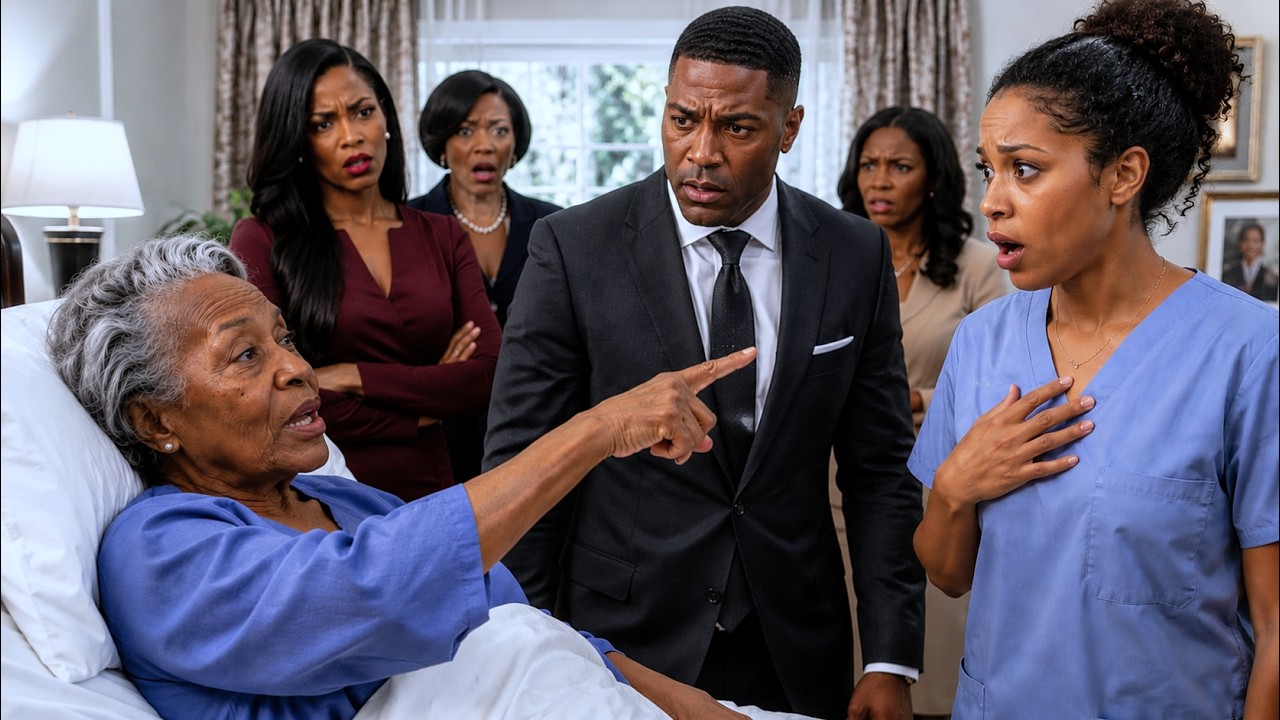
Designer dresses, expensive perfume, diamond earrings catching the afternoon light. Gloria let her eyes move slowly over each woman, one by one. Then she stopped. In the far corner, a young nurse was quietly changing an IV bag.
Gloria raised one trembling finger and pointed. Her. She’s the one. The room went silent.
And with that single word from a dying woman, the world of a billionaire was about to be turned upside down. —
Sean Robinson, thirty-eight years old, CEO of Robinson Capital, had built his empire from nothing. From a kid eating cereal for dinner in a two-bedroom apartment in South Atlanta to a man who owned commercial real estate across seven states. Every night, he drove his black Range Rover back to a four-thousand-square-foot penthouse in Buckhead.
He loosened his tie, poured a glass of bourbon, and sat at a dining table built for twelve. Alone. The only call he waited for came at exactly eight-thirty every evening. “Hey, Mom.
”
“Hey, baby. Did you eat? ”
“Yes, Mom. ”
“Liar.
I can hear it in your voice. You’re sitting at that big table by yourself again, aren’t you? ”
Gloria knew her son better than anyone. She was the reason he was alive at all.
His father, Curtis, had died in a construction accident when Sean was fourteen. After that, it was just Gloria and Sean. She worked two jobs—sewing at a shop during the day, cleaning office buildings at night. Sean sometimes went with her on the night shift, doing his homework in empty conference rooms while his mother mopped floors.
She never complained. Not once. She hummed gospel songs while her hands worked without stopping. Sean got a scholarship to Morehouse, then an MBA from Emory.
Then his first deal, his second, his tenth. Before he knew it, the boy who used to do homework in other people’s offices was buying those same buildings. The first thing he did when money came was buy his mother a beautiful house in Druid Hills. Five bedrooms, a garden, everything she deserved.
Gloria toured every room, touched the granite countertops, then smiled at her son. “It’s beautiful, baby. But I’m staying in Decatur. ”
“Mom, that house is falling apart.
”
“That’s where your daddy asked me to marry him. That’s where I brought you home from the hospital. That’s where Curtis’s spirit still lives. I’m not leaving.
”
Sean argued. He begged. He even had contractors quietly renovate her house while she was at church. He fixed the plumbing, patched the roof, redid the kitchen.
Gloria noticed everything. She didn’t say thank you. She said, “I hope you kept the wallpaper in the hallway. Your daddy picked it out.
”
He kept the wallpaper. That was Gloria. Proud, stubborn, full of a love that she measured not in dollars but in presence and in remembering the things that mattered. —
It was a Tuesday morning in late September when Sean’s world collapsed.
He was in a board meeting when his phone buzzed. Then again. And again. Emory University Hospital.
His blood ran cold. Gloria had collapsed in her kitchen. A neighbor heard the fall through the thin walls and called emergency services. By the time Sean arrived, she was in a room hooked up to machines that beeped in rhythm with nothing.
The doctor, Dr. Patricia Lane, led him to a private consultation room. “Mr. Robinson, tests show a mass in your mother’s pancreas.
It’s pancreatic cancer. Stage four. ”
Sean stared at her. The words landed, but he couldn’t absorb them.
“Stage four? ”
“Yes. It’s already spread to her liver. We can manage her pain.
Chemotherapy might slow it down, but the five-year survival rate is low. Less than ten percent. ”
“How long? ”
His voice cracked on the second word.
“Months. Perhaps six if we’re lucky. ”
Sean stepped out of the consultation room and stood in the hallway, his back against the cold wall. The fluorescent lights hummed.
The smell of antiseptic filled his lungs. For the first time since his father’s funeral, Sean Robinson cried. When he finally pulled himself together, he went back to Gloria’s room. She was awake, watching him.
She already knew. “They told you. ”
It wasn’t a question. “Mom, we’re going to fight this.
I’ll bring in the best oncologists. MD Anderson, Mayo Clinic, whoever you want. ”
Gloria shook her head slowly. “Baby, I’ve lived a good life.
I raised a good son. I’m not afraid. ”
“I am,” Sean whispered. Gloria reached out and took his hand.
“Then sit here with me. That’s all I need. ”
They sat in silence for a long time. Then Gloria spoke again, her voice soft but firm.
“Sean, I don’t want to die in a hospital. I want to be in my home. My bed, where your daddy’s spirit lives. ”
“Mom, you need medical care.
”
“I need my home. Bring me someone who can take care of me there. A good nurse, a kind person. That’s all I ask.
”
Sean wanted to argue. Every instinct told him to keep her in the hospital. But he looked at his mother’s face and saw the same quiet stubbornness that had carried her through losing Curtis, through raising a son alone. He nodded.
“Okay, Mom. I’ll find you the best. ”
—
Three days later, on a Friday morning, a young woman stepped off the number 42 bus at the corner of Church Street in Decatur. She carried a worn medical bag and a small plastic container of food.
Yolanda Foster was twenty-nine. Her hair was pulled back in a neat bun. No makeup. No jewelry except a thin gold chain her grandmother had given her.
In her left hand, she carried banana pudding made from scratch the night before—her grandmother’s recipe. Because Grandma Odessa always said: don’t walk into someone’s home with empty hands. Sean’s Range Rover was already parked in the driveway. He was leaning against it, arms crossed, watching her approach.
He expected someone older. Someone with gray hair and decades of experience. Instead, he saw a young woman in faded scrubs who came by city bus carrying homemade banana pudding. He didn’t hide his disappointment.
Yolanda recognized that look. She’d seen it before. “Mr. Robinson, I’m Yolanda Foster.
The agency sent me. ”
They went inside. Gloria was in the back bedroom, propped up on pillows. She looked tired, but her eyes were alert.
Yolanda walked over to the bed. But she didn’t grab Gloria’s wrist to check her pulse. Didn’t pull out a blood pressure cuff. Instead, she set the food on the nightstand, pulled up a chair, sat down, and gently took Gloria’s hand.
“Mrs. Robinson, before I check anything—tell me about the garden outside. Those roses are beautiful. Even the dying ones.
You can tell someone loved them. ”
Something in Gloria’s eyes softened. For the first time since hearing the word cancer, Gloria Robinson smiled. “Those are my climbing roses,” she said.
“Curtis planted the first one the year we moved in. He said every woman deserves flowers that come back every spring without asking. ”
“That’s a good man,” Yolanda said softly. “The best,” Gloria replied, squeezing her hand.
From the doorway, Sean watched. His mother was smiling. Yolanda had drawn out something he hadn’t seen in days—weeks. Yolanda spent the next hour with Gloria.
She checked vitals, reviewed medication, set up a care schedule. But between medical tasks, she talked. She asked about the photos on the wall, about Curtis, about the quilt. Gloria answered every question like she’d been waiting for someone to ask.
—
Yolanda grew up in the West End. Her mother, Brenda, worked as a kitchen assistant at a nursing home. Her father left when Yolanda was seven without a note or a phone call. Just an empty closet and a missing suitcase.
Yolanda had a younger sister, Keisha, born with sickle cell anemia. Yolanda learned to recognize the signs of a pain crisis before it started. By twelve, she could manage her sister’s symptoms better than some nurses they met. Keisha died at nineteen from complications of a blood transfusion.
Yolanda sat beside her on the hospital bed, holding her hand, feeling the warmth leave her sister’s fingers. That night, in the hospital parking lot, Yolanda sat for three hours in the dark. She didn’t cry. She just thought.
About all the nights Keisha suffered. About the nurses who were kind and ones who weren’t. About the ones who stayed. She decided she would become the nurse who stays.
Yolanda graduated at the top of her class and went straight into palliative care. End-of-life nursing. Work most people don’t want to do. You don’t save lives in palliative care—you help people die with less pain and less fear.
She kept a small notebook. She called it her “last wishes list. ” Every time a patient told her something simple they wanted before the end, she wrote it down. A man who wanted to hear a Sam Cooke song again.
A woman who wanted her granddaughter to know she forgave her. Yolanda fulfilled every one. Not because it was her job, but because that was her nature. —
The first week passed quickly.
By the second week, something had changed in Gloria’s house. Yolanda arrived every morning at 6:45, fifteen minutes early. She made coffee, checked medications, and then did something not in any nursing manual. She cooked.
One morning, she made oatmeal from scratch—whole grain oats with cinnamon, brown sugar, and a little vanilla. She brought the bowl to Gloria’s room on a tray with a cloth napkin. Gloria took a bite. Then another.
She looked up at Yolanda with something like surprise. “This is the first thing I’ve been able to taste in weeks. ”
“My grandmother’s recipe,” Yolanda said. “She believed food was medicine before medicine was medicine.
”
After that, Yolanda cooked every morning. And Gloria ate. Then came the music. Yolanda noticed a dusty stack of gospel CDs on Gloria’s shelf.
One morning, she brought a small Bluetooth speaker and pressed play. The sounds of the Mighty Clouds of Joy filled the room. Gloria opened her eyes and began to sing softly, a thin, fragile voice. But she was present.
—
One night, about ten days in, everything changed between them. Gloria woke at two in the morning, screaming. The pain had come on suddenly, doubling her over. Yolanda arrived in seconds.
Gave her medication. Adjusted the pillows. Rubbed Gloria’s back in slow circles. But the drug took time to work, and during those minutes, Gloria was trembling, tears streaming down her face—not just from pain, but from fear.
“I’m scared,” Gloria whispered. “I don’t want to die afraid. ”
Yolanda didn’t say “you’ll be okay. ” She didn’t say “don’t worry.
” Because those words would have been a lie. Instead, she pulled her chair closer, took Gloria’s hand, and said, “Can I tell you about my sister? ”
Yolanda told her about Keisha. The sickle cell, the hospital stays, the night she died.
When she finished, they were both crying. Gloria pulled Yolanda to her and held her. Two women who barely knew each other clinging to one another in the dark. “Thank you,” Gloria said, “for not pretending.
”
From that night on, Gloria stopped calling her Miss Foster. She called her “baby girl. ”
And when Yolanda left, Gloria turned to Sean and said, “That girl has a gift. She doesn’t just care for my body—she cares for my soul.
”
Sean nodded. “Seems good at her job. ”
“It’s not a job to her, son. That’s what you don’t understand yet.
”
Sean didn’t ask what she meant. But Gloria could see the bigger picture. She was dying, she knew that. But she wasn’t leaving this world without doing one last thing for her son.
—
To understand what Gloria was planning, you need to understand something about her son. Sean Robinson had been at war with love. Three years before the diagnosis, Sean had been engaged to a woman named Tiffany Wells. She was beautiful, educated, charming in public.
Sean thought he’d found his partner. He opened his heart. Then one night, Sean returned home early from a business trip and found Tiffany with his business partner. The betrayal itself hurt.
But later, his lawyer discovered Tiffany had signed the prenuptial agreement not because she accepted its terms but because she’d calculated exactly what she would get if she divorced him after five years. It was a business plan disguised as a marriage. Sean was the mark. He cancelled the engagement that night.
Changed the locks. Changed his number. Something inside him turned off like a light switch. Since then, Sean dated women like he reviewed contracts—looking for the fine print, waiting for the hidden clause.
He always found one. Now there were two women orbiting Sean. Monique Chambers, a public relations executive who came to visit Gloria once a week with expensive gifts but left after exactly fifteen minutes. Renée Lawson, a corporate lawyer who talked about mergers and market trends and never once asked Gloria how she was feeling.
In the small house, Gloria watched everything. How each woman entered the room, where their eyes landed first, how long they stayed, and how they treated the people who could offer them nothing. One evening, after both women had come and gone, Gloria said, “Son, when are you going to stop playing games and find someone real? ”
“Mom, I’ve tried.
”
“No. You’ve tried the wrong kind of women. You keep picking the ones who look right instead of the ones who are right. ”
“How am I supposed to know the difference?
”
Gloria smiled. Tired, but knowing. “You’ll know when they’re not trying to impress you. When they’re not even thinking about impressing you.
Because they’re too busy being themselves. ”
—
The Thursday of that week brought Gloria’s assessment into full focus. Three women passed through her home, and each left a mark. Monique arrived first in a cream blazer, heels clicking on the hardwood.
She brought imported Belgian chocolates tied with a gold ribbon. She set it on the nightstand with a smile that was more performance than feeling. They made small talk for a few minutes. Then Gloria had a coughing fit—a violent one that bent her forward, tears in her eyes.
The kind where you can hear the illness in every rough exhale. Monique recoiled in her chair. Her face tightened. She looked toward the door, then at her watch.
Yolanda was there in an instant. Wiped Gloria’s mouth, supported her back, rubbed small circles between her shoulder blades until the coughing subsided. Monique stood. “I should let you rest, Mrs.
Robinson. ”
She was out the door in under a minute. Total visit: twenty minutes. Renée arrived in the afternoon with her tablet, wanting to show Gloria pictures of a condo.
“Isn’t it gorgeous? ” she said, holding the screen toward Gloria. Gloria answered flatly: “It’s beautiful. ”
Renée spent thirty-five minutes talkinabout her work, her business partners, a conference she was invited to speak at in Miami.
She never asked Gloria a single question about her day or her pain. When she left, she bent and kissed Gloria on the forehead. A kiss like you’d give a photograph. An hour later, Yolanda came in to check Gloria’s vitals.
She noticed Gloria staring at the ceiling, hands folded. Yolanda didn’t ask what was wrong. She sat down, put on Gloria’s favorite playlist, and let the music fill the room. Then she noticed Gloria’s hair—tangled from lying for days.
Yolanda went to the bathroom, came back with a wide-tooth comb and a spray bottle, and began to brush Gloria’s hair, strand by strand, like a daughter would. Gloria closed her eyes. Her breathing slowed. “Thank you, baby girl.
”
“For what, Mrs. Robinson? ”
“For treating me like a person, not a patient. ”
—
That evening, after Yolanda had gone home, Gloria picked up the phone and called her old friend Opal.
“Opal? It’s me. ”
“Gloria, honey, how are you feeling? ”
“Tired.
But I need to tell you something. ”
“What is it? ”
“I found her. ”
A pause.
“Found who? ”
“The right woman for my son. ”
Opal was silent. Then she laughed softly.
“Lord, Gloria, what are you plotting now? ”
“The last important thing I’ll ever do. ”
“And who is this woman? ”
“My son’s nurse.
”
A longer silence this time. “Gloria Robinson, you are something else. ”
“I know what I see, Opal. I’ve watched her every day for three weeks.
She’s the one. I just need to figure out how to make it happen before I run out of time. ”
—
Thursday evening. The house was quiet.
Sean sat on the chair beside his mother’s bed, holding her hand gently. Gloria’s voice came through the darkness. “I need you to promise me something. ”
“Anything, Mom.
”
“I’m not going to be here much longer. And the only thing I’m more afraid of than dying is leaving you alone. Your daddy died before he could say everything he wanted. I’ve carried that regret for twenty-four years.
I won’t make the same mistake. ”
Sean’s jaw tightened. “Sean, let me choose. ”
“Choose what?
”
“Your wife. Let me choose the woman who will spend her life with you. ”
Sean stared at his mother. She stared back.
She wasn’t joking. She was completely serious. “That’s not how this works,” he said softly. “Baby, your way hasn’t worked for thirty-eight years.
Let a dying woman have this one thing. ”
That was the one sentence Sean couldn’t argue with. He sat there for a long time. Then he leaned forward and kissed his mother’s forehead.
“Okay, Mom. Okay. ”
—
The Sunday came quickly. Sean spent the days in between calling women.
Monique. Renée. Two other women he’d dated casually during the past year—Denise Porter, a real estate developer from Marietta, and Jasmine Cole, a local TV anchor. He kept the invitations vague.
“Mom wants to see everyone. Her health isn’t great. Can you come Sunday afternoon? ”
They all agreed.
Sunday morning dawned warm and golden over Decatur. Opal arrived early in her church dress, carrying yellow roses from her own garden. She helped rearrange the living room, pushed back furniture, set out extra chairs. Gloria insisted on sitting up.
She had Yolanda help her wash her face and put on the blue blouse Curtis had always loved. The one with small pearl buttons. “If I’m going to do this, I’m going to do it right,” Gloria said. Yolanda smiled.
She didn’t know what was happening. She assumed Gloria just wanted to look nice for visitors. —
Monique arrived first. She stepped out of a white BMW wearing a burgundy dress, her perfume arriving before she did.
“Mrs. Robinson, you look wonderful. ”
“I look like a dying woman in a nice blouse,” Gloria said coolly. “But thank you.
”
Renée arrived next in a navy pantsuit with pearl earrings. She brought a fruit basket wrapped in cellophane. She greeted Gloria warmly and professionally—the way you’d greet a client’s mother. Denise and Jasmine arrived together.
The living room filled quickly. Four women, each beautiful, each successful, each watching the others through the corner of her eye. In the back corner, Yolanda moved quietly. She checked Gloria’s monitor, adjusted the oxygen tube, folded a clean towel.
She was wearing her usual faded blue scrubs. No makeup, no jewelry. She didn’t sit. She didn’t introduce herself.
She just worked. Sean stood by the doorway, arms crossed, feeling ridiculous. He watched the women make small talk, watch each other, smile at Gloria. And he watched his mother.
Gloria’s eyes moved slowly from face to face. She took her time. She noticed everything. Monique checking her reflection in the dark window.
Renée scrolling on her phone under the arm of the chair. Denise glancing around the small living room as if calculating square footage. Jasmine talking too loud, filling every silence with meaningless words. And Yolanda, in the corner, quietly refilling Gloria’s water glass without being asked.
After thirty minutes, Gloria spoke. “Sean. ”
The room went still. “Come here, baby.
”
Sean walked to his mother’s bedside and knelt beside her. “I’ve made my choice,” Gloria said. The silence that followed could be felt on your skin. Monique straightened.
Renée uncrossed her legs. Denise clasped her hands. Jasmine held her breath. Gloria raised her right hand slowly.
Her fingers trembled. She pointed—not toward Monique in her burgundy dress, not toward Renée with her pearl earrings, not toward the other two. She pointed toward the corner of the room. Toward the woman in faded scrubs folding a towel.
“Her. ”
A single word. No one gasped. No one erupted.
The room simply froze, as if the entire world had been paused. Yolanda looked up. The towel still in her hands. Her eyes wide, confused.
She looked at Gloria, then at Sean, and back at Gloria. “I’m sorry, Mrs. Robinson? ”
“You, baby girl.
” Gloria’s voice was faint but firm. “I choose you. ”
Yolanda shook her head slowly. “Mrs.
Robinson, I don’t understand. I’m just your nurse. ”
“I know exactly who you are,” Gloria said. And her voice grew warmer, deeper.
“That’s why I chose you. For three weeks, I’ve watched you do things nobody else in this room would do. You held my hand at three in the morning when I couldn’t sleep. You washed my hair when I was too weak to lift my arms.
You cried with me when the pain was bad. ”
Gloria’s eyes moved slowly around the room, without judgment but with the clear-eyed certainty of a woman who had run out of time for pleasantries. “These women,” she said softly, “came here for my son’s name. For his money.
For what he could give them. ”
She looked back at Yolanda. “You came here for me. You come here every day for me.
You’ve never asked for anything in return. ”
Tears filled Yolanda’s eyes. “Mrs. Robinson, I was just doing my job.
”
“No, baby girl. You were just being yourself. And that’s the rarest thing I’ve ever seen. ”
Gloria reached out and squeezed Sean’s hand.
“This is the woman, Sean. This is the one who will love you for who you are, not what you own. ”
—
The silence lasted about ten seconds. Then Monique broke it.
She stood up so fast her chair scraped thew ooden floor. Her face went from calm to fury in an instant. “This is ridiculous. You’re picking the help over me?
Over us? ”
Gloria looked at Monique calmly. “And that, dear, is exactly why I didn’t choose you. ”
Monique stared at Gloria for a moment.
Her mouth opened, then closed. She grabbed her purse and walked out, slamming the front door hard enough to shake the picture frames in the hallway. Renée stood next, more slowly. She smoothed her suit and walked to Gloria’s bed.
“I wish you well, Mrs. Robinson. ”
Then she looked at Sean—a look of pity and relief mixed together—and left without another word. Within minutes, the others were gone too.
The front door closed for the last time. The house went quiet. Opal slid into the kitchen and started washing the cups. Yolanda put down the towel she was still holding.
Her hands were shaking. “Mr. Robinson, I need to talk to you outside. ”
—
They stood on the front porch.
Yolanda crossed her arms over her chest. “I don’t know what just happened in there,” she said, her voice steady but her eyes glistening. “But I need you to understand something. I’m your mother’s nurse.
That’s all I am. I didn’t come here for this. I didn’t ask for this. And I won’t be anyone’s charity project or arranged bride.
”
“Yolanda, I know. I know this is crazy. I didn’t plan any of this. It was my mother’s wish.
”
“Your mother is dying and in pain. She’s not thinking clearly. ”
“My mother is the smartest person I’ve ever known,” Sean said quietly. “Especially now.
”
Yolanda searched his face for something. “I’ll finish my shift. After that, I think it’s best you find another nurse. ”
The words hit Sean harder than he expected.
He went back inside. Gloria was propped up on her pillow, eyes half closed. “Mom, what did you just do? ”
“The best thing I’ve ever done for you, baby.
”
“She wants to quit. She wants to leave. ”
Gloria smiled. A small, tired smile, but certain.
“She won’t. ”
“How do you know? ”
“Because she’s not the kind of person who walks away from someone who needs her. That’s the point, Sean.
That’s why I chose her. ”
—
The next morning, Sean drove to Decatur early. He pulled into the driveway and sat for a minute, staring at the front door. He was certain Yolanda wouldn’t come.
She’d meant what she said. At 6:45, the number 42 bus stopped at the corner. Yolanda got off. Same medical bag, same faded scrubs.
She walked up the sidewalk without looking at Sean’s car. She climbed the porch steps, opened the door with her key, and went inside. Shaen followed her in. She was already in Gloria’s room, checking vitals.
“You came back,” he said from the doorway. Yolanda didn’t lift her head. “I’m here for your mother, Mr. Robinson.
Nothing else. Is that clear? ”
“Perfectly. ”
—
But over the next two weeks, something began to happen.
It started with chicken soup. Yolanda made a pot for Gloria. Sean arrived for a visit after work, still in his suit with his tie loosened. He stood in the kitchen doorway watching her stir the pot.
“Want some? ” she asked without turning around. “There’s plenty. ”
He sat at the kitchen table—Gloria’s table with the plastic floral cover and the salt and pepper shakers shaped like roosters.
Yolanda put a bowl in front of him. They ate together. For the first time, they talked about something other than medicine. Yolanda asked about the photos in the hallway, about Curtis.
“Tell me about your father. ”
Sean was quiet for a moment. “He built things with his hands. Real things—walls, roofs, porches.
He’d come home with sawdust in his hair and cement under his nails. He was tired, but he was proud. ”
Yolanda looked at him across the little table. “You miss him.
”
“Every day. ”
—
A few days later, Gloria asked Sean a favor. “Yolanda needs to pick up my prescription and she doesn’t have a car. Can you drive her?
”
“Sure, Mom. ”
In the car, silence at first. Sean turned on the radio. Jazz.
John Coltrane. “A Love Supreme. ” Yolanda listened, then said softly, “That’s beautiful. It sounds like someone praying without words.
”
Sean looked at her. He’d heard hundreds of people talk about jazz. No one had ever said anything like that. He said, “That might be the most accurate description of Coltrane I’ve ever heard in my life.
”
Yolanda laughed. “I don’t know anything about jazz. I just know how it makes me feel. ”
They finished the drive in comfortable silence.
When they got back, Sean realized he’d smiled more during that twenty-minute drive than in months. —
Then came the night of the quilt. Sean began spending more and more time at Gloria’s house. Some nights he didn’t leave at all.
He’d fall asleep in the armchair beside his mother’s bed, his tall body folded into a chair made for someone half his size. One night, around two in the morning, Yolanda came in to check on Gloria. She found Sean asleep. Head tilted at an angle that would hurt in the morning.
Still wearing his shoes. One arm dangling over the side of the chair. Yolanda went to the hallway closet and pulled out the old quilt—the one Gloria’s mother had made. She spread it carefully over Sean’s shoulders.
Tucked in the edges. Adjusted his head gently on the chair rest. Dimmed the lamp. Left the room.
In the morning, Sean woke up under the quilt with a cramp in his neck. He saw the cover and knew who had put it there. Neither of them said anything about it, but when she handed him his coffee, their eyes met, and Sean smiled. A small smile.
Real. Every woman he’d dated had tried to impress him. Yolanda wasn’t trying to impress anyone. She was just being herself.
And it was more compelling than anything he’d ever seen. Sean Robinson was falling in love. And for the first time in his life, he wasn’t afraid of it. —
It was about a week later when everything shifted between them again.
It had been a bad day for Gloria. One of the worst. The pain was relentless. Yolanda gave all the medication she could.
Called the doctor. Adjusted positions. She did everything she was trained to do. But some days, the pain wins.
By seven o’clock, Gloria had finally fallen asleep, the drug having kicked in. Sean was inside with his mother. Yolanda went out to the front porch, sat on the top step, pulled her knees to her chest, and cried. Sean came out a few minutes later.
He saw her. He didn’t say anything. He sat down next to her, close enough that their shoulders almost touched. But he didn’t speak.
After a while, Yolanda wiped her eyes with the back of her hand. “I’m sorry. That was unprofessional. ”
“That was human,” Sean said.
Yolanda let out a shaky breath. “Every time I lose a patient, I tell myself this time won’t hurt. I’ll keep my distance. Be objective.
Professional. It always hurts. Every time. ”
She paused.
Her voice cracked. “Your mother reminds me of my grandmother. And my sister. And I know how this ends, Sean.
I’ve seen it so many times. I know what the last days look like. I know what the last hours look like. AndI still can’t get used to it.
”
Shaen listened. He didn’t interrupt. He didn’t offer solutionsor moneyor specialists. He just listened.
“Do you want to hear something? ” he said. “Yes. ”
“I was fourteen when my father died.
I didn’t cry at the funeral. I stood there in a suit my mother borrowed from our neighbor, held her hand, and told myself I had to be strong. I’ve been strong ever since. Twenty-four years of being strong, and I’m so tired of it, Yolanda.
I’m so tired. ”
Yo’landa looked at him—really looked at him. “Grief isn’t something you get over,” she said softly. “It’s something you learn to carry.
Some days it’s heavy. Some days you barely feel it. But it never really goes away. And that’s okay.
It means the love was real. ”
They sat in silence for a while. “Who takes care of you? ” Sean asked finally.
“When you go home after watching someone die? Who holds you? ”
Yo’landa opened her mouth, then closed it. She looked at her hands.
“No one,” she said. Sean reached out and placed his hand over hers. Not gripping, not pulling. Just there.
Warm. Present. “Maybe it’s time someone did. ”
Yolanda didn’t pull away.
She turned her palm over so their hands touched. And they sat there, two people on a porch step in Decatur, holding hands in the dark. —
The next weeks passed quickly. Gloria slept more—eighteen to twenty hours a day.
She barely ate. A few sips of soup. A spoon of the oatmeal Yolanda still made every morning out of hope more than expectation. Yolanda knew the signs.
She’d seen them dozens of times. One afternoon, Gloria woke up clear-eyed and stronger than she’d been in days. Yolanda recognized that too. It’s called a window of clarity.
Gloria asked to speak with Yolanda alone. “Close the door, baby girl. ”
Yo’landa sat beside the bed, holding Gloria’s hand. “I need you to promise me something,” Gloria said.
“Take care of my son. Not because I asked you to, but because you want to. Can you promise me that? ”
Yo’landa’s chin trembled.
“I care about him, Mrs. Robinson. I do. More than I expected.
More than I planned. ”
Gloria smiled. “I know. Yolanda, Iknow.
I’ve known for a while. Since the night you covered him with that quilt at two in the morning. I was awake. I saw everything.
”
Tears streamed downYo’landa’s cheeks. “You were supposed to be asleep. ”
“That’s what mothers do. We watch.
Even when they think we’re not looking. ”
—
That evening, Gloria asked to speak with Sean. Alone. He sat on the chair beside her bed.
Gloria looked at him for a long time. Just looking. Comitting his face to memory. “Don’t make the same mistake your father and I almost made,” she said finally.
“What mistake? ”
“We almost waited too long to say the important things. Curtis died on a Tuesday. On Monday night, I almost told him how much he meant to me.
I almost did. But I thought we had more time. ”
She squeezed his hand. “Don’t wait, Sean.
Don’t you wait. ”
“I love you, Mom. ”
“I know, baby. Now go love someone else, too.
”
—
It happened early on a Thursday morning. The kind of early when the sky’s still trying to decide between night and day. Yolanda was there. She was always there.
She sat on the left side of the bed holding Gloria’s hand. Sean was on the right side. The little speaker on the nightstand played a hymn so softly it was almost silence. Gloria had been asleep for hours.
Her breathing was slow and shallow. Then she opened her eyes. She looked at Yo’landa. They looked at Sean.
They looked at Yolanda again. And she smiled. Not a big or dramatic smile. Just a small, peaceful turn at the cornerver of her mouth that said everything words couldn’t.
She pressed their hands together at once—for the last time. Then she closed her eyes and didn’t open them again. She left the way she lived. Quietly, gracefully, surrounded by love.
Yo’landa reached out and turned off the monitor. She didn’t need it to tell her what she already knew. She leaned her forehead on Gloria’s hand and cried silently. Sean sat on the other side, tears streaming down his face, still holding his mother’s fingers.
—
Three months passed. Sean buried his mother on a Saturday, next to Curtis. Half of South Atlanta came out—people she’d sewn for, people she’d cleaned offices with, people from her church who remembered her peach cobbler. After the funeral, Sean went quiet.
He took two weeks off from work—the first time in his adult life. He didn’t call anyone. He drove toDecatur every day. He watered Gloria’s roses.
He sat on the porch swing. But he also called Yolanda. Every day. At first, the calls were short.
“How are you? ” “I’m okay. How are you? ” Then they grew longer.
Then they became something they both needed. They started spending time together outside the house. Yo’landa took Sean to her mother’s apartment for Sunday dinner. Brenda made fried chciken and collard greens and asked Sean if he went to church.
He said no. She said, “We’ll fix that. ” Yo’landa kicked her mother under the table. Sean took Yolanda to his favorite barbecue place in Kirkwood—not the fancy Buckhead restaurant where he took clients, but the small joint where the owner had known his father.
They sat at a plastic table and ate ribs with their hands and talked until the place closed. They cooked together at Gloria’s house. Badly, at first. Sean burned the rice.
Yolanda over-salted the greens. They laughed about it. Real laughter. —
One evening in December, Sean drove Yolanda to Decatur.
He didn’t tell her why. “I want to show you something,” was all he said. The house had changed. The roses were pruned properly.
The porch had been repainted. White lights hung along the fence. Simple white lights, the kind Gloria would have loved. They sat on the porch swing.
It creaked just like it always did. “Yolanda? ”
“Yes? ”
“I want you to know something.
I’m not doing this because of what my mother said. Not because of her wish. Not because of anything that happened on that Sunday. I’m doing this because in thirty-eight years, I’ve never met anyone who made me want to be a better man.
”
He reached into his pocket and pulled out a small velvet box—old, worn at the corners. He opened it. Inside was a ring. Not diamond.
Not platinum. A simple gold band, thin, scratched in places. The kind a worker buys with his first real paycheck. “My father gave this to my mother in 1975,” Sean said.
“He didn’t own anything. No money. No company. He owned a promise.
And that was enough for her. ”
He held out the ring. “I want to give it to you the same way. I don’t have anything but a promise that I’ll love you, see you, and never stop choosing you.
”
Yolanda looked at the ring, then at Sean. Tears were streaming down her face. Her hands were shaking. “Sean, your mother gave me this whole world.
She gave me a family I never expected. She gave me you. And now you’re giving me this. You gave us this world.
”
“Yolanda, you just don’t realize it. ”
She touched the ring. Felt the scratches. The history.
The love of two people who built a life with their hands and hearts. “Yes,” she said. Sean slid the ring onto her finger. It fit perfectly, as if it had been waiting for her.
They sat on Gloria Robinson’s porch swing, wearing Curtis Robinson’s ring. For a moment, everyone who had ever loved in that family was there. Curtis. Gloria.
Keisha. Grandma Odessa. —
The wedding was held in Gloria’s garden the following March. The roses were in full bloom—every single one, as if they knew.
It was small. Thirty people, maybe. No country club. No dance floor.
Just folding chairs on the grass, white ribbons tied to the porch railing, and a hand-painted sign made by Opal that read “Gloria’s Garden” in gold letters. Brenda Foster sat in the front row and cried before the ceremony even started. Cried through the procession. Cried through the vows.
Yolanda wore a simple white dress she’d found at a thrift store on Moreland Avenue for thirty-two dollars. She carried roses from the garden. When Sean saw her, he pressed his lips together. His eyes went red.
He didn’t try to hide it. “You look amazing,” he whispered. “You do too,” she whispered back. At the vows, Sean said, “I spent my whole life building things.
Buildings. Companies. Portfolios. Nothing I built compares to what you’ve built in me.
You taught me that love isn’t a business deal. It’s not something you earn or negotiate. It’s something you give and hope someone gives it back. ”
He paused.
“My mother saw that in you before I did. She was always smarter than me. ”
Yolanda laughed through her tears. So did half the guests.
Then Yolanda spoke. “I spent my career helping people die peacefully. That’s what I do. I sit with people at their end and try to make sure they’re not alone and not scared.
But at some point, I forgot how to live peacefully. I forgot I deserved someone who would sit with me too. ”
She squeezed his hands. “You reminded me.
So I promise never to stop choosing you. ”
—
In the evening, after the guests had gone, Sean and Yolanda stood on Gloria’s porch. The white lights still hung along the fence. The roses swayed in the evening breeze.
They danced. Without music. Just the creaking of the porch boards and the sound of crickets. One year later, Sean still ran his company.
He still made deals. But now he left at five. Sometimes earlier. His assistant had stopped being surprised.
Every evening, he drove his Range Rover past Buckhead and Druid Hills and every neighborhood where billionaires were supposed to live, stopping at a little white house in Decatur. The house with the rose garden. The house where his father proposed to his mother, where his mother died, and where his wife changed his life. They lived there now.
Sean had sold his Buckhead penthouse without hesitation. He traded four thousand square feet of silence for eight hundred square feet of family warmth. Yolanda worked part-time at the foundation. Three days a week, she reviewed applications from nursing students and trained palliative care workers.
The other days she rested—because she needed rest now. —
One Tuesday evening in October, Sean came home and found Yolanda sitting at the kitchen table with the vinyl cover. She was holding a small black-and-white photograph. She slid the photo across the table without saying a word.
Sean picked it up. Looked at it. Looked at her. “Your mother is going to have a granddaughter,” Yolanda said.
Sean stared at the photo. His hands began to shake. Then his chin. Then his whole body.
He pulled Yolanda up from her chair and wrapped his arms around her so tightly she laughed. “We’re naming her Gloria,” he whispered into her hair. “I don’t want any other name. ”
—
That night, after dinner, after the dishes, after Yolanda had fallen asleep on the couch with her hand on her belly, Sean went out to the porch.
He sat on the swing—the same swing Curtis had sat on with Gloria, the same swing Sean had proposed on, the same swing that creaked under the weight of three generations of love. The roses were sleeping for winter. But they’d come back in spring. They always did.
Yolanda had said something to him the week before. Something he turned over in his mind like a stone in his pocket. “You know what your mother knew that most people don’t? That kindness isn’t weakness.
It’s the only thing that lasts. ”
Sean looked up at the sky. The stars were faint over Decatur—too many city lights. But they were there.
“You were right, Mom,” he whispered. “You were always right. ”
The story began with a dying mother’s last wish.
It ended with a love that would outlast them all.