The handcuffs clicked shut before Byron could finish his sentence. His cheek hit the wet grass of his own lawn, the morning dew soaking through his shirt as Officer Pennington pinned him down. Shaw pulled his wallet and phone from his pockets, tossing both onto the ground like evidence from a crime scene. “Officer, my name is Byron Brooks.
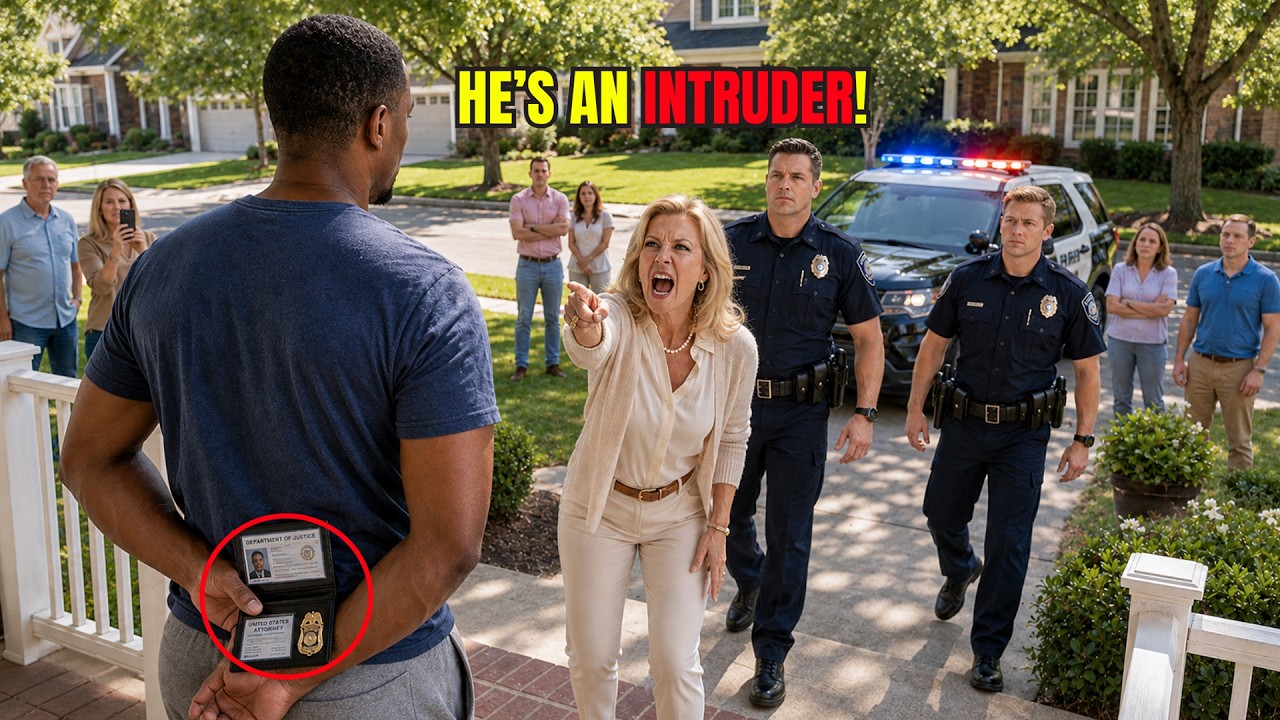
I work for the United States—”
“Shut your mouth. I don’t need the name of a criminal like you. ”
Pennington stepped on the wallet, grinding his heel into the leather, then turned to Pamela Hargrove, who stood recording everything on her phone. “Don’t worry, ma’am.
We deal with this type all the time. ”
Pamela smiled at the camera. “He’s breaking into that house. This neighborhood goes to hell when people like him show up.
”
The neighbors gathered on the sidewalk. Not one of them spoke. But soon enough, they would know exactly who they had just disrespected. Six hours earlier, the street had been quiet.
Byron Brooks pulled the rented moving truck to a stop in front of 14 Maplewood Ridge Drive and killed the engine. Two stories of red brick, a wraparound porch with white railings, a freshly mowed lawn. He had just bought this house, twelve minutes from his office, a place where he could finally stop renting and start building something permanent. He grew up on the east side of Baltimore, where his mother Gloria worked two jobs to keep the lights on.
She never complained. She just worked. Byron earned a full scholarship to Yale Law, graduated top ten in his class, and at thirty-six was appointed United States Attorney for the Eastern District of Virginia. His conviction rate was above ninety percent.
He called his mother when he arrived. “I’m here, Mom. Standing in front of it right now. ”
“Is it nice?
”
“Beautiful. Big yard, porch swing. ”
A pause. “What are the neighbors like?
”
“Haven’t met them yet. ”
Another pause, longer this time. “Byron. Baby, be careful.
You know how it is. ”
He smiled. “Mom, I’m a federal prosecutor. Nobody’s going to give me trouble.
”
“That badge doesn’t show on your face, sweetheart. All they see is a black man they don’t recognize. ”
Across the street and three houses down, Pamela Hargrove stood at her kitchen window, watching him carry boxes. President of the homeowners association, coordinator of the annual block party, and the first person to file a complaint about anything.
The neighborhood ran on her approval, and everyone knew it. When Byron lifted a box from the truck, he heard a voice behind him. “Excuse me, what do you think you’re doing? ”
A blonde woman stood on the sidewalk, arms crossed.
“I’m moving in. Just bought the house. ”
Pamela walked to a box sitting near her driveway, planted her foot against it, and shoved it off the curb. A picture frame slid out and landed face down.
“Your junk is on my sidewalk. Move it now. ”
Byron bent down, picked up the frame—a photo of him and his mother at his law school graduation—and placed it carefully back inside. “Ma’am, I’ll move the boxes, but I live here now.
”
“People like you don’t live here. You never have. And if I have anything to say about it, you never will. ”
Byron straightened up and looked her in the eye.
“I’m not going anywhere. ”
Pamela turned, walked back to her house, and pulled out her phone. Four minutes later, two squad cars turned onto Maplewood Ridge. Officer Greg Pennington stepped out of the lead car, a man who moved like he had already decided how this would end.
Officer Ryan Shaw followed, glancing at Pennington for direction before he even looked at the house. Byron was standing on the porch. He raised both hands, palms out. “Good morning, officers.
I’m Byron Brooks. I just moved into this house today. ”
Pennington crossed the lawn in five long strides. “Step away from the building.
”
“Officer, I live here. This is my house. I have the key right here—”
Pennington grabbed Byron’s wrist. “Don’t move.
”
“I was reaching for my house key. ”
“I don’t care what you were reaching for. ”
Pennington twisted Byron’s arm behind his back and pushed him to the ground. Byron went down, not because he couldn’t resist, but because he knew better.
He had prosecuted excessive force cases. He knew what happened when a black man moved too quickly during an arrest. His knees hit the grass, then his chest, then his face. Shaw searched his pockets, tossed the wallet and phone onto the lawn.
Byron spoke with his face half-pressed into the dirt, his voice steady. “Officer, my full name is Byron Alexander Brooks. I am a resident of this address. If you check my identification—”
“Shut your mouth.
Criminals don’t get to introduce themselves. ”
Pennington picked up the wallet, held it for a moment without opening it, then dropped it back onto the ground and stepped on it. Byron watched from the grass. He said nothing.
Pamela stood at the edge of the lawn, phone raised, live streaming to a climbing viewer count. “I told you all. I told every single one of you he was breaking into that house. ” She pointed the camera at Byron’s face.
“Look at him on the ground where he belongs. The owner. The only thing people like him own is a rap sheet and a pair of stolen sneakers. ”
The chat moved fast.
Viewer count passed five hundred, then eight hundred. Byron lay still, handcuffs digging into his wrists. He could feel the soil against his lips. He did not speak.
He kept his eyes open and stared straight ahead at the porch steps of his own house. None of the neighbors said anything. Pennington keyed his radio. “Dispatch, suspect detained at 14 Maplewood Ridge.
Possible B&E. Requesting transport. ”
“Any ID on the suspect? ”
Pennington looked down at the wallet in the grass.
“Negative. He’s not cooperating. ”
Byron breathed slow and measured, the way his mother taught him when they were pulled over on a dark road. Don’t move.
Don’t speak. Just breathe. The radio crackled again. “Be advised, Captain Morrison is en route for a supervisory check.
”
Pennington clipped the radio back to his vest. He had no reason to be concerned. This was routine. Another call, another arrest, another face in the grass.
Shaw stood at the edge of the scene. Something didn’t sit right. The man on the ground wasn’t shouting or thrashing. He just lay there breathing, eyes open, like someone who had been through this before.
Shaw opened his mouth to say something to Pennington, then closed it. They put Byron in the back of the squad car and drove him to the station. At intake, they processed him like anyone else. Pennington sat him in a holding room and left without a word.
The handcuffs came off, leaving red rings around each wrist. In the lobby, Shaw brought Pamela a bottle of water. She sat near the front desk, telling her story louder this time. “He was trying to force his way in.
I saw it with my own eyes. A man like that in our neighborhood. ” She pulled up the live stream. “Look, 15,000 views already.
People are thanking me. ”
Pennington returned to the holding room with a clipboard. He filled out the incident report in longhand, not speaking. “I want to make my phone call,” Byron said.
“You’ll get your call when I’m done with the paperwork. ”
“I have a legal right to a phone call. I’m requesting it now. ”
Pennington didn’t look up.
“You’ll get it when I say you get it. ”
Twenty more minutes passed. Byron sat in the hard chair, hands resting on the table. His mind was somewhere else—twenty-two years old, in the passenger seat of his mother’s car, red and blue lights flashing behind them.
Gloria gripping the wheel, telling him without turning her head, “Don’t move, baby. Don’t speak. Just breathe. ”
He opened his eyes.
His voice was measured, clear, and final. “I want my phone call now. That is my constitutional right, and I am invoking it. ”
Something in his tone made Pennington stop.
He tossed a desk phone across the table. Byron picked up the receiver and dialed a number from memory. The line picked up on the second ring. He spoke two sentences.
Then he hung up. “Who was that? ” Pennington asked. Byron looked at him for the first time since the arrest.
He didn’t answer. Captain Ela Morrison arrived at the station at 6:47 that evening. She had been called in for a routine supervisory check, expected to sign off and be home before dinner. She picked up the intake file and read the name on the first page.
Byron A. Brooks. She read it again. Her hand tightened around the folder.
“Where is he? ”
“Holding room two, Captain. ”
Morrison walked down the hallway. She opened the door.
Byron sat at the table, his shirt still damp, grass stains on his joggers, the red marks on his wrists deepened to a dull purple. Morrison went pale. “Mr. Brooks.
Are you—are you the Byron Brooks from the Eastern District? ”
“Good evening, Captain. ”
Morrison closed the door and sat across from him. “When did they bring you in?
”
“Early this afternoon. ”
“On what charge? ”
“Suspected breaking and entering into my own home. ”
Morrison closed her eyes for a moment.
Then she stood, walked to the door, and leaned into the hallway. “Pennington. Shaw. My office now.
”
Her voice carried down the corridor like a gunshot in a library. “Do either of you know who you arrested today? ” Morrison stood behind her desk, palms flat on the surface. Pennington shrugged.
“Black male, suspected B&E at 14 Maplewood. Resident called it in. We responded. Standard procedure.
”
“Did you check his identification? ”
“He wasn’t cooperating. ”
“Did you check his identification? ”
Silence.
“Did you open his wallet? ”
More silence. Morrison’s voice lowered. “The man sitting in holding room 2 is Byron Alexander Brooks, United States Attorney for the Eastern District of Virginia.
He is the federal prosecutor our department has been coordinating with for the past three weeks on the Patterson racketeering case. He has sat in this very conference room. And today you arrested him on his own front lawn, put him in handcuffs, and threw his wallet in the dirt. ”
The room went silent.
Pennington’s face drained of color. His hand dropped to his side. “Go to holding room 2, open the door, and personally escort him to the front of this building. You will address him as Mr.
Brooks. You will not speak to him unless he speaks to you first. ”
They left. Morrison picked up the phone and dialed the chief of police at his home.
“Sir, it’s Morrison. We have a situation. The man our officers arrested this afternoon for breaking and entering is Byron Brooks, the US attorney. ”
She could hear him breathing on the other end.
Then a single word. “Tomorrow. 6 a. m.
My office. Bring everything. ”
In the lobby, Pennington held the front door open for Byron. Byron walked through without looking at him.
His phone buzzed in his pocket. Three missed calls from his mother, one from his deputy, and one text from a 202 area code. It read: “Received. We’re on it.
”
The two sentences he had spoken in the holding room had reached the Deputy Attorney General of the United States. The Department of Justice was now aware that one of its own prosecutors had been arrested on his own property by local police who never bothered to check his name. Byron called a cab to take him home. The front door was still open.
The picture frame was still face down on the lawn. He picked it up, looked at the photo—him and his mother, graduation day, her hand on his shoulder, both of them smiling—and carried it inside. The next morning at 6 a. m.
, Chief Raymond Ellis sat behind his desk with the door closed and the blinds drawn. Captain Morrison walked him through every detail. When she finished, Ellis picked up his coffee, looked at it, and set it back down. “This is the worst day of my career,” he said.
Not dramatically. Like a man stating a fact. He pressed the intercom. “Send Pennington in.
”
Pennington walked into the office the way he walked into every room, shoulders first, chin up, a man who still believed he had done his job correctly. “Walk me through yesterday,” Ellis said. Pennington described the call, the response, the arrest. He used words like protocol, standard operating procedure, officer safety.
Ellis listened without interrupting. Then he asked one question. “Did you check his identification? ”
“The suspect was not cooperating.
”
“That’s not what I asked. Did you check his identification? ”
“No, sir. ”
“Did you open his wallet?
”
“No. ”
“Did you look at the property deed he offered you? ”
“The situation was escalating—”
“You stepped on his wallet. You ground your heel into it.
That’s on your own body cam. Is that part of protocol? ”
Pennington said nothing. “He told you he worked for the federal government.
You cut him off. He told you his name. You told him—and I’m quoting your own audio—’I don’t need the name of a criminal like you. ‘ Is that standard operating procedure?
”
Ellis closed the file. “You’re suspended. Effective immediately. No pay.
Turn in your badge and your firearm before you leave this building. ”
Pennington stood, unclipped his badge, and set it on the desk. He walked out without looking at either of them. Shaw walked in like a man entering a courtroom where the verdict had already been decided.
His hands were shaking. “What did you find when you went through his pockets? ”
“His wallet, his phone, some loose change. ”
“And when you handled the wallet, did you open it?
”
Shaw hesitated. “No, ma’am. I didn’t open it. ”
“But you felt it.
And what did it feel like? ”
“Heavy. There were cards inside. Multiple cards.
”
“Did it occur to you that one of those cards might have been a government-issued ID? ”
Shaw looked at the floor. “Yes, ma’am. ”
“Then why didn’t you check?
”
The answer came out small, like a confession whispered into a pillow. “I didn’t want to contradict a senior officer. ”
Ellis stared at him for a long time. “You’re suspended with pay pending the outcome of the investigation.
You will complete a mandatory six-month retraining program. Understood? ”
“Yes, sir. ”
When Shaw left, Morrison said, “There’s more.
Pamela Hargrove. Her live stream has been picked up by national media. CNN ran a segment last night. The video has over two million views.
The hashtag is trending nationally. ”
Ellis rubbed his face with both hands. “Bring her in. ”
Pamela Hargrove arrived at the station that afternoon.
This time, no one offered her water. They brought her to an interview room, the same kind of room where suspects sat. Her smile thinned. “Mrs.
Hargrove, on the morning of August 12th, you called 911 to report a break-in at 14 Maplewood Ridge Drive. Is that correct? ”
“Yes. I saw a man, a strange man, trying to get into the house.
”
“A man carrying boxes from a moving truck? ”
“I didn’t notice the truck. ”
“The truck was parked directly in front of the house, fourteen feet long, with the name of the rental company printed on both sides. ”
Pamela shifted in her seat.
“I was focused on the man. ”
“The man who was using a key to open the front door? ”
“I didn’t see a key. ”
Morrison slid a still frame from the body cam footage across the table.
It showed Byron on the porch, key extended in his right hand, the front door half open behind him. “This is from Officer Pennington’s body cam, timestamped four minutes after your call. The key is visible. The truck is visible.
The boxes are visible. ”
Pamela looked at the photo, lips pressed together. “You told the 911 operator—and I’m reading from the transcript—’There is a black man breaking into a house on my street. He is trying to force the door open.
‘ At any point, was the man forcing the door? ”
“It looked like—”
“It looked like he was using a key. His own key, to his own house, which he had purchased six days earlier. The deed is on file with the county.
”
Pamela’s chin lifted, but defiance had gone thin. “I was protecting my neighborhood. ”
Morrison leaned forward. “You called 911 on a man unlocking his own front door.
You live-streamed his arrest and called him a criminal. The man you did this to is a United States attorney. You are being investigated for filing a false police report. This is a criminal offense.
”
Pamela’s mouth opened. Nothing came out. Outside the station, Byron stood at a podium in front of a row of microphones. His voice was calm.
No anger. No tremor. Just precision. “What happened to me yesterday happens to black men and women across this country every single day.
They are stopped. They are questioned. They are handcuffed. They are humiliated on their own property, in their own neighborhoods, in front of their own homes.
The only difference between me and thousands of others is that I had the credentials to make the system acknowledge what it did. Most people don’t. I am not the first black man this has happened to. I am simply the first one in that neighborhood who had the power to make sure it doesn’t happen again.
”
That evening, Chief Ellis held his own press conference. He announced three things: Pennington suspended without pay pending a formal disciplinary hearing; Shaw suspended with pay pending mandatory retraining; and a new protocol—all 911 calls involving suspicious persons would require dispatch verification, including a cross-check of property records, before officers were sent to the scene. Mandatory implicit bias training would begin within sixty days. A reporter asked if the department was admitting fault.
“We are admitting that we failed,” Ellis said, “and we are committing to doing better. ”
The story spread fast. News outlets replayed the body cam footage alongside Pamela’s live stream. The hashtag Byron Brooks trended for three consecutive days.
And buried in the noise, a quieter pattern emerged. People began sharing their own stories. A black doctor stopped outside his own clinic. A black professor who had campus security called on him while moving into his new office.
The names were different. The cities were different. The story was always the same. Byron watched the coverage from his living room, sitting on an unpacked box.
He read through the messages on his phone. He didn’t respond yet. He just sat and read and breathed. The disciplinary hearing took place two weeks later.
Pennington’s body cam footage ran for twenty-three minutes. The board watched every second. They saw him cross the lawn without asking a single question. They saw the handcuffs go on before any identification had been requested.
They saw his boot come down on the wallet. They heard him say, “I don’t need the name of a criminal like you. ”
The vote was unanimous. Officer Greg Pennington was terminated from the department, effective immediately.
He walked to his car carrying a cardboard box of personal items from his desk—a coffee mug, a framed photo of himself at the academy, young and smiling. Shaw’s verdict was measured. Demoted to probationary status, six-month retraining program focused on civil rights law and de-escalation, one year of departmental probation. He accepted without protest.
Pamela Hargrove’s case moved through a different channel. She pled no contest to filing a false police report. The judge sentenced her to twelve months of supervised probation, two hundred hours of community service, and mandatory completion of a diversity and cultural awareness program. “This is not an act of civic responsibility,” the judge said.
“This is an act of harm. ”
Within a week, Pamela resigned from her position as president of the homeowners association. She wasn’t asked to resign. She simply stopped showing up to meetings.
On the same lawn where he had been pressed face down into the dirt, Byron stood in the late afternoon sun. He carried the last box inside and set it on the kitchen counter. Inside were the picture frame, the legal pads, the Yale diploma in its mahogany plaque, and the manila envelope with his DOJ credentials. He hung the diploma above the fireplace and placed the photo of him and his mother on the mantle.
Then he called Gloria. She answered on the first ring. “It’s over, Mom. ”
She was crying before he finished the sentence.
“I’m home,” he said. “And I’m staying. ”
Six months later, Maplewood Ridge looked the same. The lawns smelled like fresh cut grass.
Flags hung limp on porches. The oak trees still stretched across the sidewalks. But something had changed. Two new families had moved onto the street: the Hendersons at number eight, both teachers, and the Carters at number twenty-two, a woman who worked as a pediatric surgeon and kept the best garden on the block.
No one called 911. The new dispatch protocol became a model for three other police departments in the state. In the first six months, calls classified as “suspicious person, no evidence of criminal activity” dropped by forty percent. Byron continued his work as United States Attorney.
Every other Thursday evening, he opened his conference room to a group of law students from Howard University and the University of Virginia. He called it the Brooks Fellowship, an informal mentorship program for young black lawyers navigating systems that had not been designed for them. He didn’t lecture. He told stories.
How to walk into a room where no one looks like you. How to keep your composure when someone assumes you are the defendant instead of the prosecutor. He told them about Maplewood Ridge. Not as a victory, not as a cautionary tale.
As a fact. “This is what happened. This is what I did. This is what changed.
And this is what still hasn’t. ”
He never told the story with anger. He told it with clarity.
And every time he finished, the room was quiet for a long moment before the first hand went up.