Eden Underwood’s phone buzzed at five in the morning. It was a text from Terrence Cole, her chief operating officer. “Day six today. You sure you want to keep going?
”
She typed back without hesitation. “I need to see everything, not just the good shifts. ”
She closed her laptop, tied her hair back, and grabbed her jacket. No jewelry, no makeup, nothing that would give her away.
Three weeks earlier, Bloom Collective—the beauty empire she had built from nothing over six years—had finalized the acquisition of Heartwell & Company, a twelve-location luxury café chain across Manhattan. The deal was signed, but the announcement was being held. Eden didn’t buy businesses blind. The numbers looked strong.
The internal reports told a different story. Staff turnover at the Upper East Side flagship was triple the company average. Three complaints about management in six months. Two baristas quit without notice.
Something was wrong inside that building, and spreadsheets couldn’t tell her what. So she did what nobody expected. She applied for a barista position at the flagship store. Fake resume, real name.
No one in that café had any idea that the woman tying an apron behind the counter had just signed the check that bought the entire chain. Terrence thought she was out of her mind. “You’re a CEO. You have people for this.
”
“My people gave me reports,” she told him. “Reports don’t sweat. Reports don’t cry in the breakroom. I need to see it with my own eyes.
”
The train pulled into the 77th Street station. Eden climbed the stairs into the cold, gray morning air of the Upper East Side. Heartwell & Company sat on the corner of Madison and 78th. Floor-to-ceiling windows, Italian marble countertops.
It looked like the kind of place that had everything figured out. It didn’t. Samuel Watts, the store manager, was already inside. Mid-fifties, thin smile, soft handshake.
He ran the café with one rule: keep the wealthy happy no matter what. If a customer yelled at a barista, Samuel’s solution was to apologize to the customer. If someone complained about a staff member, he didn’t investigate. He just scheduled that person for fewer shifts.
Eden had watched him closely for five days. He wasn’t cruel. He was worse. He was a coward dressed in politeness.
The other baristas were mostly young, hardworking, underpaid. They liked Eden. She was calm, reliable, never complained. A twenty-two-year-old named Jess once whispered to her during a rush, “You’re weirdly unshakable.
What’s your secret? ”
Eden just smiled. “Good sleep. ”
She didn’t tell Jess that she’d been up until one in the morning reviewing quarterly projections.
She didn’t mention the conference call with Tokyo she’d taken at four in the morning from her bathroom so the sound wouldn’t carry. By six-thirty, the machines were humming. The display case was full. The morning light came through the tall windows and turned the marble gold.
Then, at exactly eight o’clock—the same time every day, never a minute late—a black SUV pulled up to the curb outside. The door opened. A pair of red-soled heels hit the pavement. Candace Thornton had arrived.
Every barista behind the counter felt it. A shift in the air, like the temperature dropped two degrees the moment she walked through the door. Eden wiped down the counter, took a breath, and waited. Day six was about to begin.
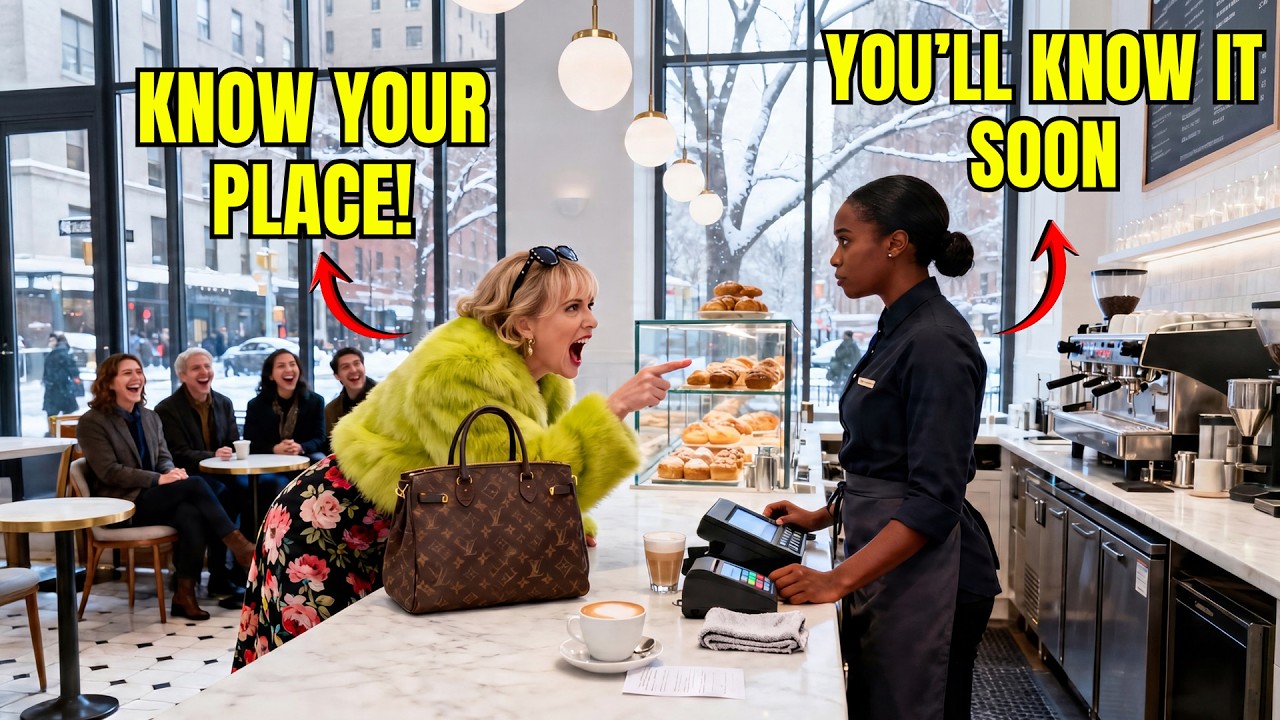
Candace walked in like she owned the building. Her perfume arrived before she did. Heavy, sweet, suffocating. She didn’t wait in line.
She never waited in line. She walked straight past four people and placed both hands flat on the counter. Her rings clicked against the marble. “I’ll have my usual, and I shouldn’t have to say it twice.
”
Eden already had the order memorized. Oat milk latte, extra hot, two pumps vanilla, light foam, served in a ceramic cup, never paper. She started making it before Candace finished talking. Candace leaned on the counter and watched her like she was supervising a child doing homework wrong.
“You know, I’ve been coming here for three years. They’ve never had someone like you behind the counter. ”
Eden didn’t look up. “Someone like me?
”
“Don’t play dumb. You know exactly what I mean. ”
Eden set the cup down gently. Perfect foam.
Perfect temperature. “Your latte, ma’am. ”
Candace picked it up, took one sip, and pushed it back across the counter with two fingers, like it carried a disease. “It’s bitter.
Make it again. ”
It wasn’t bitter. Every other customer that morning had complimented the coffee. But Eden didn’t argue.
She poured it out, started fresh. Same recipe, same precision, same steady hands. Candace took the second cup, sipped it slowly, then tilted it over the trash can right in front of Eden and let the whole thing pour out. She didn’t break eye contact.
The liquid splashed against the plastic liner. The sound filled the silence of the entire room. Barely acceptable. Then she left.
No tip, no thank you. Just the sharp click of heels on marble and the smell of that perfume hanging in the air like a bruise. That night, Eden sat cross-legged on her bed in Brooklyn and typed her daily report to Terrence. “Day six.
Customer CT. Repeat pattern of verbal hostility directed exclusively at me. Manager present. No intervention.
No documentation. ”
Terrence replied in thirty seconds. “Come home. You’ve seen enough.
”
“Not yet. ”
Day eight. The café was packed. Morning rush.
Every table full. A line stretched out the door. Candace arrived at her usual time. She cut the line without a word.
Nobody protested. They never did. She stood at the counter and looked Eden up and down slowly, head to toe, then back again, like inspecting something on the bottom of her shoe. “Still here?
I honestly thought you’d be gone by now. Most of your kind don’t last long in places like this. ”
Eden’s jaw tightened. Just barely.
Just for half a second. “Good morning. The usual? ”
“Are your hands clean?
”
“Yes, ma’am. ”
“I mean really clean. I saw you touching the garbage bin earlier, and now you want to make my drink with those same hands. That is disgusting.
”
“I sanitize between every task. Health code requires—”
“I didn’t ask for a lecture. Just make my drink and try not to contaminate it. ”
A businessman at the nearest table looked up from his laptop.
He heard everything. He looked at Eden. He looked at Candace. Then he quietly looked back at his screen as if nothing had happened.
Samuel Watts stood by the pastry case, rearranging croissants that didn’t need rearranging. His back was half turned, but his shoulders were stiff. He heard every word. Eden made the drink.
Perfect once again. Handed it over. Candace took it without looking at her, like receiving something from a vending machine. Day ten.
This was the day things shifted from cruel to something much darker. Candace came in with a friend, a blonde woman in oversized sunglasses and a cashmere wrap. They stood at the counter together, and Candace spoke about Eden as if she wasn’t standing right there, three feet away. “See what I mean?
This is what I deal with every morning. They put this girl on the counter and expect me to pretend everything is fine. ”
The friend looked uncomfortable. “Candace, maybe…”
“No.
Look at her. Does she look like she belongs in a place like this serving people like us? Please. ”
Eden could hear every syllable.
Her hands moved steadily—grinding beans, steaming milk, wiping the nozzle. She didn’t look up. Candace leaned closer to her friend but didn’t lower her voice, not even slightly. “I swear it’s like a social experiment.
Put a black girl in an Upper East Side café and see how long before the regulars stop coming. ”
The friend said nothing. She stared at her phone. Eden placed two lattes on the counter.
“Your drinks are ready. ”
Candace picked hers up, examined it like it might be poisoned, and turned to walk away. Then she stopped, turned back slowly. “Oh, and sweetie, you missed a spot.
” She pointed at the counter. A spot that didn’t exist. “Maybe pay attention instead of eavesdropping on conversations that don’t concern you. ”
They walked out laughing.
The glass door swung shut behind them. Eden wiped the invisible spot with a clean cloth. Her face showed nothing. But in the breakroom twenty minutes later, she stood at the sink alone and gripped the edge of the porcelain basin until her knuckles ached.
She wasn’t angry at Candace. She was angry at the room. Twelve people sat in that café during those moments. Twelve adults with ears and eyes and voices.
Not one of them ever used any of it. She pulled out her phone and opened her notes. “Day 10. Escalation.
CT brought companion. Third-person references in earshot. Racial language fully explicit. Manager absent.
No customer intervened. Bystander passivity deeply embedded. ”
Day twelve. Candace came in alone again.
But today she was in a different kind of mood. Her eyes were red and raw. Her movements were sharp, impatient, reckless. She’d been checking her phone obsessively since she walked in.
Later, Eden would learn why. Gerald Ashford had been photographed at a charity gala the night before with his wife—the actual wife—smiling, holding his arm, wearing a diamond necklace that could fund a small school. Candace had seen those photos that morning. Candace, who owned nothing.
Whose apartment was in Gerald’s name. Whose credit cards belonged to Gerald. Whose entire life was a lease agreement with no guaranteed renewal. And when a woman like Candace feels small, she finds someone smaller to crush.
“Hey. You. ”
Eden looked up from the register. “Good morning.
”
“Don’t good morning me. I asked for oat milk last time and you gave me regular. I was sick for two days because of you. ”
That was a lie.
Eden had triple-checked the milk that day. She always did. “I’m sorry to hear that. I’ll make sure—”
“Sorry doesn’t fix anything.
Maybe you shouldn’t be handling food at all. Have you even been tested for anything? You don’t exactly come from the cleanest background, do you? ”
The café went dead silent.
Every conversation stopped at once. A spoon clinked against a saucer near the window, and then even that went quiet. A mother with a stroller pulled her child closer. Samuel appeared from the back room, assessed the scene in two seconds, and walked over.
Not to Candace. To Eden. “Eden, why don’t you take a quick break? I’ll cover the counter.
”
That was his answer. Remove the target. Protect the attacker. Eden untied her apron and walked to the back without a word.
She sat on a cold plastic chair beside the mop bucket in the storage room. She wasn’t surprised. She’d seen this exact pattern described in the internal complaints she’d read before going undercover. She typed to Terrence: “Manager response confirmed.
Remove staff to protect aggressive customer. Pattern matches all prior complaint reports. This location needs full restructure from leadership down. ”
Terrence typed back one line.
“Say the word and I’ll have legal send the restructure memo tonight. ”
Eden stared at the message for a long time. “Not yet. I need them to show me everything.
”
She tied her apron back on and walked out to the counter. Candace was gone. Her cup sat abandoned on the table, lipstick on the rim, half-finished. No tip.
Not a single dollar again. Day fourteen. Candace had found a new game. She didn’t just come alone anymore.
She started bringing an audience. Two women trailed behind her that morning. They sat at the table closest to the counter, not because it had the best view, but because it had the best earshot. Candace stood at the register and stared at Eden for a long moment.
Then she turned to her friends. “Watch this. Every single morning, I have to deal with this. ”
She turned back to Eden.
“I want my usual, and this time try to get it right. I know that’s asking a lot. ”
Eden’s voice was steady. “Oat milk latte, extra hot, two pumps vanilla, light foam, ceramic cup.
”
“Did I ask you to recite it? Just make it. ”
Eden turned to the machine. The steam hissed.
The milk foamed. Her hands moved with precision that came from years of discipline. Not from making coffee, but from building something much larger while the world looked the other way. Candace leaned back toward her friends and didn’t even try to whisper.
“She’s been here for two weeks and she still can’t get a simple drink right. I swear they hire these people just to meet some kind of quota. ”
One friend laughed. The other shifted in her seat but said nothing.
Eden placed the latte on the counter. “Your drink, ma’am. ”
Candace took a sip and grimaced. “This is disgusting.
It tastes like you made it with your feet. Start over. ”
There was nothing wrong with the drink. Everyone behind that counter knew it.
Jess, the twenty-two-year-old barista at the pastry station, clenched her jaw so hard her teeth hurt. She looked at Samuel, waiting for him to say something. He didn’t. Eden made it again.
No protest. She placed the second cup on the counter. Candace sipped and shrugged. “Mediocre.
But I guess that’s the best you’re capable of. ”
She walked back to her friends. Their laughter floated across the café like smoke. That evening, Eden added a line to her report.
“Coworker Jess visibly distressed, looked to manager for support. None given. Staff morale erosion in real time. ”
Day fifteen.
This was the day Candace crossed a line she couldn’t uncross. The morning rush had died down. The café was half full. Eden was wiping the counter when she noticed Candace sitting at her usual table, phone raised, aimed directly at her.
She was taking a photo. Not of the coffee. Not of the pastry case. Of Eden.
Specifically of Eden on her hands and knees wiping a spill near the base of the counter. Candace showed the photo to the friend beside her. They laughed. Candace typed something slowly, carefully, like composing a masterpiece.
Her friend leaned over to read the caption. More laughter. Louder this time. The kind designed to be heard.
Eden didn’t know what the caption said. Not yet. But Terrence did. That evening, he called.
His voice was tight. “Someone in my network sent me a screenshot. Candace posted a photo of you on her private Instagram. You’re on your knees cleaning.
The caption says—and I’m quoting—‘The help doing what the help does best. At least she knows her place. ’”
Silence on the line. “Eden, that’s enough.
Pull out. We have more than enough to restructure. ”
Eden sat on the edge of her bed, jaw set, eyes dry. “Who saw the screenshot?
”
“It’s been shared in at least two group chats. Someone screenshotted the original post with the timestamp and her username visible. ”
“Save everything. ”
“Already done.
Eden, I’m serious. ”
“I need three more days. ”
“For what? ”
“Because I want to see what the manager does when it gets worse.
I want to see if there’s a single person in that building who will stand up. If there isn’t, I need to know that before I take over. ”
Terrence went quiet for a long moment. “Three days.
Not one more. ”
Day seventeen. Candace was getting bolder. Whatever fear of consequences she might have once had was gone.
The café had taught her through silence, through compliance, through Samuel’s spineless smiles that she could do anything. She walked in and went straight to the counter. She didn’t order. She just stood there looking at Eden with an expression somewhere between boredom and contempt.
“You know what I find fascinating? How someone like you can stand there every morning and pretend this is normal. Pretend you belong here. Pretend we don’t all see exactly what you are.
”
Eden met her eyes. “Would you like to order? ”
“I’m talking to you. Don’t interrupt me.
”
“I’m here to take your order, ma’am. ”
“See, that’s your problem. You think putting on an apron makes you equal to the people on this side of the counter. It doesn’t.
It never will. You’re serving me because that’s where you belong. And deep down, sweetheart, you know it. ”
The words hung in the air.
A mother two tables away covered her young daughter’s ears. The little girl looked confused. She didn’t understand the words, but she understood the tone. Children always do.
Eden didn’t blink. She didn’t look away. Her hands rested flat on the counter. “Oat milk latte.
”
Candace slammed her palm on the marble. The sound cracked through the room like a gunshot. Every head turned. “Are you deaf?
I said I’m talking to you. Don’t dismiss me with your little robot routine. ”
Samuel appeared from the back. He saw Candace’s face.
He saw Eden motionless behind the counter. He walked over quickly. “Is everything all right here, Miss Thornton? ”
“No.
Your employee has an attitude problem. She’s rude. She’s dismissive, and she makes me uncomfortable every time I walk in here. I spent a fortune in this place.
I am your customer. Three years I’ve been coming here. ”
Samuel nodded quickly. Too quickly.
Then he turned to Eden. “Eden, maybe you should take the back for a while. I’ll handle the front. ”
Eden looked at Samuel for three full seconds.
She searched his face for something that looked like courage. Nothing. She untied her apron and walked to the back without a word. In the storage room, she typed one line to Terrence.
“Manager sided with aggressor again. Day 17. Pattern unbroken. ”
Day eighteen.
The last day. Candace arrived at eight sharp alone, smiling. That smile was the worst part of all. It meant she had something planned.
She ordered her usual. Eden made it perfectly. She always did. Candace picked up the ceramic cup, examined it, sniffed it, held it up to the light, took the smallest sip.
Then she set it down, looked Eden dead in the eyes, and slowly, deliberately tilted the cup over the edge of the counter. The coffee poured onto Eden’s hands. Hot. Not scalding, but hot enough to sting.
Hot enough to make her skin flush red. It splashed across her apron, soaked through to her stomach, dripped onto her shoes, and pooled on the floor. The smell of burnt milk and vanilla rose between them like something ruined. Candace held the cup steady until every last drop was gone.
Then she set the empty cup down with a soft click. “Oops. Guess your hands are dirty again. ”
The café froze completely.
Fourteen people in that room. No one spoke. No one stood. A man in the far corner pulled out his phone and began recording.
His hands were shaking. Samuel stood near the espresso machine. He opened his mouth, then closed it, then looked at the floor. Eden looked down at her hands.
Coffee dripped from her fingers onto the tile. She watched the drops fall for what felt like a long time. She reached behind her back slowly, untied the apron, folded it with steady hands, and set it on the counter. She looked at Candace one last time, directly, without anger, without fear.
“I think I’ve seen enough. ”
She picked up her bag and walked straight out the front door. No shouting. No tears.
Just the quiet sound of footsteps on marble and the soft click of the glass door closing behind her. Outside, the morning air hit her face. Cold, clean. The noise of Madison Avenue rushed in.
The world kept moving. It always does. The café stayed silent for a long time after she left. Candace smirked and reached for a napkin.
She checked her reflection in her phone screen and carefully adjusted her hair. She had no idea what she had just done. No idea who she had done it to. No idea that the woman who walked out that door owned the counter, the espresso machine, the building, and every single thing inside it.
And no idea that in exactly fourteen days, the whole world would know it too. Two weeks later, the morning of November 12th started like any other Tuesday in Manhattan. But on every newsstand, on every magazine rack, in every bookstore window from SoHo to the Upper East Side, one face stared out from the cover of Forbes. Eden Underwood.
The photograph was striking. She wore a tailored black blazer, no jewelry, no makeup tricks. Her arms were crossed. Her expression was calm.
The same calm she wore behind the counter at Heartwell & Company while coffee dripped from her fingers. The same calm she wore when Candace told her she didn’t belong. The headline read: “The Quiet Disruptor: How Eden Underwood Built a $200 Million Beauty Empire While Nobody Was Watching. ”
The article ran eight pages.
How Eden had founded Bloom Collective at twenty-three with $1,200 and a laptop. How she had bootstrapped a clean beauty supply chain serving thirty-six states. How she had quietly closed partnerships with three of the country’s largest retail chains. How her company had just completed a Series B round at $50 million.
And buried in the sixth paragraph, the detail that would set the internet on fire. “In her most unconventional move yet, Underwood spent 18 days working undercover as a barista at the flagship location of Heartwell & Company, the luxury café chain Bloom Collective acquired in a deal finalized last month. ”
“I don’t buy businesses from a boardroom,” Underwood told Forbes. “I needed to stand where my employees stand.
I needed to see what they see, feel what they feel, and understand what’s broken before I try to fix it. ”
The article didn’t name Candace Thornton. It didn’t need to. It described a pattern of targeted racial harassment from a regular customer and a management culture that prioritized revenue over the safety and dignity of its staff.
“I watched a manager remove a black employee from the floor to protect the comfort of the person abusing her,” Eden said. “That told me everything I needed to know about the leadership at that location. ”
By noon, the article had been shared 400,000 times. By evening, it was trending in twelve countries.
Everyone was talking about the CEO who went undercover and discovered exactly how broken her new company was. And then someone found the Instagram post. It didn’t take long. Someone in Candace’s social circle had screenshotted her original post weeks ago.
The photo of Eden on her knees. The caption that read: “The help doing what the help does best. ”
The screenshot still had Candace’s username and timestamp visible. Within hours, the two images were side by side on every platform.
On the left, Eden on her knees, mocked by a woman who thought she was nothing. On the right, that same woman standing on the Forbes cover, worth $200 million. Candace Thornton was at brunch when it hit her. She was sitting at a corner table with two friends at a restaurant on the Upper West Side.
White tablecloth, half-finished mimosas, sunlight coming through tall windows. She was laughing about something meaningless when one of her friends stopped scrolling and her face changed. “Candace… what? ”
Her friend turned the phone around.
The Forbes cover filled the screen. Candace stared at it. Her mouth opened, but nothing came out. She grabbed the phone with both hands, zoomed in on the face, and scrolled down to the article.
Her eyes moved fast. Undercover barista. Heartwell. Eighteen days.
Racial harassment. Management failure. “That’s not… that can’t be the same. ”
“It is.
”
Candace’s other friend was already looking at her own phone. Her voice was barely a whisper. “Candace, your Instagram post is everywhere. It’s next to the Forbes cover.
Everyone is sharing it. ”
The mimosa glass in Candace’s hand trembled. She set it down too hard. Champagne splashed across the white tablecloth.
“Delete it. I need to delete it right now. ”
“You already deleted your account. It doesn’t matter.
People screenshotted it weeks ago. ”
Candace’s phone rang. She looked at the screen. Gerald Ashford.
She answered with shaking hands. Gerald didn’t greet her. His voice was flat and cold. “My PR team called me six minutes ago.
Your name is being connected to mine in every article about this story. Do you understand what that means? ”
“Gerald, I didn’t know who she—”
“I don’t care what you didn’t know. I care about what you did.
And what you did is now on the front page of every website in this country, with my name attached to it like a stain. ”
“I can fix this. Let me explain. ”
“We’re done, Candace.
I’ll have someone collect your things from the apartment by Friday. The cards will be cancelled tonight. ”
The line went dead. Candace sat at that brunch table with a phone full of missed calls, a champagne stain spreading across white linen, and the sudden understanding that everything she had—the apartment, the car, the cards, the clothes, the tables at restaurants like this one—had never actually been hers.
And now even the borrowed version was gone. The internet moved fast. By the next morning, the side-by-side images—Eden on her knees in Candace’s Instagram post, Eden standing tall on the Forbes cover—had been shared over two million times. The headlines wrote themselves.
“Billionaire’s Mistress Mocked Black Barista for Weeks. Barista Turned Out to Be Her Boss. ”
Hashtags erupted overnight. Baristas, waiters, hotel workers, and retail employees started posting their own stories.
Moments they were humiliated by customers who saw their aprons and decided they were less than human. Heartwell & Company was dragged into the spotlight. Former employees came forward. Three baristas who had quit the Upper East Side location gave interviews describing the same pattern: wealthy customers who abused staff and a manager who did nothing except remove the employee from the floor.
Samuel Watts was named in every account. His photograph circulated online. The café’s Yelp page was flooded with one-star reviews. Its Google rating dropped from 4.
6 to 1. 8 in a single day. Candace tried to reach Eden. She called the café, but Eden no longer worked there.
She tried mutual acquaintances, but every door was closed. So she apologized badly. A friend still willing to speak to her posted a statement on Candace’s behalf, since Candace had deleted all her own accounts. “I want to sincerely apologize to anyone who was hurt by my actions.
That is not who I am as a person. I was going through an incredibly difficult time in my personal life and I took my frustrations out in ways that don’t reflect my true character. I am committed to learning and growing from this experience. ”
It was a textbook non-apology.
Every line calculated to deflect rather than accept. “Anyone who was hurt” instead of Eden’s name. “Not who I am,” despite eighteen straight days of evidence proving exactly who she was. “Difficult time,” as if personal problems justified pouring hot coffee on another woman’s hands and calling her the help.
People dismantled it word by word. One video, a young black woman sitting in her car calmly dissecting every sentence, got eleven million views in two days. “That’s not who I am, ma’am? You did it every single day for almost three weeks.
That is exactly who you are. That is the most ‘who you are’ thing I’ve ever seen. ”
Gerald Ashford’s PR firm released a formal statement that same afternoon. Four sentences, cold and precise.
Cunningham had no ongoing personal or business relationship with Ms. Thornton. He wished Ms. Underwood well and had the utmost respect for her work.
Within seventy-two hours, every one of Candace’s lifelines was severed. The apartment was in Gerald’s name. The car was leased through his company. The credit cards were extensions of his accounts.
All of it gone. Candace Thornton, who had walked into Heartwell & Company every morning like she owned the city, now owned nothing. Three weeks after the Forbes cover, Eden Underwood filed a civil lawsuit against Candace Thornton in Manhattan Superior Court. The charges were precise: harassment, defamation, invasion of privacy.
The unauthorized photograph posted publicly with a caption designed to humiliate formed the backbone of the privacy claim. The eighteen days of verbal abuse supported the harassment charge. And the caption itself—“the help doing what the help does best”—was defamation in writing, aimed at a specific individual, published to an audience, and demonstrably false. The discovery phase broke the case open.
First, the video. The customer who had recorded the final incident provided the footage to Eden’s legal team. It was fifty-three seconds long. Clear audio, clear visual.
You could see Candace tilting the cup deliberately. You could hear the splash. You could hear her voice saying, “Guess your hands are dirty again. ” And you could see fourteen people sitting in frozen, absolute silence.
Twelve million people watched it in the first forty-eight hours. Then came Candace’s phone records. Her attorneys were compelled to produce text messages relevant to the case. What emerged was devastating.
Texts to friends joking about her “morning entertainment” at the café. A message describing Eden as “the black girl who thinks she can make coffee. ” A group chat where Candace sent the Instagram photo before posting it publicly, with the message: “Watch me put this one in her place. ” Another text from the same week read: “She looked like she was about to cry today.
Best Monday I’ve had in months. ”
Then came Samuel Watts, called as a witness during a deposition. He admitted under oath that he was aware of Candace’s behavior toward Eden and other staff members. He admitted that he had never documented a single complaint.
He admitted that his standard response to customer aggression was to remove the employee, not confront the customer. When asked why, his answer was simple and damning. “She spent a lot of money here. I didn’t want to lose the account.
”
Eden’s eighteen daily reports, sent to Terrence every night during her undercover evaluation, were entered into the record as contemporaneous documentation. Each report was dated, detailed, and consistent. Together, they formed a paper trail that no defense attorney could dismantle. Candace’s position collapsed.
Without Gerald’s money, she couldn’t afford extended litigation. Her attorney advised settlement. Eden’s legal team agreed, but with conditions that left no room for quiet resolution. Candace was required to issue a formal written apology—reviewed and approved by Eden’s attorneys to ensure it contained no deflection, no passive language, no excuses—published in the same Forbes outlet that had run the cover story.
She was required to pay a substantial financial settlement, estimated in the high six figures. She was required to complete two hundred hours of certified anti-discrimination training, with quarterly progress reports submitted to the court for eighteen months. And she was permanently banned from all twelve Heartwell & Company locations. Separately, Samuel Watts was terminated.
His termination letter, signed by Eden personally, cited sustained failure to protect employee welfare and deliberate prioritization of revenue over the physical and psychological safety of staff. The Upper East Side location was closed for two weeks for full operational restructuring. Every employee across all twelve locations was required to complete bystander intervention and anti-discrimination training. A new internal policy was implemented: any customer engaging in abusive behavior would be asked to leave immediately, and any manager who failed to enforce this policy would face termination.
Eden gave one interview after the settlement. Just one. She sat down with Naomi Griffin, the Forbes journalist, in a quiet room with white walls and natural light. “I didn’t stay in that café to collect evidence,” Eden said.
“I didn’t go in with a plan to catch anyone. I went in because I needed to understand what my employees experience every day. And what I found was a system that punishes the people at the bottom and protects the people at the top. ”
Griffin asked if she felt the settlement was justice.
Eden paused for a long time before answering. “Justice isn’t a settlement check. Justice is the next barista who gets screamed at by a customer and watches her manager walk over—not to her, but to the customer—and say, ‘You need to leave. ’ That’s justice.
That’s what I’m building toward. ”
Six months later, Bloom Collective closed its Series B at $50 million and expanded into twelve new markets. Eden opened a flagship store in Brooklyn, three blocks from the apartment where she used to sit on her bed at one in the morning, typing reports to Terrence while the rest of the city slept. She named her foundation the Diane Underwood Foundation, after her grandmother—the woman who once sat with her on a porch in North Carolina and told a teenage girl that the world would try to put a ceiling on her before she even stood up.
The foundation provided free legal representation to service workers facing harassment and discrimination. In its first six months, it took on two hundred cases across fourteen states. Most callers said the same thing: “I didn’t think anyone would believe me. ”
Eden still made her own coffee every morning.
French press, no milk, no sugar. She said it kept her honest. Candace Thornton moved out of Manhattan. She completed her two hundred hours of court-mandated cultural sensitivity training.
She paid the settlement in installments, because there was no longer a billionaire writing checks on her behalf. The social circles that once welcomed her closed their doors without a word. The women who had laughed with her at the café refused to return her messages. The restaurants where she once had reserved tables no longer recognized her name.
She learned in the slowest and most painful way possible what it felt like to be invisible. Samuel Watts left the service industry without a word. No public statement, no interview, no apology. The last anyone heard, he had taken a warehouse job in New Jersey.
Heartwell & Company, under Bloom Collective’s leadership, became a national model for worker protection. The new employee handbook opened with a single line printed in bold on the very first page: “The dignity of our staff is not negotiable. ”
A framed copy of Eden’s Forbes cover hung behind the counter at the Upper East Side location. The new staff put it there themselves.
Not as a marketing tool. Not as decoration. As a reminder of what happens when one person decides that silence is no longer acceptable. Eden’s success didn’t begin when Forbes put her face on a magazine.
It started years before any of that, in a grandmother’s living room, with $1,200 and a secondhand laptop, built one quiet decision at a time by a woman who decided that the world’s opinion of her was never going to become her opinion of herself. The real twist wasn’t that a barista turned out to be a CEO. The twist was that it took a magazine cover for people to treat her like a human being. She was the exact same person behind the counter that she was on that cover.
Same hands, same mind, same calm, same worth. The only thing that changed was what other people knew about her. It wasn’t one cruel woman who was the problem. It was the fourteen people sitting in that room who let her be cruel every single day for eighteen days.
Fourteen others with ears, eyes, and a voice. Not one of them opened their mouth. One cruel person can only do so much damage alone. But a group full of people who watch it happen and say nothing—that’s where real damage comes from.
The silence. The looking away. The pretending you didn’t hear it. That’s what makes cruelty possible.
So next time you are in that room—and you will be that room—don’t be the fourteen. Be the one. The one who says “that’s enough. ” Even if your voice shakes.
Even if nobody joins you. Because one voice is all it takes to break the silence. And the silence, once broken, never goes back together the same way. Cruelty needs an audience to survive.
Don’t give it one.


:max_bytes(150000):strip_icc():focal(749x0:751x2):format(webp)/Tyga-and-Doja-Cat379-08132026-baed2eed30bb4d96b507e45f6dcb4368.jpg)