He had just stepped out of his car when he saw her. A woman in a soaked blue uniform sitting on a stone bench beneath an old maple tree, eating lunch in the middle of the Seattle rain. Darius Whitmore, owner of dozens of high-rises, stood there with the car door still open, watching her shoulders tremble. She wasn’t cold.
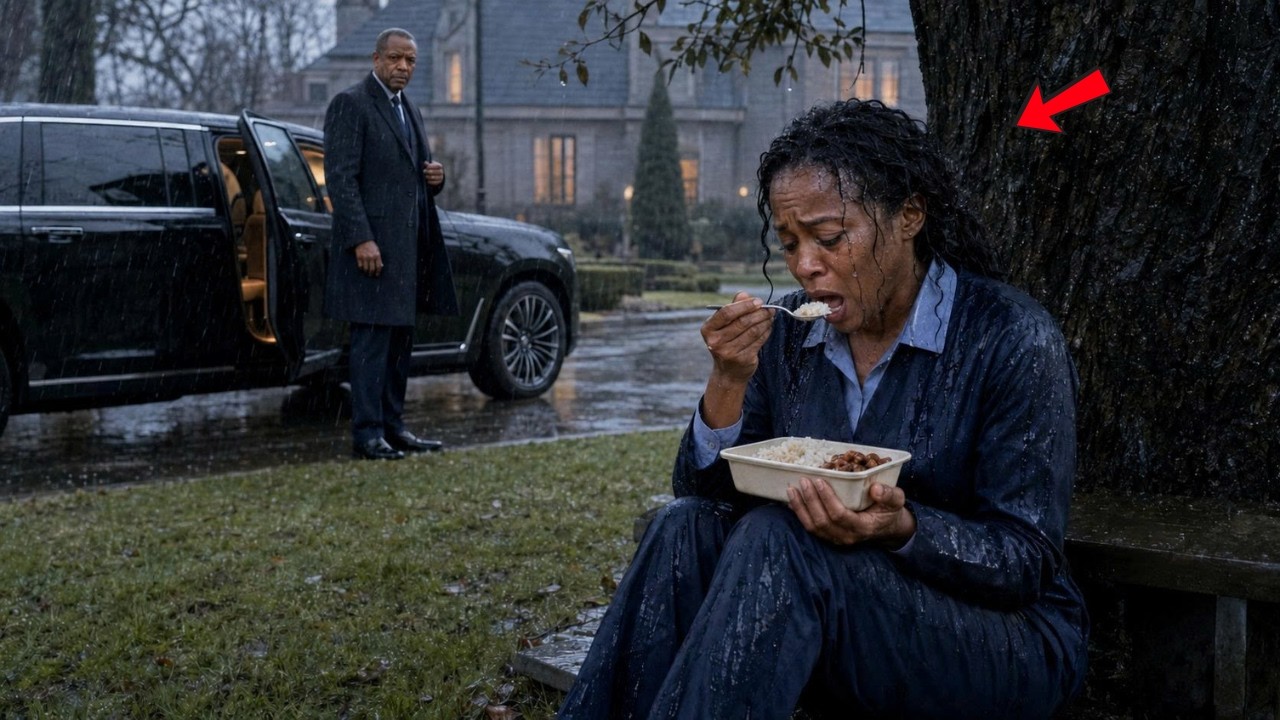
She was crying, and still, she kept eating. He was about to learn that the empire he had built was worth less than the half-eaten lunch in her hands. All evening, that image wouldn’t leave him. The 26-room mansion felt too quiet.
His daughter Aaliyah was in New York, and they had spoken exactly three times that year, all about money. His wife Yolanda had died six years ago, and her clothes still hung in the closet. When he closed his eyes that night, he saw the woman in the rain, and then another image overlapped it. Tacoma, 37 years earlier.
His mother, Odessa, walking home a mile in the rain to save bus fare, her hands cracked and bleeding from scrubbing other people’s floors. She had eaten her cold lunch on the floor beside him, stroking his hair, whispering that he would go farther than she ever dared to dream. Darius woke with tears on his face. For the first time since his wife’s funeral.
The next morning, he asked the head housekeeper, Evelyn Price, about the woman. Evelyn, who had worked for him for 15 years, gave answers that were too smooth, too evasive. Finally, she admitted the name. Renee Carter.
She had worked there for nine months. And when Darius asked why she had been eating outside in the rain, Evelyn told him it wasn’t her place to report it. At noon, Darius found Renee in the back garden. When he asked why she ate outside, she told him the truth, flat and emotionless.
Three weeks earlier, at a fundraiser he had hosted, a guest named Mrs. Caldwell had complained that Renee smelled of cleaning chemicals. She suggested it would be better if staff ate outside. Darius felt like he had been punched in the chest.
Renee smiled a small, empty smile and said the fresh air was pleasant. Then she walked away, back straight, head high, as if being humiliated was an ordinary part of her day. He confronted Evelyn, who finally spoke the truth she had carried for years. His guests were routinely rude to the staff, treating them as invisible.
Renee was only the latest. The others had learned to disappear whenever guests were in the house. When Darius asked why she still worked for him, Evelyn answered without bitterness. “Because if I quit, who will stand between guests like Mrs.
Caldwell and the people cleaning this house? I have always believed you were not cruel, only blind. ”
Darius began digging. He discovered that his household staff were hired through an outside agency and paid wages far below what he had assumed.
There was no reporting channel for them. No policy about shared spaces. He had prided himself on catching hidden clauses in million-dollar contracts, yet he had never spent ten minutes learning how the people in his own house were treated. He drove to Renee’s address in South Park.
From a distance, he watched her laugh with her teenage daughter, Maya, in their apartment window. A real smile. He thought of his own daughter, who looked at him like a walking ATM. On the way home, he passed a vacant parcel of land his board had rejected as “not worth developing,” just a few blocks from where Renee lived.
He needed to understand. Not through files or windows. From the inside. At 2 a.
m. , he called his old college roommate Terrence, who ran a cleaning company. He asked Terrence to hire him for one night as a cleaner, under a fake name, in one of his own buildings. Terrence agreed, on the condition that Darius explain the whole story afterward.
On Friday night, Darius became Curtis Boone. He put on old jeans and a canvas jacket and showed up at Cascadia Tower. The night crew looked exhausted before the shift even began. And there was Renee.
She smiled at him warmly, a real smile, and gave him advice about his back and staying hydrated. She was kind to him, a stranger, because that was what kind people did. For four hours, he pushed a cleaning cart, scrubbed toilets, and emptied trash. His back throbbed, blisters formed on his palms, and he felt like he was dying.
Renee moved at twice his speed, never stopping. During their break, she showed him a worn photograph of Maya. She told him about her ex-husband who had abandoned them, about working two jobs just to make rent, about calculating Maya’s nursing tuition obsessively at night. Darius clenched his hands beneath the table.
She asked about his daughter. When he said it was nice having her nearby, his voice was so empty that even he could hear it. “You are lonely, aren’t you? ” she asked.
He admitted it. She told him they recognized each other, those who carry loneliness inside. “Maybe every one of us is holding ourselves together alone in our own way. So sometimes being kind to a stranger is the only thing we still have left to hold on to.
”
He lied to her for three more weeks, working beside her, listening to her fears and her dreams. And every night, the guilt grew heavier. Renee was pouring her heart out to Curtis Boone while the real listener was the employer who had let her eat in the rain without noticing. He finally confessed, sitting across from her on the stone bench.
Her face went white. The water bottle nearly fell from her hand. “You lied to me,” she said, her voice cold as a blade. “I told Curtis about my ex-husband, about saying no when Maya asked for $20.
I thought Curtis understood because he was lonely too. But that was never real. That was my employer in disguise to see how workers behave when he is not there. ”
He tried to explain, his voice breaking.
She cut him off. “You put on poor people’s clothes for four hours, then gave yourself the right to think you understood enough to come fix me. I have been juggling two jobs for eight years. Do you think four hours can stand equal to eight years?
”
She walked away, back straight, tears on her cheeks. For two weeks, she barely spoke to him. He tried to make amends with a check large enough to cover all of Maya’s tuition. Renee looked at it like it was a snake.
“If I take your money, who do I become in this story? The poor woman rescued by her rich employer after he felt guilty? I do not want to be that character. My daughter needs to know her mother stood on her own two feet.
”
She told him what she actually wanted. “I need a workplace that does not humiliate me. I need fair pay for everyone, not just me because you feel guilty. I need to know that if I report a rude guest, I will not lose my job because of it.
Fix the system that allowed this to happen. ”
Darius understood then that the problem was not Renee Carter. It was himself. He spent weeks rewriting policies.
He raised base pay for all household employees, added full health insurance for their families, expanded paid and sick leave, created a confidential reporting line, and opened the break room to everyone. He demanded that his commercial cleaning contractors raise their wage floors. He lost money. He did not care.
He did not tell Renee about any of it. She had made it clear she needed fairness for everyone, not a story about being saved. At his next dinner party, Vanessa Caldwell insulted a server. Darius stood up and asked her and her husband to leave.
He lost two shared investments and a golf club membership over it. He did not care. Six months passed. Slowly, Renee began eating in the break room with her co-workers.
She gave up her night shifts one evening at a time. She never fully forgave him for Curtis Boone, and Darius understood he had to accept that. One sunny afternoon in May, Renee came to him with a smile that had no caution in it. Maya had been accepted into the nursing program, by herself, without anyone’s help.
Renee had saved enough for the first semester with her new salary. “I am not saying this to thank you for saving me,” she said. “I did this myself. But I acknowledge you cleared the path for me to do it myself instead of standing in my way like before.
”
“That is all I ever wanted,” Darius said quietly. Around the same time, Darius called his daughter Aaliyah, not about money, but just to ask how she was. She was surprised, then slowly she began to respond. At the end of May, she flew home for the first time in three years.
He told her he was wrong, that he had given her everything except himself. She told him she had always thought he didn’t care because he never asked her anything. “I know,” he said. “I am sorry.
I want to do things differently if you give me the chance. ”
They hugged, not out of formality, but because they both needed it. One afternoon during the summer rain, Darius walked down into the garden and sat on the stone bench beneath the maple tree. The bench no longer meant what it used to.
Now, anyone could sit there because they wanted to, not because they were forced. He thought of his mother, who had believed he would go very far. He had become a wealthy man. But true greatness lay in finally learning to see the people who had always been right in front of him, waiting to be seen as they truly were.
Human beings, no more and no less. The Seattle rain fell lightly on his shoulders, and this time, he did not hurry to find shelter.