Lenora Whitfield stood outside the iron gate of the Buckhead mansion, the rain soaking through the shoulders of her brown coat. Her shoes were clean but old, the leather worn thin at the toes. She held no suitcase, no legal papers, nothing suggesting she planned to fight her way in. Just a folder of documents pressed close to her chest and a small piece of paper, gone soft from being unfolded too many times.
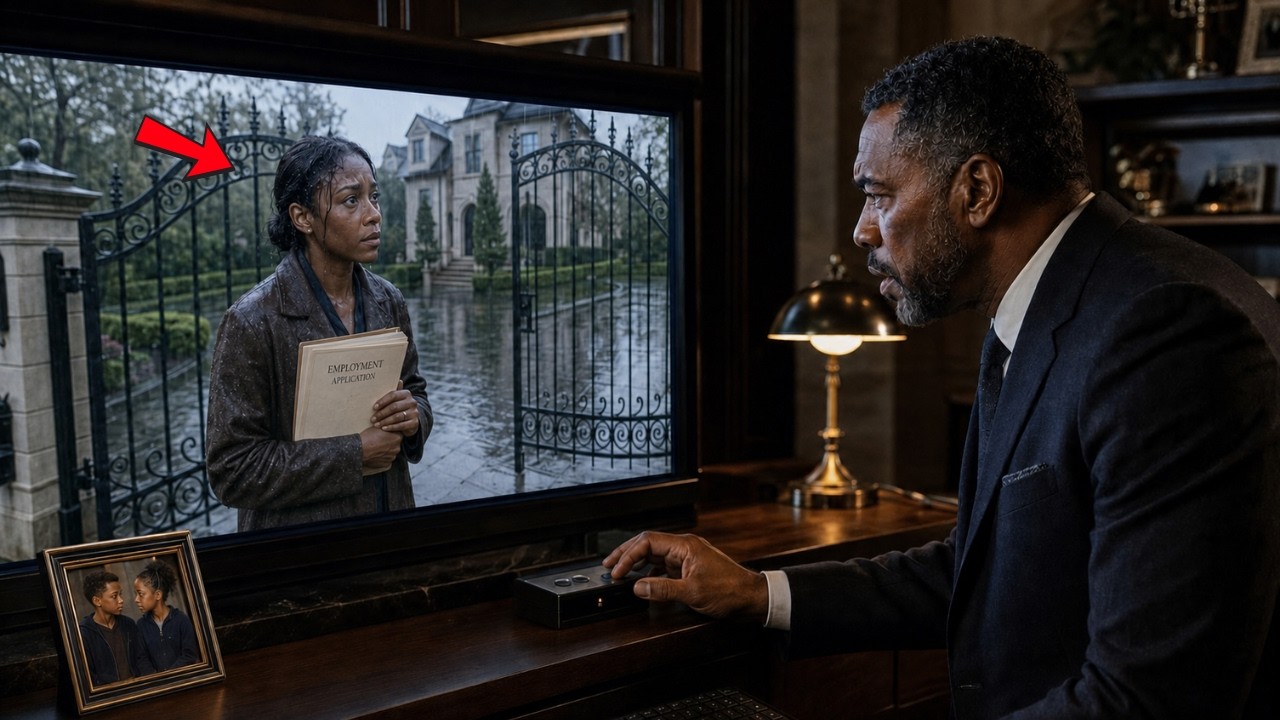
Alton Grayson watched her through the security screen in his study. Behind him, a map of his shipping routes spread across North America. Beside the computer sat a photo of Camden and Amara Whitfield, taken beneath the oak tree in front of the mansion. The two children were not smiling, but they no longer looked at the camera the way one looks at an adult who might vanish at any moment
Alton had just adopted those two children.
He had signed hundreds of pages over the past 19 months, learned to cut the tags out of Camden’s collars, learned that Amara couldn’t sleep if the door was shut all the way, learned to sit in the hallway through a nightmare without stepping in until called. He had done everything people said a father should do. No one had taught him what to do when the mother the file said had disappeared was now standing in front of his house in the rain
Lenora’s voice came through the intercom, steady despite the weather. “I have not come to ask for money.
I have not come to take them away either. I only ask for a job. Washing clothes, mopping floors, cleaning kitchen. Anything close enough for me to know they still eat their fill and can sleep.
"
Alton’s hand rested on the gate button, but he didn’t press it yet. He had seen the way Camden tied his shoes, one lace with two knots, the other ith one. The way Amara couldn’t finish a meal without hiding bread in her pockets. He had built a life around those details, carefully, slowly, like folding paper without creasing it.
And now the woman who had given those children life was standing fifteen feet away, asking not for them, just for a place near them
Nineteen months earlier, Alton had come to Harbor House Family Crisis Nursery for a reason that had nothing to do with adopting a child. His foundation had funded a backup generator system for the facility. The communications team wanted photos of him shaking hands with staff in front of the new sign. Alton was good at things like that: sign checks, stand in the right spot, smile just enough, leave before anyone started telling stories that were too real
The common room smelled of laundry detergent, sliced apples, crayons.
Eleven children sat around low tables. Nine of them looked up when he walked in. A boy waved. A girl ran over to show off a purple sun drawing.
But two children by the window did not raise their heads. They sat close together on the blue carpet, a supermarket flyer spread between them. The boy used his fingernail to press every fold flat. The girl held the edges of the paper so the house wouldn’t lean crooked.
When it was finished, she drew three windows. Two were colored in black. The thirdwas left white
Bernice Holloway, the director, noticed the direction of his gaze and pulled him aside. “Camden and Amara Whitfield, twins, 6 years and 11 months old.
Their mother left an address, a phone number, and a date she would return. For the first 6 weeks, she called regularly. Then all contact stopped. The address was no longer in use.
The phone number disconnected. No relative could be verified eligible to take both of them. Harbor House has kept them past our usual limit. Next week, they’ll be transferred to state care.
Two families have agreed to take them, but each can only take one child. "
Alton looked through the glass. Camden had turned the paper house toward his sister. Amara picked up a pen and wrote a very small date beneath the roof, then tucked it into her sweater pocket.
In that moment, Alton was 9 years old again, sitting on a plastic chair in a children’s services office, gripping his younger sister Rochelle’s wrist so tightly it left a red mark. A woman had said they would only be apart a few days. Alton believed her because adults in clean shirts often make words sound like truth. Three days became 30 years.
Rochelle grew up in a different state. When he finally found her, he owned a multi-billion dollar company, two airplanes, and a team of lawyers who could find almost anyone. She only sent back a short letter; she had a family, a peaceful life, and didn’t want old memories walking back into it
“How long until they get separated? " Alton asked
“Four days.
"
Alton took his watch off his wrist and set it on the table, as if its weight had suddenly become unbearable. Camden raised his head for the first time. His gaze crossed the room and stopped on the man in the expensive suit. No pleading, no hope, just the look of a child who had learned to measure adults by how long they stayed.
Alton walked across the room, sat down on the carpet in his expensive suit, and looked at the paper house. “I don’t know how to fold this. "
Amara held the paper in her lap. Camden watched his empty hands, then pulled a new sheet from the stack of flyers and set it down between them.
Alton placed his finger on the corner of the first sheet. His fold was crooked by nearly half a finger’s width. Camden saw it, but didn’t correct it. He only held one corner so the paper would not slide off Alton’s knee.
Amara placed a finger on the next fold line, then pulled her hand back. Neither child smiled, but neither did they walk away
That afternoon, Alton left Harbor House without a single press photo. He brought home a blue folder of documents and the crooked-roofed paper house, placed inside a watch box. Four days later, before Camden and Amara could be sent to two different addresses, he filed an application for temporary care of both of them.
That decision began with a supermarket flyer. Its real cause had been written 30 years earlier
The promise that kept Camden and Amara sitting by the Harbor House window until the lights went out in the yard began in a small apartment in West End, 8 weeks before the day they met Alton
Lenora Whitfield woke at 4:18 in the morning to the sound of water dripping into a pot set in the middle of the living room. The ceiling had swelled since the previous winter. Whenever it rained, water fell along a brown crack onto the rug where Camden liked to lie and read.
She had submitted six repair requests. The manager replied twice, both times saying they were scheduling it
That morning, an orange notice was taped to the front door before the three of them had even finished breakfast. The building had been declared no longer fit for habitation. All tenants had 8 days to leave.
Lenora read the paper twice, folded it, tucked it under the sugar box, then divided the last of the oatmeal into three bowls. Camden received the smaller portion but said nothing. Amara noticed and pushed one of her own spoonfuls over to him. Lenora turned her back to wash a pot that was not yet dirty so the children wouldn’t see her counting what money was left: $312 in the account, $48 in cash, a car overdue for an oil change, two school uniforms, and a pair of Camden’s shoes starting to pinch at the big toe
8 days
Lenora used to work the night shift in the laundry department at St.
Anne’s Hospital. She knew how to sort bed sheets by the color of thread at the hem, knew which stains needed a cold soak, which would set permanently if they met hot water. Three months earlier, the hospital outsourced the department. Seventeen people lost their jobs in a single afternoon.
She picked up extra work cleaning offices, but the hours changed every week. Rent did not know how to negotiate with weeks that held fewer hours
Over those 8 days, Lenora called 23 places. Eleven required a deposit beyond what she had. Six did not accept children.
Three were already full. Two never called back after she said she only had temporary work. The last was a 6-week hotel housekeeping training program in Macon with dormatory housing and a promised job interview upon completion. The program did not allow children to come along
Lenora sat in the car outside the public library for nearly an hour, both hands on the wheel.
In the back seat, Camden used a pencil to write the date on the edge of a flyer. Amara folded the rest into a three-window house. The two children had grown used to their mother’s silence when she had to make a decision, so they only sat closer together
Harbor House was the only option that did not require Lenora to give up her rights as a mother. The crisis care program allowed children to stay short-term when a parent faced a crisis involving housing, health, or employment.
Lenora read every line of the agreement. She asked about calling hours, medical decision rights, length of stay, and what would happen if the job took longer than expected. She only signed once
On the last night in the car, Lenora combed Amara’s hair under the parking lot lights. She wet the comb with water from a bottle, parted her daughter’s hair into four sections, tied ith two ribbons washed to the point of fading.
Camden sat in the front seat holding the flashlight and trying not to look at the two bags of clothes at his feet
The next morning, she brought the children to Harbor House. Each backpack held three sets of clothes, a toothbrush, one book, and her phone number written in four different places. She left a medical authorization form, the address of the training program, the name of the person in charge, and a calling schedule for Tuesday, Thursday, Sunday evenings
Before their mother left, Amara took out of her pocket a paper house with three windows. She gently tore off the third window and handed her mother half of it.
“So you’ll know the way back. "
Lenora placed the piece of paper in the small compartment of her wallet. She did not say she would never leave the children again. She had learned that children remember absolute words longer than adults remember the circumstances that force them to swallow those words back
“You’ll come back before your birthday.
"
Camden wrote that date behind the roof, then had his mother check it, as if a promise could only exist once it was written down
For the first 6 weeks, Lenora called at exactly the right times. She told them about folding towels into fans, about the room with four bunk beds, about the shoes she was saving up to buy for Camden. By the evening of the seventh Sunday, the phone at Harbor House sat silent on the front desk. Bernice checked the clock at 8:00.
Then 8:30. Camden sat by the window, the calendar page open on his knees. Amara held the paper house in both hands
More than a hundred kilometers from Atlanta, Lenora was lying on the floor of a rest stop bathroom. Pain beneath her ribs kept her from standing up.
When the ambulance arrived, the bag holding her phone, papers, and Amara’s window fragment was placed on a different stretcher
Three days later, she woke up with a plastic bracelet on her wrist, her name on it, missing one letter. Her throat was so dry she couldn’t make a sound. She remembered the bus leaving Macon, the cramping pain, cold tile pressed against her cheek. Her wallet, phone, and bag of papers were gone from the cabinet beside the bed.
A staff member said the belongings might have been misplaced while she was moved from emergency to treatment
Lenora asked to call Harbor House, but the only number she knew by heart was the old hospital number where she used to work. Once she could walk, she used the phone at the end of the hallway to call one place after another, starting with the addresses written on the flyer still left in her pocket. The training program in Macon had shut down after a financial dispute. The person in charge no longer worked there.
Calls made to Harbor House from the hospital’s number were not matched to the correct file because Lenora couldn’t remember the case code
While she traced one lead after another, Camden and Amara were transferred into the state’s care system. At Harbor House and at school, the twins still went by their mother’s surname, Whitfield. But on birth certificates and legal records, they were filed under Harris, their late father’s surname. The search applications Lenora later submitted all listed Camden Whitfield and Amara Whitfield.
The system returned no matching record
Four days after their first meeting, Alton returned to Harbor House in a car with no press team. He brought two child car seats still bearing instruction labels, three sets of confirmation paperwork, and the wrongly folded paper house inside the watch box. The social worker explained this was only temporary care. The first goal was still to find the mother, relatives, or a safe path to reunification.
Alton listened closely, but his hand tightened at the word temporary
Camden walked out first, both straps of his backpack pulled over his shoulders. Amara followed, holding the shoe box of paper houses. Neither asked where Alton lived, how wealthy he was, or what their rooms would look like. “Do we get to go together?
"
Bernice didn’t answer with a promise. She opened the car door and pointed to the two seats set side by side. Camden looked at the gap between them, no wider than a hand’s width, climbed inn on his own, and waited for Amara to sit before buckling his seat belt
The Grayson mansion had 12 bedrooms. On the first night, the two children didn’t sleep in any of them.
Odessa Price, the housekeeper of 14 years, had prepared the east room with two twin beds, a moon-shaped nightlight, a new bookshelf. Camden stood at the doorway for nearly a minute, looking at the high ceiling, the large window, the empty space between furniture, as if the room could swallow the sound of breathing. By midnight, Alton found them in the dressing room connecting the two bedrooms. Amara curled up on the rug, her head resting on the shoe box.
Camden leaned his back against the wardrobe door, eyes still open. Alton didn’t carry them back to bed. He pulled two thin mattresses onto the floor, sat outside the door until the boy’s breathing slowed
The next morning, he had some of the furniture taken out of the room. His therapist, Dr.
Audra Bennett, said children who had once lost their home didn’t need a perfect room. They needed to know that a cup set down tonight would still be in the same place tomorrow morning
Alton began with things that could repeat. Breakfast at 7:10, the car leaving at 7:45, the hallway light turned on before dark. Every Friday night, he wrote next week’s schedule on a board for Camden to check.
If a meeting made him late, he called ahead and gave an exact time. It took Camden 3 weeks before he stopped checking the lock three times. Amara needed longer to finish a whole meal without hiding bread in her pocket. Alton found four dried pieces of bread in her clothes.
He didn’t ask. That evening, a small box appeared in the low cabinet of the kitchen holding crackers, an apple, water. On the lid, a handwritten line: Camden and Amara may take this any time
The children still called him Mr. Grayson.
Alton didn’t correct them
Months passed through home visits, therapy sessions, paperwork signed in windowless conference rooms. The state kept sending notices to Lenora’s old apartment, posting search listings under Harris. When her whereabouts couldn’t be determined, the court opened review hearings. Based on records showing every attempt at contact had failed, Lenora’s parental rights were terminated before the adoption process entered its final stage
Lenora was not present.
She was still searching for the two children under a different surname
On the day the adoption was finalized, the judge asked Camden and Amara whether they understood what was happening. Camden nodded. Amara looked at Alton for a long moment before signing in small handwriting. He set down the pen last of all, without feeling like he had won.
On the other side of those pages, there was still a woman no one had been able to find
That night, Amara carried the shoe box into the study. She took out the first house, its roof now creased, the third window still left white, and set it beside a new photo frame. “Does my mom know we’re here? "
Alton looked at the date written behind the roof and pulled the chair out beside him.
Before Amara could sit, the phone rang: the legal office. A staff member said a woman had just come in asking about two children with the surname Whitfield. That call didn’t lead Alton to Lenora. The staff checked and concluded the woman was searching for two different children.
Camden and Amara continued living in the mansion. Amara still left the third window blank. Alton kept saying,“I don’t know. " instead of using a promise to cover the gap
Nineteen months after he first met them, Lenora found the name Grayson in a copy of the adoption decision that a legal aid organization had helped her obtain.
She learned the mansion’s address throughthe foundation’s public records, took three bus rides, and stood outside the gate just as the rain began
Odessa was the first to reach the security room. On the screen, Lenora stood still. She didn’t ring a second time nor try to look through the fence. The documents she brought included a birth certificate, a copy of the crisis care agreement, hospital records with an admission date matching the week the calls had stopped, and a list of agencies she had gone to.
The edges were soft, marked with handprints and creases. Not documents a lawyer had prepared. They had passed through many waiting rooms
Alton called Audra before opening the gate. He didn’t ask whether he had the right to refuse; that right already belonged to him.
He asked what would cause the children least harm. Audra required identity verification, then the adults had to agree on what would be said. No one was to force Camden and Amara to choose. Lenora was not to promise to take them away.
Alton was not to use his position as legal father to turn their past into something forbidden to mention
The gate opened at 9:26. Lenora stopped just past the first stone marker. A security staff member handed her a towel. She wiped her face, then folded it into a rectangle.
As she was led into the sitting room beside the library, her eyes didn’t linger on the crystal lamps or paintings. She looked at a pair of children’s shoes set unevenly beneath the bench. One tied with two knots. The other had only one
Alton sat across from her.
Lenora told the whole story in order: the illness, three days unconscious, the lost bag of belongings, the training program shutting down, the sealed apartment, months of going from one agency to another, searching under Whitfield while records listed Harris. She set a photo on the table: Camden and Amara, younger, matching jackets, standing on either side of their mother in front of the library entrance. No one wore new clothes. Lenora bent between them, her smile tired but intact
“I have not come to tear apart the home you have given them.
" After saying it, she pressed her two thumbs together to keep her hands from shaking
The first meeting was arranged the following afternoon, under Audra’s supervision. Lenora arrived 20 minutes early wearing a dark blue dress with a hand-stitched hem. Camden walked in first, stopping when he was still nearly 4 meters from his mother. Amara lightly touched his back, then stood still.
Over 19 months, they had learned not to let their bodies move ahead of the truth
Their names caught in Lenora’s throat. She sat on the low chair, set the paper house on the table, opened her hand. Inside was half a window, gone yellow with age. Amara reached into her dress pocket and took out the other half.
The two halves fit together so exactly that the torn line nearly disappeared
Lenora sang four lines, very softly: the lullaby she used to sing when the apartment lost power and the three lay together on the mattress in the middle of the living room. Camden dropped his spoon. The sound of metal hitting the floor was faint but sharp. Amara took one step forward, then another.
Lenora kept her hands still in her lap. When her daughter was close enough, Amara placed the window fragment into her mother’s palm. Lenora closed her fingers around it, bowed her head low until Camden pulled his chair closer to the table
The visit lasted 40 minutes. Lenora didn’t ask if they missed her.
She asked Camden whether his feet still hurt when he wore stiff shoes. Asked Amara if she still saved the crispiest bit of bread crust for the end of the meal. They answered with small movements. Camden looked straight at her for longer.
Amara set the paper house down between the three chairs
Lenora wanted to be near her children, but didn’t want her right to see them to depend on Alton’s pity. Odessa suggested she apply through an independent household management company. Identity verification, background check, work references, and a contact plan built by Audra took 12 days. On the morning of the 13th day, Lenora returned to the mansion in a gray uniform folded inside a paper bag.
The contract stated she would work only in common areas, not enter the children’s rooms without permission, not ask them to keep secrets, not make promises that were not certain
As she pinned the badge to her uniform, Amara stood at the end of the hallway with Camden. “Miss Whitfield. "
Lenora turned. Amara walked over without hugging her.
She only tucked the half-paper window into the uniform pocket, then stepped back beside her brother
Odessa opened the door leading down to the laundry room. The door closed behind Lenora with a very soft sound. The laundry room was larger than their old apartment. Three industrial washing machines lined the wall; white towels set on shelves reaching shoulder height.
The soap smelled so clean, nearly free of memory. Odessa only pointed out the symbols on clothing tags,and how children’s clothes had to be washed separately. Lenora wrote everything down in a small notebook, never glancing back at the staircase where Camden and Amara had just disappeared
On the first day, she worked only on the ground floor. Near noon, she found two small sweaters in the clean laundry basket.
She recognized Camden’s before she even saw the name: the collar had been cut with clumsy scissors, the fabric edge slightly frayed. When he was younger, he had once cried because a tag scratched his skin, then apologized as if his own discomfort were a fault. Lenora took needle and thread from her pocket, folded the fabric edge, stitched it with small, even stitches. She left no note
When Camden put the sweater on the next morning, he touched his neck twice, then looked toward the laundry room.
Lenora was sorting sheets behind the half-open door. Her son’s name trembled inside her chest, but she kept working. Only after he turned away did her hand grip the edge of the table
The following days were measured out by very clear boundaries. Lenora stopped outside the children’s bedroom door.
Even when Amara left it open, she knocked before entering the shared study. Even when Odessa asked her to bring clothes up, if she found a toy under a chair, she set it on the table out in the hallway. Audra said trust was built when a child saw an adult respect the same boundary enough times that the body stopped bracing itself
Amara began appearing in the laundry room by the end of the second week. She brought a book, sat near the door, read while Lenora folded towels, the distance between them nearly 3 meters.
At break time, Lenora cut an apple into eight even pieces and set the plate on the table in the middle of the room. Amara waited a full minute before standing, taking a piece, returning to her chair
Camden was harder to draw closer. He often stood at the top of the stairs, checked that Lenora was still there, then walked away before she looked up. One rainy afternoon, a clap of thunder rattled the windows.
Camden appeared with a blanket wrapped around his shoulders, stopped at the threshold. Lenora remembered the power outage nights in West End, when he used to count the gap between lightning and thunder. She slowed her folding just enough for him to count along with the movement of her hands
Alton watched these changes from a distance he didn’t want to admit. He saw Amara stop hiding bread on the days Lenora was present.
He saw Camden set aside on top of the laundry basket only the shirt that needed mending. He also saw that Lenora never used a weak moment to pull the children back toward herself
At Sunday breakfast, Alton tried folding a napkin into a house the way Camden had shown him. The roof tilted to one side; one corner of paper stood up like a chimney. Amara stared at it for a long time before letting out a short laugh.
Camden tried to keep a straight face, but his shoulders shook. Alton looked at what he had made. “This house might not survive the rainy season. " Amara laughed again.
Lenora, standing by the kitchen counter, turned toward the window to hide her own smile. It was the first time all four of them had been in one room without anyone having to think first about where they were allowed to stand
One morning, Lenora found a platinum cuff link at the bottom of the dryer. She placed it in an envelope, noted the time and machine number. The item alone could have covered more than a year’s rent.
She only asked Odessa whether the filter needed checking again
The management company offered to advance 3 months’ pay so Lenora could settle into stable housing. She accepted only the exact deposit amount for a small room near a bus line, asked for it to be deducted week by week. Alton never mentioned it. He only had her old sewing machine repaired after noticing she had to turn the flywheel by hand.
She repaid him by mending the lining of the coat he had worn since the earliest days of his company
On the Friday night of the fourth week, Camden ran a high fever. Alton found him on the bathroom floor, cheeks flushed. When lifted, Camden stiffened as the blanket touched his neck. Lenora heard hurried footsteps, but stopped outside the room.
She told Alton to fold the blanket down below the collarbone,and to place the cool cloth at the back of the neck instead of on the forehead. Camden gradually relaxed in his arms. Lenora went down to the kitchen, prepared water and medicine per the doctor’s instructions. Left everything on the table, then returned to the laundry room, though every part of her wanted to be beside her son
Near midnight, Alton came down looking for a towel.
He found Lenora sitting beside the dryer, hands clasped tightly, eyes never leaving the staircase. “The fever has gone down. " Her shoulders dropped. Lenora bent to pick up a half-folded towel.
Alton looked at the woman who had stood outside her own child’s room for 4 hours only because she had promised to respect a closed door
The next morning, Camden came down to the kitchen, still in pajamas. On the wall was the work schedule Lenora had written in blue ink, marking each day she came in and the hour she left. He stood in front of the paper for a long time. Then turned.
“Mom. "
The knife in Lenora’s hand stopped midway through the apple. “How long will you stay this time? "
She set the knife down, pulled the calendar off the wall, flipped to the next month’s page.
It was still blank. Lenora took out the blue pen from her pocket,and filled in each day she was scheduled to work. She didn’t write forever, nor circle a date so far off that no one could hold her to it. She wrote Monday, Wednesday, Friday, the hours she would arrive and leave.
At the bottom of the month, the name of the management company along with Odessa’s phone number, so Camden could ask if the schedule changed
His finger stopped on an empty box, a day off between two weeks. Lenora added the address of the room she was renting,and the time she would call. Camden didn’t say thank you. He folded the calendar along its old crease, held it against his chest, went upstairs
That night, Alton saw the paper taped beside the bed, low enough to be level with a child’s eyes
Three days later, Alton hired an independent investigation team that had never worked for Grayson Atlas before.
He didn’t want a report written for his comfort. Every record concerning Lenora, Harbor House, the hospital, the closed apartment, the adoption, was to be reviewed from the beginning. The first report ran to 186 pages. The opening lines held only case codes, transfer dates, blank fields.
But the more he read, the more he saw a mother emerge from within those blank spaces
Lenora had called three agencies in the first month after leaving the hospital. She sent two certified letters,and went in person to the family services office by bus. A staff member wrote down Camden and Amara Whitfield, but the system had them filed under Harris. The contact address remained the sealed apartment.
When the letters were returned, the file was marked residence undetermined. Four cold words had made months of searching look as though no one had ever come back
The section on housing made him pause longer. Statistics on rent burden, percentages of Black households spending more than half their income to keep a roof. The numbers fit neatly into a few lines.
They didn’t say how many meals Lenora skipped to buy Camden’s shoes, or which night Amara woke up cold in the car. Nor did they say that a person could work enough hours, pay on time for years,and still lose her home after a single job loss. Alton had once seen poverty as a problem money could fix. The report showed sometimes the money arrives after the door has already closed, while the system only records that the person standing outside had no address
He found Lenora in the laundry room near midnight.
Her shift had ended, but she was still mending a seam on Amara’s coat because the next morning would be cold. Alton set the report on the table. “What did you find? " He told her about the phone calls, the letter sent to the wrong department, the mismatch between the two surnames.
When she heard about the first letter, Lenora closed her eyes. She didn’t feel relief at having proof she had searched. What hurt her was thatthe proof had existed somewhere all along, while Camden and Amara sat waiting
That night, Alton took Lenora up to the third floor. He stopped at the room at the end of the hallway, the one whose key always stayed in his pocket.
Inside: nothing of value. A small bed, a few paper boxes, letters stacked by year. All addressed to Rashel Grayson. Alton told her about the day the siblings were separated,the promise he had written on the back of a bus ticket,and 30 years spent trying to become wealthy enough that no one could take the person he loved out of his hands again.
When he finally found Rashel, he sent 12 letters in one year. She answered once, saying her current life had no room left for the past
Lenora sat on the floor and began sorting the letters back into order by date. Alton sat across from her. Between them lay old paper, dust, sentences never sent.
“Some promises don’t die just because we couldn’t keep them," Lenora said. “They just stay inside us, in a different way. "
The next morning, her old sewing machine was sent out for repair. Lenora didn’t thank him with words.
She used it to mend the lining of Alton’s coat. The two exchanged small acts, as if both understood that some distances shouldn’t be crossed by one big decision
That weekend, the investigator called while Alton was helping Camden tie his laces. A document had just been found in the county agency’s archive: a letter Lenora had sent exactly 3 weeks before the adoption was finalized. The envelope bore a received stamp, a staff member’s signature,and a case code with one digit written incorrectly.
The letter asked for the process to be paused so she could see her children. It had sat in an unrelated drawer until this very day
Lenora walked into the hallway with a basket of laundry just as Alton was still holding the phone. The basket tilted; a child’s shirt slid toward the edge, but didn’t fall. Camden was still sitting on the low chair, one lace loose.
He looked at Alton, then at his mother, trying to measure the distance between the adults through the silence that had just appeared. Alton bent down to finish tying the lace, told Camden to go have breakfast, then brought Lenora into the study
The copy of the letter arrived within the hour. Inside, Lenora had written the hospital’s address, the treating doctor’s name,a request to see her children before any long-term decision. In the corner, a staff member had written the case code incorrectly.
One digit. An error small enough no one remembered making it, large enough to keep the letter in storage for nearly 2 years
Lenora read it through, folded the paper along its old crease. Asked whether Camden and Amara needed to know right away. Audra advised the adults prepare carefully.
The truth could heal, but it could also shake the sense of safety the two children had just built
The news didn’t stay contained. A former contract worker who had handled transfer records at Harbor House recognized Lenora in a photo taken outside the mansion gate. Dug up a piece of old data,and sent it to a local news site. Two days later, a reporter called Grayson Atlas communications, asking whether Alton had adopted the children while their mother was still searching
Wesley Torrance, Alton’s chief of staff for 16 years, understood what that question could become.
He met Lenora at a coffee shop near the bus station on her day off. Placed in front of her a stack of papers and a sum large enough to buy a house, pay years of tuition, never wear a housekeeper’s uniform again. In exchange, Lenora would leave Atlanta, not speak to the press,and let all communication with Camden and Amara pass through lawyers. He presented it as protection for the children
Lenora read to the last page, closed the folder, pushed it back.
“I lost my children because I had no home. I will not sell them to buy another one. " She stood up before Wesley could explain further
His warning was not entirely wrong. The next morning, an unfamiliar car parked near the school.
By afternoon, a photo of Lenora walking into the mansion appeared on a news site, headline asking whether the housekeeper was in fact the biological mother of the two children the billionaire had just adopted. Lenora didn’t read the comments. The headline alone reminded her of agency hallways where people looked at her clothes before they listened to her words
That afternoon, Amara came home with her hood pulled low. Camden asked why someone had photographed their car.
Alton increased security, changed the school pickup route. The house, which had just found a rhythm, was suddenly full of the sound of locks turning
Lenora decided to leave the job, but not to leave her children. She washed her uniform one last time, returned her badge,and wrote two letters: one to Alton, one to Camden and Amara. She wrote down the address of the shelter, her new phone number,a calling schedule thatwould not change.
The two letters went into the internal mail system
Wesley knew about them before the recipients ever saw them. He didn’t destroy them. He asked that they be held until the end of the week, citing legal review
48 hours isa small span for an adult. For Camden and Amara, it was two mornings with the laundry room lights off, two dinners with the chair near the kitchen empty,a calendar that still said their mother was coming.
Amara took the third window out of every paper house. She didn’t tear them. She folded them into a separate stack,like things she could not yet believe in, but could not throw away. Camden took the calendar off the wall,and erased the blue ink lines until the paper tore through at Friday’s box
Alton came home near 9 that night.
He knew Lenora had quit,but didn’t yet know about Wesley’s deal or the two letters. When he saw Camden sitting on the floor, scraps of paper around his knees,the old fear turned into anger before it could become a question. He called Lenora. She had just walked into the shared dormitory at the shelter.
A child crying echoed from the end of the hallway
“Why did you leave without telling the children? "
Lenora tried to explain she had left a letter. But in his ears there was only the sound of a car door closing years ago, the moment Rashelle was taken away. “You just did the exact thing Camden fears most.
" He hung up before she could give the address
The next morning, Odessa opened the mail cabinet to look for a maintenance invoice. Two envelopes sat beneath a stack of contracts, front marked in Lenora’s blue handwriting. She saw the postmark was already 2 days old. She picked them up and walked straight to the conference room where Wesley sat with the board.
Odessa didn’t knock. She set the two envelopes down in the middle of the quarterly reports. Twelve board members sat around the long table. No one spoke as she stated when the letters had arrived, where they had been found,the name of the person who had ordered them held
Alton opened the envelope addressed to the children first.
Inside: the address of the shelter, a new phone number,a calendar copied out again in blue ink. The letter addressed to him was shorter: she wrote she didn’t want rumors to make Camden and Amara look out the window again every time an unfamiliar car stopped at the gate. If Alton didn’t want her to return to the mansion, she would still show up for the therapy sessionsand call on the days she had promised
The anger inside Alton didn’t disappear. It changed direction.
Wesley admitted to offering the deal,and holding the letters to protect the company from an emotional decision. Alton looked at the man who had worked beside him for 16 years,and realized he was using the same method on his own family:cutting out the part he couldn’t control,and calling it protection
Alton had the secretary record in the minutes that Wesley was suspended immediately. All contact with Lenora,the school,the press was sealed off for an independent investigation. By noon, Alton knew Lenora was at the North Avenue Family Center.
He could have called, requested a private room, sent a car. He didn’t
Odessa handed him the remaining letter. He took it home, sat on the living room floor with Camden and Amara,and told them he had been wrong to believe their mother had left without a word. Camden read the letter twice, finger tracing over each word in the address at the bottom.
Amara took out the windows she had removed,and lined them up on the rug. She hadn’t put them back yet. When Alton asked if they wanted him to go find their mother, Amara pushed the paper with the address toward him
North Avenue was housed in an old building near a bus line. The first-floor hallway was crowded with folded strollers, bags of clothes,children’s shoes lined against the wall.
A father fixed a backpack strap with tape. Near the water fountain, a woman divided a small box of cereal into three paper cups for her children. Alton stood in front of the information board while a staff member went to find Lenora. On it: a summary of a federal report on homelessness.
During a one-night count in January, 230,366 people in families with children experienced homelessness, a decrease of about 11% from the previous year. A note stated this was only a point-in-time count,couldn’t fully reflect every family sleeping at someone else’s place, living in a car, moving constantly
Alton had seen numbers like these on presentation screens. In conference rooms,beside budget charts. Here, each number had a wet coat on the back of a chair, a box of medicine beside a baby bottle,a child doing homework on their knees because there was no table
Lenora’s name appeared on the center’s volunteer schedule.
Though she had only arrived 2 days earlier,she had already taken shifts in the laundry room,and was drafting a proposal for keeping records for parents without a fixed address. She wasn’t sitting around waiting for Alton to fix her life. She was using the very part of her life thathad cost her children to find a way to keep other people from vanishing from the record
Lenora walked out carrying a basket of clean towels. When she saw Alton,she stopped,but didn’t set the basket down.
He apologized first. He didn’t explain the board’s pressure. He didn’t bring up his own loss of Rashelle to lessen his present wrong. Alton said he had judged her usingthe exact same gap thatothers had once used to judge him
There were dark circles under Lenora’s eyes.
On her wrist,a lanyard holdingthe laundry room keys. When she heard the letters had reached the children,her shoulders eased slightly. “I haven’t come to ask you to come back to work. " Alton set a folder on the table:the contact information for an independent family lawyer of Lenora’s own choosing,the therapy schedule Audra had proposed,a written confirmation that her right to see Camden and Amara did not depend on whether she worked at the mansion, at Grayson Atlas, or on her relationship with Alton
Lenora reviewed each clause.
Then she took the key ring off her wrist, chose the smallest key, and fit it into the lock of the visiting room door. The door swung inward. Alton stepped through
The internal review continued for 6 weeks. The conclusion confirmed Wesley had used the company’s apparatus to interfere in a family matter,and had held the letters outside proper procedure.
He left the board. Grayson Atlas issued a policy banning any corporate department from controlling, delaying, or negotiating on behalf of correspondence related to an employee’s family rights
Lenora didn’t return to the mansion’s laundry room. Three days later,she walked into the activity room together with Audra,where Camden and Amara were waiting beside a sealed shoe box. Audra asked Alton to put his phone away,Lenora to bring no paperwork,and gave the two children the right to leave the room at any time.
Camden chose to sit on the rug,his back against Amara’s chair. She set the box of paper houses beside her feet,lid still closed
Alton began with the hardest thing to say. When he adopted the children,he believed the authorities had searched for their mother,and failed. He didn’t know Lenora’s letter had arrived before the process was finalized.
Nor did he know her phone calls had been separated from the file because of the mismatched surname
Lenora told her side using exact dates:the day she left Harbor House,the day she was admitted to the hospital,the day she woke up and discovered her belongings missing,the first day she went to the county office,the day she sent the letter never matched to the right case. She didn’t use her illness to ask for forgiveness. Nor did she claim she had done everything perfectly. Lenora admitted she had believed 6 weeks would be enough to rebuild her life,and had promised a date of return while unable to control everything that happened along the way to that date
Camden held a corner of the rug,rubbing it back and forth until the fibers stood up.
“Why did you both say you love us,and still make us wait so long? "
The question wasn’t loud, but the room went so quiet the air conditioner switching on sounded like something dropping. Alton didn’t explain he had followed the law. Lenora didn’t bring up being poor and without an address.
Both things were true,but neither shortened a child’s time of waiting
Alton said he had trusted the paperwork too much because the paperwork let him feel he wasn’t taking something that belonged to someone else. Lenora said the shame of having no home had made her walk into every office trying to prove she was worthy,instead of forcing them to stop and search for her children’s names correctly
Amara opened the shoe box. She took out house after house until a row of crooked paper roofs lined the rug. The third windows had been removed from most.
“Was there ever a time you forgot about us? "
Lenora took out an old calendar page wrapped in a plastic sleeve. The ink had smudged in many places. Each day she had called marked with a blue dot.
Days she rode the bus to the county office circled in red. Some boxes held only one word:waiting
Amara took the calendar page with both hands. Tears came when she found her and Camden’s birthday. Beside that date,Lenora had written:“Buy two small cakes.
" Even though at the time she was still in the recovery ward, had no money,didn’t know where her children were
Camden picked up his mother’s letter. He read each line slowly,then set it down beside the calendar. The two pieces of evidence couldn’t give back the lost months. But for the first time,he saw that waiting had existed on both sides
No one asked anyone to hug anyone.
As the visit neared its end,Camden took a blank sheet of paper,drew four lines,wrote out new family rules. No one is allowed to disappear without leaving an address. No one is allowed to promise forever without knowing about tomorrow. If the schedule changes,the adults must say so beforehand.
When someone does not know the answer,they must say they do not know
Alton signed first. Lenora signed after him. Amara drew a window beside her name. Camden folded the paper in half and placed it in the box together with the old houses
The months that followed didn’t make everything easy.
There were days Camden didn’t want to see his mother. There was a night Amara fell asleep at the room Lenora was renting,then called Alton to pick her up because she missed the hallway light at the mansion. Neither adult treated these choices as betrayal
Lenora took a coordinator position at a transitional housing program run by an independent organization. Her salary didn’t come from Alton.
Her contract didn’t pass through Grayson Atlas. She built a system to help parents keep their contact addresses on record even while having to move
Alton sent Rashelle a single letter:no plane ticket, no check, no request to meet. He wrote he was sorry for turning the search for her into a way of rescuing himself. If she didn’t answer,he would still respect that
Between Alton and Lenora,feeling grew in the hours that didn’t belong to work:a cup of coffee beside the calendar,an afternoon spent waiting together outside the therapy room.
Once Lenora fell asleep while mending the strap of Camden’s bag,and Alton pulled a blanket over her shoulders,then sat reading in the chair across the room
It was not until early spring,after Lenora had been out of any working relationship with the mansion for more than 6 months,that Alton invited her to dinner without discussing paperwork,therapy,or the children’s school schedule. “I don’t want you to save me. "“I don’t want you to save me either. " It wasn’t a declaration of love.
It was only the first time the two of them stepped toward each other without either having to kneel so the other could stand taller
Out on the porch,Camden and Amara were folding a large sheet of paper. Alton tried to help,makingthe roof crooked just as he had the first time at Harbor House. Amara burst out laughing. Lenora sat down beside them,fixed one fold,but left the tilted roof as it was
Six months later,Alton and Lenora were married in a small ceremony at Piedmont Park.
Camden held the family rules. Amara carried the paper housewith four windows. No one changed their surname. No name was erased to prove they belong to each other
After the ceremony,Camden wrote the date on the back of the house.
Amara cut an extra opening beneath the paper roof,and set it on the windowsill. Two years later,that opening became the brightest window in a new building in the middle of Atlanta
One October morning,Alton asked Lenora to wear again the dark blue dress she had worn the first time she met the children. He didn’t say where they were going. Camden and Amara had left home early with Odessa,carrying a long box wrapped in brown paper.
As the car passed through Piedmont Park,Lenora looked at the bench where the four of them had once eaten lunch,in the first months they tried appearing together in front of the world
The car stopped in front of a six-story building of bright brick and glass. Standing on a lot that had once held an empty warehouse. No red carpet. In front of the entrance stood baby strollers,a few social workers,teachers,lawyers,families who had once lived at North Avenue.
Bernice Holloway stood beside Audra. Odessa wore the cream-colored suit whose sleeve Lenora had mended the night before. Over the main door,the sign was still covered with white cloth
Camden walked over,and took his mother’s hand. He was now nearly as tall as her shoulder,but still tied one shoe with two knots,the other with one.
Amara stood on the other side,holding the old paper house inside a glass frame. The folds had gone soft,the roof still crooked,the four windows held in place by a layer of clear paper
Alton handed Lenora the cord. When she pulled it,the cloth fell away:“The Whitfield-Grayson Family Bridge Center. " The name Whitfield came first
Lenora looked at Alton.
Two years earlier,at their first meeting about it,he had suggested using only her name. Lenora had refused,not wanting this place to turn a billionaire into a benefactor,and a poor mother into a rescued symbol. In the end,Camden wrote the two surnames side by side,and Amara drew a small bridge between them
Inside: 32 short-term stay rooms,a laundry room running around the clock,a child care area,a legal aid office,a contact record system thatdid not depend on a home address. Every parent was given a case code thatstayed the same even as they moved.
Letters,calls,appointments no longer vanished just because someone had to sleep in a car
At the podium,Alton didn’t tell Lenora’s life story as a lesson in charity. He mentioned only one number:as of September 30th,2024,there were 328,947 children in the foster care system in the United States. He paused. In the front row,a mother held her son’s hand with both of hers.
At the back,a little girl slept on her father’s shoulder,backpack still on
“The data knows the day a child enters the system," Alton said. “But the data does not always know who is still trying to find their way back to that child. " He left the podium before the applause ended
Bernice handed Lenora a copy of Camden and Amara’s original case file. Clipped inside:the list of calls thathad once failed to connect,the letter with one wrong digit,the crisis care agreement she had signed at Harbor House.
Lenora placed themin the display case beside the paper house. Not to condemn any one worker or agency,but so the people working here would understand that a great failure sometimes begins with a blank box,a different surname,a letter filed in the wrong drawer
Odessa ran the job training program. Audra designed the therapy room with two exits,so a child would never feel held there against their will. Bernice organized an emergency search line for parents who lost contact with a care facility.
Lenora’s office was on the first floor beside the main door,and the laundry room
Camden opened the long box. Inside was a brass key mounted on a wooden board. He placed it in his mother’s hand,then pointed to the four windows in the paper house. “Whoever holds the key doesn’t own the house.
" Amara turned the glass frame around. On the back,a line the two children had written together:“Whoever holds the key makes sure no one has to stand outside the door just because they haven’t found a way yet to explain why they’re late. "
In the back row,a woman in a gray coat stood up. Alton recognized Rashelle before she stepped out from behind the column.
He didn’t walk over. He didn’t call her name,as if 30 years of waiting entitled him to close the remaining distance. Rashelle only nodded. Alton nodded back.
She didn’t stay until the end,but on her chair was left an envelope with an address,and a specific date written in the corner:Sunday,3:00 p. m
Near noon,it began to rain. Staff were moving chairs indoors when the gate camera showed someone standing outside. On the screen:a young woman holding a baby inside her coat.
Beside her,a boy gripped a bag of clothes with both hands. The woman didn’t ring the bell a second time. She stood close against the eaves,using her body to shield the two children from the rain
Lenora took the key Camden had just given her,walked through the main door,went down the wet front steps. Alton followed,but stopped under the awning.
Camden and Amara stood inside the glass,each holding open one side of the door
The young woman began to say she didn’t have enough money,that her papers were somewhere else,that tonight’s shelter placement had just been cancelled. Lenora didn’t make her finish the story. Standing in the rain,she opened the gate wide,took the heavy bag from the boy’s hands,and led the three of them toward the light in the lobby. Odessa brought over more chairs.
Amara set four paper cups on the table
When the door closed behind that mother and her children,Lenora understood that sometimes what a family needs is not a miracle. They just need a door opened before circumstance can take them from each other
Lenora had once believed she had come too late to still be a mother. Alton had once thought money could protect him from every kind of separation. Camden and Amara had once learned not to believe in adults’ promises.
But four people carrying four different sorrows ended up proving that family is not made only of blood,paperwork,or a roof. Family is made of the people who keep coming back,who keep telling the truth,who keep opening the door to each other even after they’ve had every reason to be afraid
Out there,mothers may still be looking for the way back to their children. Children may still be staring out a window,wondering if they’ve been forgotten.
There may also be someone like Alton,living among many rooms,who has not yet realized that the largest emptiness in a life cannot be filled with money