My birthday fell on a Wednesday that year, and by Thursday morning my son was in the ICU with a heart doing things hearts aren’t supposed to do. The birthday cake my daughter-in-law baked me was the reason—or rather, the reason was that I couldn’t eat it. My doctor had put me on a strict diet a week earlier,so I drove the cake to my son’s fire station so his crew could enjoy it instead of me. He ate two slices.
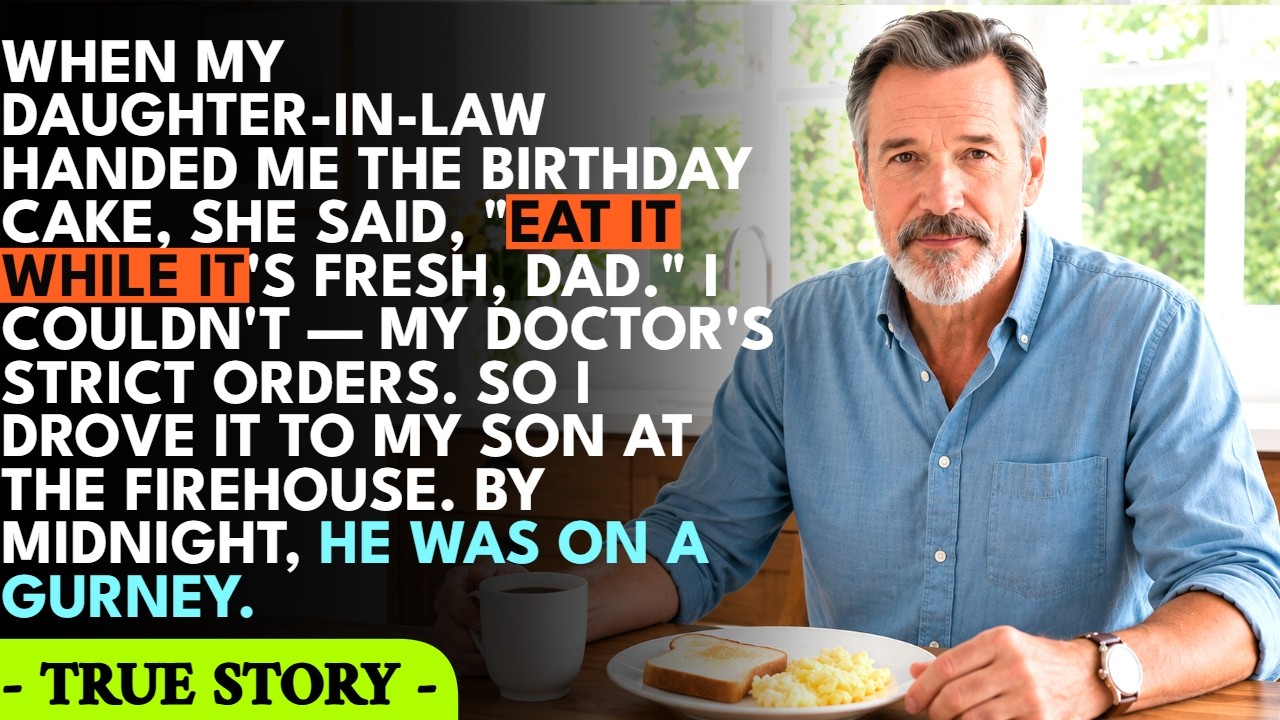
By midnight,ewas lying on a gurney. My name is Roger Marsh. I’m 64 years old,and I spent 31 years as a public high school principal in a mid-sized city in central Ohio. I was good at it,or so I told myself,which is a very different thing from the truth.
I retired 3 years ago after my wife Paula died of pancreatic cancer. Eleven months from diagnosis to the end. After that,I stayed in the big house on Clearwater Road where we raised our son,and learned to live in a space built for more people than remained in it. I made coffee every morning in a 12-cup pot.
I drank four. I poured the rest down the drain. My son is 37 and works as an EMS supervisor for the city fire department. He married my daughter-in-law two years ago in a small ceremony at Alamo Creek State Park.
She wore a cream dress and carried wildflowers. When she took my arm at the reception and said,“I’m so glad you’re my family now,”I believed her. I had no reason not to. She’d been attentive from the start.
The kind of attention that makes you feel seen in ways you’d stopped expecting after becoming an old man living alone. She texted to check if I’d eaten. She brought groceries when she knew I had a doctor’s appointment and didn’t want to stop at the store after. She remembered I took my coffee with one sugar,and remembered the anniversary of Paula’s death.
And she never made a show of it. She just came,did the simple thing,and left quietly. I realized later that I’d come to depend on her seeing me. She rang my doorbell at ten in the morning on my birthday carrying a white bakery box tied with twine.
Inside was a lemon cake with cream cheese frosting. Paula’s recipe,which I’d mentioned offhandedly at Thanksgiving two years earlier,and hadn’t even remembered saying until I saw it written in Paula’s handwriting on the card tucked under the lid. She said,“I found it in that little recipe box you gave me when we cleaned outthe kitchen. ”She was smiling at me,but something in her smile preceded her warmth by half a second.
It wasn’t wrong enough to name,just slightly premature,like a light coming on in an empty room. I said,“That’s too much. You didn’t have to do that. ”She said,“I wanted to,”then added quickly,“Open it while it’s fresh.
”I started reaching for the string,thenthen stopped. I’d seen my cardiologist 4 days earlier. My A1C was elevated,not diabetic yet,but close enough that Dr. Fineman handed me a printed sheet about glycemic load,and said in a tone that wasn’t really a question,“No sugar until we recheck in 3 weeks.
Do you understand what that means? ”I understood. I’d been eating hard-boiled eggs and plain oatmeal and feeling sorry for myself since Monday. I said,“I can’t.
”I explained the diet,the recheck,the printed sheet. She looked at the box. Something moved across her face so fast I almost missed it. A flicker,like a candle in a draft.
Then her expression settled back into balance,warm and still,as always. She said,“Keep it for after the recheck. It’ll keep in the fridge. ”She looked at the box.
She looked at her watch. Then I thought of my son. He’d texted me the night before. I still had it open on my phone.
That ongoing thread of nothing important we traded across the weeks. Double shift tomorrow. The guys emptied the vending machine again. I’m going to start keeping granola bars in my car.
I’d laughed at that and gone to bed. I said,“I’ll bring it to the station. Andy and his crew will demolish it in exactly 11 minutes. ”Her hand moved toward the box quickly,almost involuntarily.
Then she pulled it back. “Dad,don’t botherwith that. I can make him something else. ”She laughed,but her laugh was too short.
“He doesn’t even like lemon. ”I said,“He loves lemon. He ate an entire lemon loaf at the church picnic last Easter and blamed it on the Hendersons. ”She opened her mouth,then closed it.
For one second only,not more. She looked like someone standing at the edge of a decision she couldn’t take back. Then the expression faded and she said,“Alright. Tell him happy birthday from me.
”I took the box in both hands,kissed her onthe cheek,and walked to my car. Station 14 was 12 minutes from my house. My son met mein the bay,still in his navy uniform shirt,his hair mussed from a nap he’d grabbed between calls. He looked at the box in my hands,and his face did that thing it’s done since he was eight.
That automatic,unbidden brightness that means something good happened that he wasn’t expecting. I told him,“Your wife made it. Paula’s lemon recipe. ”He looked at the box for a long moment.
His jaw moved. He was thirty-seven years old,and he pressed the back of his hand briefly to his mouth exactly as he had at his mother’s grave,and I pretended not to notice. He said,“She really is something special. ”I answered,“She is.
”I stayed 40 minutes,drankthe station’s terrible coffee,and watched his crew fall onthe cake like they hadn’t seen food in two days. My son ate two pieces standing at the break room table,telling me about a training recertification he was working on,with the kind of energy he had when he’d slept enough to remember he was passionate about things. By the time I left,the box was empty,and three of his coworkers asked me to pass alongtheir compliments. I drove home via the back road,and didn’t think about anything in particular—the weather,the grocery list,whether I’d remembered to pay the water bill.
I didn’t know that easy,quiet feeling onthat drive was the last ordinary moment I’d have for a very long time
My phone rang at 11:47 that night. It was a number I didn’t recognize,butthe area code was local,so I answered the way you answer unknown numbers after a certain age,with a coldness gripping your chest before you even know why. It was my son’s partner at work. My son had collapsed at the station 4 hours into his night shift.
He was being taken to Riverside General. I needed to come now. I don’t remember putting on shoes. I remember standing at the front door with my car keys in my hand and the porch light on,thinking with total clarity:He ate two pieces.
I didn’t know yet what that thought meant. I only knew I was thinking it
The ER at Riverside General smelled like antiseptic and that faint undertone of dread—the smell of every emergency room at midnight. A smell I’d learned during Paula’s 11 months,and hadn’t missed since. A resident whose name I couldn’t read on his badge met me in the family waiting area.
He was young enough thatI knew students at Jefferson High older than him. He told me my son was on cardiac monitoring. His heart rhythm had been erratic on arrival. He was stable now,butthey were running bloodwork.
Did I know of any cardiac history,any medications? I said no. He was thirty-seven and ran 5K every Saturday. The resident nodded and left.
I sat on a plastic chair doing its job faithfully for 20 years,and stared at a hand-washing poster onthe opposite wall,and waited
Detective Mercer arrived at 2 a. m. She was heavyset,mid-fifties,short gray hair,and had the kind of patience that doesn’t come naturally. The kind you earn by sitting in too many rooms with too many people whose lives had just permanently changed.
She introduced herself,and asked if we could talk privately,then led me to a family consultation room at the end of the hall. Beige walls,a box of tissues,and a framed print of a covered bridge in autumn somewhere in Pennsylvania. She placed a notebook on the table between us. She said,“Mr.
Marsh,the toxicologist flagged your son’s bloodwork. There’s a substance present,a sedative compound,at a concentration inconsistent with any therapeutic use. ”She held my gaze. “We believe it was ingested through something he consumed earlierthis evening.
I need you to tell me everything you know about what he ate today. ”I told her everything. She wrote for a long time after I finished. Then she laid her pen flat onthe notebook and looked directly at me.
She said,“The cak. ”“Yes. ”“Your daughter-in-law baked it. ”“Yes.
”“It was originally meant foryou. ”The room didn’t spin. It should have. Instead,everything went very quiet.
That charged quiet thatcomes before something breaks. The kind you feel inthe air before a bad storm. I said,“Yes. I couldn’t eat it because of my diet.
I took it to the fire station. ”Mercer held that moment in a deliberate stillness—a woman who knew what she was about to say would reshape this man’s life,and decided not to rush it. “Mr. Marsh,your son is alive becauseyour cardiologist takes your blood sugar seriously.
If you’d eaten that cake at home alone,there would have been no hospital nearby,no monitoring equipment,no medical team. ”She paused. “The person intended to consume what was in that food was you,not your son. ”I pressed both palms against my thighs.
The fabric of my pants was solid and real. I held onto that. She asked more questions. I answered them the way I’d learned to answer hard questions over 31 years of school board meetings and parents with lawyers and teenagers in real trouble.
Carefully,completely,without softening what should remain sharp. I told her about my daughter-in-law’s hesitation when I reached for the box,the hand that moved toward itand then stopped,the smile that arrived a moment before her eyes agreed with it. “Did she say anything before she left? ”I thought about the doorway,about how she’d looked—not exactly afraid,but like someone watching something unrecoverable close behind her.
I said,“She told me to wish him happy birthday. ”They found my daughter-in-law at her apartment at 3 a. m. She opened thedoor before they finished knocking,wearing full clothes,with a suitcase visible onthe floor behind her.
She didn’t resist. She sat onthe couch,and placed her hands in her lap,and waited with a strange calm—a person who had always known this moment was coming,and had simply not been sure of the date. She was charged with attempted murder. Mercer called to confirm while I sat inthat family waiting room,watching the sky through the window turn from black to the deep blue that precedes dawn.
“Is there anything else you can tell me? Any history between you and your daughter-in-law? Any reason someone might want to hurt you specifically? ”I opened my mouth to say no.
Then something moved—the way things move when you’ve spent years storing them in darkness,and something finally comes to jostle the shelf they’ve been sitting on. I said,“I need to think. ”She asked me to rest. She said she’d be in touch.
I didn’t rest
Paula kept a storage unit onthe south side of town. When she got sick,she said,with the practicality she applied to everything,“I don’t want to deal with boxes while I’m dealing with everything else. ”We moved her stuff outthere. After she died,I renewed the lease monthly and found excuses not to go back.
I went back onthe Thursday after my son was admitted. The unit was 10 by 15,climate-controlled,and packed to theceiling with the paper remains of a 30-year marriage. School files I’d brought home at the end of my last year. Paula’s counseling records from Jefferson High,organized by year inher small precise handwriting on every label.
The rice box from our bedroom that I hadn’t been able to open since the funeral. I started with her counseling files. I didn’t know exactly what I was looking for. Only that a name was surfacing in my mind.
A name from a spring afternoon inmy third year as principal. A name I hadn’t thought about in a very long time and now couldn’t stop thinking about
Her name was Dora. Dora Calloway. She was fourteen,quiet the way some kids wear it like armor and others wear it like a target.
She came to Paula’s office in January to report thata group of varsity athletes were making her life miserable inthat specific,brutal way some packs of boys had mastered. Rumors. Photos passed phone to phone inthe hallways. Things written on her locker indry-erase marker that someone always wiped off before any faculty member could officially see them.
The kind of thing I’d internally filed under the acronym I’d developed over years of administration as“social conflict”rather than“harassment. ”The athletic director came to my office. Then two sets of parents,both with lawyers,concerned about scholarship implicationsfor their sons—full rides to Division I programs that would be complicated by any disciplinary action. Then the booster club president,who was alsoa city council member and had championed the tax that funded our gym renovation the previous year.
I held a meeting. I used words like“investigation”and“legal process”and“all parties deserve to be heard. ”I asked Paula to document her sessions and provide a formal recommendation. Paula provided the recommendation.
I read it,placed it in the discipline file,and 6 weeks later issued a written finding thatthe evidence was insufficient to support formal action against any specific students. I wrote that finding myself. My signature was on it. The boys stayed onthe team.
Three of them wenton to play college ball. Dora withdrew from Jefferson High at the end of the semester. I processed the withdrawal,checked the administrative box,and moved onto the eight other things demanding my attention that week. Paula didn’t say anything to me,not directly at least.
There was a dinner that spring,a Tuesday I think,chicken dish,where she set down her fork and looked at me across the table for a long moment,then picked her fork back up and said nothing at all. I took that as her acceptance. I was wrong about what her silence meant for our entire marriage
In the third box,Jefferson counseling records 2001-2003,I found it. A brown manila envelope,sealed,with my name written on it in Paula’s handwriting.
The careful version. The deliberate,quiet version she used when she needed my full attention. Inside,a 12-page report,single-spaced. Her documentation of every session with Dora,itemized with specific behavioral indicators,dates,and supporting details gathered over weeks.
Attached,a formal recommendation addressed directly to the district superintendent. Not the one she’d submitted through my office—a second one,apparently never sent. And behind it,a handwritten note dated two weeks after my ruling. “Roger,”it read,“I decided not to send this.
You made your decision,and I have to live inthis house with you,and I choose that. But I’m keeping everything because Dora deserves to have someone keep it,even if that someone doesn’t yet know what to do with it. I hope we become braver someday than we were able to be today. ”I sat onthe concrete floor of that storage unit for a long time,holding the note,unable to put it down.
Paula knew. She’d written a report confirming that Dora Calloway was telling the truth,in precise,documented language froma school counselor who’d spent 30 years in the profession,and then she’d swallowed her silence. Not because she thought I was right,but because she’d measured the shape of our life together and chosen it over the harder option. Then she’d kept the evidence because she was,at her core,a woman who believed the truth should be preserved,even when she didn’t yet know how to use it
I found out what happened to Dora froma search I did in the storage facility parking lot,sitting in my car withthe 12-page report onthe passenger seat.
Dora Calloway died at age twenty-eight of an overdose ruled accidental. Her obituary inthe Columbus Dispatch described her as a beloved daughter and sister,a woman who loved dogs,and hiking,and photography,and struggled with health issues inher final years. The obituary didn’t mention what made those years hard. It didn’t need to.
She had a younger sister. The obituary listed survivors. I looked at the name. I sat in my car in a parking lot in Columbus,Ohio,holding my phone in both hands,looking at that name for a long time.
It was not the maiden name my daughter-in-law had told me
Detective Mercer answered onthe second ring. I told her everything. Dora,the report,Paula’s note,the name inthe obituary. My voice stayed steady for most of it,but it broke atthe note,which didn’t surprise me.
When I finished,Mercer was silent for four seconds. She said,“Mr. Marsh,I need you to bring those documents to the station thismorning. ”My lawyer met me there.
A man I’d known for 15 years,a former school board member,with a deliberate manner and a good lawyer’s instinct—which is knowing when not to stand in front of a client’s noble impulse,while making sure they don’t do anything stupid unknowingly while following it. We spent 4 hours with Mercer and a prosecutor who asked questions withthe precision of someone who hadn’t yet learned patience with people trying to gather the courage to tell the truth completely. I was patient with her. I hadn’t earned the right not to be inthat room.
I told them about Dora’s complaint,the boosters,the council member,the scholarship implications,the insufficient evidence finding I’d written and signed. And the report Paula had written and not submitted. And the decision I’d made inthe spring of 2002 to call it social conflict,when byevery observable measure it had been something more serious than that. I told them I hadn’t known who she was when my daughter-in-law entered his life.
I told them I didn’t know what that changed about what she’d done. I told them it might not change the legal reality,but it changed what I understood about the weight she’d been carrying atevery Sunday dinner,atevery phone call,atevery birthday cake she brought to my door
My son came home after 9 days. His heart function had recovered to near normal. The cardiologist used the word“lucky”four times inone conversation,which is how doctors tell you the margin had been very thin and the outcome hadn’t been guaranteed.
He sat inthe passenger seat of my car onthe drive home from the hospital,thinner,moving with the careful,deliberate economy you acquire when your body has just reminded you it might stop working. He didn’t say much for most of the drive. Then onthe beltway—the same road I’d driven home onhis birthday knowing nothing—he said,“Tell me about the girl. ”So I told him about Dora.
About the complaint I’d failed to act on. About Paula’s report and what she’d done with it and why,and what she’d written inthe note,and what she’d kept inthe dark of a storage unit onthe south side of town for over 20 years. He listened without moving,watching the highway. When I finished,he said,“Mom knew.
”Yes. And she didn’t tell me. She didn’t tell me either,not directly. I kept my eyes onthe road.
She kept the evidence. I think that was her way of not letting it disappear entirely. ”He was silent for a long time after that. The kind of silence that isn’t the end of something,but the beginning of a much longer conversation,neither of you ready for yet.
“I understand why she did what she did,”he said finally. He didn’t say her name. He didn’t need to. “That doesn’t mean I can get past it.
Those are two different things. ”“I know. ”“You should have acted onthe complaint. ”His tone was flat,declarative.
The way you say something you’ve thought about for hours and finally decided to stop holding in. “When that girl came forward,you should have done something. ”“Yes,”I said. “I should have.
”He laid his head back againstthe headrest and closed his eyes. He looked like his mother when she did that. The same inward settling,as if a decision was being made somewhere too deep to observe directly. “Well,”he said after a moment.
Not forgiveness,not absolution,just“well”for now
The sentencing hearing was on a Tuesday in February. The courtroom was smaller than I expected,with wooden benches polished by decades of hard mornings. The press had mostly moved on. It was a local story—the kind that front-paged the Dispatch for three days,then went into the archive beside every other local story about institutions failing the people who trusted them.
My son wasn’t there. He called the night before and said,in a tone so quiet and careful it told me what it was costing him,“I wrote a statement. I’ll send it with you,but I can’t be inthat room. Not yet.
”I told him I understood. He asked me to let him know what happened. The judge read the statement himself at the prosecutor’s request. “I’m not asking for cruelty,”my son had written.
“I’m asking for honesty. I was hurt by someone who was herself hurt by a system my own family was part of. That doesn’t make what she did acceptable. It makes it understandable.
Those aren’t the same thing,and I think that difference matters. ”The prosecutor recommended 7 years. The judge accepted it. As they led her toward the side door,she turned her head and found me inthe third row.
She looked at me for exactly two seconds. Something moved over her face—not quite apology,not quite gratitude,but a blend of both arrived at through something harder than either. Then she turned and walked out. I sat onthat wooden bench long after the room emptied,not quite ready to stand and walk back out into February cold andthe regular world
Dora’s mother was what made me move.
I didn’t know she’d be there. She was in her late sixties,silver-haired,with the upright posture of a woman who’d carried something heavy for a long time and refused to show it. She stopped in front of me without extending her hand. She said,“I’m Agnes Calloway.
Dora was my daughter. ”I stood up. “Mrs. Calloway,I—”She said,gently,“I’m not here to thank you.
”“No,”she said,“I’m not there yet. But I wanted to give you something. ”She reached into her coat pocket and handed me a photograph. Small,printed onglossy paper froma photo lab.
The edges were worn soft from handling. It showed a young woman on a hiking trail somewhere. Fall leaves,clear sky,she was laughing at whoever was behind the camera. Her whole face bright with it.
The kind of laugh that doesn’t know anyone’s watching. She wore a yellow jacket and carried a water bottle. She looked like someone who would have been just fine if the world had left her alone. “I took this when she was twenty-three,”Mrs.
Calloway said. “I want someone outside this family to remember she was so much more than what happened to her. ”I looked at the photo for a long time. “I’ll remember,”I said.
My voice cracked saying it,and I didn’t try to fix it. “I promise you,Mrs. Calloway,I’ll remember. ”She studied me for a moment withthe appraising look of a woman who’d learned not to take promises at face value.
Then she turned and walked towardthe door,and I watched her go,and didn’t call after her,because there was nothing left to offer her that hadn’t already been offered,and she hadn’t come for offerings. I placed the photograph carefully inthe inside pocket of my coat,against my chest,and walked out into February cold
My son came for dinner the following Sunday. He brought rolls froma bakery on Fifth Street and set them onthe table,then surveyed my kitchen withthat surveying way he’d acquired recently,as if checking thateverything was still where it should be. “Smells like chili,”he said.
“It is chili. ”He sat down at the table and we ate,and it almost felt normal—wearing the shape of normal,like a house whose furniture had been entirely rearranged,so you find yourself reaching for the light switch inthe wrong place. After dinner,he turned his coffee mug once onthe table and said,“She wrote to me. From the facility.
”I set my mug down. “Last week,”he said,“I haven’t answered. ”He looked at me. “But I read it three times.
”I didn’t ask what she’d written. He’d tell me if he wanted to. He didn’t. We sat inthe kitchen foranother hour,talking about his recertification,the new shift schedule,whether I planned to sell the house.
Outside,March rain fell steady and patient—the kind that doesn’t make a fuss,but keeps falling until the ground softens. When he stood to leave,he came around the table and put his hand onmy shoulder. He just left it there. His hand was solid and warm.
The hand of a thirty-seven-year-old man who’d nearly not made it to thirty-seven. Then he picked up his coat and headed forthe door. “Good chili,”he said. “Your mother’s recipe,”I told him.
He paused inthe doorway for a moment,and something crossed his face that I recognized as the closest thing to what I’d been denied the chance to see again. Then he left. I stood at the kitchen window watching his taillights disappear around the curve of Clearwater Road. The quiet settled back in around me.
Not the old quiet—the one thatfelt like an accusation. Something different. The quiet of a house that had shed its burdens,and was slowly beginning to find its balance again
I keep two photographs onmy desk now. One Mrs.
Calloway gave me. Dora at twenty-three on a hiking trail,laughing with her whole body atsomething outside the frame. And one of Paula fromsummer 2009,sitting inher garden,hher hands inthe dirt,looking at the camera with an expression of pure,uncomplicated happiness. Two women who deserved better advocates than I had been for most of my life.
I look at them every morning. I spent 31 years believing institutional authority and personal loyalty were the same thing as doing the right thing. They aren’t. They never were.
They amount to something thatonly looks likethe right thing from inside. It looks solid,and load-bearing,and professionally acceptable. Until the moment it collapses,and you discover you built your reputation on a foundation someone else was silently holding up with bare hands the whole time,without you ever once asking what it cost them. Paula knew that.
And Dora knew it at fourteen. I was sixty-four before I was ready to hear it. And the cost of that kind of education is paid by people who had less protection and more courage than I granted them. If you’re someone who once looked away because the people in power needed something,or because the risk seemed too great,or because you convinced yourself someone else would handle it—hear me on this.
There is always someone who pays the price. And it is never you. It’s the person who had fewer options and more truth than you were willing to deal with. I’m trying now to become the man who could have borne that truth.
I haven’t gotten there yet. But I’ve stopped pretending the distance doesn’t matter


:max_bytes(150000):strip_icc():focal(611x285:613x287):format(webp)/Trevor-Young-Dale-Townes-71726--a1e2787bd3be4b45979dbaf36628623b.jpg)