A heavy hand slammed into his chest, shoving him toward the open door of the train car. Miles Preston stumbled back, his backpack digging into his shoulder. “Get out of this door, you dirty animal,” Clayton Moore Jr. spat, his voice dripping with contempt.
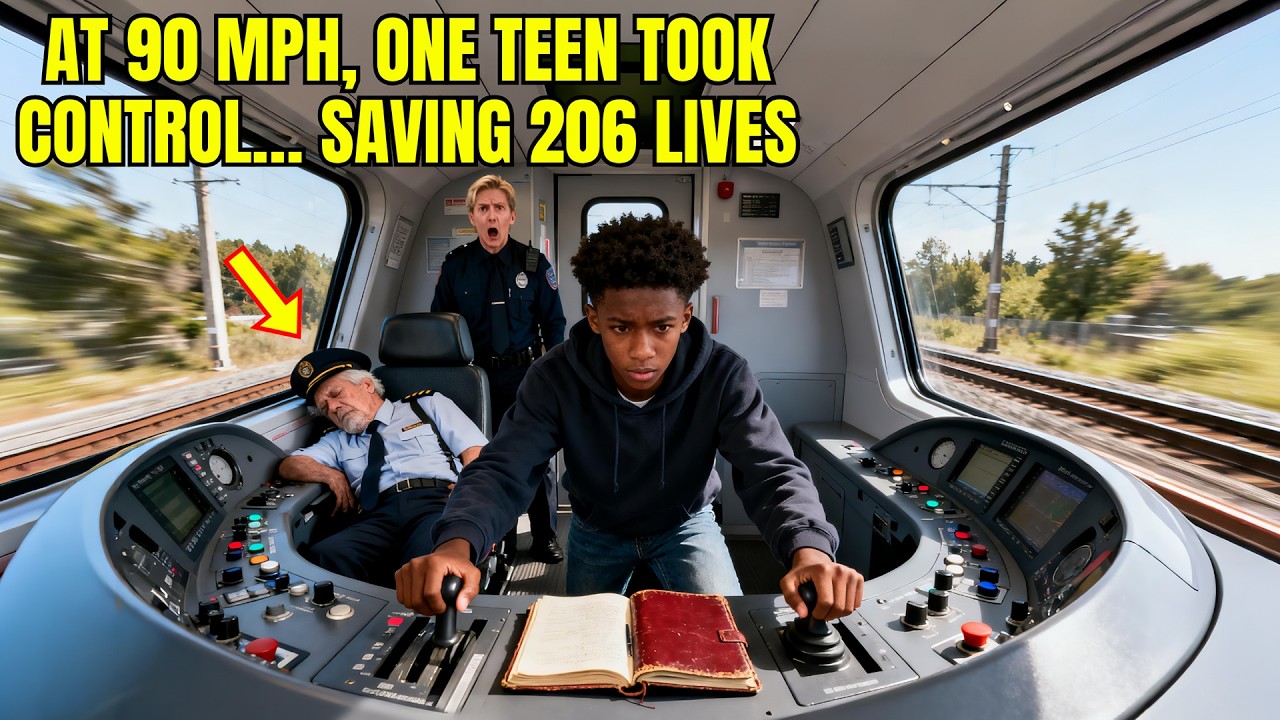
The teenager looked at him, meeting the older man’s furious gaze without flinching. He saw the sweat on Clayton’s forehead, the slight tremor in his hands. “Sir, the train’s engineer collapsed,” Miles said, his voice calm but urgent. He could feel the rhythm of the train change, a deep, menacing vibration moving up through his shoes.
“He’s passed out. ”
“And you think you can fix it? ” Clayton laughed, a short, brutal sound. He gestured at Miles’ worn jacket, his dark skin.
“Look at you. You stink. You’re disgusting. Go back to whatever hole you crawled out of.
”
A crowd of two hundred passengers watched in silent shock. No one moved. No one spoke. “Sir, please,” Miles tried again.
“Someone’s going to die. ”
“Shut up! ” Clayton roared, his voice cracking. “What could you possibly know how to do?
A *Black* boy like you only knows how to collect garbage. ”
The train lurched violently, throwing a woman against a seat. Luggage tumbled from the overhead racks. Miles Preston didn’t blink.
He looked past Clayton, past the terrified faces, and saw the flashing red emergency light at the end of the car. He pulled out a worn, leather-bound notebook. He opened it with deliberate calm, his eyes scanning the familiar charts. Ninety miles per hour.
Four minutes to the Coleman Bridge. Two hundred and six souls on this train. He looked back at Clayton. “You just wasted thirty seconds of their lives.
”
Clayton’s face went pale. “What did you do? ”
What happened next in that train car, no one on board ever expected. —
Six hours earlier, the kitchen smelled of black coffee and old wood.
Edna Preston stood at the counter, her faded blue apron tied over a simple dress. At seventy-eight, with hands that had buried a husband and raised a grandson, she never trembled in front of strangers. She poured two cups of coffee, pushing one across the table. Miles sat there, a letter of rejection flattened in front of him.
Ridgeway Academy of Railways. One paragraph, no explanation, only: *After careful review, we regret to inform you that your application does not meet our current criteria. *
He had graduated top of his class in mechanical engineering. He had built a working model of a train braking system for his senior project, receiving a standing ovation from the judges.
His teacher had written a recommendation calling him the most naturally gifted engineering mind he’d seen in 23 years. *Does not meet our current criteria. *
Miles read the line so many times the ink began to smudge under his thumb. Edna said nothing.
She never did when the wound was fresh. She let silence do what silence does—carry the weight until you are ready to carry it yourself. But this morning was different. She reached up to the cabinet above the stove, the one Miles was never allowed to open, and brought down a brown leather notebook, cracked at the spine, its pages yellowed with age.
The old Ridgeway Railway logo was stamped faintly on the cover. “Take this with you today. ”
Miles looked up. He knew what it was.
He had seen his grandfather write in it a thousand times. But Edna never let him touch it. Not once since Harold died. “Grandma, I can’t.
”
“You can, and you will. ” She placed it in his hands. “Your grandfather poured forty years of his life into that book. Every system, every protocol, every fix they told him he had no right to claim for his own.
” Her voice didn’t waver. It never did. “He wanted you to have it when you were ready. ”
Miles opened the first page.
Harold’s hand was small, precise, and slanted slightly to the left. Sketches of brake systems, drawn with a ruler and a steady hand. Notes in the margins. *The pressure valve should release at 12 PSI, not 15.
The company manual is wrong. I corrected this. 1998, page 22. *
A full diagram of a cabin layout, every switch labeled, every gauge explained.
Harold had drawn arrows between the components, showing how one system fed the next. More detailed than any textbook, because it wasn’t just theory. It was the accumulated knowledge of forty years of riding steel and listening to the machines talk back. Page 38, circled in red ink, underlined twice.
The emergency braking protocol. Six steps. Harold’s masterpiece. The procedure that had saved Ridgeway Rail from two derailments and become the national standard.
The official manual read: *Developed by Ridgeway Rail engineering division, 1997. * No name. No credit. No Harold.
Miles closed the book and held it to his chest. “I’ll bring it back safely. ”
Edna touched his face, a single touch, the way she always did when she tried not to cry. “Bring yourself back safely.
The book can handle the rest. ”
—
He almost missed the train. Ridgeway Express 415, platform 9. Two hundred and six passengers headed north.
Miles ran through the station, backpack on one shoulder, the notebook under his arm. Economy class, seat 14C. He settled in, placed the notebook on the fold-down tray, and opened it to page 38. The Preston Method.
Harold designed it in 1996 after two derailments exposed fatal flaws in Ridgeway’s original system. He presented it to the board. It was implemented within six months, and it was still the approved standard on every Ridgeway train in the country. Harold’s name appeared nowhere in the documentation.
No footnote. No vague mention. Three rows ahead in first class, Clayton Moore Jr. sat with one leg crossed over the other.
Operations Director for Ridgeway Rail. He was on the phone, speaking loudly enough for half the car to hear. “The rebranding is on schedule. The new safety manual drops in October.
We’re removing all references to the old protocols. A fresh page. The board wants to end the Preston era. And I mean end it completely.
”
Miles didn’t hear him. But if he had, he would have recognized the name. It was the same name Edna whispered like a curse on nights she couldn’t sleep. Four seats behind Miles, Garrett Wells was reviewing his files.
He was fifty-five, had worked for Ridgeway for 31 years. He walked past while checking tickets and caught a glimpse of the notebook on the tray. He stopped in his tracks. That logo—the old Ridgeway logo—he hadn’t seen it in 20 years.
Not since they changed it right after Harold was fired. Garrett kept walking, but his hands were shaking. He knew that notebook. He knew who it belonged to.
And the memory he’d spent two decades burying was about to surface. —
At 4:52 PM, the train was traveling at 88 miles per hour through the Ashlin Valley pass. The engineer, Bill Thornton, a 20-year veteran, had felt the headache starting around 4:30. Pressure behind his left eye, a tingling running down his right arm.
Thirty more minutes to the next station. He could make it. He couldn’t. At 4:52, Thornton’s left hand slipped off the throttle.
His body slumped. His forehead hit the control panel. He slid to the floor. The dead man’s switch released, but the train’s momentum carried it forward.
88, 89, 90. The lights flickered twice. The emergency strip on the ceiling flashed red. Then the alarm went off.
A piercing wail that snapped every head in every car around. “What’s happening? Why are we speeding up? ”
Garrett was in car 4 when he heard it.
He ran. Three cars in 40 seconds. The override key. The cabin door opened.
Thornton was on the floor, unconscious, his pulse weak but present. Garrett looked at the control panel. Buttons, switches, screens, flashing lights, warnings he had never been trained to understand. He was a ticket inspector, not an engineer.
His world was tickets and passengers. The cab was another universe entirely. Radio static in the mountain pass cut the signal. The ground emergency line was dead.
Speed: 90 miles per hour. The Coleman Bridge was 11 minutes away. The speed limit at the curve was 45. Anything over 60 would derail the train.
206 passengers, 11 minutes, and the only man who was supposed to know what to do was lying on the floor. Garrett stepped toward the aisle. His face said everything. A passenger grabbed his sleeve.
“Do something. ”
“I’m trying. ”
“Try harder. ”
People crowded the aisle.
Voices rose and overlapped. Prayers, arguments, phone calls that wouldn’t connect. A woman leaned her back against the window and closed her eyes. An elderly man held his wife’s hand and said nothing.
That’s when Garrett saw him. Miles Preston, standing at the end of the second car, a notebook in his hand, walking toward the cabin. He wasn’t running. He wasn’t panicking.
He was just walking. Walking like a man who had prepared for a moment he hoped would never come. Garrett looked at the notebook, then at the young man. And deep in his mind, a ghost whispered the name of a boy he’d known 22 years ago.
Harold. “Make way for him. ”
Clayton Moore Jr. stepped out of first class.
“Excuse me? ”
“I said, make way for him. ”
“You’re letting a strange boy into the cabin of a moving train. ”
“He’s not a stranger.
” Garrett’s voice cracked on the last word. “Make way for him now. ”
Miles reached the cabin door. He didn’t ask permission.
He didn’t offer an explanation. He looked at Garrett, and Garrett looked back. Something passed between them—recognition, guilt, hope—all in a single moment. Miles went inside.
He closed the door behind him. The countdown began. —
Miles closed the cabin door, and the noise, the screaming, the alarm, the chaos faded to a low hum behind the steel. Inside, he was alone.
The unconscious engineer on the floor, and the control panel stretching across the front wall, flashing red warnings like a heart running out of time. He placed the notebook on the control panel. His hands were trembling, but his mind was clear. He opened it to page 38.
His grandfather’s handwriting stared back at him. Steady, patient, certain. Everything Miles was not feeling right now. 91 miles per hour.
The needle rested just past the red line. He looked at the panel. The design was newer than what Harold had drawn. Digital screens instead of analog gauges, touchpads instead of manual switches.
But underneath the upgrades, the skeleton was the same. The same structure, the same logic. Harold’s logic. Miles placed his left hand on the throttle.
His right hand hovered over the brake control unit. He closed his eyes for half a second. *What do you feel? * The vibration, steady and deep, coming up from the wheels, through the floor, up through the control unit, into his fingertips.
The same vibration Harold had taught him to read in the 4412 on those long summer afternoons when the rest of the world had forgotten his grandfather existed. *When it changes, you change. *
He opened his eyes. Step one: set the throttle to neutral.
He pulled the throttle to the middle position. The engine stopped accelerating, but the momentum stayed at 90. Step two: activate the dynamic brakes, gradual release. He found the lever on the right side of the control unit, in a slightly different position than Harold’s drawing, but the mechanism was identical.
He pulled it down in three controlled stages. The train shuddered, not violently. A slow, deep groan running through the steel, like something massive finally being asked to rest. 88…
85. Step three: release the air pressure for the auxiliary brakes. 12 PSI, not 15. He reached under the control unit to the manual valve.
Ridgeway’s official manual says 15. Harold’s notebook says 12. Harold was right then. Harold was right now.
He turned the valve. A hiss of pressurized air filled the cabin. 80… 75.
Step four: distribute braking force across all axles, sequenced from rear to front. His fingers moved across the touchscreen, selecting the braking unit for each car in reverse order. The method Harold had devised reduced the risk of derailment by 60 percent. No textbook had taught this.
Harold learned it through feel. Through years of listening to what the machine told him when no one else bothered to listen. 70… 65.
Step five: reduce to 40 before the curve. Stability. The Coleman Bridge was 4 minutes away. The curve required 45 or less.
Miles aimed for 40. He kept his hand on the dynamic brakes, adjusting pressure with the fine movements Harold had shown him. Gently. Patiently.
Never forcing. The needle dropped. 60… 55…
50. The train leaned slightly into the curve. The wheels sang on the rails. A high, pure sound, almost peaceful.
45… 42… 40. Step six: come to a complete stop.
Use the emergency brakes. Miles pulled the final lever. The train sighed. A long, slow release of pressure and momentum and 22 years of silence.
The wheels stopped turning. The steel gave a final groan. Then nothing. No movement, no sound, only the ticking of cooled metal and the low hum of electrical systems shutting down.
The speedometer read zero. Miles stood alone. His hands were shaking now. They had waited until it was safe to shake.
He looked at the notebook. Page 38. Harold’s six steps. Every single one had worked exactly as written.
Twenty-two years after his name had been erased, Harold Preston had just saved 206 lives. Behind the cabin door, there was silence, minutes of it. Then a sound, one voice, then another, then the sound Miles would never forget for as long as he lived. Two hundred people realizing at the same moment that they were still alive.
The applause started in the first car and rolled backward through every car like a wave. People were standing, crying, hugging strangers, thanking no one in particular and everyone at once. Garrett Wells opened the cabin door. He looked at the speedometer.
Zero. He looked at the notebook on the control panel. He looked at Miles. His eyes were red.
“That sequence you just ran,” Garrett’s voice was barely a whisper. “Your grandfather wrote it. I’ve watched engineers use it for 20 years. None of them ever knew where it came from.
”
Miles didn’t answer. He picked up the notebook, closed it carefully, and held it to his chest the same way he had in his grandmother’s kitchen that morning. A woman pushed past Garrett and hugged Miles so hard he couldn’t breathe. She was crying.
“Thank you. Thank you. I have two kids at home waiting for me. Thank you.
”
An old man shook his hand with both of his. “God bless you, son. God bless you. ”
One by one, they came.
Strangers touching his shoulder, squeezing his arm, looking at him like he was something they’d never seen before. An 18-year-old Black kid from economy class had just done what no one else on the train could do. But Clayton Moore Jr. didn’t come.
He stood at the far end of the aisle, phone pressed to his ear, voice so low it was almost a hiss. His face had gone from white to red. His jaw was clenched tight. He was already making calls, already building his walls of defense.
From the window of car 3, Sophie Adams lowered her phone. She had recorded everything since the moment Clayton shoved Miles in the aisle to the moment the train stopped. Every second, every word, every ugly thing Clayton had said. She opened her social media app and typed four words: “Watch what just happened.
” Then she hit share. By the time rescue crews arrived 18 minutes later, the video had 400,000 views. By midnight, it would pass two million. Paramedics carried Bill Thornton out on a stretcher, in stable condition.
Doctors would later confirm it was a mild stroke. Treatable. Recoverable. Police took statements.
A local news crew arrived with cameras and microphones. They pointed them at Clayton Moore Jr. first because he was wearing the most expensive suit. Clayton straightened his tie and stood in front of the camera like he’d done it a hundred times before.
“Ridgeway Rail’s safety systems worked exactly as they were designed today. Our protocols ensured the safe deceleration of the train and the protection of all passengers aboard. ”
He said it without blinking. Without shame.
Without once mentioning the name of the 18-year-old who had actually stopped the train. But Sophie’s video was already everywhere. And in the comments, one question repeated itself thousands of times. *Who is that boy?
*
—
Nora Caldwell watched the video at 6:47 PM, sitting at her desk in the newsroom of the National Herald. She watched it three times. Then she picked up her phone and started calling. She could sense a bigger story beneath the surface.
Something old. Something buried. Something someone had paid a lot of money to keep hidden. Three days later, a letter arrived at the Preston household.
Not from Ridgeway Academy this time, but from the legal department of Ridgeway Rail. The letter offered Miles a $50,000 settlement in exchange for signing a non-disclosure agreement. He would agree never to discuss the train’s events publicly. Never claim credit for stopping it.
Never mention his grandfather’s name in connection with Ridgeway Rail. Fifty thousand dollars to buy his silence. Fifty thousand dollars to erase another Preston. Miles read the letter twice.
Then he picked up the phone and called Thomas Bradley. Bradley was a civil rights lawyer who had spent 30 years fighting discrimination cases in the transportation industry. He had seen the viral video the night it appeared. He had been waiting for this call.
They met the next morning. Bradley’s office was small, crowded with case files and framed newspaper clippings of victories that had taken years to achieve. Miles placed the notebook on the desk, next to the rejection letter from the academy and the settlement offer from the company. “They want me to disappear,” Miles said quietly.
“Just like they made my grandfather disappear. ”
Bradley picked up the notebook and turned the pages slowly. His expression changed with each page, from curiosity to recognition to something like suppressed anger. “What do you want, Miles?
”
Miles didn’t hesitate. He had been practicing this answer in his head since the moment the train stopped. “I want them to acknowledge his name publicly and in official records. I want Harold Preston recognized as the inventor of the emergency braking protocol.
I want his credit restored in every company document. I want to establish a scholarship fund in his name for Black students in engineering. I want Clayton Moore Jr. to apologize.
Not to me, but to my grandmother, personally, and on camera. And I want a guarantee that no employee will be fired because of their race without independent review. ”
Bradley wrote it all down. Five conditions.
Non-negotiable. He looked at Miles over his glasses. “Do you understand? They’ll fight every single one of these.
”
“I know. It might take months. It’ll get ugly. They have an army of lawyers, more money than you can imagine, media connections reaching to the top.
My grandfather had none of that, and yet he built the system that saved their lives. ” Miles placed his hand flat on the notebook. “I won’t sign their papers. I won’t take their money.
And I’m not going to back down. ”
Bradley smiled for the first time. A small smile, but real. “Then let’s get to work.
”
That evening, Clayton Moore Jr. received a call from Bradley’s office outlining the five conditions. Non-negotiable. Clayton laughed out loud.
The sound echoed through his corner office on the 32nd floor. “That boy wants us to apologize for what exactly? ”
Bradley’s voice came through the line, calm and precise as a scalpel. “For everything you’ve been hiding for the past 22 years, Mr.
Moore. And I suggest you stop laughing, because by this time next week, the entire country is going to know exactly what your family did to Harold Preston. ”
Clayton stopped laughing. —
Miles got home a little after 10 that night.
The porch light was on. It was always on when Edna was waiting for him. She was sitting at the kitchen table, the TV on mute. The screen showed a news anchor talking over Sophie’s video—the same clip that was now everywhere.
Edna had watched it 11 times. She hadn’t moved from that chair in 3 hours. Miles put his bag by the door. He placed the notebook on the table between them.
Neither of them spoke for a long time. The only sounds were the hum of the refrigerator and the muted voice of the news anchor on the TV. Then Edna reached out and touched the notebook. Her fingers traced the cracked leather cover.
Like she was touching something that belonged to a ghost. “He would have been proud of you today. ”
“I used his protocol, Grandma. Step by step, exactly as he wrote it.
”
“I know. ” Her voice was steady, but her eyes weren’t. “I was watching. ”
Miles pulled a chair opposite her and sat down.
The kitchen smelled the same as it always did. Coffee, dish soap, the faint sweetness of whatever Edna had baked that evening. It smelled like every safe place Miles had ever known. “Grandma, I need to tell you something.
”
Edna looked at him. “The man who blocked my way on the train. His name is Clayton Moore Jr. ”
The name landed like a stone in still water.
Edna’s hands froze on the notebook. Her jaw tightened. She didn’t blink. “Go on,” she said.
It wasn’t a question. It was a quiet directive. “He’s the Operations Director for Ridgeway Rail. His father was the one who—”
“I know who his father was.
” Edna’s voice dropped. It wasn’t anger. It was something deeper than anger. Something that had been sitting still in her chest for 22 years, quiet and patient, waiting for a reason to surface.
“His father sat behind the desk in front of Harold and told him his work belonged to the company. That his name didn’t matter. That he should be grateful they let him work there at all. ” She paused, took a breath, and continued.
“Your grandfather came home that night and sat exactly where you’re sitting now. He didn’t say a word. He just opened that notebook and started writing. He wrote all night.
Page after page. I brought him coffee at midnight. He didn’t look up. I brought him breakfast at six.
He was still writing. ”
Miles looked at the notebook. He had never heard this story before. “What was he writing?
”
Edna reached over and opened the notebook to the very last page. There, folded between the back cover and the final page, was a letter. Yellowed, crumpled, never sent. Miles unfolded it carefully.
He could feel the paper might crumble in his fingers. Harold’s handwriting, the same small precise letters. But these words were different from the technical notes and diagrams that filled the rest of the book. These words were addressed to the board of directors of Ridgeway Railway.
*I do not write this letter to demand my job back. I write it because I want you to know that I existed. I designed the emergency braking protocol your company now uses on every train in your fleet. I tested it.
I refined it. I risked my career to present it to you when your own engineer said it was impossible. You took my work. You deleted my name.
You told me to be grateful. I am not grateful. But I am not angry either. I am tired.
Tired of being erased. I don’t need your money. I don’t need your position. I need you to remember that I was here.
That I built something of value. That my name is Harold James Preston. And that I mattered too. *
Miles set the letter down.
His hands were trembling. Edna watched him. “I’ve read that letter a hundred times over the past 22 years. Every word is engraved in my memory.
” She said quietly, “He never sent it. He said there was no point. He said they’d just throw it away. ”
Miles folded the letter and put it back inside the notebook.
He pressed his palm against the cover. “They won’t throw it away this time. ”
Edna looked at her grandson for a long, still moment. Then she nodded once, stood up from the table, and made tea.
And for the first time in 22 years, her shoulders relaxed a little. Like a door that had been locked for decades, finally opened from the inside. —
The next afternoon, there was a knock at the door. Edna opened it.
Garrett Wells stood on the porch in civilian clothes. No uniform, no papers, just a man in a rumpled shirt who looked like he hadn’t slept in two days. “Mrs. Preston, my name is Garrett Wells.
I worked with your husband. ”
Edna studied him for a long moment. Then she stepped aside and let him in. They sat in the living room.
Miles stood near the window, arms crossed. Garrett sat on the edge of the couch, hands between his knees, like a man in a confessional. “I was 33 years old when they fired Harold,” Garrett began. His voice was low and carefully controlled.
“I’d been with the company for 3 years. I was in the room when Clayton Moore Sr. told Harold that the brake protocol belonged to the company. That Harold had no claim to it.
That if he insisted on his position, they’d find a reason to fire him. ”
“And what did you do? ” Miles asked from the window. Garrett lowered his eyes to the floor.
“Nothing. I did nothing. I sat in that room and watched it happen, and I told myself it had nothing to do with me. ”
The silence in the room was heavy enough to touch.
“Two weeks later, they falsified an incident report. They said Harold had violated safety procedures during a routine inspection. It was a lie. Everyone in the department knew it was a lie.
But no one dared speak up, because if they could target Harold Preston, the man who’d given them their best safety innovation in 30 years, they could target anyone. ”
Garrett looked at Edna. His eyes were wet. “He looked at me on his way out.
Your husband. He didn’t say a word, but his eyes said, ‘You could stop this. ‘ And I looked away. I’ve been looking away for 22 years, Mrs.
Preston. And I’ve had enough. ”
Edna sat completely still. Her hands rested in her lap.
There was no expression on her face. Twenty-two years of pain, borne the same way she bore everything—with a dignity that had cost her more than anyone might ever realize. Then she spoke. Quietly.
Clearly. “It’s never too late to use your voice, Mr. Wells. ”
Garrett let out a breath that seemed like he’d been holding it since 2004.
“I’ll testify publicly. Anything you need, anything your lawyer needs, I’ll tell them exactly what happened in that room. Every word. Every name.
Every lie. ”
Miles uncrossed his arms. He looked at Garrett, this man who had carried guilt like a stone in his pocket for two decades, and felt something he hadn’t expected. Not anger.
Not contempt. Something closer to respect. Because admitting you were a coward takes a different kind of courage. —
While Garrett was confessing in the Preston living room, Nora Caldwell was digging.
She had spent the past 48 hours tracing every lead she could find. FOIA requests, interviews with former employees, public records from the Ridgeway Railway Safety Board. And she had found something. A cache of internal meeting minutes from March 2004.
The meeting where the board voted to adopt Harold’s braking protocol. The minutes were supposed to be confidential, but a former secretary, now retired and tired of keeping secrets, had kept a personal copy. The document read: *Motion to adopt the emergency braking protocol as designed by H. Preston, Chief Engineer.
Motion carried unanimously. Action required: reassign credit for the protocol to the engineering division. Remove individual attribution, as it is more directive. *
*Remove individual attribution, as it is more directive.
*
There it was, in black and white. Not just a rumor, not a suspicion. A direct order from Clayton Moore Sr. to steal Harold Preston’s work and erase his name.
Nora kept digging. She found three more cases. Three other Black engineers who’d been pushed out of Ridgeway Rail between 2002 and 2006. Different departments, different supervisors, and a single pattern: contributions stolen, credit stripped, violations fabricated, and terminations.
It wasn’t the grudge of one man. It was a system. A policy. A pattern so consistent it could only be intentional.
She recorded everything. She called Miles that evening. “I’m writing the story, but I need your help. I need the notebook.
”
“Why? ”
“Your grandfather’s handwriting, his original sketches. If I can match them step by step against Ridgeway’s official protocol documents, we’ll have physical proof that Harold created the system. Not circumstantial evidence, not testimony, but physical evidence.
The kind lawyers can’t refute. ”
Miles looked at the notebook lying on the kitchen table. Harold’s life’s work. His grandmother’s most precious possession.
“I’ll bring it to you tomorrow. ”
—
That week, Miles drove to the old Ridgefield maintenance yard. The gate was chained shut, with a faded warning sign wired to the fence. The chain was rusted through.
With one strong pull, it snapped in his hands. The yard had been abandoned. Weeds grew through cracked concrete. The maintenance building, where Harold had spent 40 years of his life, was a shell of peeling paint and broken windows.
Rainwater had leaked through the roof. Birds nested in the rafters. The company had let the place rot the way it had let Harold’s memory rot. Miles walked through the main hall.
His footsteps echoed on the concrete floor. Dust floated in the shafts of afternoon light coming through the broken windows. At the back wall of the main workshop, he found what he was looking for. A wooden plaque hung behind cracked, clouded glass.
It listed the names of all the chief engineers who had worked at the Ridgefield facility between 1970 and 2010. Twelve names. Twelve men who had built the trains that connected half the country, neatly ordered and precisely engraved. But between the eleventh and twelfth name, there was a gap.
An empty space where a name had been removed. And above that space, someone had painted a thin layer of basic white primer. Carefully, deliberately, as if they could make a man disappear with a coat of paint. Miles reached out and pressed his thumb against the white spot.
He rubbed slowly, gently, the way you’d reveal something fragile. The primer flaked away. And beneath it, letter by letter, a name emerged. *Harold J.
Preston, Chief Engineer. *
Miles stood there for a long time, his thumb still pressed against the glass, his grandfather’s name glowing faintly through the dust and the primer and the years of silence. “I see you, Grandpa. ”
He took out his phone, photographed the plaque, and sent it to Nora Caldwell with a single line: *They painted over his name, but it’s still there.
*
Then he sat down on the floor of the empty workshop, opened the notebook to a random page, and read Harold’s handwriting in the quiet afternoon light. For the first time since the train had stopped, Miles allowed himself to feel the full weight of what he was carrying. Not just a notebook. Not just a protocol.
But an entire life lived by a man who deserved so much more than the world had given him. The sun moved across the floor. The shadows lengthened. And somewhere in that silence, Harold Preston sat beside his grandson once again.
—
The first attack came Monday morning. Ridgeway Rail issued an official press release at exactly 8 AM. It had been written by their crisis management firm, a company that charged $400 an hour to make ugly things look acceptable. The statement read: *On the evening of April 14th, an unauthorized individual entered the cab of a Ridgeway Express train during an emergency.
While no passengers were harmed, Ridgeway Rail takes the unauthorized operation of federal railway equipment very seriously. We are cooperating with the Federal Railroad Administration and local law enforcement to conduct a full investigation into this breach of protocol. *
Unauthorized individual. Breach of protocol.
Not one mention of the word “saved. ” Not one mention of the name Miles Preston. But they weren’t done. By Tuesday, a second statement followed.
This one was crueler. *Ridgeway Rail is exploring all legal options regarding the unauthorized entry into our locomotive cab. Under 49 U. S.
C. , the operation of railway equipment by an unlicensed individual is a federal violation punishable by fines and possible criminal charges. *
They were threatening to prosecute the 18-year-old who had saved 206 of their passengers. Clayton Moore Jr.
appeared on television that evening. He sat on a leather chair in a Ridgeway Rail conference room, the American flag behind him, the company logo perfectly framed in the center. He’d been media-trained. Every word was carefully weighed.
Every pause was deliberate. “We understand the public’s emotional reaction to the viral video, and we’re grateful all passengers arrived safely. But we have to be clear. We cannot set a precedent where untrained civilians take control of federal transportation equipment.
Today it worked. Tomorrow it might not. Safety means following procedures, not circumventing them. ”
He paused, looked directly into the camera, and added with the precision of a man who had practiced the line six times in front of a mirror.
“We’re not the villains here. We’re the ones who built the systems that keep people safe every day. ”
*We built. * He said it as if it were an established fact.
As if he had personally laid a single rail or tightened a single bolt in his entire life. As if his family had done anything other than inherit a seat at a table built by men like Harold Preston from nothing. The comments section under the broadcast erupted. Half the country wanted to give Miles a medal.
The other half wanted to know why the engineer had been allowed to work alone without a backup protocol in the first place. And a growing number, driven by Sophie’s video now seen over 8 million times, were asking a very different question: *Why did a man in a suit try to stop the only person who could save them? *
The pressure wasn’t just on screens. It followed Miles home.
A letter from Ridgeway Rail’s legal team arrived at the Preston home on Wednesday. It wasn’t the settlement offer he’d already refused. This one was different. This was a formal notice of a potential civil lawsuit.
The letter stated that Miles had caused emotional distress, reputational damage, and operational disruption to Ridgeway Rail, and that the company reserved the right to seek damages. Damages. From the boy who had saved their train. The legal system was being weaponized against an 18-year-old whose only crime was knowing more about Ridgeway’s equipment than anyone in its executive suite.
Edna read the letter at the kitchen table. She read it once. She read it again. Then she folded it carefully, placed it on the counter next to the toaster, and went out to the garden.
She pulled weeds for an hour without saying a word. That’s how Edna handled anger. In silence. On her knees.
Hands in the dirt. The same way she had handled every injustice this family had ever faced. The neighbors were divided. Mrs.
Callahan across the street brought a dish of food and a handwritten note: *So proud of you, Miles. * But two doors down, Mr. Driscoll told his wife loudly enough for the mailman to hear that the boy should have stayed in his seat and let the professionals handle it. Journalists camped outside the house.
Three satellite trucks lined the curb from morning to midnight. A photographer from a tabloid tried to get a shot through the kitchen window. Edna closed the curtains for the first time in 40 years. The house that had always been a sanctuary now felt like a fishbowl.
Miles sat on his bed that night, staring at the ceiling. The notebook lay on the table beside him, next to the rejection letter from the academy and the legal threat from the company. Three documents. Three different ways the world had told him he didn’t belong.
“Maybe I should have stayed in my seat,” he said to no one. Edna appeared in the doorway. She had heard him through the thin walls of the old house. She always heard him.
She walked over and sat on the edge of the bed. She didn’t touch him. She just sat close enough for him to feel her warmth. “Your grandfather didn’t raise you to stay seated, Miles.
And neither did I. ”
She stood and paused at the door. “I’m making the beef roast he liked tonight. With the carrots the way Harold loved them.
Wash your hands and come down. ”
It was such a simple thing. A plate of roast. Some carrots.
A grandmother’s kitchen on a Wednesday night. But in that moment, it was the one thing Miles Preston had to hold onto. And sometimes, that’s all it takes. A warm meal from someone who loves you to remind you why you got up in the first place.
—
Thursday morning, Nora Caldwell’s article was published. The headline ran across the top of the front page of the National Herald in bold black letters: *THE NAME THEY ERASED: How Ridgeway Rail Stole a Black Engineer’s Legacy and Tried to Erase Him Twice. *
The article was 12,000 words long. Nora had spent 6 days writing it and 3 sleepless nights fact-checking.
Every claim was sourced. Every document was scanned and included. Every quote was on the record. The evidence was damning and comprehensive.
The 2004 board meeting minutes stripping individual attribution. Harold’s original notebook sketches laid side by side with Ridgeway’s official protocol manual, identical in every detail except one: the author’s name. Garrett Wells’s sworn testimony describing the exact moment Harold was fired. Interviews with three other Black engineers forced out of the company between 2002 and 2006.
The photo Miles had taken at the Ridgefield maintenance yard—Harold’s name visible beneath the primer paint. And the final piece, the one that would bring down the walls: an internal email from three months prior, sent by Clayton Moore Jr. himself, to the head of admissions at Ridgeway Academy of Railways. The email contained a single line regarding Miles Preston’s scholarship application.
*Preston family. Flag the application and reject. Do not process. Do not respond with details.
Flag and reject. *
The son had picked up exactly where the father left off. Two generations of Moores systematically erasing two generations of Prestons. Not through negligence, not through oversight, but through deliberate, documented institutional malice.
The article included a timeline showing how the “Preston Protocol,” as Nora called it, had prevented at least 14 serious incidents since its adoption. Fourteen times Harold’s work had saved lives. Fourteen times his name had been absent from the safety record. Fourteen times a Black man’s genius had been quietly consumed by a system that couldn’t afford to give him credit and couldn’t function without him.
The hashtag appeared within the hour: #JusticeForHaroldPreston. By noon, it was trending nationally. By evening, it had crossed over to international news platforms. Engineers, activists, historians, educators, and union leaders.
Thousands of people sharing the article, adding their own stories of stolen credit, erased contributions, and names that had been painted over and forgotten. Ridgeway Rail’s stock dropped 4% at market close. Two board members issued private statements distancing themselves from Clayton Moore Jr. before sunset.
Clayton was summoned to an emergency board meeting on Friday morning. The boardroom was cold. Eight directors sat around the mahogany table. No one offered Clayton coffee.
No one made small talk. No one looked at him the way they used to, with respect, with deference, with the simple warmth that comes from being the son of the man who built the empire. The chairman, 70-year-old Walter Hammond, placed a printed copy of Nora’s article on the table. “Explain this.
”
Clayton tried. He blamed the media. He blamed the viral video. He blamed activist journalists with agendas.
He said the article was largely fabricated and taken out of context. He said the email about Miles had been misinterpreted. He said the protocol credit changes were routine administrative procedures. Hammond pushed a second document across the table.
The internal email. “Flag and reject. ” Clayton’s own words. His own email address.
His digital signature at the bottom of the page. “Is this also fabricated? ”
Clayton’s mouth opened. Closed.
Opened again. Nothing came out. For the first time in his career, the man who always had an answer for every question found himself in a room filled with silence, with nowhere to hide. The board voted unanimously to suspend Clayton Moore Jr.
from all operational duties, effective immediately, pending a full independent investigation into his past and present conduct. His access badge was confiscated at the door. Security escorted him to his car. No handshakes.
No goodbyes. As he crossed the parking lot, a photographer from the Herald caught him. Clayton Moore Jr. , former Operations Director, carrying a cardboard box to his car in the rain, alone.
The photo ran the next morning next to a picture of Harold Preston, taken from Edna’s private collection, smiling in his Ridgeway Rail uniform in 1995. Two photos, of two very different men, and two very different endings to two very different legacies. That evening, Ridgeway Rail’s PR team issued a new statement. No more threats.
No more condescending legal language. The tone had changed completely. *Ridgeway Rail acknowledges the serious concerns raised by recent reporting. We are committed to a transparent review of our historical practices and will hold a public press conference on Monday to address these matters directly.
*
A press conference on Monday. Invitations to national media. The same conference room where Clayton had smiled at the cameras a week earlier would now become the stage for something no one had expected. Thomas Bradley called Miles at nine that night.
“They’re scared. They want to get ahead of this before it spirals further out of control. They’ll try to offer a surface-level apology, admit some mistakes, promise reforms, avoid naming names. Classic damage control.
”
“What do we do? ”
“We show up and we don’t let them control the narrative. You have five conditions, Miles. Monday is the day we put them in front of the entire country.
”
Miles hung up the phone. He sat alone in his room. The notebook was open on his lap. He flipped to the last page, Harold’s unsent letter.
He read the final line again: *I need you to remember that I was here. *
Miles picked up a pen, and beneath his grandfather’s final words, in his own handwriting, he added a single line: *They’ll say your name tomorrow, Grandpa. I promise. *
He closed the notebook and set it on the nightstand.
Then he turned off the light. Tomorrow, everything would change. And for the first time in 22 years, the truth would walk into a room full of cameras. And it wouldn’t sit silently.
—
Monday, 9:00 AM. Ridgeway Rail conference hall. Every one of the 300 seats was filled. Camera crews lined the back wall in three rows.
Photographers prowled the aisles. Reporters from every major outlet sat with open notebooks and recording phones. The Ridgeway Rail logo hung behind the podium—the new logo, the one they’d redesigned after erasing the old era. Beneath the logo, a long table with microphones, four chairs, and cups of water no one would touch.
Edna Preston sat in the second row. She wore the dark blue dress she’d worn at Harold’s funeral. She sat with her hands clasped in her lap, her back straight as a ruler. She hadn’t entered a Ridgeway building in 22 years.
The last time she’d walked through a Ridgeway door, she’d been retrieving Harold’s belongings in a cardboard box while a security guard watched to make sure she didn’t take anything that belonged to the company. Miles sat beside her. The notebook was in his hands. Thomas Bradley sat on his other side, his briefcase on the floor between his feet, calm as a man who had done this a hundred times and never lost his nerve.
Garrett Wells sat three rows behind them. He was wearing a suit. It didn’t fit quite right. He kept tugging at his collar.
At exactly 9:15, Patricia Hall, Ridgeway’s interim spokesperson, brought in from the corporate communications department two days prior, stepped up to the podium. She looked polished but clearly uncomfortable. “Good morning. Ridgeway Rail has convened this press conference to address concerns raised by recent media coverage regarding our company’s historical practices.
We want to be transparent, accountable, and forward-looking,” she read from a pre-prepared statement, crafted with surgical vagueness. The statement acknowledged procedural shortcomings. It expressed deep respect for all engineers, past and present. It didn’t mention a single name.
It didn’t include a single word of truth. She paused, preparing to move into the “future initiatives” section. Diversity programs, unnamed scholarships. Thomas Bradley stood up.
“With all due respect, Ms. Hall, my client has a statement he’d like to make. ”
The room shifted. Every camera turned to him.
Patricia looked at Ridgeway’s legal team sitting in the front row. Someone nodded, barely visible. They couldn’t refuse, not with cameras rolling, not with the whole country watching. Patricia stepped aside.
Miles Preston stood up. He buttoned his jacket with one hand. The notebook was in his other hand. He walked toward the podium with the same steady steps he’d used on the train.
Unhurried, unafraid, as if he’d been walking toward this moment his entire life. He placed the notebook on the podium and opened it to the last page. Harold’s unsent letter on the left, his own written promise on the right. He looked out at the room full of cameras, microphones, and strangers.
Then he spoke. “Twenty-two years ago, a man named Harold Preston sat at a desk in this company and designed the emergency braking system that is still used on every Ridgeway train today. That system saved 206 lives two weeks ago. It saved all of you.
And no one here has ever said his name. ”
The room was silent. “My grandfather didn’t want money. He didn’t want revenge.
He wanted one thing. To be remembered for what he built. You took his work. You put your name on it.
You fired him when he asked for credit. And when he died, you thought the story died with him. ”
Miles paused. His voice was steady.
His eyes were clear. He wasn’t performing. He was speaking from a place so deep that everyone in that room could feel it in their chest. “But here’s what you didn’t count on.
He taught me. Every summer, every afternoon, with every page of this book. ” He placed his hand on the notebook. “He poured everything he knew into a kid everyone told him would never amount to anything.
”
He looked at the row of Ridgeway executives. Not with anger. With something worse. With clarity.
“So here I am, standing before the same people who erased him, using the same system he built, carrying the same book he wrote. You can erase a name from a document. You can paint over a plaque. You can flag and reject a scholarship application.
”
He left those three words hanging in the air. *Flag and reject. *
Half the room gasped. “But you cannot stop a grandfather from teaching his grandson.
And you cannot stop that grandson from standing here, now, and saying what should have been said 22 years ago. ”
Miles took a breath and said it. “His name was Harold James Preston. He was a chief engineer at Ridgeway Rail.
He designed the Preston Protocol. And he saved every single one of you. ”
The silence lasted a full three seconds. Then it broke.
The applause started at the back of the room and rose like thunder. People stood. Reporters, strangers—they stood and clapped. Some cried because they had just heard something real in a room built for lies.
Edna didn’t stand. She didn’t clap. She sat in her chair, hands clasped in her lap, tears streaming silently down her face. She had waited 22 years to hear someone say her husband’s name inside a Ridgeway building.
And now her grandson had said it to the entire country. Before the applause faded, a man in the third row stood up. No one had summoned him. No one had scheduled him.
Garrett Wells adjusted his ill-fitting jacket, cleared his throat, and spoke loudly enough for every microphone in the room to pick up. “My name is Garrett Wells. I worked for Ridgeway Rail for 31 years. And I was there the day they fired Harold Preston.
”
The applause stopped. The room went quiet. “Everything this young man just said is true. I was in the room when Clayton Moore Sr.
told Harold that his work belonged to the company. I watched Harold walk out that door carrying only his notebook. He looked at me on his way out. ” Garrett’s voice cracked.
He steadied himself. “His eyes said, ‘You could stop this. ‘ But I looked away. I said nothing.
For 22 years, I said nothing. ”
He turned and looked directly at Miles. “I won’t look away anymore. I’m telling you, everyone in this room, everyone watching at home: Harold Preston built the system that keeps Ridgeway trains safe.
He was fired because he asked for credit for his own work. The incident report was falsified, and the company has known the truth this entire time. ”
Two more men stood. A retired engineer named Darnell Cooper.
A former safety inspector named Raymond Foster. Both Black. Both forced out of Ridgeway during the same period. Both silent for two decades.
“What Mr. Wells said is true. ”
“The same thing happened to me. ”
“Same pattern.
Same result. ”
The room erupted. Journalists began shouting questions. Cameras flashed.
Ridgeway’s legal team sat frozen in their seats like statues, watching their building collapse around them. Patricia Hall stepped back to the podium. Her pre-prepared notes were useless now. She looked at the crowd, looked at her notes, and made a decision that would define the rest of her career.
She set the speech aside. “On behalf of Ridgeway Rail, I want to say what should have been said from the very beginning today. We let Harold Preston down. We let his family down.
And we let down the principles this company was supposed to represent. The board will meet this afternoon to address every condition formally put forward by the Preston family. ”
She paused for a moment, then spoke the name. “Harold James Preston designed the emergency braking protocol that Ridgeway Rail has used for over two decades.
His contribution has saved lives, including the lives of 206 passengers aboard the Ridgeway Express two weeks ago. His name should never have been removed from our records, and it will be restored. ”
Miles stood at the side of the podium, pressing the notebook to his chest. He looked at his grandmother.
Edna met his gaze. She nodded at him. A single, small, firm nod. The same nod she’d given him the morning she handed him the notebook.
It was done. Clayton Moore Jr. wasn’t in the room. He hadn’t been invited.
But he watched the entire press conference from his living room on a television far too large for a man who suddenly felt very small. The boy he’d been told to put in his seat had just stood up in front of the entire nation. And the company that had spent 22 years erasing a name had just been forced to say it out loud while the world listened. —
Six weeks later, sunlight streamed through the tall windows of the Ridgeway Rail headquarters lobby as if it had been waiting for permission to enter.
The lobby had been renovated—not the walls or floors or fixtures. Those remained the polished marble and brushed steel they’d always been. What had changed was what hung on them. A new bronze plaque, mounted at eye level beside the main entrance, where every employee, every visitor, every traveler passing through those doors would see it before anything else.
*HAROLD JAMES PRESTON, CHIEF ENGINEER, RIDGEWAY RAIL, 1978–2004. INVENTOR OF THE PRESTON EMERGENCY BRAKING PROTOCOL. HIS WORK HAS SAVED THOUSANDS OF LIVES. HIS LEGACY WILL NEVER BE ERASED AGAIN.
*
The unveiling ceremony was small and deliberate. Not a media event, but a family event. Catherine Shaw, the new interim CEO of Ridgeway Rail, had asked Miles what kind of ceremony he wanted. He said, “Quiet.
My grandfather was a quiet man. ” So they kept it quiet. Thirty people in the lobby. Edna, Miles, Thomas Bradley, Garrett Wells, and Nora Caldwell standing in the back with her notebook closed this time.
Darnell Cooper and Raymond Foster, the two engineers who’d stood at the press conference, and a handful of Ridgeway employees who had known Harold and never spoken up. Catherine Shaw spoke first, briefly and directly, without the usual corporate language. “Harold Preston gave this company its most important safety innovation. We repaid him by erasing his name.
That ends today. The emergency braking protocol will be officially renamed the Preston Protocol in all company documents, effective immediately. ”
Then she stepped aside. Edna walked toward the plaque.
At seventy-eight, wearing the dark blue dress, the same one she’d worn to the press conference, the same one she’d worn to Harold’s funeral. She had told Miles this would be the last time she wore it for mourning. She stood before the plaque, read every word, and ran her fingertip across Harold’s name. “There you are, Harold.
” Her voice was barely a whisper, but in the quiet of the lobby, everyone heard it. “Right where you belong. ”
Miles stood behind her. He didn’t say a word.
He didn’t need to. He held the notebook to his chest and let his grandmother have her moment. The moment she had earned through 22 years of keeping Harold’s memory alive when no one else would. The room was still.
No applause this time. Just presence. Just witness. Just the quiet act of righting a wrong in a building that had spent two decades pretending that wrong never happened.
After the ceremony, Catherine Shaw handed Miles an envelope. “This is from the Ridgeway Rail board of directors. ”
Miles opened it. A full scholarship.
Four years. Fullerton Institute of Technology, one of the best engineering programs in the country. All costs covered. The letter was addressed to *Miles James Preston*.
The middle name was new. He had legally added it 3 weeks prior. “And this,” Catherine said, handing him a second document. The charter for the *Harold Preston Engineering Fellowship*.
A yearly scholarship fund for Black students pursuing careers in transportation engineering. Funded by Ridgeway Rail. Managed by an independent board. In perpetuity.
Miles read the charter. At the bottom, among the list of founding advisory board members, one name stood out. *Garrett Wells. *
Miles looked across the lobby to Garrett.
The old conductor stood by the window, hands in his pockets, looking at the plaque. He felt Miles’s gaze and turned. Their eyes met. Garrett nodded once.
Miles nodded back. No words were needed. The man who had looked away 22 years ago was now guarding the legacy he had once failed to protect. That evening, Miles sat in the engineering lab at Fullerton.
His first week of classes didn’t start for another month, but the department head had given him early access. The lab was empty and quiet. Fluorescent lights hummed overhead. In front of Miles, spread out on the workbench, were blueprints for a next-generation braking system—his senior thesis proposal, already accepted before his first class began.
Beside the blueprints lay the notebook. Harold’s notebook. The leather was cracked, but the binding held. The pages were yellowed, but the ink was still sharp.
Every diagram, every note, every correction was still there. Still legible. Still true. Miles opened the notebook to the last page.
Harold’s unsent letter. Below it, his own handwriting from the night before the press conference: *They’ll say your name tomorrow, Grandpa. I promise. *
They had said it in a boardroom, on TV, on a bronze plaque in the lobby of the company that had tried to erase him, in a hashtag shared by millions, in a fellowship that would carry his name for generations to come.
Miles smiled. A real smile. He turned to the next blank page, the first empty page after 40 years of Harold’s writing. He picked up a pen, and in his own hand, small, precise, and slanted slightly to the left, just like his grandfather, he wrote: “PAGE ONE.
THE NEXT CHAPTER. ” Then he began drawing a new braking system. A new design, built on the foundation Harold had laid. Reaching toward something Harold had never lived to see.
The notebook wasn’t finished. It was just beginning.