The workshop smelled like sawdust and linseed oil, even on the coldest January mornings, when the Ohio air had that sharp metallic bite. My grandfather built that workshop in 1961. My father refinished the floors in 1984. I hung the pegboard on the east wall the summer before my son was born.

Three generations of hands had touched every surface in that room, and I knew it the way you know your own face. I was 63 years old, and I had lived on that property my entire life. I stood at the workbench on a Tuesday morning in late October, running my thumb along the edge of a half-finished cabinet door, listening to the sound of nothing. The yard was quiet.
The old maple out back had turned orange and gold. The smell of wood smoke from a neighbor’s fire pit drifted over the fence. My wife, Margaret, had loved this time of year. She used to sit on the back porch with a cup of tea and a book, and she would stay out there until her fingers went numb, then come inside and say it had been worth it.
Margaret had been gone for 2 years and 4 months. I didn’t count the days anymore, but I knew the number. The house was a farmhouse about 40 minutes outside Columbus, set back from the road with a gravel driveway and a line of oak trees my grandfather had planted as saplings. It wasn’t a grand house.
It wasn’t worth a fortune, though the land had grown valuable in ways nobody expected when my grandfather poured the foundation. It was four bedrooms, two bathrooms, a kitchen with a window that faced the sunrise, and a workshop out back that I considered the most important room on the property. Margaret and I had raised our son here. We’d had Christmases and Thanksgivings and a 4th of July every year where the neighbors came over and somebody always burned the burgers.
We had buried two dogs in the yard under the maple tree with small stones I had carved their names into myself. This was not just a house. It was the shape of our entire lives. My son moved in 18 months before any of this happened.
He called it temporary. He and my daughter-in-law were going through what he described as a financial rough patch, which I later understood to mean they had spent 2 years spending more than they earned and had finally run out of room to maneuver. They needed a place to land while they got back on their feet. He asked with a boyish sincerity that reminded me of when he was 12, asking to borrow the car, and I said yes the same way I always had.
I told them they could stay as long as they needed. My daughter-in-law was 31 years old, and she had strong opinions about everything. This was not by itself a problem. Margaret had strong opinions, too.
And I had loved her for 34 years partly because of that. But there’s a difference between a person who has opinions about the world and a person who has opinions about your world. My daughter-in-law was the second kind. Within the first month, she had rearranged the living room furniture because the layout was, in her words, not functional.
Within 2 months, she had painted the guest bathroom a shade of gray she described as sophisticated and that I can only describe as the color of an overcast sky at 4:00 in the afternoon in February. Within 3 months, she had begun referring to the house as “our home” in conversations with people I had never met, in a tone that suggested she had always lived here and intended to continue doing so indefinitely. I said nothing. They were under stress.
I tried to be patient. My son worked remotely doing something with software that I had never fully understood, and my daughter-in-law was in the process of starting a business that she described in different terms every time she mentioned it, but which seemed to involve selling things online and required, she told me one evening over dinner, more space than she currently had. She glanced toward the back of the house when she said it. I did not acknowledge the glance.
I paid all the utilities. I paid the property taxes. I bought the groceries most weeks. When my son mentioned, with some embarrassment, that they were still catching up on some debts, I let him draw from the joint emergency account I had set up after Margaret died, the one I had created so that he would have access to funds if something happened to me.
He drew from it twice. “Small amounts,” he said. He would pay it back. He did not pay it back.
I’m telling you this not to make myself sound like a saint, because I am not one, but because I want you to understand the baseline: what I had already given, and what I had already absorbed, before the morning that changed everything. It was a Thursday in early March. I had driven into Columbus for a routine cardiology appointment, the kind that happens when you turn 60 and your doctor starts monitoring things that used to take care of themselves. I was gone from the house for approximately 4 hours.
When I came back, the upstairs hallway felt different, though I could not immediately identify why. I went to the kitchen, poured myself a glass of water, and then walked toward the spare bedroom where Margaret and I had kept what I always called the quiet room. Not an office, not a guest room exactly, just a room where we kept things that mattered. Her cedar chest was in that room.
Her grandmother’s writing desk. A shelf of books she had read so many times the spines were soft. A wooden box on the nightstand that held letters she had written to me over the years. The ones from before we were married.
The ones from the years when I traveled for work and she stayed home with our son. The ones she wrote during a difficult period in our marriage that we had come through together and that I kept as a reminder of what we had survived. The room was empty. Not rearranged, not reorganized.
Empty. The cedar chest was gone. The desk was gone. The shelf was cleared.
The nightstand held nothing. I stood in the doorway for what felt like a long time, though I couldn’t tell you how long. Then I went downstairs and found my daughter-in-law at the kitchen table with her laptop open. I asked her what had happened to the room.
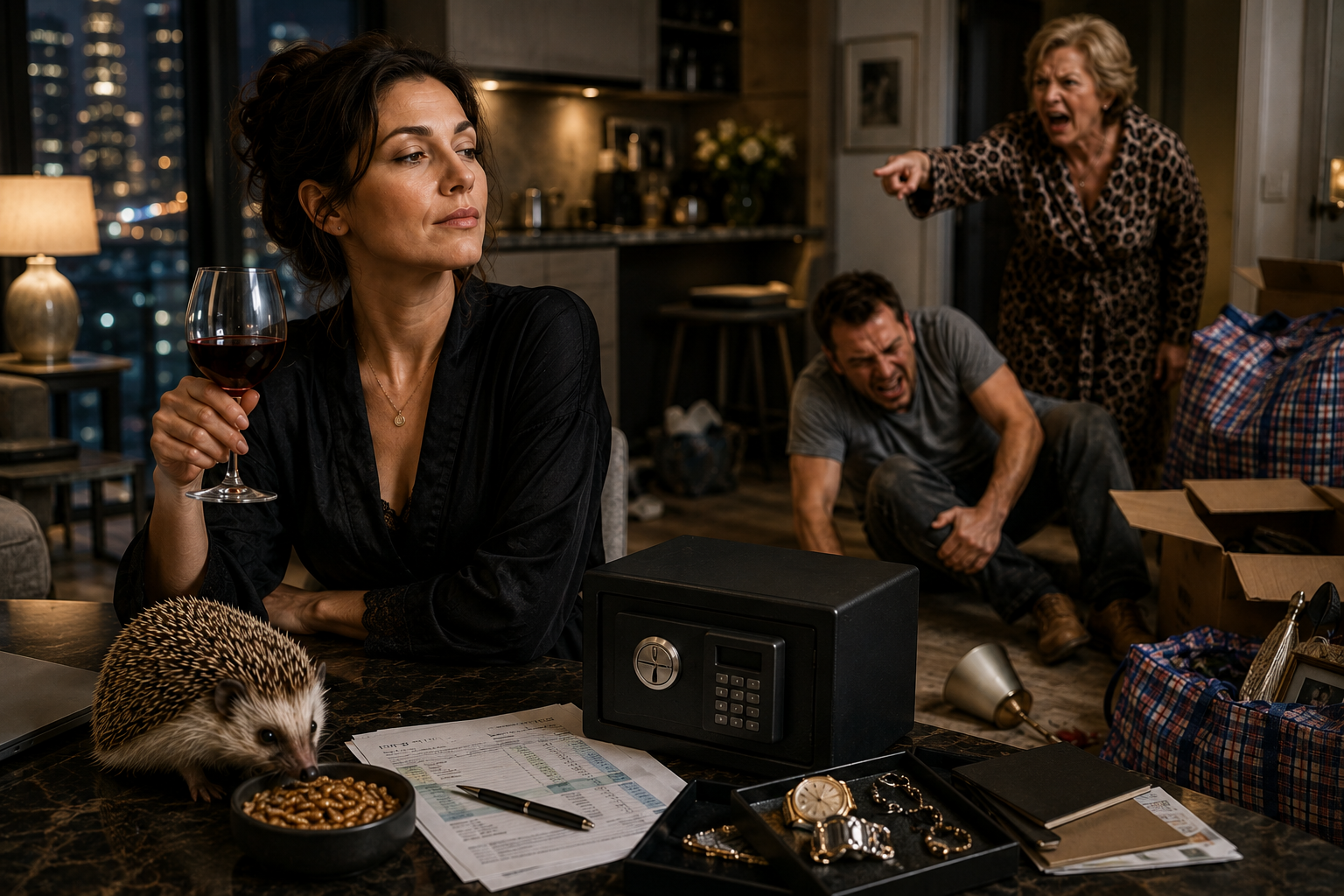
She looked up with an expression I can only describe as pre-defended, the look of someone who has already prepared their argument. She told me she had donated the furniture to a church thrift sale the previous weekend. She said the room needed to be cleared out because she was planning to use it for her business inventory. She said, and I remember this precisely, that holding on to all of that was not healthy, and that she was sure Margaret would have wanted the space to be useful.
She said Margaret’s name as if she had known her. I asked about the cedar chest. I asked about the letters. She told me the chest had gone with the furniture.
She hadn’t looked inside it, she said. She had assumed it was empty. I went to my son’s office down the hall. He was on a call, but when he saw my face, he ended it.
I told him what had happened. He listened. Then he looked at the table and said that she had mentioned wanting to clear the room and that he hadn’t realized it was going to happen so quickly, but that to be honest, Dad, she had a point. It wasn’t good for any of us to have the house feel like a museum.
He said the word museum the way people say it when they mean shrine. He said he thought it might help me to move forward. I looked at my son for a moment. He was 34 years old.
He had his mother’s eyes. I told him I needed some air and went to the workshop. I sat on the stool at the workbench and looked at the pegboard with all the tools hanging on it, each one in its place. And I thought about my grandfather who had built this room.
And my father who had taught me to use every tool on that wall. And Margaret who had brought me coffee out here on winter mornings and sat on the old stool in the corner and talked to me while I worked. And I understood something that I had been half understanding for 18 months but had been choosing not to see clearly. This was not a rough patch.
This was a direction. And it was only going one way. I did not cry. I’m not telling you that as a point of pride.
I think I was past the point where crying was the right response. I felt something colder and clearer than sadness. I felt like a man who has been standing in a doorway for a long time trying to decide whether to step through it and has finally just decided to step through. I called my attorney the next morning.
She had handled Margaret’s estate. She was sharp and practical and did not waste time. I told her I needed to understand my options regarding the property. Not in a hostile way.
Just completely and clearly. She said she would have documents ready for a meeting that Friday. I did not tell my son or my daughter-in-law that I had made the call. Over the following 6 weeks, I moved quietly and deliberately.
The way you learn to move when you spend your life working with wood, where a single rushed cut can ruin a piece you’ve spent hours preparing. I contacted a realtor through my attorney, a woman from a church I had attended before Margaret died, someone I trusted. She assessed the property and came back with a number that was substantially higher than I had expected. Land values in that corridor outside Columbus had shifted significantly, and I had not been paying attention.
I had enough equity in that house to buy a smaller property outright and still have money left over. I identified a house near my sister in Dayton. Two bedrooms, a full garage I could convert to a workshop, a yard with a view of a small pond. It was quiet.
It was modest. It was mine in a way the farmhouse had stopped being. I made an offer. It was accepted.
I arranged the listing of the farmhouse with the realtor. We agreed on a timeline. I spent three evenings getting my documents in order, going through the house carefully, retrieving anything that could still be retrieved: several of Margaret’s books that had been pushed to the back of a hallway closet, and a small framed photograph of her that had been moved from the mantel to a shelf in the laundry room at some point without my noticing. I put these things in my truck.
I updated my will with my attorney. I established a small educational trust in the names of my sister’s grandchildren, funded by a portion of the proceeds from the sale. The remainder would secure my retirement and the Dayton house, and leave nothing to chance. I canceled the joint emergency account.
I scheduled the closing for a Thursday in late April. The morning the realtor’s sign went up in the front yard, I was already in the kitchen drinking coffee when my daughter-in-law came downstairs. She stopped at the bottom of the stairs and looked through the front window. I watched her face go through several expressions very quickly.
Then she turned to me. She asked me what that sign was. I told her the property was under contract and that the closing was in 3 weeks. I told her I would need them to be out by the end of May, which gave them 30 days from the contract date and more time than the legal requirement.
I told her I had spoken with my attorney and everything was in order. I told her I hoped they would find something that suited them. I said all of this in the same voice I use when I’m explaining a woodworking technique to someone. Calm.
Specific. No extra words. She told me I couldn’t do this. She told me this was their home, too.
She told me they had been here for over a year and had established residency and had rights and that I would be hearing from her lawyer. I told her she was welcome to consult anyone she liked and that my attorney’s contact information was on the kitchen counter if she needed it. My son came downstairs 20 minutes later. He stood in the kitchen doorway in his pajamas and looked at me with an expression I had not seen on his face since he was a child: a kind of stunned disbelief, as though the ground had shifted under his feet.
He asked me if this was really happening. I told him it was. He asked me why. I thought about the cedar chest.
I thought about Margaret’s letters somewhere now in a donation bin or a landfill or a stranger’s hands. I thought about 18 months of silence and patience and extension of benefit of the doubt. And I thought about his voice saying it wasn’t healthy to hold on to things. And I thought about the word museum and the way he hadn’t looked at me when he said it.
I told him that I had thought about what he said about not holding on to things. I told him he had made a good point and that I had taken it to heart. He stared at me. He started to say something and stopped.
He tried again. He said, “Dad, that is not what I meant and you know it. ”
I told him I knew, and that I was sorry the lesson had landed the wrong way around. He sat down at the kitchen table and put his head in his hands.
My daughter-in-law was upstairs, and I could hear her on the phone, her voice carrying the particular pitch of someone performing a crisis for an audience. My son sat there quietly for a long time. Then he looked up and asked where I was going. I told him Dayton, near his aunt.
He asked if the closing was really final, if there was any way. I told him the closing was in 3 weeks and was not something I was willing to revisit. I told him I had thought carefully about this for 6 weeks, which was approximately 6 weeks longer than anyone had thought carefully about the things that were done to his mother’s belongings. He flinched.
I had not intended it as a knife, but it landed like one. I told him I was not trying to punish him. I told him that was the truth. But I also told him that there comes a point where a man has to make decisions about his own life in the same way that he and his wife had been making decisions about their lives all along, and that this was one of those decisions.
I told him I loved him. I told him I was not going away. I told him that being his father did not require me to be his landlord indefinitely, and that I was confident he was capable of taking care of himself and his wife in a way that did not involve living on someone else’s generosity. I told him about the 30 days and the arrangements I had made, and that I was available to help them look for rental listings if he wanted that help.
He did not want the help. At least not that morning. He went back upstairs. I poured a second cup of coffee and sat at the kitchen table where I had eaten breakfast every morning of my adult life, and I looked out the window at the yard, at the maple tree, at the small stones under it with the carved names.
I had already made arrangements for those stones. They were coming to Dayton with me. The closing happened on a Thursday as planned. I had packed the truck over the previous 2 weeks in the early mornings before the house woke up, carrying things to a storage unit until the Dayton house was ready.
My son had spoken to me twice more during that period. Once, to ask whether I had truly changed the will, which I confirmed. And once, late at night, when he knocked on my workshop door and came in and sat on the stool in the corner, the one Margaret used to sit on, and didn’t say anything for a while. I was working on a small cabinet, a wedding gift for my niece.
I kept working. Eventually, he said he was sorry. He said it quietly, without qualification or explanation. He just said, “I’m sorry, Dad.
” And his voice had something in it that I recognized from when he was young, from when he was honest. I set down the plane I was using and looked at him. I told him I heard him. I told him I believed him.
I told him that being sorry was a place to start, and that I was interested in starting from there whenever he was ready. He nodded. He sat there a little longer and then went back inside. That was the beginning of something different between us.
Not repaired, not resolved, but different. A different kind of honesty, maybe. The kind that comes when the comfortable arrangements that let people avoid things have been removed. The new house in Dayton has a garage with good natural light from a north-facing window, which is the best direction for a workshop because it doesn’t change with the time of day.
I put the pegboard on the east wall, same as always. I hung the tools in the same order, the order my father taught me, by size and function. Everything with a place. The small stones from under the maple tree are in the corner of the yard by the fence, and I planted a young maple beside them that the nurseryman told me would be a full tree in 20 years.
I am 63 years old. 20 years from now, I will be 83. I plan to see that tree grow. I have learned, over the course of this year, something that I wish I could tell my younger self, though I know the younger self would not have had the patience to hear it.
I learned that generosity and surrender are not the same thing, even though they can look similar from the outside for a long time. I was generous with my son and his wife. I gave them time and space and money and silence, but somewhere in all that giving, I had started to surrender things that were not mine to surrender. Margaret’s memory.
The weight of three generations in that house. My own sense of what I was owed, not in money, but in basic respect. When my daughter-in-law donated that cedar chest, she didn’t just remove furniture from a room. She told me, as clearly as she could have, what she thought my past was worth.
And when my son nodded along and told me it wasn’t healthy, he told me, just as clearly, that he had decided her assessment mattered more than mine. I don’t carry anger about this. I want to tell you that clearly, because I think the anger is the easy part to understand, and it is not actually what I felt, or at least not the deepest thing I felt. What I felt was a kind of clarity, the kind you get when you stop hoping something will be different and simply see it as it is.
I am not estranged from my son. We talk on the phone most Sundays. He and his wife found an apartment in a neighborhood near Columbus, and from what I understand, they are managing. He told me recently that they have started a savings account, which he said with a kind of sheepishness that told me he understood the full weight of the statement.
I told him that was a good start. I meant it. My daughter-in-law has not spoken to me directly since the day I told them about the sale. I imagine that will change eventually, or perhaps it won’t.
I find that I am at peace with either outcome. The cabinet I was making for my niece’s wedding came out well. Clean joints. Good grain match on the door panels.
A finish that took the light the way I wanted it to. I drove it to her house myself and helped carry it in, and she ran her hands over the surface the way people do when they recognize that something was made carefully, and she asked me how long it had taken. I told her it was started at the end of a hard year and finished at the beginning of a better one. She didn’t ask me to explain that.
She just nodded and said it was beautiful. I sat in her kitchen afterward and had coffee and watched her kids run around the backyard, loud and ordinary and completely uninterested in anything that had happened to anyone over 60, which is as it should be. And I thought about my grandfather sitting at my father’s kitchen table the same way, and my father sitting at mine. All of us making things with our hands and passing them to the people we loved, and watching them carry those things forward into rooms we would never see.
That is what I have. That is what I kept. If you are watching this and you have been patient with someone for a long time, patient past the point where patience is generosity and into the territory where it has become a kind of invisibility, I want you to hear this. Your memories are not clutter.
Your past is not an obstacle to someone else’s future. The things that mattered to the people you loved are worth protecting, and protecting them is not the same as being unable to move forward. It is exactly the opposite. It is how you carry them forward with you.
You have the right to make decisions about your own life. You have the right to decide what you hold and what you release, and that decision belongs to you, not to whoever is most comfortable with your grief being out of sight. I am in my workshop right now in my new house, with the October light coming through the north window and the smell of wood and linseed oil all around me, and I am at peace in a way I had stopped expecting to be. That is enough.
That is more than enough. I’m glad you’re here.