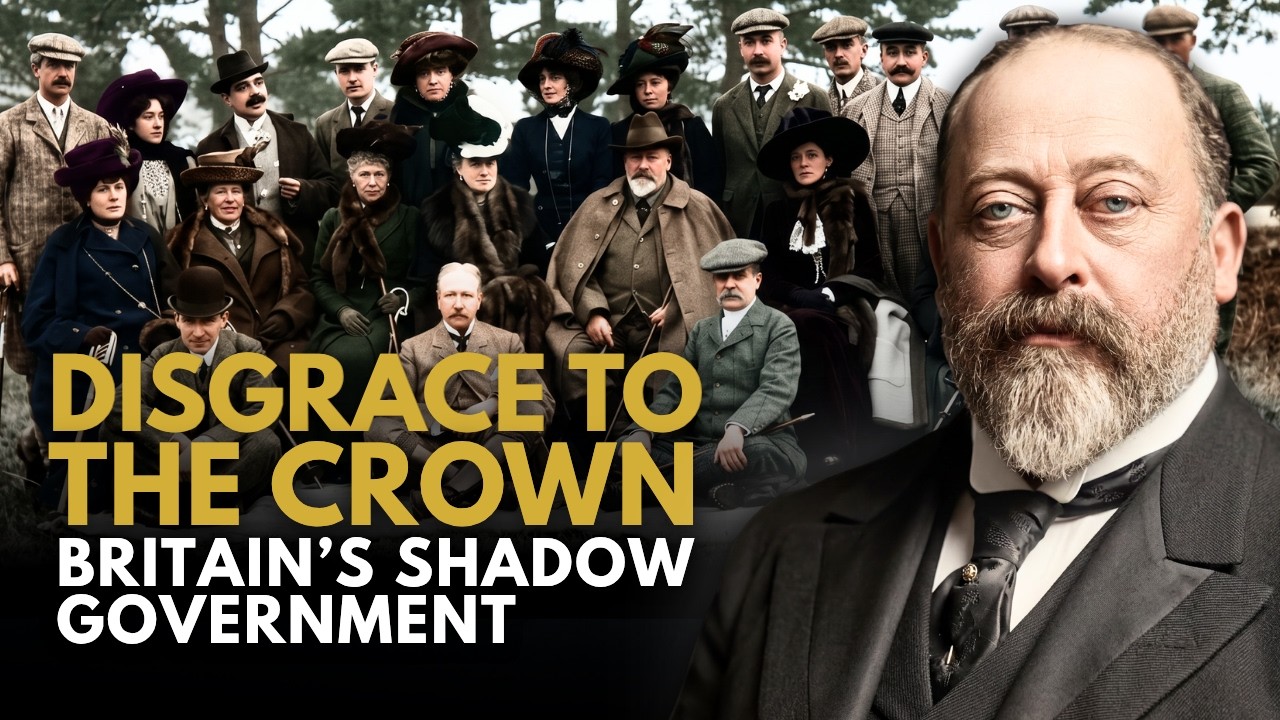
The shadow that loomed largest over Victorian Britain was not cast by the formidable Queen Victoria, but by her own son, a man who built a parallel court of hedonism, blackmail, and raw political influence that would ultimately redefine the very nature of the British monarchy. For decades, while the Queen mourned in seclusion, the Prince of Wales, Albert Edward, ruled a glittering, dangerous underworld from the gilded salons of Marlborough House, a shadow government whose members gambled with fortunes, traded in secrets, and wielded power that threatened to bring the crown crashing down.
This was not a world of stuffy drawing rooms and moral rectitude. It was a high-stakes arena where charisma trumped bloodline, where American heiresses and Jewish financiers, long locked out of the elite, bought their way into the royal inner circle with cold, hard cash. The rules were simple, brutal, and absolute.
 Do whatever you want with whomever you want, but never, ever get caught. A public scandal was the unforgivable sin, the one mistake that would banish you from this paradise forever. Yet, this carefully constructed empire of pleasure was built on a powder keg of fragile egos, colossal debts, and reckless passion, and it would take only a single spark to ignite a series of disasters that would drag the future king into the courtroom and expose the rotten underbelly of the British elite for all the world to see.
The architect of this counter-court was a man his own parents deemed a profound disappointment. Birdie, as he was known, despised books and possessed an insatiable appetite for pleasure that horrified his stern father, Prince Albert. The point of no return came in 1861.
After discovering his son’s affair with an actress, an already sick Prince Albert traveled to reprimand him, only to die shortly after. Blinded by grief, Queen Victoria irrationally blamed her son for her husband’s death, froze him out of all political power, and shut herself away in absolute, silent gloom. Left with immense royal status but zero purpose, the board prince built his own kingdom, transforming Marlborough House into a dazzling palace of hedonism that utterly horrified the old aristocracy
At the heart of this new court was a cast of characters who would become legends, each one a master of the game of influence. Right beside Birdie was always his lawful wife, the dazzling Princess Alexandra, who was perfectly aware of her husband’s endless infidelities but played by the rules of the set flawlessly, maintaining a perfect public facade and even occasionally forming polite friendships with his mistresses. But the true stars were the prince’s favorites, women whose names would thrill all of London.
There was the great French actress Sarah Bernhardt, who drove all of Europe wild, and the dazzling American Jenny Jerome, mother of the future Prime Minister Winston Churchill. There was the fabulously wealthy Countess Daisy Warwick, and the legendary courtesan Carolina de Otaro, at whose feet monarchs fell. And of course, there was Nelly Clifton, the very girl whose fleeting affair with Birdie once drove his father to the grave
But it was Lily Langtry who earned the status of the first true superstar in this circle. Born Emily Le Breton from the isle of Jersey, she possessed a striking, hypnotic beauty that captivated the heir to the throne at a dinner party in 1877. Thus began a romance that changed the rules of the game in high society.
Although Lily was not his first mistress, she became the first to achieve worldwide fame solely through her connection to the prince. They openly took morning horseback rides through Hyde Park, and Birdie even built the Red House in Bournemouth for their secret rendezvous. In an act of unbelievable, unthinkable audacity, the prince introduced Lily to his strict mother, Queen Victoria.
Lily became a phenomenon, women copied her hairstyle, her portraits were bought by the thousands, and she became one of the first celebrities in history to endorse a commercial brand, Pears’ Soap
If Lily embodied the power of beauty, figures like Princess Daisy of Pless demonstrated the absolute power of money. Marrying the heir to one of Europe’s wealthiest families, she became the mistress of a 600-room castle and traveled on a private train, her husband gifting her pearl necklaces that were seven meters long. It was exactly such people, with their astronomical budgets and international connections, who provided the set with its incredible grandeur.
True, history dealt harshly with Daisy, with the outbreak of the First World War, her fairy tale world collapsed, leaving the great socialite to live out her days in poverty. But as the years passed, the prince’s mistresses became less a source of fleeting passion and increasingly a source of power, culminating in the arrival of Alice Keppel, the last and most important love in Edward’s life
In 1898, 29-year-old Alice met the 56-year-old Prince of Wales, and this romance would last until his death. For the aging monarch, Alice became a companion, a confidant, and a true power behind the throne. Known for her incredible tact, she was the only one who knew how to diffuse the famous royal temper, and her influence was so great that government ministers would secretly approach her so she could push through necessary ideas to the king.
Alice’s own husband, George Keppel, silently accepted these rules of the game, tactfully disappearing from the house whenever the monarch appeared on their doorstep. In return, the Keppel family became fabulously wealthy. Alice was so untouchable that when Edward lay dying in 1910, Queen Alexandra personally allowed her husband’s mistress to approach his deathbed to say goodbye.
 Alice Keppel was the perfect embodiment of the rules of Marlborough House, proving that if you manage your secrets masterfully, they become an instrument of absolute power
But the problem with Marlborough House was that far from all of its members possessed the composure and intellect of Alice Keppel. Bird’s world balanced on a knife’s edge, a volatile mix of fragile male egos, colossal gambling debts, and reckless passion. And when this golden rule was broken, the illusion of safety shattered.
The walls of Marlborough House could not keep the secrets contained, and ahead, three disasters awaited the Prince of Wales and his entourage, three massive public scandals that would not only unmask the British elite, but also drag the future king into a courtroom
The prelude to this disaster began three years earlier in 1866 when wealthy politician Sir Charles Mordaunt married the dazzling 18-year-old Harriet. The couple quickly became part of the Marlborough House set, and while Sir Charles was away at Parliament, his young wife entertained a crowd of influential admirers, front and center of which was the Prince of Wales himself. But in 1869, this house of cards came crashing down.
Following a difficult childbirth, doctors suspected Harriet’s newborn daughter had an eye infection, a likely symptom of a venereal disease. Seized by panic and crushed by guilt, Harriet made a shocking confession to her husband. “Charlie,” she cried through her tears, “I have deceived you.
The child is not yours.” And she didn’t stop there. She confessed to constant infidelities in broad daylight and began naming names, among them one that landed like a bombshell, the Prince of Wales
An enraged Sir Charles took a step that was utterly unthinkable for the era, he filed for a public divorce. Breaking into his wife’s desk, he found a stack of letters from the heir to the throne himself, and the press had an absolute field day, dubbing it the Mordaunt scandal. The situation reached a crisis point, for the first time in British history, a future king was officially subpoenaed to testify in an adultery case.
It was an unmitigated disaster, and the trial of the century kicked off in February 1870 to save the monarchy from disgrace. A cruel but highly effective strategy was deployed, Harriet’s family claimed that the young woman had simply lost her mind. Her own father brought in doctors who testified under oath that she was suffering from postpartum insanity, claiming that all her confessions were nothing more than the delusions of a sick woman
When the Prince of Wales finally took the stand, he was in the witness box for exactly seven minutes. When asked if he had engaged in any criminal intimacy with Lady Mordaunt, he replied with an icy tone, “Never.” The court accepted the insanity defense with overwhelming relief, the divorce was denied, and Harriet was simply sacrificed to the system.
The young woman was erased from society and locked away in psychiatric asylums forever, spending the next 36 years there, dying in 1906, never to see freedom again. The prince escaped any legal consequences, but his reputation was in tatters. Furious crowds hissed at him in the streets, and Queen Victoria was absolutely livid.
The Mordaunt Affair became the first major crack in the shining armor of the Marlborough House set, but if the prince thought things couldn’t get any worse, he was dead wrong
 Just six years later, another bombshell dropped, and this time, it wasn’t a matter of passion, but of naked blackmail against the crown itself. In 1876, one of the prince’s close friends accompanied him on a grand tour of India, and his wife, Lady Aylesford, wasted no time, and immediately plunged into a whirlwind romance back home. The husband found out, flew into a rage, and demanded a divorce.
The Prince of Wales publicly threw his support behind his betrayed friend. But then, Lord Randolph Churchill entered the game, the father of future Prime Minister Winston Churchill. It turned out that Randolph’s own brother was the lover in question, and desperate to save his brother from public disgrace, Churchill took a catastrophically reckless step, he managed to get his hands on old, highly intimate letters that the prince himself had once written to this very same woman
Randolph marched straight into the palace and delivered an ultimatum. If the prince didn’t put a stop to his friend’s divorce, the royal letters would be leaked to the press. Churchill declared point blank,”The prince will never sit on the throne of England.”
The heir to the throne turned white with rage and immediately challenged Churchill to a duel. The situation escalated to such a breaking point that the British prime minister had to secretly intervene. The blackmail was successfully hushed up, the compromising letters were destroyed, and the Churchill family was disgracefully banished from high society, exiled to Ireland for eight long years
The third great scandal erupted in September 1890, and this time, the catalyst wasn’t a woman, it was a deck of cards. It would go down in history as the Royal Baccarat scandal, and it would once again drag the Prince of Wales into a courtroom, putting the illegal habits of his inner circle on full public display. The scene was Tranby Croft, a sprawling country estate in Yorkshire, where the prince and his friends were staying for the races.
After dinner, Birdie suggested a game of Baccarat, and herein lay the problem. At the time, Baccarat was strictly illegal in England, but it was Bird’s favorite game, and he even traveled with his own personalized set of chips. For the hosts, saying no to the future king simply wasn’t an option
Among the players at the table was Lieutenant Colonel Sir William Gordon, a highly decorated officer and a close friend of the prince. Over the course of two nights of play, five different guests became absolutely convinced they had seen Gordon cheating by secretly sliding extra chips onto his winning bets. Rather than cause a scene on the spot, they went straight to the prince’s senior courtiers.
The ultimate goal, as always, was to avoid a public scandal, so they cornered Gordon behind closed doors. The stunned officer fiercely denied the accusations, but they turned up the pressure. In exchange for their absolute silence, he had to sign a document promising never to play cards again for the rest of his life, believing it was the only way to save his honor and protect the prince.
He signed the paper and left the estate in disgrace
But a secret shared by that many people is impossible to keep, and the story leaked to high society as rumors systematically destroyed his reputation. Gordon realized he had no other choice but to sue his five accusers for slander, a move that guaranteed the one thing everyone had desperately tried to avoid, a very public trial. The trial became a massive media sensation, and the star witness, of course, was once again the Prince of Wales, who was forced to take the stand for the second time in his life.
Only this time, he was being interrogated about his participation in an illegal gambling game and his role in coercing a man into a confession. Despite a robust defense, the jury, heavily swayed by a biased judge, ruled against Gordon, and his life was ruined forever. He was dismissed from the army in disgrace and permanently ostracized from society.
 However, public opinion was sharply divided, many believed the officer had simply been used as a scapegoat, his honor sacrificed on the altar of the monarchy just to cover up the royal family’s tarnished reputation
After three monumental scandals, the Prince of Wales reputation lay in ruins. In the eyes of British society, he had permanently become Dirty Birdie, an aging playboy willing to sacrifice the honor of his friends just to save his own skin. Many, including his own grieving mother, dreaded the day this man would finally wear the crown.
But in January 1901, the clock of history struck midnight. Queen Victoria died, taking the era of stiff collars and perpetual mourning to the grave with her. At the age of 59, the eternal heir finally put on the crown, becoming King Edward VII.
Politicians braced for the worst, absolutely certain the empire was headed for disaster. But then the unthinkable happened, the catastrophe never came
On the contrary, it turned out that decades spent at card tables, racetracks, and in boudoirs had been a brilliant masterclass in diplomacy for the prince. His phenomenal charm, social tact, and ability to manipulate people made Edward a brilliant monarch. He pulled Britain out of its isolation, earned the nickname the Uncle of Europe, and forged the international alliances that would largely dictate the fate of the world in the 20th century.
But what about his entourage, what happened to the scandalous Marlborough House set? Upon ascending the throne, Edward didn’t turn his back on his co-conspirators. Instead, he threw the doors of Buckingham Palace wide open for them.
Yesterday’s lovers of illegal poker, American heiresses, and seasoned Jewish financiers, people the old aristocracy openly despised, suddenly found themselves awarded the highest government posts, titles, and knighthoods
It was in this exact moment that things became crystal clear. The Marlborough House set was never just a social club or a gathering of bored hedonists. All this time, while Queen Victoria grieved in isolation, they had been the shadow government of Britain.
For years, they had been building their networks, honing the art of influence, and biding their time. And when their time finally came, the poachers officially became the gamekeepers. They didn’t just challenge Victorian morality, they killed it.
They forged a new glittering Edwardian era where ancient bloodlines mixed with new money, and prudishness gave way to glamour. They proved one simple brutal truth to the world, behind the cold facade of absolute power, there are always living, breathing humans with their own vices and passions. And sometimes the most monumental changes in a nation’s history don’t begin in Parliament, but behind the closed doors of a really good party
The legacy of this shadow government is complex, a testament to the fact that power is rarely wielded where it appears to be. While Queen Victoria sat enthroned in mourning, her son was quietly, and not so quietly, reshaping the nation’s future from the card tables and bedrooms of Marlborough House. He proved that a monarch’s greatest asset might not be their virtue, but their understanding of human nature, its weaknesses, its ambitions, and its insatiable hunger for pleasure.
The scandals that nearly brought down the monarchy ultimately became the crucible that forged a new kind of kingship, one that was more in tune with the modern age, for better or for worse. The shadow government had not just survived, it had triumphed, leaving an indelible mark on British history that would be felt for generations to come, a reminder that the true corridors of power often lie hidden behind gilded doors, where the currency is not policy, but charm, secrets, and the willingness to play the game