“You’ve been overstepping, Turner. ”
Gerald Ashford slammed the suspension notice against her chest. Nurses behind the glass partition jumped. “Fifty-seven patients received contaminated sh—”
“Shut your mouth.
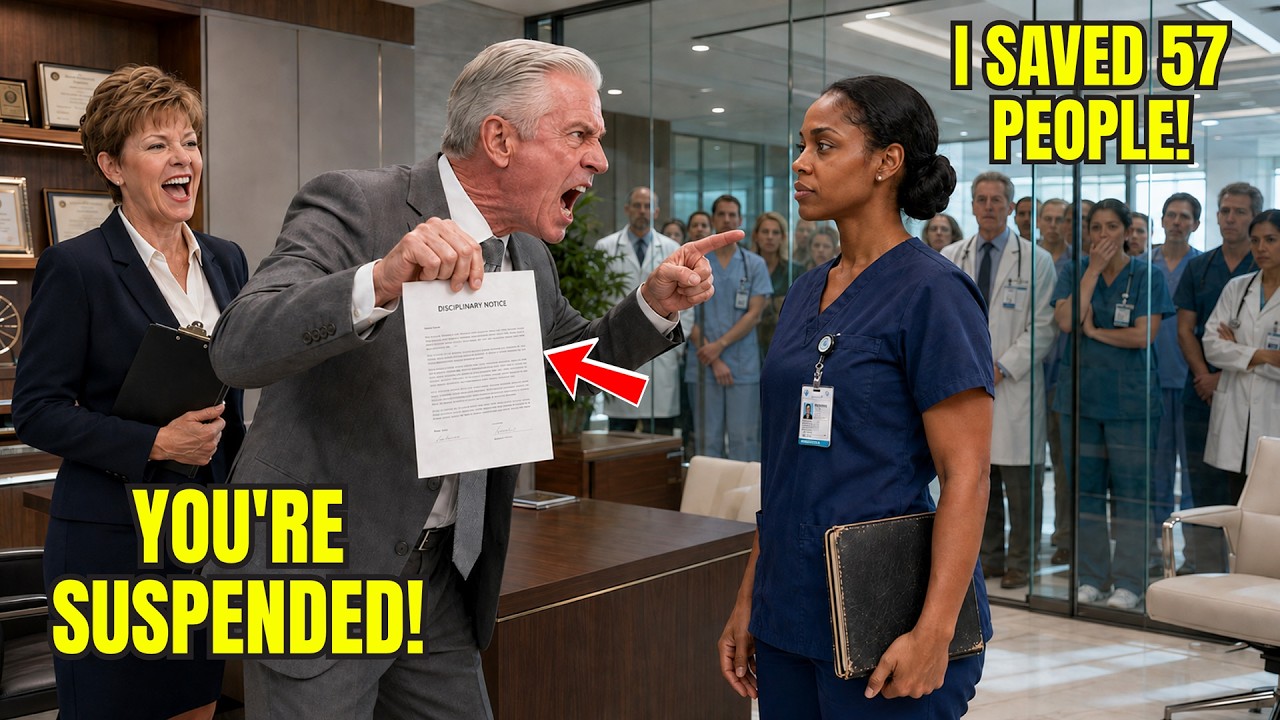
” He pointed a finger at her. “You barely graduated from a two-year nursing program. You don’t have the brains to make a diagnosis, let alone second-guess a doctor. A nobody who doesn’t know her place.
”
Patricia Hodges laughed. Faith’s hands trembled, but her voice held steady. “I was trying to save them. ”
“Your badge.
You’re suspended. ” His voice dropped cold. “If any patient’s condition worsens, you’re going to jail. ”
She unclipped her badge.
It clattered onto the desk. Staff members watched from the hallway. Not a single person stood up for the black nurse. She walked out.
But before long, they would be the ones coming to find her. Begging her to return. Three weeks earlier, Faith Turner pulled into the Ridgemont Memorial Hospital parking lot at ten minutes to eleven, the same way she had every night for the past six years. Her sedan—a twelve-year-old Honda with a cracked taillight and two hundred thousand miles on the odometer—sat between a gleaming white Audi and a black Mercedes.
Ridgemont Memorial wasn’t the kind of hospital that made the evening news. Tucked into the low-income corridor of the city’s East Side, it served the people insurance companies preferred to forget. Retired factory workers. Widowed grandmothers.
Veterans on fixed incomes. Faith was thirty-four. She had graduated top of her class in the pre-med entrance examination eight years ago—the highest composite score in her testing cohort. The acceptance letter from the state medical school had arrived on a Tuesday.
She remembered the weight of the envelope, the cream-colored paper, the way her mother’s hands shook while reading it. But her mother was a single parent raising two children on a housekeeper’s salary. Tuition was seventy-two thousand dollars a year. There was no scholarship.
There was no uncle with a savings account. There was only a choice: her future or her brother’s. She chose her brother. She enrolled in a two-year nursing program, graduated with honors, and started working nights at Ridgemont.
But Faith never stopped learning. Her small apartment was more library than living space. Pharmacology textbooks lined the kitchen counter. Toxicology journals sat stacked beside her bed.
She subscribed to three medical research databases with money she could barely afford, and she read them the way other people watch television—every morning, after every shift, until the words blurred and sleep finally pulled her under. She kept a notebook. Not the official patient charts—those belonged to the hospital. This was her own.
A black leather journal she carried in the inside pocket of her scrubs. Every anomaly she noticed, every pattern that didn’t fit, every question a doctor dismissed too quickly—she wrote it down. Date, patient, symptom, her hypothesis. No one had ever asked to see it.
No one knew it existed. On the ward, Faith moved like someone who had memorized the rhythm of the place. She knew which patients needed their pillows adjusted at midnight, which ones woke up frightened at 2:00 a. m.
, which ones pretended they weren’t in pain because they didn’t want to be a burden. Eleanor Caldwell was her favorite, though. Faith would never say that out loud. Mrs.
Caldwell was seventy-eight, a retired school teacher with silver hair and a voice that still carried the authority of a woman who had managed classrooms for forty years. She had been in the geriatric ward for five weeks—mild heart failure complicated by arthritis and the kind of loneliness that no medication could touch. “You’re my midnight angel,” Mrs. Caldwell would say whenever Faith appeared at her bedside.
Faith would smile, check her vitals, adjust her blanket, and pretend the words didn’t mean everything. The day shift nurses did not share Mrs. Caldwell’s opinion. Faith was the only black nurse on the geriatric ward.
She was assigned the heaviest patient load, given the rooms farthest from the nursing station, and paid less than colleagues with half her experience. She had filed two formal complaints in six years. Both had disappeared into Gerald Ashford’s filing cabinet without a response. Gerald Ashford was the chief administrator—fifty-six years old, silver hair, starched collar, corner office.
He ran Ridgemont the way a man runs a machine: inputs, outputs, compliance reports. Patients were bed numbers. Staff were budget lines. And Faith Turner was a line he preferred not to read.
Dr. Katherine Shaw, the attending physician for the geriatric unit, was not cruel. She was careful. She followed protocols, deferred to administrators, and avoided conflict the way a person avoids potholes—instinctively, without thinking about what was underneath.
She had never once defended a nurse in a meeting with Gerald. Patricia Hodges, the head of nursing, was fifty-two and had held her position for nine years. She watched Faith the way a person watches someone who makes them feel inadequate—with a tight smile and a clipboard always between them. Three weeks before the night that changed everything, Faith caught a dosage error on a patient’s chart.
She flagged it, showed it to the attending resident, and was told she was overreacting. The next morning, the patient’s blood pressure dropped. The resident quietly corrected the dosage without acknowledging Faith’s warning. She opened her black notebook.
She wrote it down. It started on a Tuesday night. Faith clocked in at 11:00, hung her jacket in the break room, and began her rounds. The ward was quiet—the kind of quiet that should have felt peaceful, but instead made the back of her neck tighten.
She had learned to trust that feeling. Mrs. Caldwell was the first sign. Faith found her sitting up in bed, which was unusual.
Eleanor Caldwell slept like clockwork—lights out at 9:00, asleep by 9:15, undisturbed until morning. But tonight she was awake, her hands trembling slightly on top of the blanket. “I don’t feel right, dear. ” Her voice was thin.
“Something’s off. ”
Faith checked her temperature. 37. 8°C—a low-grade fever, barely worth noting on most charts, but Mrs.
Caldwell had been stable for weeks. Faith looked at her eyes. The whites had a faint yellowish tint, so subtle that in the dim light of the ward, most people would have missed it entirely. She moved to the next room.
Harold Bennett, eighty-two, a retired postal worker with a dry sense of humor and a heart condition that kept him tethered to his bed. He was awake, too. Same low fever. Same slight tremor in his fingers.
Same faint yellow in his eyes. “Must be something in the water,” he tried to joke. But his laugh came out shaky. Room six: Sylvia Moore, seventy-four, awake, restless, temperature 37.
7, hands shaking when she reached for her water glass. She couldn’t hold it steady enough to drink without spilling. Three patients. Three identical symptom clusters.
All in the same ward. All presenting at the same time. The night shift resident, Dr. Conners, was twenty-eight and perpetually tired.
Faith found him at the nursing station scrolling through his phone. “Dr. Conners, I have three patients with matching symptoms—low-grade fever, fine tremor, mild jaundice. All onset tonight.
”
He barely looked up. “They’re elderly, Faith. Elderly patients run low fevers. It’s probably nothing.
”
“All three at the same time with the same presentation? ”
“Coincidence. Monitor and document. If it gets worse, page me.
”
He went back to his phone. Faith returned to her station and opened her black notebook. She pulled the medication records for all three patients and laid them side by side. The overlap was immediate.
All three had been started on a new lot of IV saline solution—lot RX2241—four days ago. Same supplier. Same delivery date. Same batch.
Ninety-six hours. That was the timeline. Symptoms appearing exactly ninety-six hours after the first infusion. She closed her eyes and searched her memory.
She had read something two years ago—a case study in the Journal of Clinical Toxicology about low-concentration ethylene glycol contamination in pharmaceutical-grade solutions. The symptoms described in that paper matched what she was seeing tonight almost exactly: low-grade fever, fine motor tremor, subtle hepatic stress presenting as mild scleral icterus. At low concentrations, the compound wouldn’t cause immediate organ failure. Instead, it would accumulate silently, damaging the kidneys in increments so small that standard blood panels wouldn’t flag anything unusual until the tipping point had already passed.
She found the article on her phone, saved in her research bookmarks. She read it again, comparing each symptom against her three patients. The correlation was too precise to ignore. Then she pulled the full patient roster for the geriatric ward.
Fifty-seven patients were currently receiving IV fluids from lot RX2241. Fifty-seven. Her hands went still on the keyboard. If she was right—if this lot was contaminated—then every one of those fifty-seven people was being slowly poisoned.
Not fast enough to trigger alarms. Not dramatic enough to make anyone look twice. Just a quiet, steady accumulation of damage that would present as unexplained kidney failure in another seventy-two hours. Faith spent the rest of the night at the nursing station.
She built a comparison chart. She noted the dosage rates, the infusion schedules, the onset timing. She calculated the projected toxicity curve for a patient of Mrs. Caldwell’s weight and age.
She ran the same calculation for Harold Bennett and Sylvia Moore, adjusting for their different body masses and existing conditions. The numbers told the same story every time. She wrote everything in her black notebook first, then transferred it to a formal report—typed, formatted, cited, four pages. Three symptomatic patients documented.
Fifty-seven at risk. One clear recommendation: suspend all use of lot RX2241 immediately and send samples for independent testing. By six in the morning the report was finished. Faith’s eyes burned from the screen.
But the document was clean. She waited outside Dr. Katherine Shaw’s office at 7:15. “Dr.
Shaw, I need five minutes. It’s urgent. ”
The reply came through the door, muffled and distracted. “I’m preparing for the 8:00 briefing, Faith.
Can it wait? ”
“No, I don’t think it can. ”
A pause. Then: “Leave it with my assistant.
I’ll look at it when I have time. ”
Faith stood in the hallway holding her report. Four pages of evidence. Three symptomatic patients.
Fifty-seven lives at risk. She placed it on the assistant’s desk and watched it disappear beneath a stack of budget memos. That afternoon she requested a meeting with Gerald Ashford directly. It took two hours and three emails before his secretary confirmed a fifteen-minute slot.
The meeting lasted seven minutes. Gerald sat behind his desk reading her report the way a man reads a restaurant menu he has already decided against. “Ms. Turner,” he set the report down.
“You’re a nurse. Not a pharmacist. Not a toxicologist. You don’t have the credentials to make this kind of assessment.
”
“The data speaks for itself. Three patients, identical symptoms, same lot number, same timeline. ”
“We follow protocol here. The supplier is FDA-approved.
The lot passed inspection. I’m not pulling inventory based on a nurse’s hunch. ”
“It’s not a hunch. It’s documented evidence.
”
“If I hear you’ve been playing doctor again,” his voice flattened, “there will be consequences. Serious consequences. Are we clear? ”
Dr.
Shaw was in the room. She sat in the chair by the window, hands folded in her lap, eyes fixed on a point somewhere on the carpet. She did not look at Faith. She did not speak.
Patricia Hodges, who had walked into the meeting uninvited and sat down as though she belonged there, delivered the final stroke. “She’s always like this, Gerald. Always acting like she knows more than the doctors. It’s disruptive.
It’s unprofessional. And frankly, it’s getting old. ”
Gerald nodded slowly. “That’ll be all, Ms.
Turner. ”
Faith walked out of the office. Her fingers were white around the edges of her report. The hallway stretched long and empty ahead of her.
Behind her, the door clicked shut—small and final, like a lock turning. Fifty-seven patients. Seventy-two hours. And not a single person in this building was willing to listen.
Faith drove home that morning with the report still sitting on the passenger seat. She had made a copy before leaving. The original was somewhere in Gerald Ashford’s office, probably already in the trash. Her apartment was small—one bedroom, a kitchenette, a bathroom with a door that didn’t close all the way.
But it was the bookshelves that defined the space. Pharmacology references lined the wall above the stove. Toxicology journals filled two crates beside her bed. A second-hand copy of Goldfrank’s Toxicologic Emergencies sat on the nightstand, its spine cracked and pages marked with colored tabs.
She had bought it at a library sale for six dollars. It was worth more to her than anything else she owned. She sat at the kitchen table and opened the book to the chapter on glycol compounds. She read it again, slowly, carefully, cross-referencing against her notes from the shift.
The mechanism was clear. Ethylene glycol at subacute concentrations would metabolize into glycolic acid and oxalic acid over a period of days. The acids would crystallize in the renal tubules. In healthy adults, the kidneys could compensate for a while.
In elderly patients with reduced renal function—patients like Eleanor Caldwell, Harold Bennett, Sylvia Moore—the window was narrower. Much narrower. She calculated the timeline. Four days of exposure already.
At the current infusion rate, patients with compromised kidney function would begin showing elevated creatinine levels within forty-eight to seventy-two hours. After that, the damage would compound. Dialysis might save some of them. For others, the oldest, the most fragile, it might not be enough.
Faith put down her pen and stared at the wall. The math was simple. The conclusion was obvious. And she was the only person who had done it.
She had two options. She could wait—file another complaint, escalate through channels, hope that someone with the right credentials would eventually look at her data. That could take days, weeks. By the time anyone listened, the damage would already be done.
Or she could act. The thought settled into her chest like a stone. She knew what acting meant. It meant going back to the hospital tonight on her scheduled shift and replacing every IV bag connected to lot RX2241.
All fifty-seven. By hand. Without authorization. Without backup.
If she was right, she would save fifty-seven lives. If she was wrong, she would lose her job, her license, and the only income keeping her brother in school. She picked up her phone and called the number on a business card she had kept in her wallet for two years—an independent pharmaceutical testing lab forty miles outside the city. “Rush turnaround is forty-eight hours.
The fee is three hundred forty dollars. ”
Three hundred forty dollars. That was almost everything in her savings account. She thought about the electric bill due next week.
She thought about her brother’s tuition payment in three months. She thought about Eleanor Caldwell saying, “You’re my midnight angel. ”
“I’ll pay it. I’m sending the sample tonight.
”
She packaged the IV fluid sample she had drawn during her shift—sealed, labeled, documented with lot number, date, and chain-of-custody notes she had taught herself from an online forensic science course. She drove it to the overnight courier drop-off herself. Back home, she sat at the table and opened a fresh page in her black notebook. She began planning.
She listed all fifty-seven patients by room number. She pulled their medical records from memory—weights, ages, diagnoses, current medications, known allergies, renal function estimates. She calculated individual replacement dosages for each one, accounting for drug interactions and infusion rates. She mapped out the most efficient route through the ward—which rooms to hit first, which patients were highest risk, how to stagger the replacements so no alarm would trigger on the monitoring system.
It took her four hours. No software. No calculator. Just her notebook, her pen, and ten years of reading.
When she finished, she had a plan that covered every patient, every dosage, every minute of her eight-hour shift. She set her alarm for 9:30 p. m. She lay down on her bed, still dressed, and stared at the ceiling.
She called her brother at 9:00. He answered on the second ring, his voice bright with the easy warmth of someone who didn’t know what was coming. “Hey, sis. What’s up?
”
“Nothing. Just wanted to hear your voice. ”
They talked for six minutes about small things—his classes, a professor he liked. When they hung up, Faith held the phone against her chest for a long moment.
“Whatever happens tomorrow,” she whispered to the empty room, “I did the right thing. ”
The parking lot was nearly empty when Faith pulled in at 10:45. Two cars belonged to the overnight security team. One was the night-shift resident’s.
The rest of the lot stretched dark and quiet under a sky that had gone overcast hours ago. She swiped her badge at the staff entrance. The door beeped and opened. She walked in the way she always did—steady, unhurried, invisible.
That was the advantage of being the nurse no one paid attention to. The supply room was on the first floor behind the pharmacy office. Faith had checked the inventory logs that afternoon. The hospital kept a backup supply of IV saline from a different manufacturer—older stock rotated to the back of the shelves because the newer lot had arrived.
It was still within its expiration window. She had verified it twice. She loaded a cart with fifty-seven replacement bags. She placed them in order—by floor, then by hallway, then by room number.
Each bag was labeled with the patient’s name, the dosage she had calculated, and the time she planned to make the switch. She covered the cart with a clean sheet, took a breath, gripped the handle, and pushed it toward the elevator. No one questioned a nurse pushing a cart through the hallways at 11:00 at night. That was the thing about night shifts.
The hospital belonged to the people who worked them. She started on the east wing, room one—Gladys Cooper, eighty-one, diabetic, reduced kidney function, highest risk on Faith’s list. She entered quietly, checked the IV line, compared the drip rate against her notes, disconnected the contaminated bag, and hung the replacement. She adjusted the flow, watching the first drops fall through the chamber.
Clean. Steady. Safe. She monitored for three minutes—pulse steady, no reaction, breathing unchanged.
She noted the time in her notebook: 11:07 p. m. Room two, Walter Simmons, seventy-nine. Same procedure.
Check, disconnect, replace, adjust, monitor, note. 11:14 p. m. Room by room, patient by patient, Faith moved through the ward with the precision of someone who had rehearsed every step in her mind for hours.
She didn’t rush. Rushing led to mistakes, and mistakes tonight could cost someone their life. At 12:30 she reached Mrs. Caldwell’s room.
Eleanor was awake again, propped up against her pillows, watching the doorway as if she had been expecting someone. “What are you doing, dear? ”
Faith paused at the IV stand. “Taking care of you, Mrs.
Caldwell. Like I always do. ”
“At this hour? ”
“Especially at this hour.
”
Mrs. Caldwell studied her face the way a retired teacher studies a student who is carrying something too heavy and trying not to show it. “You look tired, sweetheart. ”
“I’m fine.
”
“You’re not fine. But you’re here. And that’s what matters. ”
Faith changed the IV bag, checked the drip rate, and adjusted the flow.
She held Mrs. Caldwell’s hand for a moment—just a moment—feeling the thin, papery skin and the warmth underneath it. Then she let go and moved to the next room. By 2:00 a.
m. she had completed thirty-one switches. Her back ached from bending over beds. Her feet had gone numb inside her shoes.
The cart rattled softly as she pushed it down the corridor, and she stopped every few steps to steady it so the sound wouldn’t wake anyone. At 2:20 she noticed something that made her stop. Room 14, Agnes Whitfield, seventy-six. Faith had not flagged her as symptomatic during her initial assessment, but when she entered the room to replace the IV, she saw it.
The faintest tremor in the woman’s left hand. She lifted the hand gently. The fingernails had a barely perceptible bluish tint at the base. She checked the eyes.
The jaundice was there—not yellow yet, but a shade between white and cream that shouldn’t have been present. Faith opened her notebook and cross-checked the timeline. Agnes Whitfield had started on lot RX2241 five days ago—one day earlier than the other patients. The symptoms were further along.
Faith recalculated the replacement dosage on the spot, adjusting for the extended exposure. She moved quickly through the remaining rooms, looking not just at the IV bags, but at the patients themselves. Twelve more showed early signs—tremors too subtle for standard monitoring equipment, skin tone slightly off from their documented baselines, breathing patterns a fraction shallower than they should have been. Twelve patients that every doctor, every nurse, every machine in this hospital had missed.
Faith had not missed them. She had spent ten years training her eyes to see what instruments couldn’t measure and protocols didn’t require. She could read a patient’s condition the way a musician reads a chord—not one note at a time, but all of them together, hearing the dissonance before anyone else even noticed the music had changed. She noted each one.
Room number. Name. Symptom severity. Time observed.
For three of the most vulnerable, she added supplemental notes on hydration targets and renal function checkpoints. At 3:45 a. m. , she replaced the last bag.
Arthur Gibson, eighty-four, slept through the entire procedure, his chest rising and falling in the slow, steady rhythm of someone who had no idea what had just been done for him. Faith pushed the empty cart back to the supply room. Fifty-seven contaminated bags sat in a biohazard bin she had labeled and sealed. Fifty-seven replacement bags hung on fifty-seven IV stands, dripping clean fluid into fifty-seven arms.
She returned to the nursing station. It was 4:12 a. m. The ward was silent except for the soft rhythmic beeping of heart monitors and the distant hum of the ventilation system.
Faith sat down. Her legs gave out the moment she stopped moving. She hadn’t eaten since 7:00 the previous evening. Her water bottle was empty.
Her hands trembled—not from contamination, just from exhaustion and the adrenaline that only releases once the danger has passed. She opened her notebook to the last page and wrote the final entry:
“Replacement complete. 57. 57 patients switched from lot RX2241 to backup supply.
12 additional patients showing early-stage symptoms documented and flagged for priority monitoring. All patients stable at time of completion. Sample sent to independent lab. Results expected within 48 hours.
”
She closed the notebook and pressed her palm flat against the cover. The leather was warm from being carried against her body all night. Outside the window, the sky was beginning to lighten. Not sunrise yet—just the faintest shift from black to dark blue.
Fifty-seven people were sleeping safely in their beds tonight. None of them knew what had happened. None of them knew her name. Faith closed her eyes just for a moment.
Her alarm never went off. She woke to the sound of her phone ringing—a number she didn’t recognize. It was 11:40 in the morning. She had slept for less than five hours.
“Faith Turner? ”
“Yes. ”
“This is Margaret Collins from Human Resources at Ridgemont Memorial. You are required to report to the administration office at 1:00 p.
m. today. Mr. Ashford has requested your presence for an urgent disciplinary matter.
”
The line went dead before Faith could respond. She sat on the edge of her bed, phone still in her hand. She had known this was coming. She had known it from the moment she loaded the first replacement bag onto that cart.
But knowing it and hearing it were two different things. She showered, dressed in clean scrubs, and drove to the hospital. The conference room on the second floor held Gerald Ashford at the head of the table, Patricia Hodges to his left, Dr. Shaw in the corner by the window, the head of pharmacy across from Gerald, and a woman from human resources with a manila folder and a pen.
A security guard stood by the door—Douglas, a quiet man who usually smiled when she passed him in the hallway. Today, he didn’t smile. He didn’t look at her at all. Gerald didn’t offer her a seat.
She stood. “Miss Turner, at approximately 11:00 p. m. last night, you accessed the hospital supply room and removed 57 units of IV saline solution, lot RX2241, from active patient lines.
” He read from a typed document, his voice flat and measured. “You replaced them with unapproved backup inventory without authorization from any physician, pharmacist, or administrator. Is that accurate? ”
“I replaced them because the lot is contaminated.
”
“That has not been determined. ”
“I submitted a report yesterday with documented evidence, which was reviewed and rejected. ”
Gerald set the paper down. “What you did last night constitutes unauthorized practice, violation of medication administration protocols, and insubordination.
Effective immediately, you are suspended without pay. Your hospital access badge will be collected. You are not to enter this facility until further notice. ”
The room was silent.
Faith looked at Dr. Shaw. The doctor’s eyes were fixed on her own hands folded tightly in her lap. Her jaw was clenched, but her mouth stayed closed.
Again. Patricia Hodges spoke next, her voice carrying a satisfaction she didn’t bother to disguise. “I want it noted that I raised concerns about Ms. Turner’s behavior on multiple previous occasions.
This was entirely predictable. ”
The woman from human resources slid a form across the table. “Please sign here to acknowledge receipt of the suspension notice. ”
Faith signed.
Her handwriting was steady. The security guard stepped forward. “I’ll need your badge, ma’am. ”
Faith unclipped the ID badge from her scrub top.
She held it for a moment. Her photo. Her name. Her title: Registered Nurse, Geriatric Ward, Night Shift.
Six years compressed into a rectangle of plastic. She placed it on the table. No one walked her out. She walked herself down the hallway past the nursing station where she had spent thousands of hours, past the elevator that groaned on the second floor, past the break room where her jacket still hung on the third hook from the left.
She carried a cardboard box with her personal belongings—a spare pair of shoes, a framed photo of her brother at his high school graduation, a coffee mug with a chipped handle, and her black notebook resting on top, like the last piece of evidence in a case no one had agreed to hear. At home, the apartment felt smaller than usual. Faith set the box on the kitchen table next to the stack of bills she hadn’t opened. Electric past due.
Phone due Friday. Rent due in twelve days. Without a paycheck, the math was simple and merciless. She checked her phone.
No missed calls. No texts from colleagues. Not one person inside that building had reached out. Faith set the phone down and looked at her notebook sitting on top of the cardboard box.
The leather was scuffed at the corners from years of being carried. Inside it was every piece of evidence, every calculation, every name. The sample was still at the lab. The results would come.
The truth would come. She just had to survive until it did. Thirty-six hours passed. Faith barely left her kitchen table.
She ate what was in the refrigerator—leftover rice, two eggs, an apple that was starting to soften. She checked her email every twenty minutes, refreshing the inbox until the gesture became mechanical. Between refreshes, she reread her analysis notes, looking for anything she might have missed—any flaw in her reasoning that would give Gerald Ashford the ammunition to say she had been wrong. She found none.
On Thursday morning at 7:14 a. m. , the email arrived. The subject line read: “Laboratory Analysis Report, Sample ID FT2241-Rush.
”
She opened it with fingers that had gone cold despite the warm apartment. The results were laid out in clinical language—precise, dispassionate, final. The IV saline solution from lot RX2241 contained ethylene glycol at a concentration of 0. 3%.
Below the threshold that would trigger standard quality-control screening. Above the threshold that would cause cumulative renal and hepatic damage in patients with prolonged intravenous exposure—particularly elderly patients with pre-existing organ compromise. The report included a supplementary note from the lab director: “Concentration levels consistent with contamination during the mixing phase of production. Recommend immediate withdrawal of all units from this lot.
”
Faith read the report three times. Her eyes blurred on the second reading. By the third, her hands had stopped shaking. She had been right.
From the very beginning, she had been right. She sat in her kitchen chair and allowed herself exactly sixty seconds to feel it—the relief, the vindication, the fury that no one had listened when listening would have been enough. Then she opened her laptop and began composing the most important email of her life. The recipient was the FDA’s MedWatch Safety Reporting Program.
She attached the lab report, her four-page analysis, the patient roster with all fifty-seven names and their current medication schedules, the symptom comparison chart, the timeline of her medication switches with exact timestamps, the documentation of the twelve additional patients showing early symptoms, and the chain-of-custody records for the sample. Every piece of evidence she had gathered over the past five days, organized in the order a federal investigator would need to read it. She hit send at 7:51 a. m.
By noon, her phone rang. The caller identified himself as Dr. Raymond Cross, a senior investigator with the FDA’s Office of Pharmaceutical Quality. “Ms.
Turner, we’ve received your report. I need to ask you some questions about the documentation you submitted. ”
“Of course. ”
The call lasted forty-three minutes.
Dr. Cross was methodical, thorough, and increasingly quiet as Faith walked him through her findings. She explained the symptom pattern—how the triad of low-grade fever, fine motor tremor, and mild scleral icterus pointed specifically to glycol-family contamination rather than bacterial infection or medication interaction. She described the timeline correlation—ninety-six hours from first infusion to symptom onset, consistent with the metabolic half-life of ethylene glycol at the detected concentration.
She walked him through the renal clearance calculations she had run for each patient demographic. She cited the original journal article that had alerted her, referenced two additional studies on glycol metabolite accumulation in geriatric populations, and described the twelve patients she had identified with early-stage symptoms during the overnight switch—symptoms so subtle that standard monitoring equipment would not have flagged them for another forty-eight to seventy-two hours. When she finished, there was a pause on the line. A long one.
“Ms. Turner, how long have you been a toxicologist? ”
“I’m not a toxicologist. ”
“A pharmacist, then.
Or a physician with a specialization in—”
“I’m a registered nurse. Night shift. Geriatric ward. ”
Another pause.
Longer this time. “The analysis you submitted—the metabolic projections, the creatinine clearance estimates, the dose-response modeling—this is graduate-level toxicology work. Some of it is beyond what I see from practicing physicians with board certifications. ”
“I read a lot.
” Faith’s voice was even. “Public libraries, online databases, second-hand textbooks. I’ve been studying on my own for ten years. ”
“Ten years.
”
“Every morning after my shift. Yes. ”
Dr. Cross exhaled slowly.
“I’m dispatching an inspection team to Ridgemont Memorial today. We’re also issuing an emergency hold on all inventory from this supplier pending a full batch analysis. Based on your documentation, we have sufficient grounds for a Class One recall. ”
“There’s something else,” Faith said.
Her voice tightened for the first time in the conversation. “I was suspended from the hospital two days ago for making those replacements. The contaminated lot may have been reintroduced to patients since I left. A colleague told me Gerald Ashford ordered new IV supply from the same distributor.
”
“From the same distributor after your report was filed? ”
“He never read my report. He rejected it before the data reached anyone with the authority to act on it. ”
“I understand.
We’ll move on this immediately. ”
The call ended. Faith set the phone on the kitchen table and pressed both palms flat against the surface. The wood was cool under her skin.
She could hear her own breathing—steady, measured, the way she breathed when she was checking a patient’s pulse in the middle of the night. At Ridgemont Memorial, the FDA team arrived at 2:15 p. m. Three investigators with federal badges walked through the front entrance and went directly to the administrative wing.
Gerald was in his office when the investigators entered. The door closed behind them. It stayed closed for over an hour. Patricia Hodges stood in the hallway outside the pharmacy, clutching her clipboard against her chest.
She asked every person who walked by if they knew what was happening. No one did. The FDA team inspected the supply room, pulled records, photographed lot numbers, and sealed the new shipment Gerald had ordered—every single bag removed from shelves before it reached a single patient. They interviewed the night-shift resident, the pharmacy director, and three nurses.
Each interview was recorded. Three hours later, Gretchen Wallace called Faith from a bathroom stall, her voice barely above a whisper. “Faith, it’s happening. The federal people pulled everything.
Every bag Gerald ordered. They sealed the supply room. He’s still in his office with the door closed. I think he’s on the phone with the hospital’s lawyers.
”
“Are the patients okay? ”
“They’re fine. Every single one. The ones you switched are stable.
The twelve you flagged—their numbers are actually improving. ”
Gretchen paused, and when she spoke again, her voice wavered. “Faith, one of the investigators asked who compiled the patient data. When they told him it was a nurse, he stopped writing.
He looked up and said—I’m quoting—‘This is the most comprehensive field toxicology report I’ve seen from a non-credentialed source in 20 years of federal service. ’”
Faith didn’t say anything for a moment. “Are you still there? ” Gretchen asked.
“I’m here. ”
“They’re going to call you. The head inspector said your documentation is the reason they issued the recall this fast. He said without it, they would have needed another week of testing.
He said you probably saved every patient on that ward. ”
“There were fifty-seven of them. ”
“I know. Everyone here knows now.
Everyone. ”
That evening, the story broke on local news: “FDA issues emergency recall on contaminated IV fluids nationwide. ” The report mentioned that the contamination had been first identified by hospital staff at Ridgemont Memorial. It did not mention Faith’s name.
But the FDA’s internal preliminary report did. Paragraph four, page two: “The contamination was first identified by Faith Turner, RN, a night-shift nurse at Ridgemont Memorial Hospital, who conducted independent analysis and submitted samples for independent testing at her own expense. Ms. Turner’s documentation enabled rapid identification of the affected lot and expedited the recall timeline by an estimated 72 hours.
”
At her own expense. Three hundred forty dollars. Nearly everything she had. The next morning, Faith’s phone rang again.
Dr. Cross. “Ms. Turner, I wanted to inform you personally.
The recall has been extended to four additional lots from the same manufacturer. Preliminary testing suggests a systemic quality-control failure at their production facility. Your report didn’t just identify one contaminated batch. It uncovered a pattern that had been missed across multiple inspection cycles.
”
He paused. “The team here has been doing this work for a combined sixty years. Not one of us caught what you caught from a hospital night shift. I want you to understand what that means.
”
“I understand. ”
“Where did you say you studied toxicology? ”
Faith looked at the bookshelf above her stove—the cracked spine of Goldfrank’s Toxicologic Emergencies, the stacked journals, the colored tabs marking pages she had read so many times the ink had started to fade. “Everywhere I could, Dr.
Cross. Everywhere I could. ”
The call came on Friday afternoon. Not from Gerald Ashford.
Not from human resources. From the hospital’s regional director—a woman named Dr. Helen Archer, who oversaw the entire Ridgemont Memorial network and had flown in from the corporate office that morning. “Miss Turner, I’d like you to come in tomorrow, 10:00 a.
m. There are some things that need to be said in person. ”
Faith arrived at 9:50. She wore the same clean scrubs she had worn to her suspension hearing.
She carried nothing except her black notebook. The meeting was held in the main auditorium—not the small conference room where Gerald had taken her badge. The auditorium. The one used for annual addresses and accreditation reviews.
It seated two hundred people. It was full. Nurses, doctors, technicians, orderlies, administrative staff—they filled the rows in silence. Faith walked down the center aisle.
She could feel every pair of eyes on her. Douglas, the security guard, was standing at the back. This time he looked directly at her. He nodded.
Dr. Archer stood at the podium. Beside her was Dr. Raymond Cross, who had driven two hours to be present.
Gerald Ashford was not at the podium. He was sitting in the front row, in a chair placed slightly apart from the others. His face was gray. His hands were folded in his lap.
He did not look up. Dr. Archer read from a prepared statement—the hospital’s formal acknowledgement that Faith Turner had identified a contaminated pharmaceutical lot, had reported it through proper channels, had been ignored, had taken independent action to protect fifty-seven patients, and had been wrongfully suspended for doing so. “The suspension of Faith Turner is hereby revoked in full.
Her record will reflect zero disciplinary action. The hospital extends its formal and public apology. ”
Then Dr. Shaw stood up.
She hadn’t been asked to speak. She simply stood, turned to face Faith, and said the words she should have said in Gerald’s office five days earlier. “I should have listened. I failed you, and I failed our patients.
”
Twelve words. The room was silent for three full seconds after she finished. Then someone in the back row began to clap. One person.
Then another. Then the entire auditorium. Gerald Ashford remained seated. He did not clap.
Gerald Ashford resigned the following Monday. The official statement cited personal reasons. Everyone at Ridgemont Memorial knew the truth. The board had given him a choice between resignation and termination.
He chose the door that let him leave quietly. He cleared his office in forty minutes and did not say goodbye to anyone. Patricia Hodges received a formal reprimand that went into her permanent file. She was removed from her position as head of nursing and reassigned to administrative support in the records department—a windowless office on the first floor, two hallways away from the ward where she had once held authority over every nurse on staff.
She did not protest. She did not apologize. Dr. Katherine Shaw requested a meeting with Faith the week after the auditorium address.
They sat in the hospital cafeteria at a corner table with two cups of coffee between them. “I’ve been practicing medicine for nineteen years,” Dr. Shaw said. “I’ve made thousands of decisions.
Some of them saved people. Some of them didn’t. ” She looked at her hands. “But I’ve never made a decision as costly as the one I made when I stayed silent in Gerald’s office.
”
Faith listened. She didn’t interrupt. “You showed me the data. You showed me the evidence.
And I sat in that chair and I said nothing—not because I thought you were wrong, but because I was afraid of what would happen if I agreed with you. I was afraid of Gerald. I was afraid of the paperwork. I was afraid of being the person who disrupted the system.
”
“And I was afraid of fifty-seven people losing their kidneys,” Faith said quietly. “Fear is a matter of priority. ”
Dr. Shaw nodded slowly.
She didn’t try to justify herself further. That was the moment Faith decided she could forgive her. Not because the silence was acceptable, but because the acknowledgement was real. Two weeks after her reinstatement, Faith received a letter on hospital letterhead.
It was an offer—a newly created position: Patient Safety and Pharmaceutical Advisor for the entire Ridgemont Memorial network. The role had never existed before. It was created specifically for her. The letter was signed by Dr.
Helen Archer. Underneath the formal text, in handwritten ink, Archer had added a single line: “The position requires no specific degree. It requires exactly what you have. ”
Faith accepted.
But she did not leave the night shift. She negotiated a dual role—advisory during the day when needed, clinical on the ward three nights a week. She told Dr. Archer that the patients on the geriatric ward were the reason she had found the contamination in the first place.
If she stopped being close to them, she would stop seeing what needed to be seen. On her first night back, Faith walked through the ward at 11:15, the way she always had. The hallway was the same—fluorescent lights, beeping monitors, the faint smell of antiseptic and clean linen. But something had shifted.
Nurses she had worked beside for years—nurses who had never spoken to her beyond shift hand-offs—stopped her to say welcome back. One of them brought her coffee. Another had left a card on her station. Gretchen Wallace was waiting at the end of the hall.
She didn’t say anything. She just hugged her. Mrs. Caldwell was awake as usual.
“There you are. ” The old woman’s voice was warm and certain. “I knew you’d come back. ”
“I’m not going anywhere, Mrs.
Caldwell. ”
“I know. That’s why I waited. ”
Faith checked her vitals.
Temperature normal. Pulse steady. Eyes clear. She wrote it in her notebook.
Same notebook. Same pen. Same handwriting. New page.
Three months later, Faith’s brother called her on a Sunday afternoon. “Sis, I got in. ”
“Got in where? ”
“Medical school.
Full scholarship. ” His voice broke. “They saw the essay I wrote about you. ”
Faith sat on the edge of her bed—the same bed where she had stared at the ceiling the night before she changed fifty-seven IV bags.
She pressed the phone against her ear and let the tears come without sound. She had worked double shifts for four years to save enough for his tuition. She had eaten rice and eggs for dinner three nights a week so the numbers would work. She had given up her own seat in medical school so he could one day take his.
And now he had. “I’m proud of you,” she said. “No, Faith. I’m proud of you.
”
She didn’t correct him. She just said, “Study hard. Take care of your patients. And always—always—trust what you see with your own eyes.
”
Faith Turner didn’t have a medical degree. She didn’t have a title that opened doors or a credential that demanded respect. She had a second-hand textbook, a black notebook, and ten years of reading by lamplight after everyone else had gone to sleep. She had eyes that saw what machines couldn’t measure.
She had the kind of courage that doesn’t announce itself—the kind that shows up at 11:00 p. m. , pushes a cart down a dark hallway, and does what needs to be done because no one else will. Fifty-seven people are alive today because of her.
Not because the system worked. Because she did.