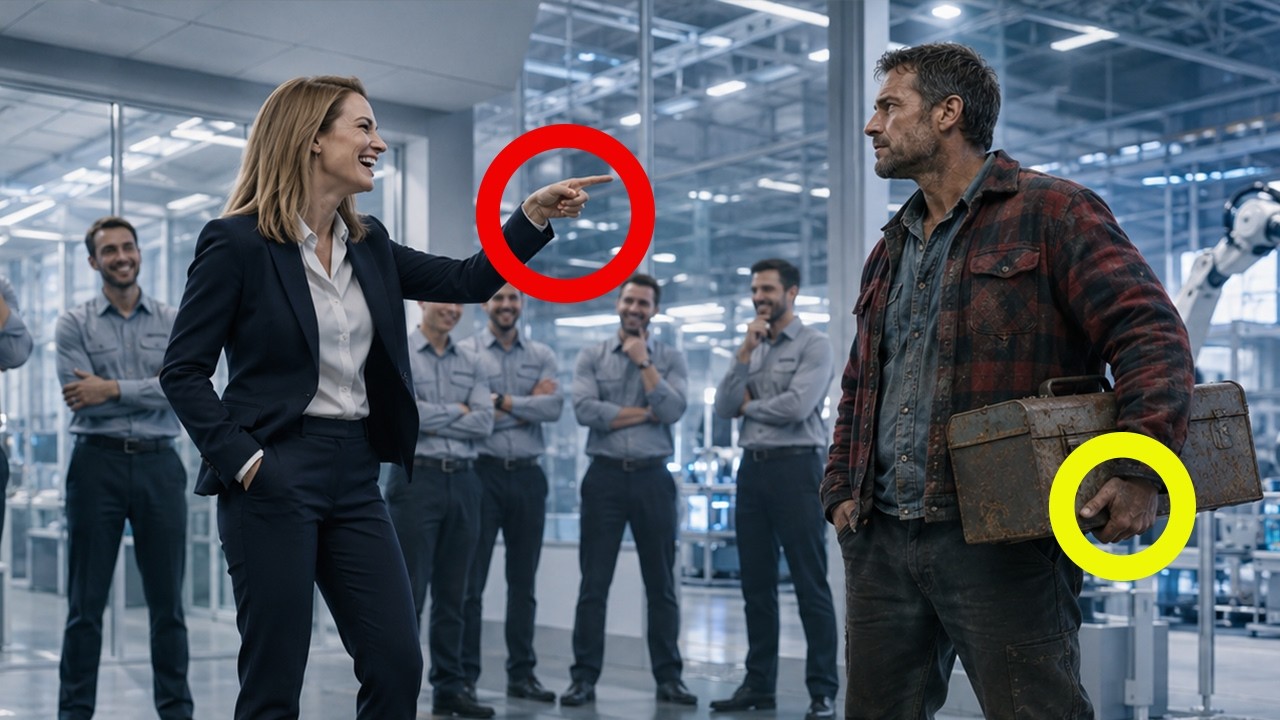
The first sign of trouble wasn’t the crash. It was the moment I opened my front door to a gray-haired stranger in hospital sweatpants, holding a paper bag with everything he owned. A toothbrush. A comb.

A bottle of blood pressure pills with no name on the label. That was all the hospital could send him home with. Behind me, Linda didn’t raise her voice. She never did when it mattered most.
“If that man walks through our front door, Daniel, I’m walking out. ”
Twenty minutes later, I watched a U-Haul pull away from the house we’d shared for 32 years. People ask when my life changed. They expect me to say it happened when the stranger turned out to be rich.
It didn’t. My life changed the moment I chose to open that door. My name is Daniel Harper. I’m 59 years old.
For nearly four decades, I’ve owned Harper Auto Repair on the east side of Springfield, Missouri. Two service bays, a faded blue sign that should’ve been replaced years ago, a coffee pot older than some of my customers’ grandchildren. But it put food on our table. It paid for Eric’s college.
It helped Melissa buy her first used car. And little by little, it paid off our mortgage. Linda and I had finally reached the point we’d talked about for years. Retirement wasn’t a distant dream anymore.
Another 12 months, maybe 18, and we’d slow down. Travel a little. See the Smoky Mountains in the fall. Spend Christmas with grandkids we hoped would come someday.
Then came that November storm. I remember every detail because nights like that stay with you. Highway 60 was nearly empty. Rain slammed against the windshield so hard the wipers barely kept up.
Visibility couldn’t have been more than 50 feet. Then I saw headlights where headlights shouldn’t have been—down in the ditch. I pulled over without thinking. An SUV had rolled at least twice before crashing into a stand of small trees.
Steam poured from the engine. One door had been ripped completely off. I called 911 while running toward it. A man was trapped behind the wheel.
Blood covered one side of his face. His eyes were open, but they weren’t focused. “Sir! Can you hear me?
”
Nothing. The dispatcher said emergency crews were coming, but flooding had blocked part of the highway. It could take 20 minutes. The smell of gasoline hung in the air.
I don’t know where the strength came from, but I managed to force the driver’s door open just enough to pull him free before smoke started pouring from under the hood. By the time the ambulance arrived, we were both soaked to the skin. A paramedic looked at me and simply said, “You probably saved his life. ”
I drove home thinking that would be the end of it.
It wasn’t. Three days later, I stopped by Mercy Hospital to check on him. He was awake. Confused.
The nurse smiled when she saw me. “He’s been asking about the man who pulled him out. ”
The stranger looked at me politely. “I’m sorry,” he said.
“Have we met? ”
I thought he was joking. He wasn’t. Doctors explained the head injury had caused severe memory loss.
He couldn’t remember his name, his family, his job—nothing. Police searched the wreckage. No wallet. No driver’s license.
No phone. The flood water had carried most of the debris downstream. They listed him as John Doe. Weeks passed.
Nobody came looking for him. One afternoon, a social worker asked if I could step into her office. She looked exhausted. “We’ve contacted adult protective services.
They’ve called every nursing facility within 80 miles. No openings. Waiting lists months long. ”
“What happens now?
”
She hesitated. “If no family is found, he’ll probably be transferred to a temporary shelter. ”
I glanced through the office window. He was sitting alone in the hallway reading a magazine upside down.
Not because he couldn’t read—because he didn’t realize it was upside down. Something about that broke my heart. That evening, I told Linda everything. She listened without interrupting.
When I finished, she stood at the kitchen sink for a long time before speaking. “We’ve worked our whole lives for what we have. ”
“I know. ”
“We don’t know this man.
”
“I know. ”
“He could become violent. ”
“I don’t think so. ”
“You don’t know that.
” She turned around. There were tears in her eyes. “Daniel, we’re finally debt-free. ”
I walked over and took her hand.
“I can’t leave him with nowhere to go. ”
She pulled her hand away. “What about us? ”
The conversation lasted nearly two hours.
Neither of us yelled. That almost made it harder. Eric came over after Linda called him. He folded his arms and looked at me like I was making the biggest mistake of my life.
“Dad, kindness is one thing. This is different. You’re gambling Mom’s retirement on someone you met for five minutes. ”
Melissa arrived later.
She sat quietly beside me on the couch. “I understand why you want to help him. ” Then she whispered, “But I’m scared too. ”
The next morning, I drove back to the hospital.
The stranger looked up when I entered. “They said I have to leave. I don’t know where to go. ”
Neither of us spoke for several seconds.
Finally, I said the words that changed everything. “You can stay at my place until we figure this out. ”
When we reached my driveway that afternoon, Linda was already loading boxes into the back of a rented U-Haul. Eric was carrying furniture.
Melissa stood beside her mother, crying. Linda looked straight at me. “If he comes inside—” She stopped, took a breath. “We’re leaving.
”
The stranger looked confused. “I don’t want to cause trouble. ”
I answered quietly. “This isn’t your fault.
”
I picked up his paper bag, unlocked the front door, and stepped inside. Behind me, I heard the truck engine start. I didn’t turn around—not until it disappeared at the end of the street. Then the house became so quiet.
I could hear the old grandfather clock in the hallway ticking for the first time in years. The first week was awkward. Not because the stranger did anything wrong—because neither of us knew how to live in a house that suddenly felt too big for the people inside it. My wife had taken most of the family pictures.
The living room walls still showed pale rectangles where frames had hung for years. Half the closet was empty. Even the coffee mugs looked lonely. The stranger noticed all of it.
“I really am sorry,” he said one morning as he stood at the kitchen table carefully buttering a piece of toast. “I don’t remember what happened before the accident, but I know enough to see that your family left because of me. ”
I poured coffee into two chipped mugs. “They left because of the choices they made.
”
He lowered his eyes. “I still wish it hadn’t cost you so much. ”
“So do I. ”
That was the truth.
I missed Linda every day—not because I doubted my decision, but because 32 years of marriage don’t simply disappear when someone drives away. I still reached for the other side of the bed some mornings before remembering it was empty. I’d catch myself saving the sports section of the newspaper because Linda always liked doing the crossword after breakfast. The hospital had called him John Doe, but that wasn’t much of a name for sharing a house.
“I guess we ought to call you something,” I told him. He smiled sheepishly. “I suppose so. How about Jack?
”
He laughed for the first time since I’d met him. “Why Jack? ”
“No idea. Works for me.
”
So Jack it was. Little by little, we settled into a routine. Every morning, we left the house at 7:30. I opened Harper Auto Repair.
Jack swept the shop floor before I even asked him to. He organized tools, wiped down workbenches, fed my old Labrador Rusty every afternoon without forgetting once. He insisted on paying his way even though he didn’t have a dollar to his name. “I’ll earn my keep somehow.
”
“You already are. ”
The funny part was watching him discover ordinary things all over again. One afternoon, I found him standing in front of the television. “What are you doing?
”
“I’m trying to turn this thing on. ”
“The remote’s in your hand. ”
He stared at it. “Oh.
” Then, perfectly serious, he asked, “So this is the television controller? ”
I laughed so hard I nearly spilled my coffee. “Remote control. That’s much shorter.
”
Another evening, he offered to make grilled cheese sandwiches. The smoke detector went off before either sandwich made it onto a plate. We ended up eating canned soup instead. “I appear to have mastered burning bread,” he announced.
“You’ll fit right in around here. ”
For the first time since Linda left, the house actually sounded alive again. Business at the garage stayed steady for a while. Most of my regular customers didn’t care about the rumors.
Others did. Springfield isn’t a huge city—people talk. Some believed I’d taken in a dangerous stranger. Others thought I’d finally lost my mind.
One customer quietly asked, “So this fellow sleeping in your house—should we be worried? ”
I simply answered, “If I trusted him enough to share my home, I trust him enough to work beside me. ”
He never mentioned it again. Money became a different story.
Without Linda’s paycheck from the county library, things tightened quickly. The heating bill came. Then property taxes. Then my truck needed new brakes.
One Friday afternoon, I opened the mailbox and found an envelope from a lawyer. Divorce papers. I sat in the office behind the garage for nearly an hour before opening them. Thirty-two years, reduced to signatures and legal language.
Jack quietly knocked on the door. “You’ve been sitting here a long time. ”
I handed him the papers. He didn’t read them.
He simply folded the envelope closed and handed it back. “I’m sorry. ”
I shook my head. “Don’t.
This isn’t your fault. ”
That evening, my son Eric called. “I’ve been talking to Mom. I figured you can’t afford that house by yourself.
”
“I’ll manage. ”
“No, you won’t. ” He wasn’t trying to sound cruel, just practical. “Sell it now before the divorce is finalized.
Take the equity. ”
“I’m not selling. ”
“Dad . .
. no. ” He sighed heavily. “I don’t even recognize you anymore.
”
After he hung up, I sat on the porch until dark. Jack joined me carrying two cups of coffee. He didn’t ask what happened. He already knew.
Around Thanksgiving, something unexpected happened. Mrs. Evelyn Carter walked into the garage carrying a velvet box. She’d been a customer for 20 years.
Inside was an old gold pocket watch. “My husband carried this every day after Korea,” she said softly. “Nobody can fix it. ”
I examined it.
Tiny gears, broken mainspring, delicate work. “I’m afraid watches aren’t exactly my specialty. ”
Jack looked over my shoulder. “May I?
”
He held the watch in his hands for several seconds. Something changed in his expression—not recognition exactly, more like instinct. “If I could borrow a small screwdriver. ”
Twenty minutes later, the watch began ticking.
Evelyn gasped. Tears filled her eyes. “How on earth did you do that? ”
Jack stared at the watch almost as if someone else had repaired it.
“I honestly don’t know. ”
After she left, I asked the same question. “You’ve never mentioned working on watches. ”
“I don’t remember ever doing it.
” He looked genuinely disturbed. “My hands just knew. ”
That night, he barely spoke. Memory hadn’t returned—only fragments of ability, like pieces of a puzzle scattered across a table.
Then, about a week later, I woke up around 2:00 in the morning. The front door creaked. Jack was gone. Panic hit me harder than I expected.
I drove around Springfield for almost an hour before spotting him sitting alone on a bench at the Greyhound station downtown. He had a small duffel bag at his feet. “You planning a trip? ”
He looked embarrassed.
“I thought leaving might fix your life. ”
“You honestly believe that? You’ve lost your wife. You didn’t take her.
You’ve lost your children. They made their own decisions. ”
He looked down at the pavement. “I can’t keep costing you everything.
”
I sat beside him. “My father used to tell me something. Doing the right thing usually costs something. ”
Silence settled between us.
Finally, I stood. “Come on. We’re home. ”
He hesitated.
“You still call it that? ”
I smiled. “As long as you’re under my roof, that’s exactly what it is. ”
He quietly picked up the duffel bag.
Neither of us noticed the black Chevrolet Tahoe parked across the street. Its headlights stayed off, but someone inside was watching us. The same SUV appeared outside the garage two days later—then again near the grocery store. I told myself it was probably nothing, until the night someone broke into my shop.
They didn’t touch the cash register. They ignored thousands of dollars worth of tools. The only thing missing was the newspaper clipping I’d saved about the night of the accident. Standing in the middle of my ransacked office, I felt a chill run through me.
Whoever broke in hadn’t come looking for money. They had come looking for Jack. The police dusted for fingerprints, took photographs, and asked the same questions three different ways. “Was anything valuable taken?
”
“Just an old newspaper clipping. ”
The officer frowned. “Nothing else? ”
I pointed toward thousands of dollars worth of tools hanging untouched on the wall.
“Nope. ”
He looked around the office one more time before closing his notebook. “Mr. Harper, people usually don’t risk breaking into a business for an old newspaper.
”
I knew that. That was the part that scared me. Whoever had come into my garage hadn’t wanted money. They wanted information—or maybe the man sleeping in my guest room.
For the next week, I checked the rearview mirror more often than the speedometer. The black Chevrolet Tahoe showed up twice—once outside the hardware store, once across the street from the garage. Never close enough to confront, always close enough to notice. I mentioned it to Jack over breakfast.
He set his coffee cup down. “I don’t think anyone should be following me. ”
“You don’t even know who you are. ”
“I know.
” He stared out the kitchen window. “And somehow, that worries me even more. ”
A few days later, life almost felt normal again. Almost.
The shop was busy changing winter tires and replacing weak batteries before Christmas. Around noon, the radio in the garage began playing old Christmas songs. Then Frank Sinatra came on. “Have yourself a merry little Christmas.
”
Jack froze. A wrench slipped from his hand and hit the concrete floor with a loud clang. His breathing changed. His eyes weren’t looking at the garage anymore—they were looking somewhere far away.
“Jack. ”
He whispered one word. “Sterling? ”
“What did you say?
”
He grabbed the workbench as though he might fall. “Sterling. Is that your name? ”
He closed his eyes.
“I—I don’t know. ”
Then it was gone. Just like that, whatever memory had surfaced disappeared again. Three days later, everything changed.
A reporter from the local Springfield television station showed up at the garage. She wanted to do a short piece about small businesses helping people during the holidays. I almost said no. Then she noticed Jack sweeping the floor.
“Is that the gentleman everyone was talking about a few months ago? ”
I nodded carefully. She interviewed us for maybe five minutes—nothing dramatic, just ordinary questions. Why did I help him?
How was he doing? Did he remember anything? The segment aired that evening. I figured nobody outside Greene County would ever see it.
I was wrong. The following morning, two detectives pulled into my parking lot. Not local police—state investigators. “Mr.
Harper? ”
“That’s me. ”
“I’m Detective Alan Brooks. ” He held up a photograph.
It showed a younger man in an expensive suit standing beside a large factory. The resemblance wasn’t perfect—the hair was darker, the face fuller—but the eyes were exactly the same. “Do you know this man? ”
I looked over at Jack.
He stared at the photograph, his forehead tight. “I… I don’t know. ”
The detective turned toward me. “Would you mind if we asked him a few questions?
”
For nearly an hour, they spoke privately in my office. Nothing came back. No memories, no names, nothing. Before leaving, Detective Brooks handed me a business card.
“We’d like permission to run a DNA comparison. ”
“Comparison with who? ”
He paused. “We’re not ready to discuss that.
”
Two days later, my phone rang before sunrise. The caller ID showed Missouri State Police. “Mr. Harper?
”
“Yes. ”
“We’d appreciate it if you could come downtown. ”
“Is something wrong? ”
A long pause.
“No. ” Another pause. “We think we’ve identified your friend. ”
Jack sat beside me during the drive.
Neither of us said much. The conference room at police headquarters held six people: two detectives, a state attorney, a gray-haired woman wearing an expensive navy blue suit, and an older gentleman who looked like he’d barely slept in weeks. The older man stood up the moment Jack walked in, his eyes filled with tears. “Charles.
”
Jack looked confused. “I’m sorry. Have we met? ”
The man stepped closer.
“I worked for you for 31 years. ”
Silence. “My name is Richard Sloan. ”
Still nothing.
Richard smiled sadly. “You always twisted your wedding ring whenever you were thinking. ”
Jack instinctively looked down without realizing it. He had been doing exactly that.
Richard’s voice cracked. “I saw you do it on television. ” He turned toward me. “I knew it had to be him.
”
The detective slid a folder across the table. “The DNA results confirmed it this morning. ” He looked directly at Jack. “Your name is Charles Sterling Whitmore.
”
Nobody spoke. “You’re the founder of Whitmore Engineering Group. ”
Jack blinked. “I’m—” He couldn’t finish the sentence.
“You disappeared eight months ago,” the attorney continued quietly. “Your vehicle was found after the accident, but flooding destroyed most identifying evidence. ”
Richard swallowed hard. “The company searched everywhere.
”
Jack looked completely overwhelmed. “I don’t remember any of this. ”
“We know. ”
Richard reached into his briefcase.
He carefully placed a family photograph on the table. Three grown children. Several grandchildren. A beautiful home.
Jack stared at it. “Nothing. ” Then very slowly, his hand began shaking. “My daughter.
”
Everyone leaned forward. “I… I remember teaching her to ride a bicycle. ”
Another image flashed. “So many leaves.
”
Then another. “A blue house. ”
His breathing became uneven. “I remember…” His voice broke.
“I remember my wife. ”
The room fell silent. Richard quietly wiped away tears. “She passed away three years ago.
”
Jack closed his eyes. Tears rolled down his face. He wasn’t remembering his fortune. He wasn’t remembering board meetings.
The first thing he recovered was grief. Over the next week, pieces of his memory returned little by little—never all at once, like old photographs slowly developing. He remembered founding his company, traveling overseas, long hours, his employees. Then something darker emerged.
The accident hadn’t been entirely accidental. Charles had quietly begun investigating financial fraud inside his own company. Millions of dollars had disappeared. Only a handful of executives knew he was looking into it.
The day before the crash, someone had warned him to stop asking questions. He ignored the warning. Now, federal investigators believed someone may have tampered with his SUV. The investigation reopened immediately.
News spread faster than either of us imagined. Within 48 hours, satellite trucks lined our quiet street. National reporters stood outside my garage. Neighbors gathered on sidewalks.
One reporter shouted as I locked up the shop:
“Mr. Harper, what was it like living with Charles Whitmore? ”
I answered honestly. “I lived with Jack.
Nothing more, nothing less. ”
Two mornings later, Charles asked if I’d stand beside him at a press conference. “I don’t think I belong there,” I said. He smiled gently.
“You’re the only reason I can be there. ”
Hundreds of reporters filled the ballroom in downtown Springfield. Executives, lawyers, employees, camera crews. Charles stepped to the podium.
He looked healthier than I’d ever seen him—still older, still carrying the weight of everything he’d lost. His first words weren’t about the company. They weren’t about money. They weren’t even about the investigation.
Instead, he looked directly toward me. “The wealthiest man I’ve met this year,” he paused, “owns a small auto repair shop. ”
The room became perfectly still. “When I had nothing, not even my own name, he expected nothing from me except honesty.
”
Camera flashes exploded. Charles continued. “My children inherited my success. This man reminded me what character looks like.
”
And somewhere watching that live broadcast, my wife, my son, and my daughter finally realized exactly who had been living under my roof. The morning after the press conference, my phone wouldn’t stop ringing. Customers, neighbors, people I hadn’t spoken to since high school. I ignored almost every call.
At my age, I’ve learned that when people suddenly become interested in you overnight, it’s usually because they’re interested in something else. Around 9:00, someone knocked on my front door. I already knew who it was. Linda always knocked twice, paused, then knocked once more.
Thirty-two years of marriage leaves you recognizing little things like that. When I opened the door, she was standing there holding an apple pie. Homemade. My favorite.
“Hi, Daniel. ”
“Morning. ”
“I baked this. ”
“I can see that.
”
Neither of us moved. Finally, I stepped aside. “You might as well come in. ”
She looked around the house.
Everything was almost exactly the way she’d left it—except now there were fresh flowers on the kitchen table. Charles had started buying them every Sunday at the farmers market because he said the house felt happier that way. Linda noticed. “I used to buy flowers.
”
“I remember. ”
She sat down carefully. “I’ve been watching the news. ”
“So have a lot of people.
”
Tears filled her eyes. “I made a terrible mistake. ”
I didn’t answer—because she had. But hearing her admit it didn’t erase the empty nights or the divorce papers sitting in my desk drawer.
She reached across the table. “I want to come home. ”
“Linda, I’m serious. ”
“So am I.
”
Silence settled between us. Finally, I said the only honest thing I could. “I’ve forgiven you. ”
Hope appeared in her eyes.
Then I finished. “But forgiveness and trust aren’t the same thing. ”
The hope disappeared just as quickly. Eric came by that afternoon.
He didn’t bring pie. He brought spreadsheets. He spread several pages across my dining room table. “Dad, I’ve been thinking.
I’ll bet if Mr. Whitmore really wants to invest in people…”
“I’m not asking him. ”
“You don’t have to. ” He smiled.
“I could expand my real estate business. ”
There it was. Not concern. Opportunity.
I folded the papers and handed them back. “You still don’t understand. ”
His smile faded. “I’ve apologized.
”
“No. You said you were sorry. You said you misjudged Charles. ” I looked him in the eye.
“You’ve never apologized for how you treated me. ”
He opened his mouth. Nothing came out. Melissa visited two days later.
She didn’t ask for anything. She simply hugged me. “I’m ashamed. ”
“I know.
”
“I should have stayed. ”
“You were scared. ”
“I was weak. ”
“Maybe.
Maybe not. Fear makes ordinary people do extraordinary things. Some good, some terrible. ”
Before she left, she quietly asked, “Do you think Mom still has a chance?
”
I answered honestly. “I don’t know. ”
A week later, Charles invited me to lunch. We sat in a small diner outside Springfield where nobody bothered us, at least for a little while.
He stirred his coffee thoughtfully. “I owe you more than I can ever repay. ”
“You don’t owe me anything. ”
He smiled.
“That’s exactly why I do. ”
A leather folder appeared on the table. Inside were documents—investment agreements, property deeds, stock certificates. “I can’t accept this.
”
“You haven’t even looked. ”
“I don’t need to. ”
He leaned back. “Then tell me what you do want.
”
I thought about it longer than he probably expected. Finally, I said, “The truth. ”
He frowned slightly. “My family believes they’re sorry because you turned out to be wealthy.
”
He nodded. “I want them to understand what really happened. ”
“And how do we do that? ”
“You tell the story publicly.
Honestly. ”
Charles smiled. “I think I know exactly how. ”
The invitation said it was a family dinner.
Nothing more. Linda assumed we were celebrating. Eric arrived wearing his best suit. Melissa looked nervous.
When they walked into the private dining room at the Springfield Country Club, they immediately noticed something unusual. Our pastor was there. Sheriff Collins. Mrs.
Carter, whose pocket watch Charles had repaired. Several longtime neighbors. Two members of Charles’s company board. Even the editor of the local newspaper.
No television cameras. No national reporters. Just people whose opinions actually mattered. Eric whispered.
“Dad, what’s going on? ”
I simply answered. “Sit down. ”
Dinner was quiet, almost uncomfortable.
After dessert, Charles stood. He wasn’t wearing an expensive business suit—just a navy sport coat and khakis. The same way he dressed when we went grocery shopping together. He raised his coffee cup.
“I’d like to tell everyone how Daniel Harper saved my life. ”
For fifteen minutes, he described everything. The accident. The hospital.
Sleeping in my guest room. Burning grilled cheese. Repairing Mrs. Carter’s watch.
The night I’d found him sitting alone at the bus station because he was trying to leave before he caused more damage. People laughed softly. Some wiped away tears. Then Charles became serious.
“There is one part of this story I haven’t shared. ” He looked toward Linda. “May I ask you a favor? ”
She nodded uncertainly.
He handed her a single sheet of paper. “I’d appreciate it if you’d read that aloud. ”
She glanced down. Her face immediately lost color.
“I—” She couldn’t continue. Charles waited patiently. “It’s your text message. ”
Silence.
Finally, she began reading. “‘Daniel has chosen that stranger over his own family. Maybe he’ll understand what he’s lost when we’re gone. ’”
Her voice broke.
She couldn’t continue. Charles gently took the paper from her. He turned toward Eric. “I have one question.
”
Eric swallowed. “Yes, sir. ”
“If your father had died rescuing me that night, would you still believe he made the wrong choice? ”
The room became impossibly quiet.
Eric stared at the table. One second. Five seconds. Ten.
No answer came. That silence spoke louder than any speech. Charles looked around the room. “I’ve spent my entire career evaluating engineers,” he said sadly.
“But character is much harder to measure. ” He paused. “Kindness means very little when it costs nothing. ”
Nobody applauded.
Nobody argued. The only sound came from the grandfather clock standing in the corner of the dining room. Even Sheriff Collins looked down at his folded hands. Our pastor quietly cleared his throat.
“I believe,” he said softly, “we’ve all been reminded of something important tonight. ”
Linda was crying openly now. Melissa reached over and held her mother’s hand. Eric finally looked at me—not at Charles, at me.
“I’m sorry, Dad. ”
For the first time, I believed he meant it. Still, some things take longer than a single sentence to repair. I stood, thanked everyone for coming, and walked onto the patio outside.
The autumn air felt cool against my face. A moment later, Charles joined me. “You all right? ”
I nodded.
“I expected revenge to feel better. It doesn’t. ”
He smiled knowingly. “No, it just feels—” he searched for the right word—“finished.
”
Charles rested a hand on my shoulder. “Sometimes that’s enough. ”
Winter came quietly to Springfield that year. The first snow fell just after sunrise, covering the roofs along our street with a thin white blanket.
From the window of my kitchen, everything looked clean again. Funny how snow can do that. It hides the cracks in the sidewalk for a while. Life doesn’t work that way.
Some cracks remain visible no matter how much time passes. Three months after the dinner, the divorce between Linda and me became final. People often ask whether I fought it. I didn’t.
The marriage had ended long before the judge signed the papers. The paperwork simply caught up with reality. I wished Linda well, and I meant it. But wishing someone well isn’t the same as asking them to come back.
That chapter of my life had already been written. Charles kept his promise about the investment. Actually, he kept it in a way I never expected. Instead of handing me a check, he asked me to meet him at the garage one Saturday morning.
Three architects were waiting, along with a contractor and a banker. “I thought you said you didn’t want money,” Charles said with a grin. “I don’t. ”
“You don’t.
” He pointed toward the empty lot beside my shop. “So I bought the land. ”
“Charles—“
“Hear me out. ”
He unfolded a blueprint across my old workbench.
The plan included one additional service bay, updated equipment, better lighting, and a small training space for young mechanics learning the trade. “You’ll still own Harper Auto Repair,” he said. “You’ll still make every decision. ”
“I don’t want people thinking I cashed in.
”
He smiled. “They won’t. ”
The agreement named Charles as a silent investor. No advertisements, no press release, no ribbon-cutting ceremony.
Just two old men trying to build something useful I could live with. The expansion gave me room to hire two apprentices from Ozarks Technical Community College. One of them was 19-year-old Tyler Jenkins. His father had died when he was 16.
His mother worked nights at a nursing home. The kid had talent. What he lacked was confidence. The first time he rebuilt a transmission without my help, he walked into my office looking like he’d won the lottery.
“I actually did it. ”
“You sure did. ”
He smiled so wide I thought his face might split in half. Watching him reminded me of Eric at that age.
Hope has a way of sneaking up on you. Charles threw himself into something entirely different. He established the Ordinary Heroes Foundation. The mission was simple: provide emergency grants to people who had put themselves at financial risk helping complete strangers.
A rancher who rescued a family during a flood. A retired schoolteacher who became guardian for her disabled neighbor. A truck driver who emptied his savings to care for an injured coworker. Ordinary people doing extraordinary things.
Against my better judgment, Charles named me chairman of the selection committee. “I don’t wear suits,” I protested. “You don’t have to. ”
“I don’t know anything about running a foundation.
”
“You know how to recognize character. ”
Apparently, that was enough. Melissa kept her word. Every Sunday after church, she’d stop by with lunch—sometimes fried chicken, sometimes homemade chili.
We never forced big conversations. We just spent time together. Trust doesn’t grow through speeches. It grows through consistency.
One afternoon, she looked around the garage and smiled. “You seem peaceful. ”
“I am. ”
“I wasn’t sure I’d ever hear you say that again.
”
“Neither was I. ”
Eric had a harder road. The real estate market shifted. Several risky investments failed.
Within a year, he’d lost nearly everything he’d built. One evening, he showed up at the shop wearing faded blue jeans instead of tailored business clothes. “Dad? ”
“Come on in.
”
“I need work. ”
I studied him for a moment. “I don’t know the first thing about fixing cars. ”
“I know.
I’ll sweep floors. ”
That answer told me more than anything else could have. He wasn’t asking for money. He was asking for another chance.
I handed him a broom. “Start over there. ”
He smiled. “Yes, sir.
”
We didn’t hug. We didn’t cry. Some relationships heal quietly. Linda wrote often.
Birthday cards. Christmas cards. Letters tucked inside plain white envelopes. She never blamed anyone else—not me, not Charles, not even Eric.
She accepted responsibility for every choice she’d made. For a long time, I left the letters unanswered. Not out of anger. I simply didn’t know what to say.
Eventually, I mailed a short note. Only three sentences. “Linda, I truly hope your life is filled with peace. I forgave you a long time ago because carrying resentment would only have made both of us poorer.
But trust grows slowly, and sometimes the kind we lose never fully returns. ”
She never wrote again. I like to think she understood. One crisp October morning, Charles and I sat on my front porch with two steaming cups of coffee.
The maple tree in the front yard had turned bright red. Rusty, now slower than ever, slept between our chairs. Charles watched the leaves drift across the lawn. “You know, people still ask me what it felt like to lose my memory.
”
“What do you tell them? ”
“The truth. ”
“And what’s that? ”
He smiled.
“I lost my past. ” He looked at me. “But somehow I found the people who actually belonged in my future. ”
I laughed softly.
“That’s a pretty good trade. ”
He chuckled. “What about you? ”
I took a slow sip of coffee before answering.
“For a long time, I thought saving you cost me my family. ” I looked toward the garage across the street, where Tyler and Eric were already unlocking the doors for the day. Melissa would stop by after church tomorrow. The shop was thriving.
The mortgage was paid. My heart felt lighter than it had in years. “I think it revealed who my family really was. ”
Charles nodded without saying another word.
Neither of us needed to. At our age, silence can be just as meaningful as conversation. Looking back, people assume this story is about a wealthy man who rewarded someone for doing the right thing. They’re wrong.
The money helped, of course. I’m not naive enough to pretend it didn’t. But money wasn’t the reward. Peace was.
The freedom to look in the mirror each morning and know I hadn’t abandoned someone who needed me. The chance to watch my children become better people—not because life was easy, but because life finally taught them what I couldn’t. And the friendship of a man who entered my life with no name at all, yet became one of the brothers I never knew I needed. If there’s one lesson I’ve carried from all of this, it’s that kindness isn’t an investment you make expecting a return.
Sometimes it costs you more than you ever imagined. But even then, it has a way of revealing what truly matters. If this story spoke to your heart, I hope you’ll share it with someone who still believes that character is worth more than comfort.
You never know whose life—or your own—you might save.