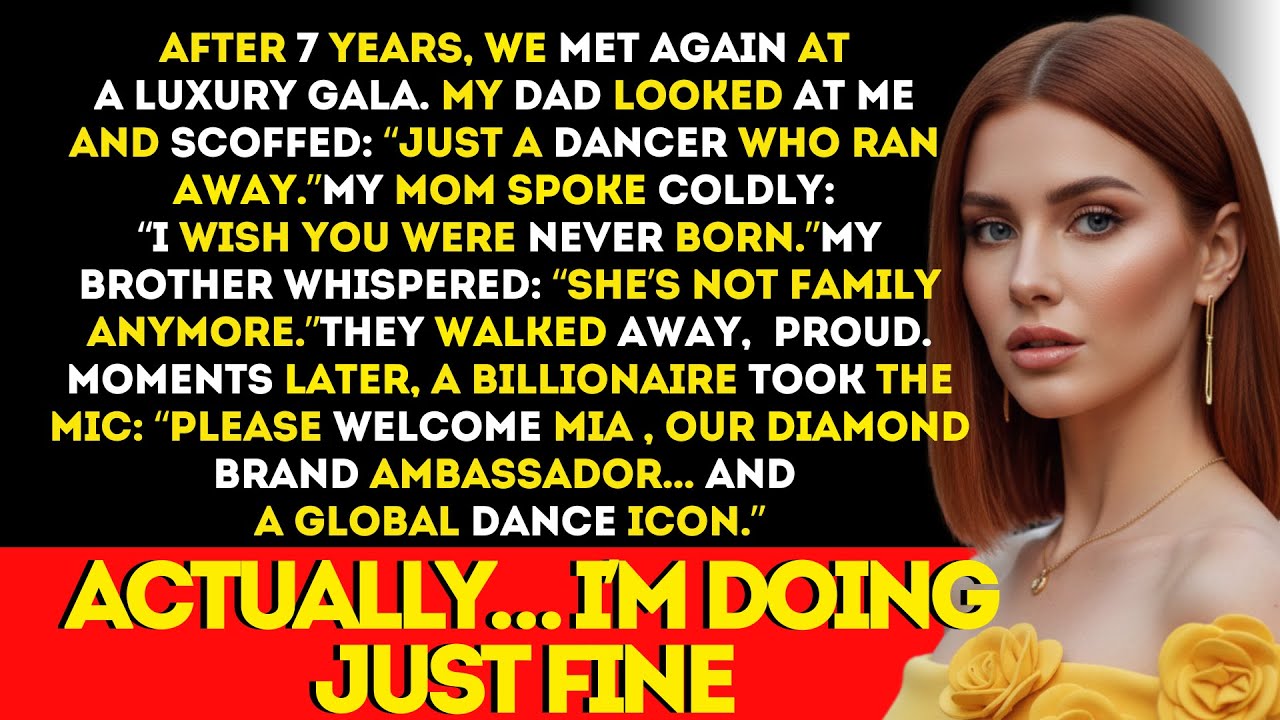
My family saw me again after seven years, and my father said I was just a dancer who ran away. My mother said she wished I had never been born. My brother said I wasn’t family. Then they turned their backs.
They didn’t wait for my reaction. That stayed with me more than the words. My father didn’t pause to see if I’d argue. My mother didn’t hesitate or soften.
My brother didn’t look uncomfortable saying it. They said what they came to say and walked away as if the conversation ended years ago, and they were just closing a door they’d already shut. I stayed where I was. Not frozen, not shocked, just still.
People around me kept talking. Laughter rose from a table. Someone clinked a glass. The gala didn’t slow down for what had just happened.
No one noticed a family quietly dismantling one of its own. That hurt most—not the cruelty, but how normal it looked. I let my mother walk away without calling her name. I let my father keep his word.
I let my brother’s verdict stand. Because at that moment, something became clear. They hadn’t come to reconnect. They hadn’t come to reconcile.
They came to confirm I was still small enough to dismiss. When they were done, they walked away. I let them. The gala itself was everything it was supposed to be.
Polished, expensive, efficient. A room designed to celebrate power without ever naming it. I wasn’t the main guest. My name wasn’t on the program.
I was there as a performer, a collaborator, a detail. I arrived alone, no plus one, no family scanning the room for me. That’s why they didn’t recognize me at first. They entered the way they always had—my father slightly ahead, my mother smiling at the right people, my brother already nodding as if he belonged in every conversation before it started.
They were greeted immediately. Hands reached for them. Compliments flowed. They hadn’t changed.
I noticed them before they noticed me. That had always been the pattern. For a moment, I considered stepping away, preserving the distance I’d spent seven years building. But I didn’t move.
I was tired of shrinking to avoid collisions that weren’t my fault. When they finally saw me, it took a second too long. My mother’s eyes slid past me once before coming back. My father tilted his head, trying to place my face.
My brother recognized me last—not because he couldn’t, but because he hadn’t expected to need to. The pause was brief. Then the old hierarchy snapped back into place. My father laughed first.
Not loud, not cruel sounding to anyone else. The kind of laugh men use when they think they’re being reasonable. “You’re still dancing,” he said, looking me up and down. Not working.
Not performing. Dancing. My mother didn’t smile. “I told you,” she said flatly.
“This is what happens when you throw your life away. ”
My brother stepped in like he always had, turning judgment into policy. “She made her choice. She’s not family anymore.
”
There it was. Clean, final, approved. I didn’t interrupt. I didn’t defend myself.
I didn’t list credits or explain why I was there. They weren’t listening. They never were. They said what they needed to say—not to me, but to themselves—and turned away without a glance back, as if there was nothing left for me to do there.
I stood longer than I should have, not because I hoped they’d return, but because I wanted to be sure I didn’t move out of instinct. I wanted to know that when I finally did, it would be because I chose to. That was when it hit me. I’d lived seven years without them.
Seven years without calls, without holidays, without anyone checking if I landed on my feet. And somehow, I was still standing. The realization didn’t feel triumphant. It felt factual.
Seven years ago, I walked out of their house with one bag and no plan. They didn’t call. They didn’t check if I was safe. The door closed, and I disappeared from their version of the family story as cleanly as if I’d never existed.
I used to think that meant I’d failed them. Now I understood it meant something else entirely. They’d never planned to keep me in the first place. Looking back, the signs were always there.
In our house, nothing was ever called love. It was called potential. My parents didn’t talk about their children the way other parents did. They talked about us the way people talk about investments—long-term return on effort, risk management.
Praise came with numbers attached. Applause arrived only after proof. Affection followed success like an accessory. The system was simple.
Perform well, and you were seen. My brother understood that early. He fit into it the way a missing piece snaps into place. When he failed a test, my parents said he was burned out.
When he lost a competition, they said he was learning resilience. Failure in his case was framed as growth. Mine was framed as character. If I forgot something, I was careless.
If I questioned something, I was difficult. If I didn’t excel fast enough, I wasn’t trying hard enough. No one announced these rules. They repeated themselves until everyone learned them, including me.
The label arrived during a family dinner when my aunt asked what I liked, what I wanted to do. “I like dancing,” I said. “I’ve been taking classes after school. ”
My mother laughed.
Not loudly. Just enough. “Oh,” she said, waving her hand. “She’s the creative one.
”
Everyone smiled. The conversation moved on. No one corrected it. The words settled into place like a nameplate screwed onto a door.
Creative—not serious, not reliable, not essential. From then on, everything I did passed through that filter. The real break came with an announcement at dinner. My parents had decided something big about the future—money, planning, years ahead.
My brother had been consulted. His preferences were discussed. I found out at the same time as the salt being passed. I asked one question.
“Was there a reason no one asked me? ”
The room shifted. My father leaned back as if preparing for a lecture. My mother’s face tightened.
My brother looked at his plate. “This is what’s best for the family,” my mother said. “You wouldn’t understand the logistics,” my father added. My brother finally looked up.
“It’s not personal,” he said. “It just makes sense. ”
Three voices, one direction. No one raised their voice.
No one threatened anything. But the decision stood. I realized then that I wasn’t part of the planning. I was part of the outcome.
I went to my room that night and sat on the edge of my bed with the door closed. I didn’t cry. I didn’t throw anything. I just sat there in the dark, trying to understand what had happened.
It wasn’t the decision itself that hurt. It was that no one had considered me worth consulting—not even as a formality. I’d been erased from the process so completely that my absence hadn’t even registered as unusual. That was when I started to understand.
I wasn’t failing to fit in. I was never supposed to fit in the first place. The morning I left didn’t feel important. No slamming doors, no raised voices.
The house moved the way it always did—predictable, efficient. My father read the news at the table. My mother stood at the counter making notes. My brother scrolled through his phone.
No one looked at me. Breakfast tasted like routine. The announcement came casually, midsip, as if it were just another logistical update. My parents had decided something about my future, about education, about direction.
They spoke in plurals. “We think this is best. We’ve considered all the options. ”
They didn’t ask if I agreed.
They didn’t even ask if I understood. I listened. I nodded. I waited for the part where my opinion entered the room.
It never did. That was the moment—the quiet, precise moment—when something inside me stopped trying to keep up. “Why wasn’t I asked? ” I said.
My mother sighed, already tired of the conversation she hadn’t agreed to have. “This isn’t about you. ”
“We’re making responsible decisions,” my father added. “I live here, too.
”
That was when my brother spoke. He didn’t raise his voice. He didn’t smirk. “It’s just not practical to factor everyone in.
Someone has to make the call. ”
Neutral. Reasonable. Final.
My father stood up. “We’re not going to turn this into a scene. If you can’t accept what we’ve decided, then maybe you need to think about what you actually want. ”
It wasn’t a threat.
That was what made it dangerous. My mother just nodded, as if relieved someone had said it out loud. I went quiet. Not defiant, not dramatic, just still.
The silence stretched longer than they expected. Finally, my father said it. “If you walk out that door, you’re making a choice. ”
He didn’t say “Don’t go.
” He didn’t say “We’ll talk about this. ” He said “choice,” a word that sounded fair, balanced, almost generous. But I understood what he meant. I nodded once.
“Okay,” I said. That was it. My mother looked startled—not because she cared, but because she hadn’t anticipated that response. My brother frowned, recalibrating.
My father watched me carefully, waiting for a catch. There wasn’t one. I stood up from the table and walked to my room. No one followed.
Packing took less time than I expected. Not because I didn’t own much, but because most of it didn’t feel like mine. I skipped the photos, the memorabilia, the things my parents liked to point to when telling stories that didn’t include my version. I took clothes, practical things, a notebook, one object I’d kept hidden for years because it reminded me of a time someone had seen me without needing proof.
The hallway felt longer than usual. My mother stood in the kitchen doorway, arms folded—not blocking my path, not offering help. My brother stayed seated, eyes down. My father stood near the door and opened it without being asked.
That gesture almost undid me. “You know where this leads,” he said. I met his eyes. “So do you.
”
That was the last sentence I ever said to him as his daughter. The door closed behind me with a sound too soft for something so permanent. No one called out. No footsteps followed.
I stood outside for a moment longer than necessary, adjusting the weight of my bag. I didn’t feel brave. I didn’t feel free. I felt accurate, like I’d finally aligned my actions with the truth I’d been carrying for years.
Walking away didn’t feel like rebellion. It felt like refusal. Refusal to keep shrinking. Refusal to keep auditioning for a role that would never be mine.
I didn’t leave because I hated them. I left because staying meant disappearing. The first morning after I left didn’t feel like a beginning. There was no sense of freedom, no relief.
I woke up because my body did what it always did. The day didn’t start. It simply continued without checking whether I was ready. The room I was in wasn’t temporary in the way people romanticize.
It was functional. A place where sleep happened, where belongings were kept close because there was nowhere else to put them. I sat up and ran through what needed to be done—not in order of importance, but in order of urgency. Food, work, paperwork.
Survival didn’t come with a narrative. It came with a checklist. The first form I filled out asked for basic information. Name, date of birth, address.
Then the cursor blinked at the next line. Emergency contact. I didn’t hesitate because I was emotional. I hesitated because there was no correct answer.
The system was binary. It required a name and a number to proceed. It didn’t have a checkbox for “I no longer exist to them. ”
The questions continued, slightly rephrased each time, as if the software were trying to catch me in a lie.
Family members. Next of kin. Relationship to patient. Each box assumed the same thing—that there was a person attached to me who could be called if something went wrong.
I tried to type “N/A,” but the box turned red, demanding a valid entry. I typed a fake number just to make the red light go away. That was when it became clear. My family hadn’t disappeared emotionally.
They’d disappeared administratively. No names to enter, no numbers to dial, no relationship to verify. They weren’t an option I was choosing not to use. They simply weren’t available in the system I now existed in.
I noticed it everywhere after that. In waiting rooms, at counters, in lines where people leaned forward to say “my mom is coming to pick me up,” secure in the knowledge that someone would answer. I watched signatures happen without thought. No one questioned these exchanges.
I wasn’t excluded. I just wasn’t accounted for. The flu hit me three weeks after I left. I woke up with a fever and a headache that made light feel like a physical weight.
I had a shift in four hours. I took two pills, drank water standing at the sink, and got dressed slowly. At work, someone asked if I was okay. I said yes.
They nodded and moved on. No one sent me home. No one offered to cover my shift. It wasn’t cruelty.
It was efficiency. If I could stand, I could work. When I finally got back to my room, I lay down fully clothed and stared at the ceiling. My phone sat on the small table.
I thought about calling someone—anyone—just to hear a voice that knew my name without me having to provide an ID number first. I didn’t because I couldn’t think of who that would be. And even if I could, I didn’t know what I’d say. I was managing.
I was functioning. That was supposed to be enough. By morning, the fever had broken. I got up, went to work, and didn’t mention it to anyone.
That was when I understood. Being alone wasn’t the right word. Alone implied absence of company. Erased implied absence of reference.
No one disliked me. No one wished me harm. There simply wasn’t a scenario where someone else was expected to step in on my behalf. A month later, I needed to sign a lease.
The landlord was an older woman who spoke quickly and didn’t make eye contact. She pushed the papers across the desk. “Sign here, here, and here. I’ll need a deposit, a background check fee, and an emergency contact—someone local who can take responsibility if something happens to you.
”
I filled out everything except that line. “You need to fill that in,” she said. “It’s required for the insurance. ”
“I don’t have anyone local,” I said.
She looked at me for the first time—not unkindly, just assessing. “Parents? Siblings? A friend?
”
I didn’t offer a sad story. I didn’t want a pity discount. Finally, she sighed and took the form back. “I’ll put my daughter’s number down.
She doesn’t need to know. Just don’t make me regret it by dying in there. ”
I moved in two days later. The apartment was small—one room, a kitchenette, a shower that only ran hot if you didn’t touch the knob.
But it was mine. No one could tell me to leave unless I stopped paying. No one could decide I didn’t belong. For the first time in my life, I lived somewhere that didn’t require someone else’s approval.
I didn’t feel angry about any of it. Anger requires friction, something to push against. There was nothing there. No moment where I thought, “How could they do this to me?
” Just a recalibration. I wasn’t abandoned. I was removed. Life continued to function around that fact without pause.
Shifts overlapped. Tasks stacked. Time compressed into blocks small enough to manage. I learned which things couldn’t wait and which could be ignored indefinitely.
There was no room to sit with thoughts. Thinking was inefficient. One afternoon during a routine shift, my body failed me for a fraction of a second. Not a collapse, just a moment where my balance didn’t catch up with my movement.
I steadied myself against the nearest surface and continued. No one asked if I was okay. No one slowed down. That moment stayed with me longer than it should have, not because it hurt, but because it confirmed something.
If I stopped, everything would continue. If I couldn’t continue, nothing would pause to accommodate that. This wasn’t neglect. It was designed.
By the time I filled out another form weeks later, my hand moved without hesitation. Emergency contact: blank. I didn’t hover. I didn’t reconsider.
I moved on to the next section. No one had to abandon me. I had already been removed. The day my body stopped cooperating didn’t look dramatic.
No sharp pain, no collapse. I woke up and stayed where I was, staring at the ceiling, waiting for my legs to move. They didn’t—not because they couldn’t, but because they hadn’t decided yet. Time passed in fragments.
Light shifted. The world moved forward without checking whether I was ready to follow. That was the worst part. No one witnessed it.
Eventually, I sat up. The motion required planting my arms first, then my back, then a long second at the edge of the bed while my body recalibrated. I reached for my phone without thinking. No messages, no missed calls, nothing that suggested my absence would register.
That was normal. Still, something about this morning felt heavier. Not sad. Final.
I broke the only rule I’d kept since leaving. I typed three words. “I’m not okay. ”
No punctuation.
No context. I stared at the screen longer than necessary, then sent it before I could reconsider. For a moment, I felt exposed, like I’d said something aloud in an empty room. I placed the phone face down.
An hour passed. Nothing. I told myself they might be busy. By evening, I was tired enough to lie down again without resistance.
The phone stayed close, near enough that I would hear it if it decided to matter. It didn’t. I slept poorly. The phone was still silent in the morning.
I went to work anyway, moved through the shift in muscle memory, smiled when expected, nodded when spoken to. No one noticed the difference. By the second night, I understood what was happening. This wasn’t delayed.
It wasn’t uncertainty. It was a decision. I got it on the third day. The phone vibrated once.
Just once. No typing indicator. No follow-up. Three words.
“You chose this. ”
No “are you safe. ” No “where are you. ” Just a verdict.
I didn’t cry right away. I sat there for a long time with the phone in my hand, not rereading the message, not locking the screen. My thoughts didn’t spiral. They adjusted, like something finally clicking into place.
This wasn’t punishment. It wasn’t anger. It was policy. For the first time since leaving, I understood the rules clearly.
There was no one behind me. Not emotionally, not practically, not administratively. If I fell now, there would be no safety net. I set the phone down carefully, as if roughness might change what it said.
It didn’t. I didn’t reply. Not out of pride, not out of anger, but because replying would mean pretending this was a conversation. It wasn’t.
It was a boundary drawn from the other side. From that day on, I changed how I moved through the world, quietly. I stopped assuming someone would catch me if I misstepped. Stopped budgeting energy for explanations that wouldn’t be received.
Instead, I built rules that didn’t rely on permission. Show up anyway. Finish what you start. Don’t fall where no one is coming.
That night, before sleeping, I looked at the message one last time. I didn’t screenshot it. I didn’t delete it. I let it stay exactly where it was—not as a wound, but as a reminder.
If I fell now, no one would come. So I wasn’t allowed to fall. At first, I thought the ache was just fatigue. The kind that disappears after sleep.
But morning came, and the ache was still there. Not sharp, not dramatic, just persistent, like something unfinished. Every stretch asked a question. Every step came with a cost.
My mind was ready. My body wasn’t. I trained anyway. Not harder, not recklessly, just the way I always had, trusting muscle memory to do the thinking for me.
There was nothing special about that session. No audience, no pressure, which is why it happened there. The mistake was small. A fraction of a second late.
A landing just off center. I heard a sound that didn’t belong to the room. The pain came after—not screaming, not cinematic, just immediate and undeniable. I tried to stand.
My weight shifted wrong. The signal didn’t reach where it was supposed to go. No one was there. Not to rush over.
Not to confirm something had gone wrong. I waited until the floor stopped feeling unstable, then stood slowly, testing each movement like it might refuse me again. The doctor didn’t look surprised. He didn’t ask why stopping wasn’t an option.
He looked at the results, gave a diagnosis, and explained the timeline. Rest, time, caution. If not, the damage wouldn’t heal the right way. “Permanent” wasn’t said dramatically.
It was said clinically. I nodded. I always nodded. The choice didn’t present itself as moral.
It wasn’t right versus wrong. It was safe versus still mine. If I stopped completely, I could preserve what remained. But stopping meant waiting, and waiting meant drifting back into a space where nothing was guaranteed except being forgotten.
I didn’t choose recklessly. I chose narrowly. I wrapped the joint tighter, adjusted my pace, changed how I landed, modified movements until they fit around the injury instead of through it. Every day became an experiment.
Pain stopped being a signal and became a parameter, something to manage, something to measure. No one applauded that adjustment. No one checked whether it was sustainable. The thought came one morning without warning.
What if you stop? Not as fear, but as logic. What if you protect what’s left? The idea lingered longer than I expected.
That was new. I still went to the studio. Not because I was confident, but because the alternative felt final. I showed up and did what was possible.
That became enough. Lying there at night, I understood something clearly. If I stopped now, I would be safe. And if I stopped now, I would be done.
I trained late because no one needed the room. That was the only reason. The lights were already dimmed. Half the mirrors covered.
The space was in the process of forgetting itself for the night. I wasn’t preparing for anything. I was reminding my body that it still knew how to move. The studio wasn’t mine.
It never had been. I used it when I was allowed to, after cleaning, after hours, when no one complained. My ankle was taped under my shoe. The joint still complained when I landed certain ways.
But I had learned how to move around it, how to distribute weight differently, how to finish sequences without letting anyone see where the pain lived. I didn’t know anyone was watching. That mattered. There was no shift in my routine, no instinct to impress.
I just kept going because that’s what I did when no one was looking. I worked through a combination I’d been refining for weeks, not because anyone asked me to, but because leaving it unfinished felt worse than the ache in my legs. The sound came after I finished. A single clap.
Not loud, not enthusiastic, just enough to interrupt the silence. I turned more confused than startled. No one had ever applauded me when I danced for myself. He stood near the door.
Older, maybe mid-fifties, dressed in a way that suggested money without announcing it. He didn’t rush to speak. That pause felt intentional, like he was giving me time to decide whether to run or stay. I stayed, mostly because I didn’t know what else to do.
“How long have you been training here? ” he asked. “A few months. After hours, when it’s available.
Before that, other places, wherever I could find space. ”
He nodded slowly. “You favor your left side when you land. Most people wouldn’t notice, but you’re compensating for something.
”
I didn’t confirm or deny it. I just waited. The questions he asked next weren’t the ones I expected. He didn’t ask what I wanted to become.
He asked how long I practiced when no one was watching. Who corrected me when there was no one to correct me. How I decided what to fix when feedback didn’t exist. I answered honestly because there was nothing to sell.
“I record myself sometimes. I watch it back and look for what doesn’t match what I meant to do. Then I try again. And when I can’t fix it, I adjust.
I find a different way to get to the same place. ”
“You’ve been doing this alone for a while,” he said. It wasn’t a question. “Yes.
”
“Why? ”
“Because stopping felt worse,” I said finally. He smiled then, just barely, just enough to soften the edges of his face. “That’s the only reason that matters.
”
He walked further into the room, not toward me, just away from the door. “You do something most trained dancers forget. You finish sequences even when no one’s counting. You don’t stop at the hard part and start over.
You push through and clean it up after. That tells me you’re not performing for an audience. You’re solving a problem. ”
I didn’t know what to say.
No one had ever described my dancing that way before. “I’m putting together a project,” he said. “High-profile, international. It’s not public yet, so I can’t give you details, but I’m looking for people who know how to work when no one’s watching.
People who don’t need applause to show up. ”
He paused, letting that settle. “I’d like you to audition. ”
The word caught me off guard.
“Audition? ”
“More of an assessment. I need to see if you can do this under pressure, with other people in the room, when the stakes are real. If you can, there’s a place for you.
If you can’t, at least you’ll know. ”
“Why me? ”
He looked at me directly, no hesitation, no politeness softening the truth. “Because I’ve been watching you for three weeks.
I’ve seen you come in here after midnight, work until your legs shake, then come back the next night and do it again. I’ve seen you tape that ankle and keep going. I’ve seen you miss steps and fix them without anyone telling you what went wrong. That’s not talent.
That’s discipline. And discipline is harder to teach. ”
Three weeks. He’d been watching for three weeks, and I hadn’t known.
The thought should have unsettled me. Instead, it clarified something. This wasn’t random. This wasn’t luck.
This was someone who had decided I was worth the effort of observation. “There’s a gala coming up,” he said, “in a few weeks. It’s not the project I mentioned, but it’s adjacent. I’ll need people there who can perform under scrutiny.
If you’re interested, I’ll send you the details. ”
He didn’t wait for me to agree. He just assumed I would. And maybe that assumption mattered more than anything else he’d said.
He saw me as someone who would say yes, not out of desperation, but out of capability. “One more thing,” he said, already turning toward the door. “When you get there, don’t try to fit in. Don’t try to impress anyone.
Just do what you do when you think no one’s watching. That’s what I’m paying for. ”
He left before I could respond. The door closed quietly behind him.
I stood there for a long time, replaying the conversation, testing it for cracks, for conditions I’d missed, for warnings I should have heard. There weren’t any. Or if there were, I couldn’t see them yet. For the first time in years, I wasn’t invisible.
Someone had looked at me and seen not what I was trying to become, but what I already was. And somehow, that was enough to make me believe I could survive whatever came next. I arrived at the audition at the exact time written in the message. The room was bigger than the ones I was used to.
Not warmer, just more efficient. Mirrors everywhere. Music already cued. People stretching without looking around to see who else was there.
No one introduced me. No one needed to. There were others, more than I expected, younger mostly. Some moved like they’d been trained to survive rooms like this.
They didn’t stare. They didn’t size me up. That was worse. No one hated me.
That was the problem. No one needed to. The work started without ceremony. A woman in black, mid-thirties, clipboard in hand, stepped to the front.
“We’re running combinations. No breaks between rounds. If you can’t keep up, step to the side. If you step to the side, you’re done.
”
No introduction. No welcome. Just parameters. Counts were called.
Music started. Bodies moved in sync or tried to. I found my place and followed the sequence as it was demonstrated—fast, technical, unforgiving. No one repeated anything twice.
My ankle protested on the turns, but I’d learned how to mask it. During the first water break, someone spoke near me. Not to me, just near me. A tall girl with perfect posture.
“If you can’t do it today, they’ll just get someone else tomorrow. ”
It wasn’t a threat. It was information. Halfway through the session, someone made a mistake.
A guy in the back row, strong technique, lost his balance on a jump and landed hard. He recovered quickly and kept going. But when the music stopped, the woman with the clipboard walked over to him. “You’re done for today,” she said.
Not unkindly, just factually. He nodded, grabbed his bag, and left. No argument. No second chance.
No one watched him go. I started noticing how observation worked here. No one stared openly. No one took obvious notes.
But people remembered, and memory in this place was a kind of weapon. The girl who had stumbled earlier was trying too hard now, adding flourishes that weren’t in the choreography. She wanted to be noticed. She didn’t understand that being noticed here meant being scrutinized.
I made a different choice. I stopped trying to stand out. I focused on being consistent, on being reliable, on being there every time, exactly when expected, doing exactly what was required. Not more, not less.
By the end of the session, three people had been dismissed. Quietly, efficiently, no explanations offered. The room thinned, and those of us who remained didn’t celebrate. We just kept going.
Afterward, in the hallway, I overheard two others talking. “Did you see Maya? She didn’t even show up today. ”
“She’s out.
Didn’t make the cut. They told her they didn’t have to. She just stopped getting messages. ”
I walked past without slowing down, but the conversation stayed with me.
One day, someone didn’t show up. No explanation. Her name just vanished from the schedule. That was when it clicked.
This place didn’t fire people. It erased them. I adjusted my thinking. This wasn’t about loyalty or passion or being chosen.
It was about remaining useful. About being the kind of reliable that didn’t require supervision. I stopped asking myself if I belonged. Belonging wasn’t a metric here.
A week later, the woman with the clipboard approached me during a break, not publicly, just a quiet moment near the water station. “Someone asked about you,” she said. “Who? ”
She didn’t answer.
“Just keep doing what you’re doing. ”
Then she walked away. I didn’t know who had asked. I didn’t know what they wanted.
I only knew that my name had moved. Somewhere in the machinery of this place, someone had noticed I was still here. I wasn’t irreplaceable. That fantasy belonged to people with safety nets.
But I could be impossible to ignore. The next message came without warning. No greeting, no context, just a time and an address. I read it twice, waiting for the explanation that never followed.
Real opportunities don’t explain themselves. They assume you’ll show up. The building didn’t look important. No sign, no logo, no receptionist smiling too hard.
Glass doors, clean lines, the kind of architecture that costs more because it looks like it costs less. Everything worked smoothly without asking to be noticed. I arrived early. No one acknowledged it.
The elevator opened without a key card. The room was quiet. Not empty, just controlled. People moved with purpose, not urgency.
No one rushed to impress. Power doesn’t hurry. The person who mattered sat at a table near the back wall. Mid-forties, dark suit, posture that suggested they’d stopped trying to prove anything years ago.
They didn’t stand up when I entered, didn’t smile, didn’t introduce themselves. They looked at me the way someone looks at weather—assessing conditions, not emotions. “You’re the one he recommended,” they said. Not a question.
I nodded. They gestured to the center of the room. “Show me. ”
No warm-up.
No explanation of what they wanted to see. The music started midtrack. No count-in. No preparation.
The floor wasn’t forgiving. This wasn’t designed for me to succeed. It was designed to reveal if I could function anyway. I moved.
Not beautifully, not bravely, efficiently, like someone who knew this wasn’t a performance. It was a test of survival. My ankle held. My balance adjusted.
When the music stopped, no one clapped. Just silence, the kind that stretches long enough to make you doubt yourself, but not long enough to invite explanation. The person at the table leaned back slightly. “You compensate well.
Most people hide injuries. You integrate them. ”
I didn’t know if that was a compliment or an observation. I didn’t respond.
“Can you do that under pressure? In front of people who matter, when there’s no second take? ”
“Yes. ”
“You’ll be needed for an event.
High-profile, public. You won’t be the focus, but you’ll be visible. Can you handle that? ”
“What’s the event?
”
“A gala. Luxury brand launch. International audience. You’ll be part of the presentation, movement, atmosphere, visual storytelling.
You’ll rehearse with the team starting next week. If you can’t commit fully, say so now. ”
I thought about my schedule, my shifts, the room I was renting, the carefully balanced precarity of my life. None of it mattered.
This was the door. You either walked through or you didn’t. “I can commit. ”
They stood, signaling the end of the conversation.
“Someone will send you details. Don’t be late. Don’t miss rehearsals. Don’t assume anything is optional.
”
I nodded and turned to leave. “One more thing. He doesn’t recommend people often. Don’t make him regret it.
”
My schedule changed overnight. Earlier mornings, later nights, rehearsals that didn’t care if I was tired. I quit two shifts, rearranged the rest. I stopped sleeping as much.
I didn’t call anyone. There was no one to celebrate with. The rehearsals were precise, clinical. Every movement timed to the second, every transition mapped.
We weren’t dancers in the traditional sense. We were elements, variables, moving pieces in a larger design that no one explained fully because we didn’t need to understand it. We just needed to execute it. I met the others on the team.
Some were dancers, some were models, some were something in between. No one shared their background. No one asked about mine. There was no camaraderie, no shared meals, no inside jokes.
Just the work and the understanding that we were all replaceable until the moment we proved we weren’t. At the end of one long rehearsal, someone mentioned the guest list casually. “They’re expecting major names. Old money, new money, people who decide what matters next year.
”
I didn’t ask questions. I didn’t need to. This wasn’t just a performance. It was a threshold.
The kind of event where reputations were built or buried in a single evening. I walked home that night thinking about doors. The ones I’d been pushed through. The ones I’d walked away from.
And now this one, unmarked, unannounced, already shutting before I’d fully stepped inside. I didn’t know if my family would be in that room. But I knew there would be no place to hide. And for the first time in seven years, I wasn’t sure I wanted to.
The night of the gala, I didn’t arrive the way people arrive when they belong somewhere. No one checked my name at the entrance. No one introduced me as anyone worth remembering. I was part of the program, a moving piece, something scheduled, not celebrated.
I had performed earlier—part of the opening presentation, movement woven into the brand reveal, my body used to create atmosphere the way lighting or music might be used. It had gone smoothly. Then I stepped back into the margins where people like me were supposed to wait. Now I was just another body in the room, indistinguishable from the servers except that I wasn’t carrying a tray.
I noticed my family before they noticed me. They always entered rooms like they expected the architecture to adjust around them. My father moved with calculated confidence, his hand extended to people who clearly mattered. My mother smiled in that controlled, practiced way that suggested status without the burden of warmth.
My brother followed half a step behind, already comfortable in the role he’d been trained for. They didn’t look for me. They had no reason to. In their version of reality, I was a closed chapter.
When they finally saw me, it wasn’t recognition. It was a glitch in their evening. My mother’s eyes slid past me once, then snapped back. My father tilted his head as if identifying a minor stain on a carpet.
My brother recognized me last, his expression a flat, neutral mask. They approached. I didn’t move. My father spoke first, his tone light, almost amused.
“So. You’re still dancing. ”
The word “still” carried all the weight he intended. It implied stagnation.
It implied I was chasing a girl’s dream while the rest of them built an empire. “I am,” I said. My voice was steady, which seemed to irritate him. My mother’s smile didn’t reach her eyes.
It never did. “I’m genuinely surprised the organizers didn’t check credentials more thoroughly. Events of this caliber usually have a filter for background talent. ”
“I was invited to be here, mother.
”
She didn’t flinch at the word. She just looked past my shoulder. “To do what, exactly? Provide the creative atmosphere?
It’s a pity. You could have been sitting at the main table if you’d just listened seven years ago. Instead, you’re standing in the shadows with the help. ”
My brother stepped forward, hands in his pockets.
He didn’t look angry. He looked disappointed, which was his favorite way to exert power. “Look, Mia, you made your choice. You walked out and chose a life of art over this family.
You can’t just haunt these rooms and expect a seat at the table. ”
“I’m not expecting a seat,” I said. “I’m just standing in a room I earned my way into. ”
My father laughed—a short, dry sound.
“Earned? You’re a detail, Mia. A backdrop. They needed a body to move on a stage, and you were available.
That’s the extent of your success. ” He leaned in slightly, his voice dropping. “Now do us a favor. Don’t make a scene.
We have people to meet who actually matter. ”
My mother adjusted her shawl, her face hardening into the expression she used when dismissing a waiter. “We should go, Arthur. I don’t want the Millers to see us talking to the performers.
It’s hard enough to explain why our daughter is a runaway. ”
My brother was the last to speak. He looked at me with cold, clear-eyed finality. “You don’t belong in this room, Mia.
You’re just a dancer who ran away. Don’t forget that when the lights go down. ”
They turned away then—not dramatically, but with the quiet, devastating efficiency of people closing a book they’d finished reading. They walked back into the crowd, merging perfectly with the sea of silk and tailored wool.
I didn’t follow. I didn’t call out. I stayed exactly where I was, letting the air they’d occupied settle back into place. No one nearby noticed the dismantling that had just happened.
The gala didn’t slow down. Someone clinked a glass. A laugh rose from a nearby table. That was the part that hit me.
How normal the cruelty looked. I moved to the edge of the room, not out of shame, but to get a better view. From there, I could see the stage. The MC was stepping into position.
The energy was shifting. People were turning, checking their watches, preparing for the main event. My family was somewhere in the front, convinced the night had returned to its natural order. They were so sure I was nothing.
So sure I was just a variable they had successfully managed. I felt my heartbeat—heavy, factual, steady. Not with fear. Not even with anger anymore.
Just with the knowledge that the script they had written for me was about to burn in front of their eyes. The MC lifted the microphone. I took a breath and waited for my name to change everything. The room was ready before anyone realized what they were ready for.
Conversation softened. Bodies angled toward the stage. Then the person holding the microphone stepped forward. I recognized him immediately—the man from the studio, the one who had watched me practice for three weeks before saying a single word.
When he spoke, his voice didn’t carry excitement or warmth. It carried certainty. “I don’t believe in potential,” he began. “Potential is what we call talent that hasn’t proven itself yet.
What I believe in is discipline. The kind that shows up when no one is counting. The kind that continues when applause isn’t guaranteed. ”
I felt my pulse slow—not from calm, but from the strange suspension that happens when you realize something irreversible is unfolding.
He spoke about work. About consistency when no one is watching. About choosing people not for how well they present themselves in rooms like this, but for what they’ve proven when no one bothered to look. The words were calm, almost understated, but the effect was surgical.
“Tonight, we’re announcing a partnership that represents more than a business decision. And the person we’ve chosen to embody that standard is someone most of you have already seen tonight, though I suspect many of you didn’t notice. ”
Then he said my name clearly once, without emphasis, without hesitation. “Mia Hartwell.
”
For a fraction of a second, nothing happened. Not because people hadn’t heard it, but because they were recalibrating. Eyes moved. Faces shifted.
Attention snapped from the stage to the crowd, searching, connecting, reassigning importance in real time. I felt it before I saw it. The way space opens when a room decides you matter. People stepped aside without meaning to.
Someone whispered my name to confirm it was real. The same body that had been invisible minutes earlier was now being located, oriented, repositioned. Across the room, my family froze. My father stopped midstep, his posture stiffening as understanding caught up to sound.
The glass in his hand tilted slightly, forgotten. My mother turned slowly, her expression tightening, eyes searching for context that no longer existed. Her practiced smile dissolved into something sharper. My brother didn’t move at all.
He simply stared, as if still expecting the room to correct itself. It didn’t. I watched my father’s face shift from confusion to comprehension to something that looked almost like betrayal, as if I had broken an unspoken rule by succeeding without their permission. I watched my mother’s jaw tighten.
I watched my brother blink slowly, like someone trying to wake up from a dream that refused to end. I didn’t rush forward. I didn’t smile. I didn’t look at them.
I moved when it made sense to move, when the path toward the stage was already clear. I walked calmly, evenly, as if this were not the most significant shift of the night. Because for me, the decision had been years in the making. “Mia will serve as the global brand ambassador for our new collection,” he continued as I approached.
“She represents what we value most—not just technical excellence, but the integrity to maintain that excellence when no one is applauding. ”
He extended a hand as I reached the stage. I took it. The handshake was brief, professional, but the look he gave me said something else.
“You earned this. Don’t forget that. ”
No one spoke about my family. No one referenced where I came from.
Nothing in the official narrative required their existence. That was the part they hadn’t anticipated. They had spent my entire life constructing a story where I was the failed variable. And now, in front of everyone who mattered to them, that story had been overwritten—not with confrontation, not with explanation, but with simple, undeniable fact.
I stood where I was supposed to stand. I listened as he finished the announcement, outlining the campaign timeline, the international markets, the scope of the partnership. I nodded when appropriate. I accepted what was being handed to me with steady hands.
When it was over, applause filled the space. Not wild, not emotional, but decisive. I stepped back from the microphone and descended from the stage, moving back into the crowd that now parted for me differently than it had an hour ago. I hadn’t embarrassed them.
I hadn’t taken anything from them. I had simply stopped protecting their version of the story. And in doing so, I had written a new one—one where their opinion of me no longer defined what I was capable of becoming. Somewhere in the room, my family was still standing, still processing, still trying to reconcile the daughter they’d dismissed with the woman whose name had just been announced.
But I didn’t look for them. For seven years, I had been erased. Tonight, I had been rewritten. And this time, I was the one holding the pen.
The room emptied the way important rooms always do. Slowly at first, then all at once. My heart rate took longer to follow. It steadied eventually, but not because of relief.
Winning publicly doesn’t come with a matching sense of peace. It just leaves you alone with the truth sooner than you expected. I didn’t leave immediately. I stood near the edge of the room, watching the space transform from event back to emptiness.
The microphone that had spoken my name was already being packed away. In an hour, there would be no evidence anything significant had happened here. But the people who witnessed it would remember. My phone lit up before I reached the door.
Messages stacked themselves without urgency. Congratulations that sounded practiced. Invitations framed as curiosity. I read them in the quiet between steps, then put the phone away.
None of it felt unreal. It felt like the world was finally responding to work it had ignored long enough. For the first time that night, I noticed how my name moved differently now. It traveled ahead of me.
It opened conversations I didn’t have to start. A woman I’d never met stopped me near the exit. “That was remarkable,” she said. “Not the announcement—the fact that you stayed composed.
You just stood there like you’d been expecting it all along. ”
I had been. Not expecting this exact moment, but expecting that work eventually reveals itself. That invisibility, when sustained long enough, becomes its own kind of presence.
She handed me her card. “Call me if you ever want to talk about what comes next. ”
I took it, not because I needed it, but because I understood what she was really saying. You’re not alone anymore.
My family existed somewhere outside the frame. Not absent, just irrelevant. I didn’t see them leave. I didn’t look for them in the thinning crowd.
The room had already decided whose story mattered. That was the quietest consequence of all. Not humiliation, not confrontation, but the slow loss of narrative power. I walked home instead of taking a car.
The city was loud in the way cities are after midnight—alive, indifferent, continuing without permission. I needed the noise. When I finally reached my apartment, the small one-room place with the shower that only ran hot if you didn’t touch the knob, I sat on the edge of my bed and let the night catch up to me. I didn’t cry.
I didn’t feel victorious. I felt accurate. The alignment didn’t erase the seven years I’d spent invisible. It didn’t undo the nights I’d gone to bed wondering if I’d made the wrong choice.
But it confirmed something I’d needed confirmed. I hadn’t been wrong. I had just been early. Three days later, the attempt arrived.
Not a call—they wouldn’t risk my voice. A text from my mother. “We saw you at the gala. We’d like to talk.
It’s been too long. Maybe we can meet for coffee. ”
I read it twice, then a third time. The words were careful, measured, scrubbed clean of any acknowledgment of what had actually happened.
No apology for what they’d said to me that night. No recognition of the seven years of silence. No mention that they’d only reached out after my name had been announced in a room full of people who mattered to them. Timing is a language.
And this one spoke fluently. Nothing about them had changed. Only my circumstances had. Part of me—the part that still remembered being thirteen and wanting my mother to smile at my report card the way she smiled at my brother’s—wanted to say yes.
Wanted to believe reconciliation was possible. But another part of me, the part that had survived without them, knew better. I answered once, briefly, kindly, firmly. “I appreciate you reaching out, but I’m not ready for that.
I need more time. I hope you understand. ”
I didn’t say what I was really thinking. That “more time” was a kindness I didn’t owe them.
That their version of reconciliation—coffee, small talk, pretending the past didn’t happen—wasn’t something I was interested in performing. My mother didn’t reply. My father didn’t reach out separately. My brother stayed silent.
That told me everything I needed to know. They hadn’t been looking for reconnection. They’d been looking for rehabilitation, a way to reinsert themselves into a narrative that now included me as someone worth knowing. When I didn’t offer that, they moved on again.
Life didn’t become lighter after that. It became heavier in different ways. More responsibility. Fewer excuses.
Pressure without sympathy. Expectations that didn’t bend. The campaign launched. My face appeared in airports, on billboards, in magazines I used to walk past without being able to afford.
People recognized me in places I’d once been invisible. The work intensified. The stakes rose. There were moments when I missed the simplicity of being no one.
When the weight of being seen felt more suffocating than the years I’d spent unseen. But the weight felt chosen, earned, honest. I knew what it cost because I had already paid it. Some nights, a memory surfaced uninvited.
My father’s voice, dismissive and easy, calling me “just a dancer. ” The phrase no longer tightened anything inside me. It arrived the way old weather does—recognizable, harmless, incapable of changing what stands now. That was how I knew something fundamental had healed.
Pain doesn’t announce its departure. It just stops demanding your attention. One evening, six months after the gala, I returned to the studio where it had all started—the one I’d used after hours when no one needed the room. The door was unlocked.
The lights were dim. I stepped inside and stood in the center of the floor, the same spot where I’d been standing the night he first saw me. I didn’t dance. I just stood there, remembering who I’d been—then, exhausted, uncertain, working with a body that hurt and a future that promised nothing.
I remembered the girl who had kept going, not because she believed she’d succeed, but because stopping felt worse. I wasn’t that girl anymore. But I hadn’t abandoned her either. She was still there in every movement I made, in every choice I defended, in every moment I refused to shrink.
She had carried me here, and I owed her the dignity of remembering that. I don’t believe in neat endings. I believe in decisions that hold. I didn’t take anything back from my family.
I didn’t rewrite the past. I didn’t win an argument that had once felt endless. I stepped out of it. The life I live now isn’t perfect.
It asks more of me than comfort ever did. But it lets me choose. It lets me say no without apology and yes without fear. It lets me keep my name intact.
I didn’t win against anyone. I just didn’t lose myself.

:max_bytes(150000):strip_icc():focal(749x0:751x2):format(webp)/michael-brown-072226-348f55c637344e45b7718a2e5287944f.jpg)